Your LLC Filing Shows Your Home Address. Three Ways Around It.
Forming an LLC puts an address into a state database that anyone can search by your name. If you filed from your apartment, that is your apartment, and there is no privacy setting to turn off.
Keeping it off costs $99 to $200 a year for a commercial registered agent, or roughly $100 to $600 a year for a virtual street address. Many people pay for both.
None of it saves you a dollar in tax. This is privacy and legal-service mechanics, and that is the honest frame for the whole page.
Your business has three addresses, not one
Almost every argument about this starts because two people are discussing different addresses.
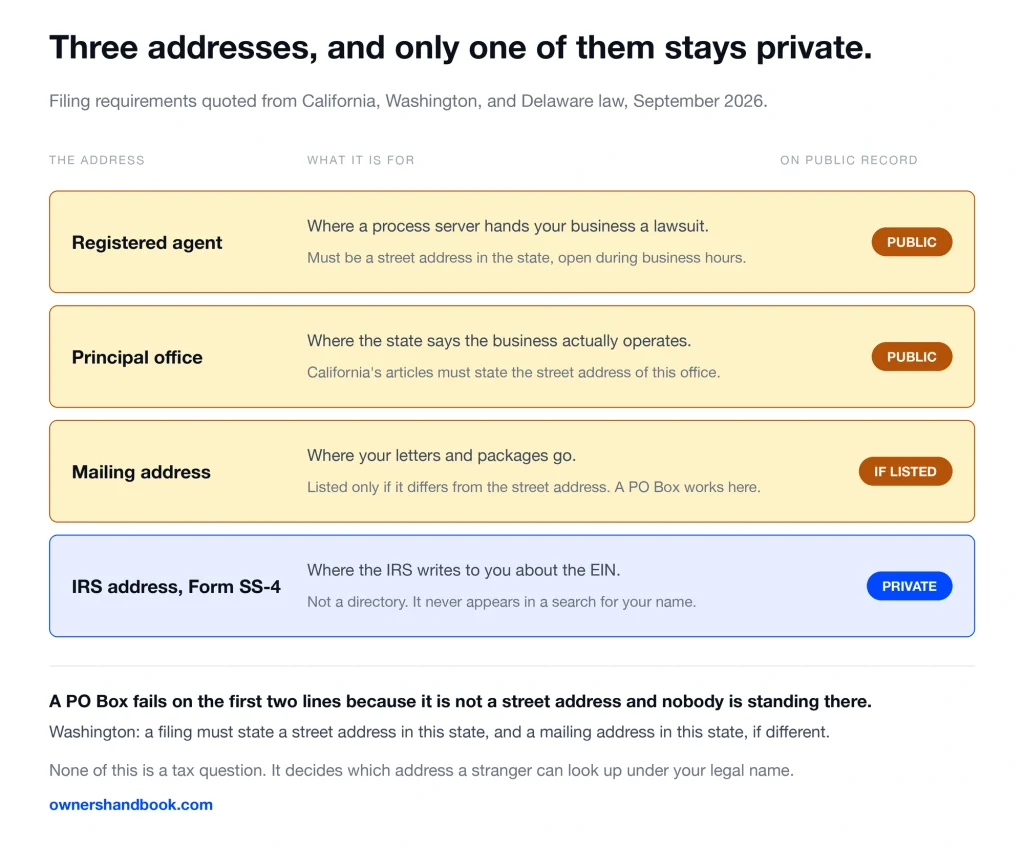
The registered agent address is where somebody hands your business a lawsuit. The principal office address is where the state says the business operates. The mailing address is where letters go.
They can all be the same address. They do not have to be, and the state form has a separate line for each.
California‘s LLC Act says a company shall designate and continuously maintain in this state both an office and an agent for service of process. Two obligations, listed separately.
Washington states the split more plainly still. A filing must state a street address in this state, and a mailing address in this state, if different.
| Address | What it is for | Public |
|---|---|---|
| Registered agent | Receiving lawsuits and state notices | Yes |
| Principal office | Where the state says you operate | Yes |
| Mailing address | Where your mail goes | Yes, if you list one |
| IRS address on Form SS-4 | Where the IRS writes to you | No |
If you have not filed anything, you are a sole proprietor and there is no state record to worry about yet. The address problem arrives with the LLC, not with the freelancing.
The registered agent address is the one that binds you
A registered agent is the person or company who accepts service of process for your business. Service of process is the legal paperwork that starts a lawsuit, handed over in person.
That job carries a physical requirement. Delaware‘s Division of Corporations states that an agent must maintain a street address and office located in Delaware and be open during normal business hours for the purpose of accepting service of process.
Read that as three conditions at once. A street address, inside the state, staffed during the day.
You can be your own agent in the state where you live, for free, which is the default in how to form an LLC. It is still the right call if the address does not bother you.
The cost of free is that your home address enters a searchable database, attached to your legal name, under the words agent for service of process.
What a commercial registered agent actually buys
A commercial registered agent rents you its street address for that line and receives legal papers on your behalf.
Prices checked September 14, 2026. Harbor Compliance lists $99 for a new customer’s first year, renewing at $149. Registered Agents Inc charges $200 a year. ZenBusiness is $99 the first year and $199 after.
So a realistic first year is $99 to $200, and a realistic second year is $149 to $199. That is the entire bill.
Here is what it does not cover. The service replaces one line on one form. It does not automatically become your principal office address, and most states still want a real address on that line too.
It is also not a mailbox. Agents forward legal notices and state correspondence. Client checks, bank statements, and the lens you ordered are not their job.
A virtual business address, and the notary it requires
A virtual business address is a real street address at a mail center that receives, scans, and forwards your mail. The regulatory term is Commercial Mail Receiving Agency, or CMRA.
Getting one is not a checkout page. USPS requires PS Form 1583, which asks for two types of identification: one government-issued photo ID, plus a second document confirming the home address you wrote on the form.
You also have to sign it in front of a notary. The current form allows that acknowledgment in the physical or virtual presence of a notary public, meaning real-time audio and video counts.
Prices checked September 14, 2026. PostScan Mail’s Starter plan begins at $10 a month, or $8.33 a month billed annually, which is $100 for the year. Standard begins at $20 and Premium at $30.
Stable sits at the other end at $59 a month, or $49 a month billed annually, with registered agent service a separate $25 a month per address. Opus Virtual Offices charges $99 a month, all inclusive.
One formatting quirk to expect. Postal rules require mail sent to a CMRA to carry PMB or a pound sign and the box number, so your address reads 1234 Main St, PMB 210.
Why a PO Box usually fails
A PO Box is not a street address. That single fact disqualifies it in most of the places people try to use it.
Washington requires a filing to state a street address in this state. Delaware requires the agent to maintain a street address and office. California’s articles of organization must state the street address of the initial principal office.
None of those sentences leave room for a box number. A box at a post office is not an office, and nobody can hand a process server anything there.
The mailing address line is where a PO Box does work. California and Washington both ask for a mailing address only if it differs from the street address, and a box is a fine answer on that line.
A coworking address, if your lease says so
A coworking membership with mail handling gives you a genuine commercial street address with staff in the building. On paper it solves both problems at once.
The catch is contractual rather than legal. Many memberships permit mail but prohibit using the address to register a business entity, because that quietly turns the operator into your registered agent.
Read the business registration clause before you file, and get the answer in writing. A cheap desk that forbids it is worth less than a $100 mailbox that allows it.
What the IRS sees is not what the state publishes
The IRS is not a public directory. Nothing you write on Form SS-4, the EIN application, turns up in a search result for your name.
The form has two address blocks and they behave differently. Lines 4a and 4b are the mailing address, and the instructions say it will generally be used on all tax returns filed for the entity.
Lines 5a and 5b are the physical location, and there the instructions are blunt: do not enter a P.O. box number.
So the IRS asks for both, keeps both, and publishes neither. Your EIN and business bank account run on a separate track from the state filing.
When an address changes, Form 8822-B is how you tell the IRS. A change in the responsible party has to be reported within 60 days.
Two things a business address does not do
First, it does not touch the home office deduction. The IRS test is regular and exclusive use of part of your home as your principal place of business.
A rented mailbox is not where you conduct business, so it neither creates nor destroys that deduction. The kitchen-table office is what the deduction was always about.
Second, renting an address in another state does not move your taxes there. State income tax follows where you live and where the work happens, not where the envelope lands.
Registering the LLC itself in another state is a different matter. A Delaware LLC run from your home state still has to register at home and pay both states, which is why forming where you live usually wins.
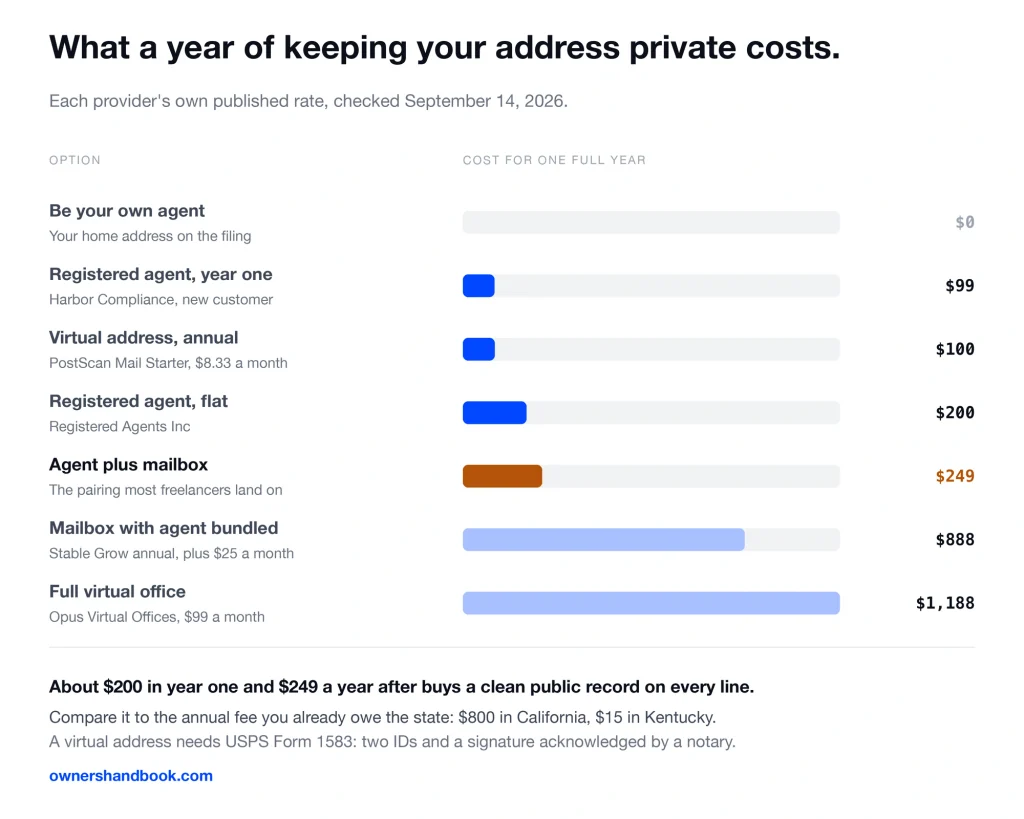
What a full year actually costs
| Option | A full year | What you get |
|---|---|---|
| Be your own agent | $0 | Your home address, searchable by name |
| Registered agent only, cheap | $99 first year, $149 after | Lawsuits go elsewhere; principal address may still be yours |
| Registered agent only, mid | $200 | Same, at a flat renewal price |
| Virtual address only | $100 billed annually | A street address and real mail handling, no agent duty |
| Agent plus mailbox | about $199, then $249 | Every public line is somebody else’s address |
| Stable Grow plus its agent | $888 | Premium scanning, deposits, agent service bundled |
| Opus Virtual Offices | $1,188 | Address, phone, receptionist; registered agent not included |
The bolded row is the answer for most freelancers. Roughly $200 in year one and $250 a year after that buys a clean public record on both lines.
Compare that against the annual LLC fee you are already paying. In California the $800 franchise tax dwarfs it; in Kentucky the $15 annual report does not.
Frequently asked questions
Can I just use my home address and not worry about it?
Plenty of people do, and nothing bad automatically happens. The risk is that the record is permanent, searchable by your legal name, and scraped by marketing databases within weeks of filing.
Does a registered agent service hide my name too?
No. Your name still appears as the organizer or member on most state filings. These services replace an address, not an identity.
Can I use a friend’s or a relative’s address instead?
Legally yes, if they consent and the address is a street address in your state. Practically it makes someone else responsible for handing you a lawsuit on time, which is a lot to ask.
Will a bank open a business account with a virtual address?
Often, but not always. Some banks flag CMRA addresses and ask for proof of a physical location, so expect to supply your home address to the bank even when the state never sees it.
What happens if my registered agent misses a lawsuit?
The case can proceed without you and end in a default judgment. That is the actual reason the street address and business hours rules exist, and the reason a paid agent is worth more than a favor.
Do I have to update the state if I move?
Yes. Every state requires the registered agent and office addresses to stay current, and the filing usually costs $0 to $50. Update Form 8822-B with the IRS separately.
Nothing here is legal or tax advice. Registered agent and mailbox prices change often, so check the provider’s own page before you buy.
Sources
California Corporations Code section 17701.13, designated office and agent for service of process
https://leginfo.legislature.ca.gov/faces/codes_displaySection.xhtml?lawCode=CORP§ionNum=17701.13
California Corporations Code section 17702.01, articles of organization
https://leginfo.legislature.ca.gov/faces/codes_displaySection.xhtml?lawCode=CORP§ionNum=17702.01
Revised Code of Washington 23.95.410, Addresses in filing
https://app.leg.wa.gov/RCW/default.aspx?cite=23.95.410
Delaware Division of Corporations, Registered Agents
USPS, PS Form 1583, Application for Delivery of Mail Through Agent
https://about.usps.com/forms/ps1583.pdf
USPS Domestic Mail Manual 508, Recipient Services
https://pe.usps.com/text/dmm300/508.htm
IRS, Instructions for Form SS-4
https://www.irs.gov/instructions/iss4
IRS, About Form 8822-B, Change of Address or Responsible Party
https://www.irs.gov/forms-pubs/about-form-8822-b
IRS, Home office deduction
https://www.irs.gov/businesses/small-businesses-self-employed/home-office-deduction
Harbor Compliance, Registered Agent Service pricing
https://www.harborcompliance.com/registered-agent-service
Registered Agents Inc, Registered Agent Service pricing
ZenBusiness, Registered Agent Service pricing
https://www.zenbusiness.com/registered-agent-service
PostScan Mail, Pricing
Stable, Pricing
https://www.usestable.com/pricing
Opus Virtual Offices