S Corp Calculator: What the Election Is Worth at Your Salary
Most S corporation calculators ask for your profit and hand back a salary. That is not a thing anyone can compute. The IRS publishes a list of factors and no percentage, so a calculator that returns a number is inventing it.
This one works the other way round. You supply a salary you could defend, and it shows what the election is actually worth at that figure — including the deduction it quietly takes away.
S corporation election calculator
What the election is worth at a salary you choose, for tax year 2026. It does not tell you what a reasonable salary is — there is no formula for that.
What the business earns after expenses, before you pay yourself.
What you would pay someone else to do your job. Write down how you got here.
Sets your brackets and the qualified business income threshold.
The yearly cost of running payroll and filing a second return.
| Sole proprietor | S corporation | |
| Social Security and Medicare | $0 | $0 |
| Qualified business income deduction | $0 | $0 |
| Federal income tax | $0 | $0 |
| Total federal tax | $0 | $0 |
| Payroll service and second return | $0 | $0 |
Brackets, standard deduction and the qualified business income threshold for 2026 come from
Rev. Proc. 2025-32;
the Social Security wage base from
IRS Publication 505.
Runs entirely in your browser — nothing you type is sent anywhere or stored.
This calculator is for informational purposes only and does not constitute legal, accounting, or tax advice,
and it is emphatically not a determination of reasonable compensation. It assumes the standard deduction,
no other household income, no state or local tax, no retirement contributions, and a business that is not a
specified service trade or business. Above the qualified business income threshold the rules become
considerably more involved than this models. Consult your own tax advisor.
Why there is no formula, and why calculators pretend there is
The rule itself is short. The IRS states that an S corporation must pay reasonable compensation to a shareholder-employee for services before non-wage distributions are made to them.
What counts as reasonable is decided on facts, and the agency publishes the facts it weighs:
| Factor | What it looks at |
|---|---|
| Training and experience | What your skills command |
| Duties and responsibilities | What you actually do in the business |
| Time and effort devoted | Full time, or a few hours a week |
| Payments to non-shareholder employees | What you pay others for similar work |
| What comparable businesses pay | The market rate for the role |
| Dividend history | The pattern of distributions over time |
| Compensation agreements | Anything you wrote down |
No percentage appears on that list. Not 60/40, not one third, not any of the splits circulating online. Those are shorthand somebody invented, and the absence of a number from the IRS’s own factors is the most useful thing to know about them.
So the honest question is not “what salary should I take.” It is “at a salary I can explain, is this worth doing.”
The three numbers that decide it
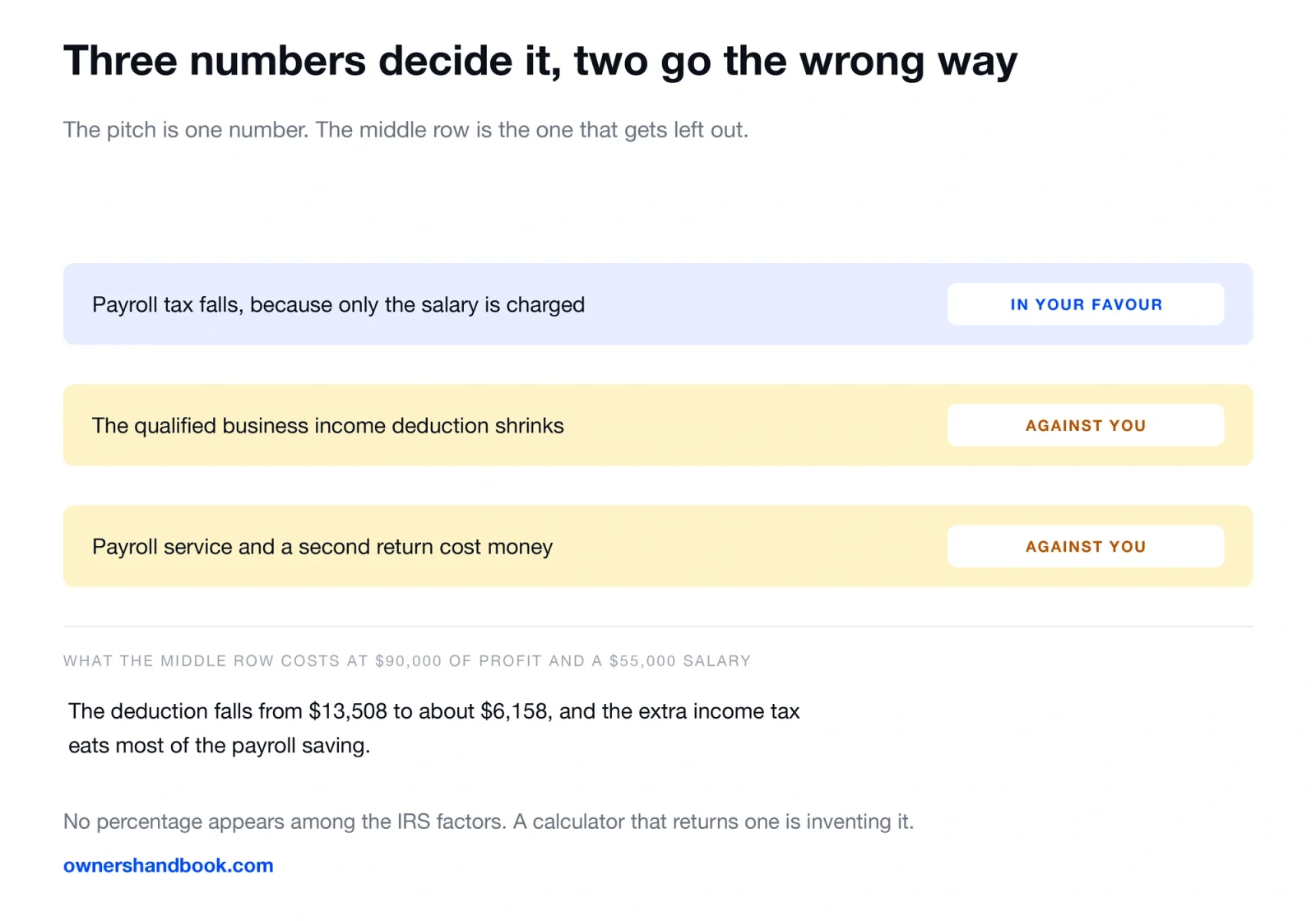
The pitch for an S corporation is one number. The actual answer is three, and two of them move the wrong way.
| What changes | Direction |
|---|---|
| Payroll tax falls, because only the salary is charged | In your favour |
| The qualified business income deduction shrinks | Against you |
| Payroll service and a second return cost money | Against you |
The middle row is the one that gets left out. Wages you pay yourself as reasonable compensation are not qualified business income, so the 20% deduction applies to a smaller number. On a $90,000 profit with a $55,000 salary, that deduction falls from about $13,508 to about $6,158 — and the extra income tax eats most of the payroll saving.
The calculator above works all three at once so you can see the net rather than the headline.
A worked example, all the way through
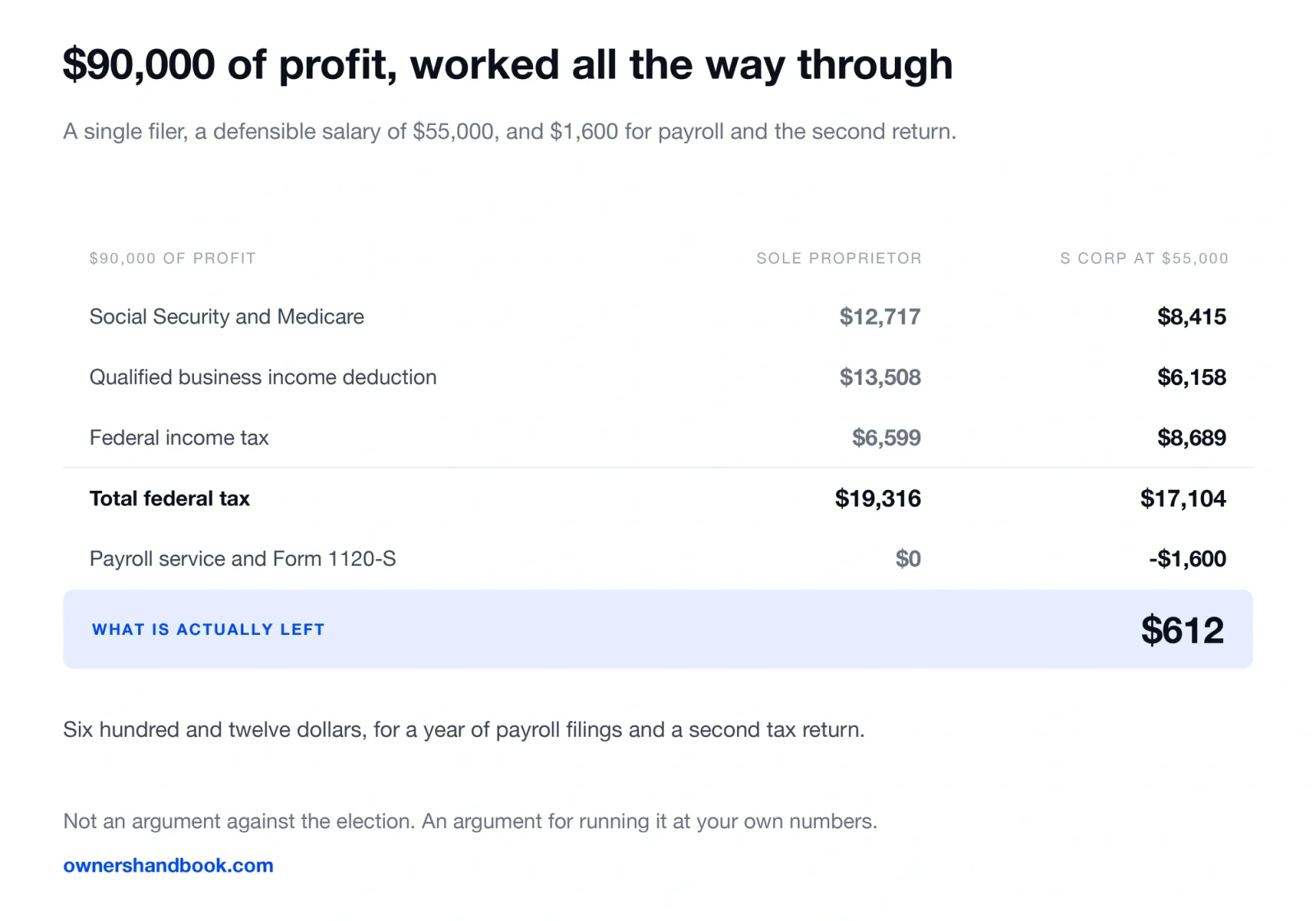
A single filer, $90,000 of profit, no other income, a defensible salary of $55,000, and $1,600 a year for payroll and the second return.
| $90,000 of profit | Sole proprietor | S corp at $55,000 |
|---|---|---|
| Social Security and Medicare | $12,717 | $8,415 |
| Qualified business income deduction | $13,508 | $6,158 |
| Federal income tax | $6,599 | $8,689 |
| Total federal tax | $19,316 | $17,104 |
| Payroll service and Form 1120-S | $0 | −$1,600 |
| What is actually left | — | $612 |
Six hundred and twelve dollars, for a year of payroll filings and a second tax return.
That is not an argument against the election. It is an argument for running the arithmetic at your own numbers rather than at the ones in a sales page. Our full walkthrough of whether the S corp election is worth it covers the rest of the costs.
Where it turns
Three things move the answer, and you can watch each one in the calculator.
Profit. The saving scales with the distribution portion, so more profit means more to save. At $40,000 of profit the election typically loses money once running costs are counted.
The salary you choose. A lower salary saves more payroll tax and costs more qualified business income deduction — those partly cancel, which is why the net is smaller than the pitch suggests. Push the salary down far enough and you are in the pattern the IRS examines rather than in a tax strategy.
Your income relative to the qualified business income threshold. Above $201,750 for most filers, or $403,500 filing jointly, the deduction rules become considerably more involved. The calculator flags this rather than pretending to model it.
And the running cost is not optional. Payroll has to actually run. An S corporation with no payroll is a different and worse problem, covered in what happens when you never ran payroll.
What this calculator does not do
Stated plainly, because the omissions matter more here than in most calculators.
| Not modelled | Why |
|---|---|
| State and local tax | Several states tax S corporations directly, and the rules vary |
| Retirement contributions | A solo 401(k) changes both sides of this comparison |
| Health insurance premiums | These run through the W-2 for a more-than-2% shareholder |
| Other household income | Assumed none, which affects your bracket |
| Specified service trades | The deduction phases out differently above the threshold |
| Whether your salary is defensible | That is a facts question, not arithmetic |
It also assumes the standard deduction. If you itemise, the income tax figures will differ.
Frequently asked questions
Is there a safe percentage for the salary?
No. The IRS publishes factors, not a formula, and no percentage appears among them. A percentage can be a starting point for your own reasoning, but it is not something you can point to.
Why does my qualified business income deduction fall?
Because wages paid to you as reasonable compensation are excluded from qualified business income. The deduction applies to what passes through after the salary, which is a smaller number.
The calculator says the election loses money. Should I revoke?
Not on this figure alone. State tax, retirement contributions and health insurance all sit outside this model and can change the answer. Take the output as the federal core of the question, not the whole of it.
What if my profit changes a lot year to year?
The election is not a one-year decision — revoking has its own timing rules and consequences. Run the calculator at a profit level you expect to repeat, not at one unusual year.
Does this tell me what to put on Form 1120-S?
No. It compares two scenarios. The number that goes on a return is one you and your advisor can support with the factors above.
I already elected and never ran payroll. What now?
That is a separate and more urgent problem. Our guide to an S corp with no payroll covers what is still fixable and what the exposure is.
Sources
IRS, S corporation compensation and medical insurance issues
IRS, Revenue Procedure 2025-32, inflation adjustments for 2026
https://www.irs.gov/pub/irs-drop/rp-25-32.pdf
IRS, Qualified business income deduction
https://www.irs.gov/newsroom/qualified-business-income-deduction
IRS, Instructions for Form 1120-S
https://www.irs.gov/pub/irs-pdf/i1120s.pdf
IRS, Publication 505, Tax Withholding and Estimated Tax