Form 8919: When a 1099 Should Have Been a W-2
Self-employment tax is 15.3% because you are paying both halves of Social Security and Medicare — the employee’s half and the employer’s half. An employee pays 7.65%. If you were treated as a contractor but you were functionally an employee, Form 8919 is how you report the pay and hand over 7.65% instead of 15.3%. The employer’s half is the employer’s problem, and the form exists to say so.
What the form actually does
Form 8919 is titled Uncollected Social Security and Medicare Tax on Wages. The title is the whole mechanism. The pay was wages, the firm should have withheld your 6.2% and 1.45% and sent them in with its own matching share, and it did not. So you report the wages and pay the uncollected employee share yourself.
The IRS adds a second reason to care, which has nothing to do with this year’s tax: by filing this form, your social security earnings will be credited to your social security record.
You must file it if all four of these are true. You performed services for a firm. You believe the pay was not for services as an independent contractor. The firm withheld none of your social security and Medicare tax. And one of the reason codes below applies.
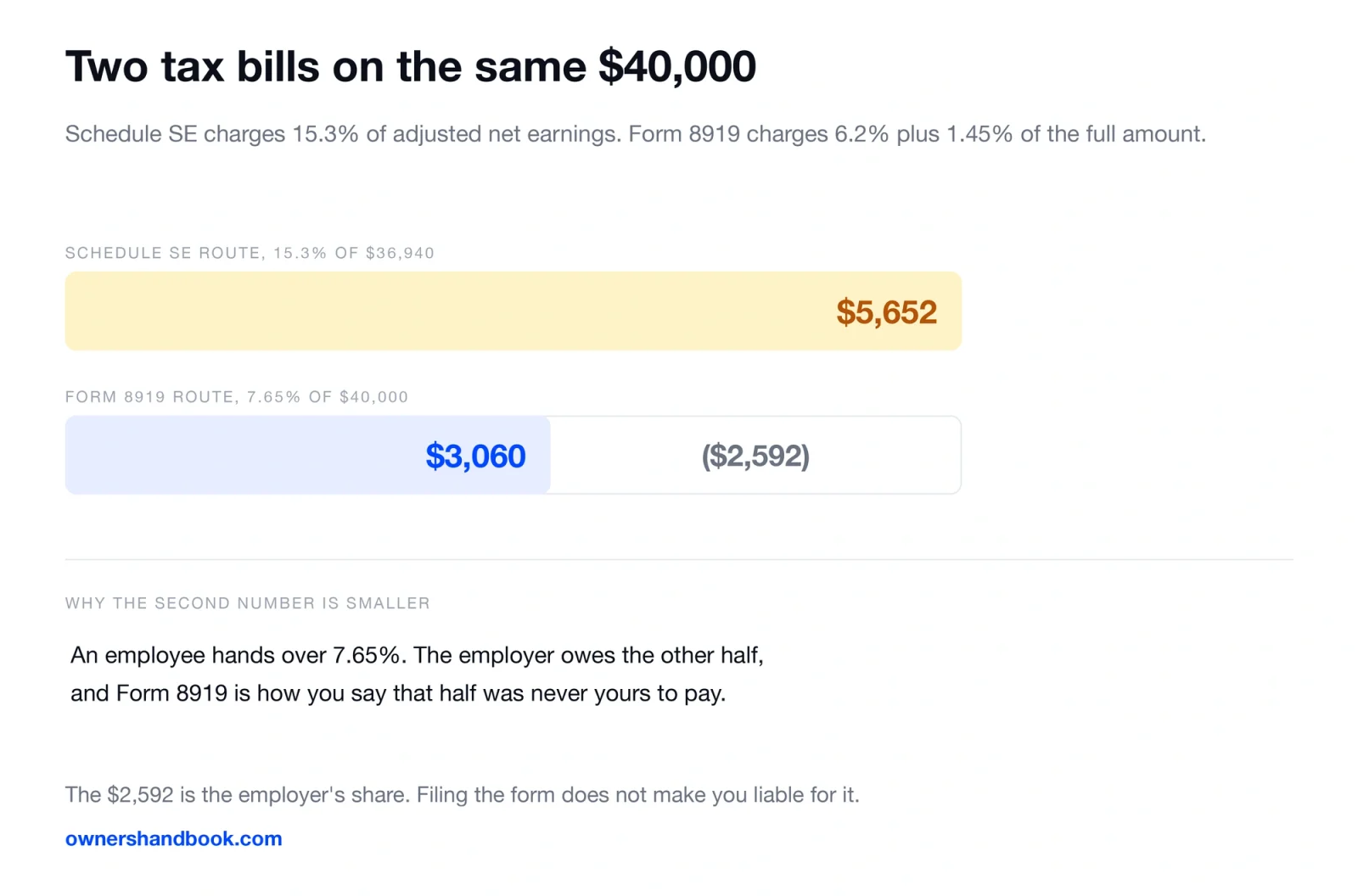
Here is the arithmetic on $40,000 of pay from one firm, with no other wages that year.
| Schedule SE route | Form 8919 route | |
|---|---|---|
| Amount the tax is figured on | $40,000 × 0.9235 = $36,940 | $40,000 |
| Rate | 15.3% | 6.2% + 1.45% = 7.65% |
| Tax | $5,652 | $3,060 |
| Deduction for half the tax | $2,826 | None |
The $2,592 gap narrows after income tax, because the Schedule SE route lets you deduct half the self-employment tax against income and the Form 8919 route gives you nothing to deduct. At a 22% marginal rate that deduction is worth about $622, so the real difference on these numbers is closer to $1,970. Still the largest single line you will move on the return.
The test is control, and it is not about the contract
The label on the paperwork does not decide this. Neither does a signed independent contractor agreement.
Publication 15-A says the facts that provide evidence of the degree of control and independence fall into three categories: behavioral control, financial control, and the type of relationship of the parties. Form SS-8 is laid out in exactly those three parts, which is the fastest way to see what the IRS is actually asking.
| Category | What the IRS weighs | Points toward employee |
|---|---|---|
| Behavioral control | Instructions on when, where and how to work; what tools to use; what order to follow; training given | The firm kept the right to control the details, whether or not it used it |
| Financial control | Unreimbursed expenses, your investment in tools, whether you sell to the market at large, how you are paid | You cannot realize a profit or a loss on the work |
| Type of relationship | Written contract, employee-type benefits, permanency, how central the work is to the firm | Open-ended engagement doing the firm’s core work, with benefits |
The publication is careful on the first one. Even if no instructions are given, sufficient behavioral control may exist if the employer has the right to control how the work results are achieved. The key consideration is whether the business has retained the right to control the details of a worker’s performance or has instead given up that right.
There is no scoring. The IRS says there is no magic or set number of factors that makes the worker an employee or an independent contractor, and no one factor stands alone.
Form 8919 answers the federal employment tax question only. Minimum wage and overtime run on the Department of Labor’s test, and your state may apply a third, so a worker can come out differently under each.
The four reason codes, one at a time
Column (c) takes exactly one code per firm. This is where most people stall, so here is which facts put you in each.
| Code | You are here if | Form SS-8? | Column (d) |
|---|---|---|---|
| A | You filed Form SS-8 and received a determination letter saying you are an employee of this firm | Already filed | Date of the letter |
| C | You received other IRS correspondence stating you are an employee, including being designated a section 530 employee | Not needed | Date of the correspondence |
| G | You filed Form SS-8 and have not received a reply | Required, on or before the date you file | Leave blank |
| H | You received both a Form W-2 and a Form 1099-MISC or 1099-NEC from this firm for the same year, and the 1099 amount should have been wages | Do not file | Leave blank |
Code H is narrower than it looks. It is for a single firm that sent you both forms, where the 1099 covers what was really employee pay — the instructions list bonuses, awards, travel expense reimbursements not paid under an accountable plan, scholarships, and signing bonuses. Here the IRS tells you not to file Form SS-8 at all. A W-2 already says you were an employee.
Code C has a wrinkle. You are a section 530 employee if the IRS determined you were an employee but your employer was granted relief from paying employment taxes under section 530 of the Revenue Act of 1978. The IRS can decide the firm owes nothing and still agree that you were an employee. The uncollected share is then yours, and code C is the entry.
Code G is for everyone else — the 1099-only worker with no letter from anyone, and the entry the IRS tells you to use if no code fits but you believe you should have been an employee. It requires Form SS-8, filed separately, on or before the date you file Form 8919. Do not attach it to the return; the instructions say that will only delay processing. There is no fee for an SS-8 determination.
Lines 6 through 13, in order
The top half of the form is a list. The bottom half is one calculation, and line 10 is where it bites.
Line 6 is the total of column (f) across every firm — the wages you received with no social security or Medicare withholding that were not reported on a Form W-2. That number also goes on Form 1040, line 1g, which is how the income gets onto the return at all. If you are required to file Form 8959 for the 0.9% Additional Medicare Tax, line 6 goes on Form 8959, line 3 as well.
Line 7 is the Social Security wage ceiling, preprinted. On the 2025 form it is $176,100. For 2026 it is $184,500.
Line 8 is your real W-2 social security wages — boxes 3 and 7 of your Forms W-2 — plus RRTA compensation and unreported tips from Form 4137.
Line 9 is line 7 minus line 8: the room left under the ceiling.
Line 10 is the smaller of line 6 or line 9. This is the step people miss. Your W-2 job fills the Social Security ceiling first, and only the leftover room gets charged 6.2%.
Say you had $150,000 of W-2 social security wages and $40,000 of Form 8919 wages in 2025.
| Line | What | Amount |
|---|---|---|
| 6 | Form 8919 wages | $40,000 |
| 7 | Ceiling | $176,100 |
| 8 | W-2 social security wages | $150,000 |
| 9 | Room left | $26,100 |
| 10 | Smaller of line 6 or line 9 | $26,100 |
| 11 | Line 10 × 0.062 | $1,618 |
| 12 | Line 6 × 0.0145 | $580 |
| 13 | Total to Schedule 2, line 6 | $2,198 |
Note which line each rate uses. Line 11 runs on line 10, because Social Security has a ceiling. Line 12 runs on line 6, because Medicare does not. The whole $40,000 is charged 1.45% even though only $26,100 is charged 6.2%.
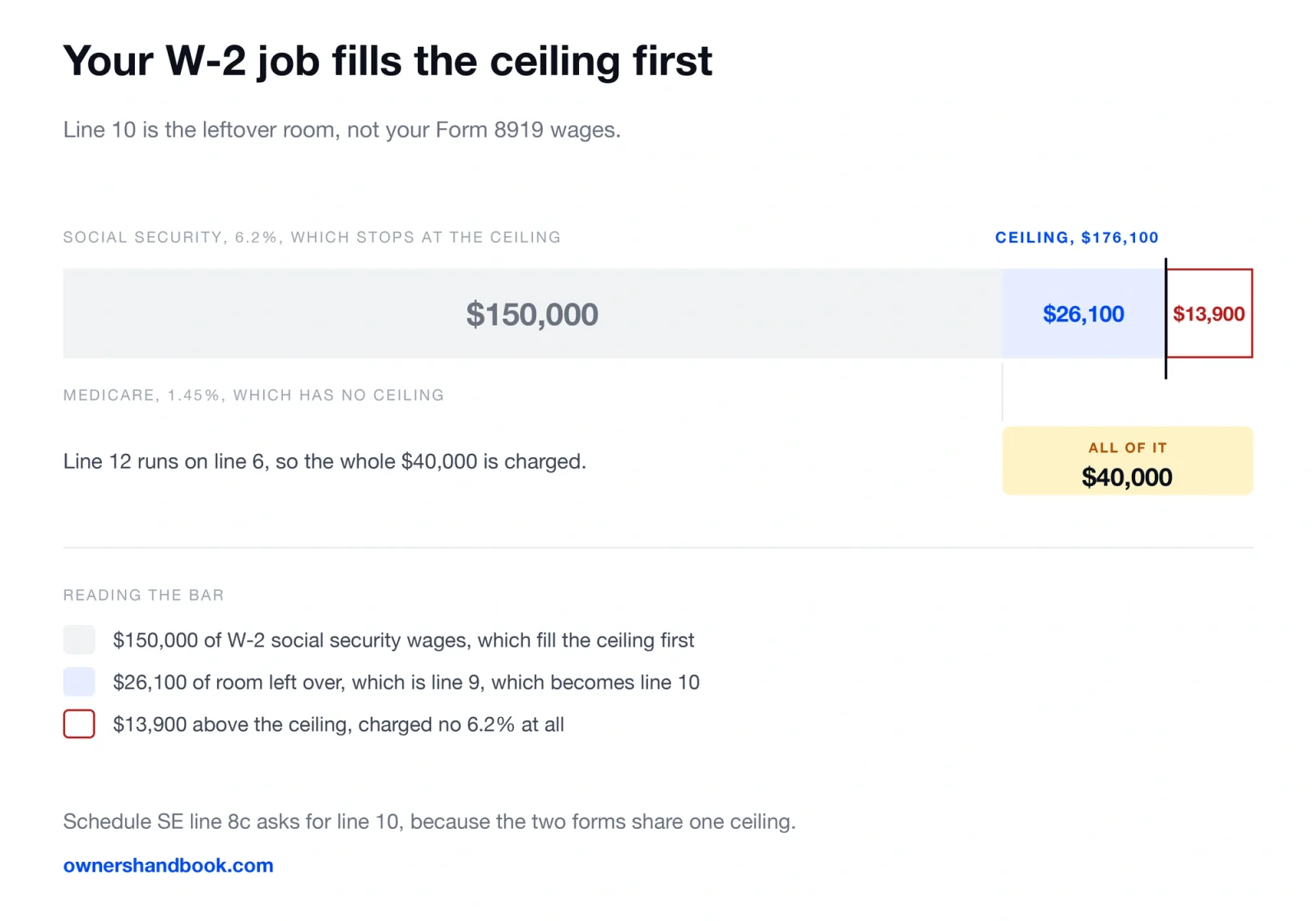
One more crossing to watch. If you also have genuine self-employment income that year, Schedule SE line 8c asks for wages subject to social security tax from Form 8919, line 10. The two forms share one ceiling, and Schedule SE is where they meet. Our walkthrough of a mixed W-2 and 1099 year covers that interaction on the rest of the return.
What filing it costs you
This is a real trade, and it is usually worth making, but you should see both sides.
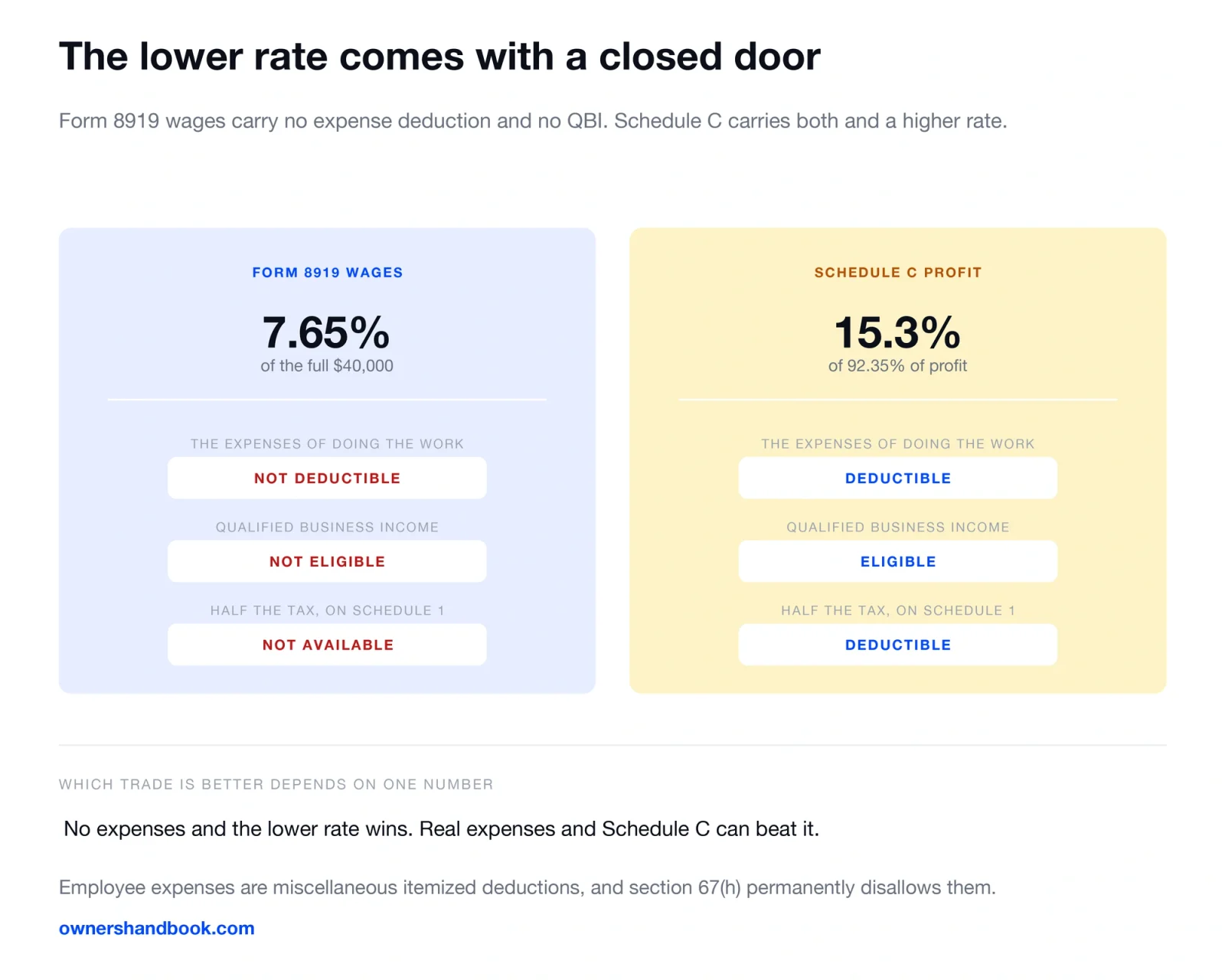
Form 8919 turns the money into wages, and wages have no Schedule C. There is no business expense deduction against them, because employee expenses are miscellaneous itemized deductions and section 67(h) says no miscellaneous itemized deduction shall be allowed for any taxable year beginning after December 31, 2017. That suspension is now permanent. Wages are also not qualified business income, so the 20% deduction does not reach them.
So if you spent real money doing the work, run both numbers. A contractor with $12,000 of genuine expenses may come out ahead on Schedule C despite the higher rate. A worker with no expenses almost never does.
The other half of the trade is that you are filing a position that contradicts what the firm filed. The form says so directly for code G: use of this reason code isn’t a guarantee that the IRS will agree with your worker status determination, and if the IRS doesn’t agree that you are an employee, you may be billed for the additional tax, penalties, and interest resulting from the change to your worker status.
Read that for what it is. The downside is paying the tax you would have owed anyway plus interest, not a finding of wrongdoing. A correct filing stays correct. What this is not is a form to try on because the number is smaller.
When this is not your form
Form 8919 is narrow. Four situations look like it and are not.
You really were an independent contractor. Then the income belongs on Schedule C and the tax on Schedule SE, which is the ordinary self-employment tax path.
The 1099 amount is simply wrong. A client who reported $30,000 when they paid you $20,000 is a reporting error, not a classification question, and the fix is getting the 1099 corrected.
You are reporting tips you did not report to your employer. That is Form 4137.
You are a state or local government worker whose position may be covered by a Section 218 agreement. Only the Social Security Administration makes that determination, and the form directs you to your State Social Security Administrator.
Protecting a refund while you wait
SS-8 cases take time, and the clock on your refund does not stop for them. The instructions are blunt: Form SS-8 is not a claim for refund, and filing Form SS-8 does not prevent the expiration of the time in which a claim for a refund must be filed. You generally have three years from the date your original return was filed or two years from the date the tax was paid, whichever is later, and no determination is issued for a year whose statute has closed.
The IRS tells you how to hold the door open. File Form 1040-X for each year at issue, write Protective Claim at the top of page 1, enter in Explanation of Changes that you filed Form SS-8 with the IRS office in Holtsville, NY and are reserving the right to claim any refund that may be due after a determination, sign it, and leave the rest blank.
Do not wait on a determination to file the return itself. The instructions say not to delay filing in anticipation of an answer, and the ordinary filing deadlines and extensions apply to you regardless.
Frequently asked questions
Does filing Form 8919 get my client audited?
The SS-8 determination process is not an examination of any return — the instructions say so directly. But the IRS generally issues the determination to the firm as well as to you, so the firm does learn. Code H involves no SS-8 at all.
Can I file Form 8919 for a past year?
Yes, by amending that year’s return on Form 1040-X, as long as the year is still open. The three-year and two-year windows above control, and a determination will not be issued for a closed year.
Do I still owe self-employment tax on my other clients?
Yes. Form 8919 applies firm by firm. One firm can be on Form 8919 while three others stay on Schedule C and Schedule SE, and the filing threshold for the self-employed work is figured on that work alone.
What if the firm paid me through a platform rather than directly?
The form defines a firm as any entity for which you performed services, and adds that the firm may or may not have paid you directly. Who cut the check is not the question. Our breakdown of taxes by platform covers how the paperwork usually arrives.
How long does an SS-8 determination take?
The IRS does not publish a processing time. A technician reviews the facts, may ask you, the firm, or third parties for more, and then issues a determination — binding on the IRS if the facts and law do not change. Code G exists precisely because you have to file before that happens.
Does any of this change whether I had a business at all?
It can. If the work was really employment, there may be no trade or business to report for that firm — a different question from whether an activity rises to the level of a business at all.
Sources
IRS, Form 8919 (2025), Uncollected Social Security and Medicare Tax on Wages, with instructions
https://www.irs.gov/pub/irs-pdf/f8919.pdf
IRS, Schedule SE (Form 1040) (2025), Self-Employment Tax
https://www.irs.gov/pub/irs-pdf/f1040sse.pdf
IRS, Form SS-8 (Rev. December 2023), Determination of Worker Status
https://www.irs.gov/pub/irs-pdf/fss8.pdf
IRS, Instructions for Form SS-8 (Rev. January 2024)
https://www.irs.gov/pub/irs-pdf/iss8.pdf
IRS, Publication 15-A (2026), Employer’s Supplemental Tax Guide
https://www.irs.gov/pub/irs-pdf/p15a.pdf
IRS, Independent Contractor (Self-Employed) or Employee?
IRS, Topic 751: Social Security and Medicare Withholding Rates
https://www.irs.gov/taxtopics/tc751
26 U.S.C. § 67, Two-percent floor on miscellaneous itemized deductions