Hobby or Business? The Test That Decides
The IRS does not care what you call it. It asks one question: were you trying to make money? If you were, it is a business, and your ordinary and necessary expenses come off your income even in a year you lost money. If you were not, the income is still taxable and the expenses are worth exactly nothing.
A loss in the first year is not the problem
Most people look this up after putting a negative number on line 31 of Schedule C and feeling like they got away with something.
You did not. A first-year loss is an ordinary result, and the IRS says so in its own words.
One of the nine things it weighs is whether your losses are normal for the startup phase of your type of business.
A first year with a website, a laptop, a camera, and three clients is a startup phase. That is what one looks like.
What gets an activity reclassified is almost never a single bad year. It is a run of them with no sign that anyone was trying to fix it.
The nine factors, in plain language
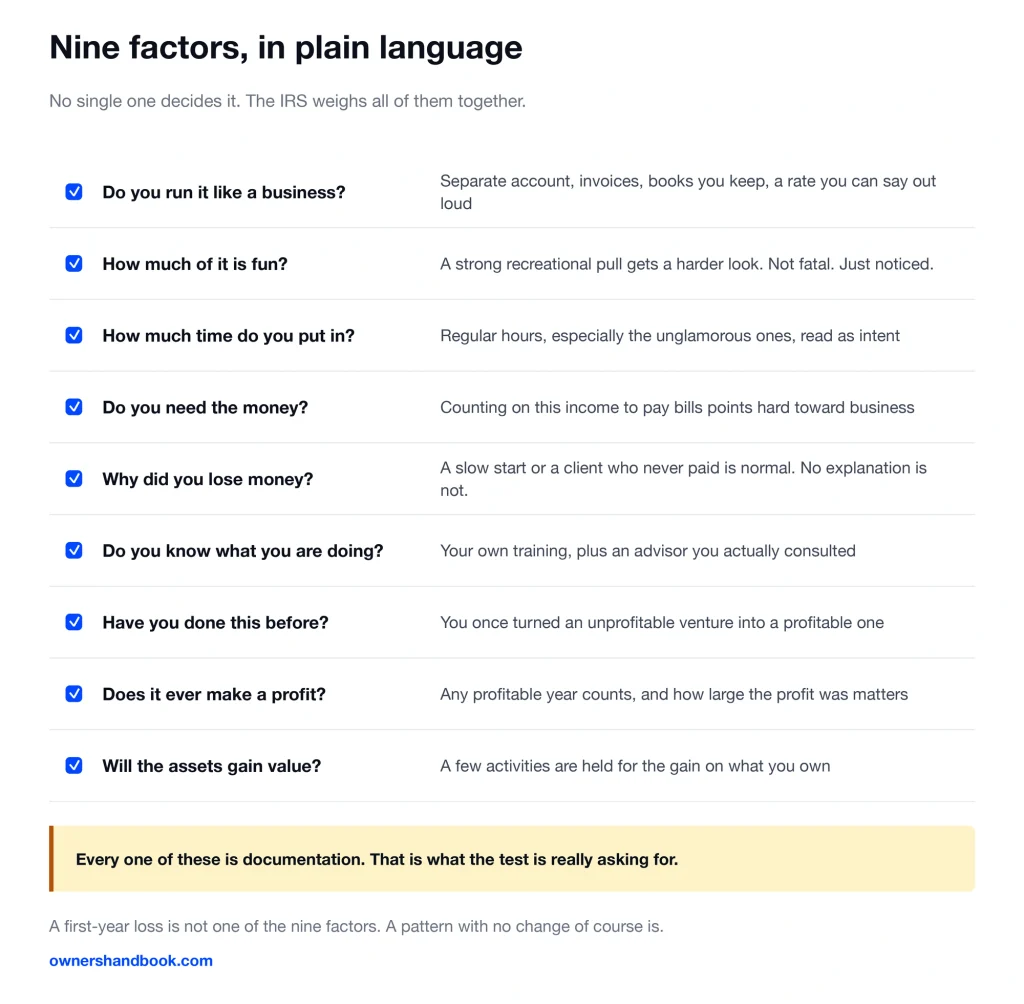
There is no single test. The IRS lists nine factors, says no one of them is decisive, and weighs all the facts together.
Here they are in words you would actually use.
Do you run it like a business? A separate account, invoices, books you keep, a rate you can say out loud.
How much of it is fun? An activity with a strong recreational pull gets a harder look. Not fatal. Just noticed.
How much time do you put in? Regular hours, especially the unglamorous ones, read as intent.
Do you need the money? Depending on this income to live on points hard toward business.
Why did you lose money? A slow start, a bad market, a client who never paid — normal. No explanation, year after year — not.
Do you know what you are doing? Your own expertise counts, and so does an advisor you actually consult.
Have you done this before? Turning an earlier venture from unprofitable to profitable is evidence about you, not just this activity.
Does it ever make a profit? Some profitable years, and how large they were, both matter.
Will the assets be worth more later? A few activities are held for the gain on what you own rather than the yearly income.
| The factor | What it looks like when you mean it |
|---|---|
| Businesslike manner | Separate account, invoices, books, a written rate |
| Personal motives | The work is work, not mainly recreation |
| Time and effort | Regular hours, kept up over months |
| Dependence on the income | You are counting on it to pay bills |
| Why the losses happened | A reason you can name and a change you made |
| Your knowledge | Your own training, plus advice you sought and followed |
| Past track record | You made an earlier venture profitable |
| Profit in some years | Any profitable year, and how big it was |
| Appreciation of assets | You hold something expected to gain value |
The three-of-five rule is a presumption, not a gate
Here is the number people have heard. Make a profit in three of the last five years, counting the current one, and the IRS presumes you are in it for profit.
For activities that are mostly the breeding, training, showing, or racing of horses, it is two profitable years out of seven.
Read what that actually does. It moves the burden. Clear it, and the IRS has to show you were not trying, instead of you showing that you were.
Now read what it does not do. Failing it does not make you a hobby.
The IRS says this to its own examiners in the audit guide: they cannot disallow losses under this rule simply because a taxpayer failed the three-of-five test.
It runs both directions, too. Even a taxpayer who meets the presumption can have the IRS rebut it.
So treat three of five as a safe harbor — clear it and you are presumed fine — not as a bar you have to clear before you may report a loss.
What it costs if the label goes the other way
Say the activity brought in $9,000 and cost $12,000 to run. Same year, same numbers, two labels.
As a business, you report $9,000 of gross receipts on Schedule C, deduct the $12,000, and finish with a $3,000 loss that comes off your other income.
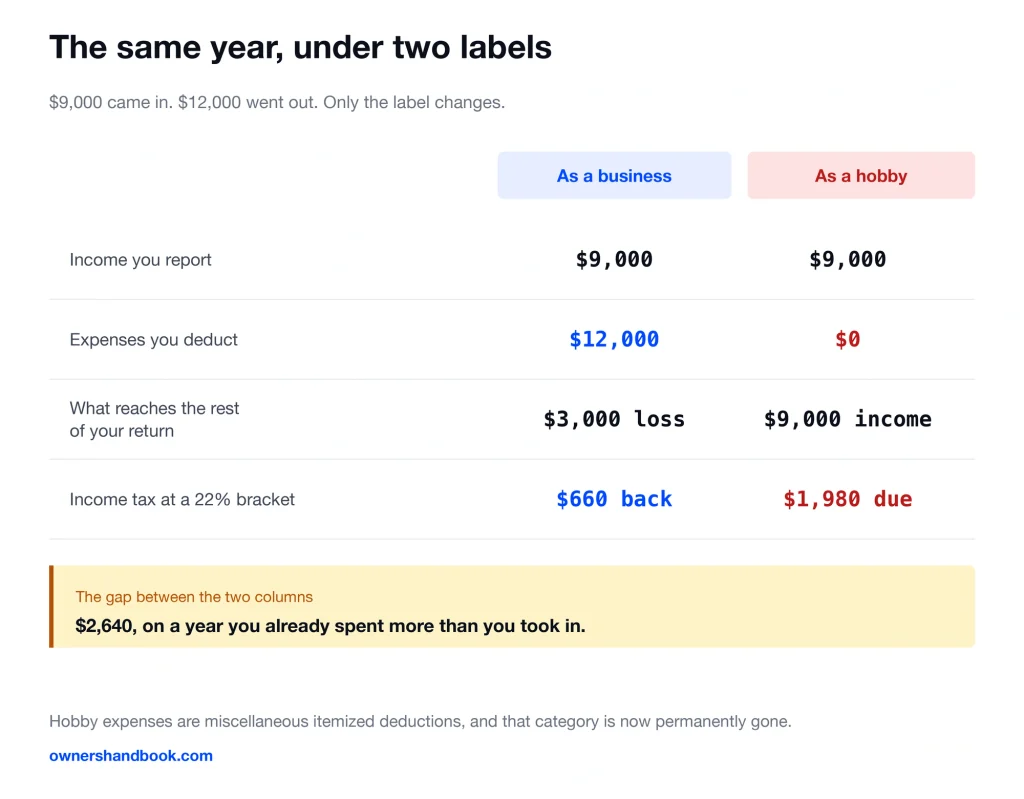
As a hobby, you report the same $9,000 as other income, and you deduct none of the $12,000.
Not a portion of it. None of it.
Hobby expenses are miscellaneous itemized deductions, and the 2017 tax law suspended that whole category. A 2025 law made the suspension permanent, so it is still gone in 2026 with no expiration date attached.
| Same $9,000 in, $12,000 out | As a business | As a hobby |
|---|---|---|
| Income you report | $9,000 | $9,000 |
| Expenses you deduct | $12,000 | $0 |
| What reaches the rest of your return | A $3,000 loss | $9,000 of income |
| Income tax at a 22% bracket | $660 saved | $1,980 owed |
The gap between those two columns is $2,640 on a year where you spent more than you took in. That is the entire stake in this question.
What a business looks like from the outside
This is the useful part, because every item on it is something you can change this month.
Open a separate bank account. One for the work, one for your life. It is free, and it is the clearest single signal you can send.
Write your rate down. A rate sheet, or the number stated in your proposals, is evidence that you priced the work to make money.
Keep books. Money in, money out, dated. A spreadsheet counts.
Market the thing. A website, a listing, a profile, an ad you ran. Someone trying to make money tries to find customers.
Change course when something is not working. Raise the rate, drop the service that loses money, leave the platform. Then write down what you changed and why.
Get advice and follow it. An hour with an accountant is a deduction and a factor in your favor at the same time.
None of this is expensive. All of it is documentation, and documentation is what those nine factors are really asking for.
Form 5213 postpones the question
If you are early and genuinely worried, there is a form for this exact situation.
Form 5213 elects to postpone the determination until the close of the fourth tax year after the year you first engaged in the activity. For horse activities it is the sixth.
You file it within three years after the due date of your return for that first year, figured without extensions.
There is a price. The election extends the period the IRS has to assess tax on those years, so a question you deferred stays open longer.
Most freelancers with a normal first-year loss do not need it. It exists for people with large losses and a long ramp to profitability.
Where hobby income goes on the return
Hobby income is taxable, and that part has never been in doubt. A Form 1099-K from a payment app arrives either way.
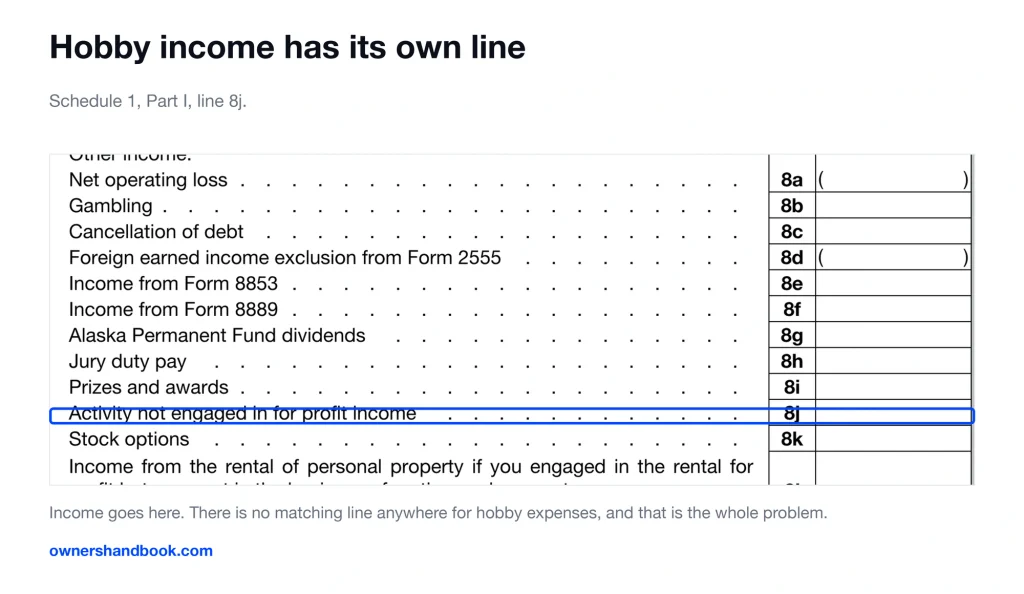
You report it on Schedule 1 of Form 1040, line 8j, labeled “Activity not engaged in for profit income.”
It does not go on Schedule C. Since it never touches Schedule C, it never reaches Schedule SE either, so no self-employment tax is charged on it.
That is the one consolation in the hobby column, and it does not come close to paying for the deductions you lost.
Frequently asked questions
Can I deduct hobby expenses up to the amount of my hobby income?
No. Older guidance describes a limit capped at your hobby income, but that deduction ran through miscellaneous itemized deductions, and those were suspended in 2017 and made permanently unavailable in 2025.
How many years can I show a loss before the IRS calls it a hobby?
There is no such number. Three profitable years out of five buys you a presumption in your favor, but missing it is not grounds on its own to reclassify you.
Does the IRS decide this automatically because I filed a loss?
No. A determination comes out of an examination that weighs all nine factors. Filing a Schedule C loss does not trigger one by itself.
I have a full-time job and this is a side thing. Does that make it a hobby?
No. Part-time is fine. What matters is whether you are running the side activity in a way meant to produce a profit.
What if I make a profit some years and lose money in others?
That is a normal business pattern and one of the nine factors looks directly at it. Both the fact of profitable years and how large those profits were get weighed.
Does forming an LLC settle it?
No. A single-member LLC still files Schedule C, and the same nine factors apply. The entity does not answer the profit-motive question.
Sources
IRS, How do you distinguish between a business and a hobby?
https://www.irs.gov/faqs/small-business-self-employed-other-business/income-expenses/income-expenses
IRS, Publication 5558, Activities Not Engaged in for Profit Audit Technique Guide
https://www.irs.gov/pub/irs-pdf/p5558.pdf
IRS, Publication 17, Your Federal Income Tax
https://www.irs.gov/publications/p17
IRS, Publication 529, Miscellaneous Deductions
https://www.irs.gov/publications/p529
IRS, Notice 2026-10
https://www.irs.gov/pub/irs-drop/n-26-10.pdf
IRS, About Form 5213
https://www.irs.gov/forms-pubs/about-form-5213
IRS, Schedule 1 (Form 1040)
https://www.irs.gov/pub/irs-pdf/f1040s1.pdf
IRS, Know the difference between a hobby and a business
https://www.irs.gov/newsroom/know-the-difference-between-a-hobby-and-a-business