Uber, DoorDash, Etsy, Upwork: Taxes by Platform
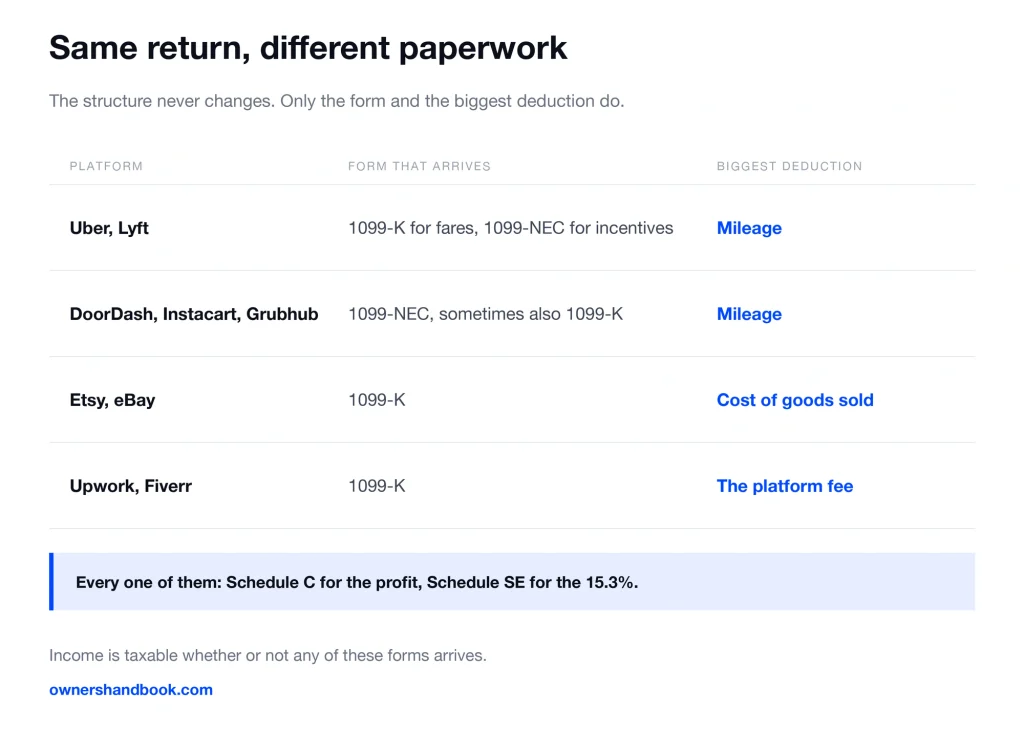
Every platform feels like it has its own tax rules. It does not. Uber, DoorDash, Etsy, eBay, Upwork, and Fiverr all land in the same two places — Schedule C for your profit, Schedule SE for self-employment tax. What changes from one to the next is only which form arrives in January and which deduction turns out to be the biggest.
One structure, every platform
You are not an Uber taxpayer or an Etsy taxpayer. You are a sole proprietor, which is the default status of anyone earning without a corporation behind them.
That means the same path every time.
Everything you took in goes on Schedule C, line 1, as gross receipts. Your business expenses go in Part II below it. Line 31 is what is left, and that is your profit.
Then profit splits in two. One copy goes to Schedule 1 and your Form 1040, where income tax is figured on it.
The other copy goes to Schedule SE, which charges self-employment tax at 15.3% on 92.35% of the number. That is Social Security and Medicare, the part an employer would normally split with you.
Schedule SE starts at $400 of net earnings. That is the whole threshold, and it does not care which app paid you.
One exception worth checking. If a platform sends a W-2 instead, that money is wages and none of this applies to it.
What actually changes is the form
Two forms show up in platform work, and they answer different questions.
A 1099-K comes from the platform acting as a payment processor. It reports gross dollars that moved through the pipe, not what you earned.
Its threshold is more than $20,000 and more than 200 transactions. Both conditions, for tax year 2025 and forward.
That number was scheduled to drop to $600. The One Big Beautiful Bill, the tax law passed in 2025, reversed it retroactively and put the old threshold back. A lot of advice online has not caught up.
A 1099-NEC comes when the platform paid you out of its own pocket rather than passing along a customer’s money. Referral bonuses, quest and streak incentives, earnings guarantees.
Those are nonemployee compensation, and the threshold there is $2,000 for 2026.
So one driver can get both forms from one company. A 1099-K for the fares, a 1099-NEC for the bonuses.
You can also get neither. Income is taxable whether or not a form reports it, and the IRS says exactly that on its gig economy page.
| Platform | Form you will probably get | Your biggest deduction |
|---|---|---|
| Uber, Lyft | 1099-K for fares, 1099-NEC for incentives | Mileage |
| DoorDash, Instacart, Grubhub | 1099-NEC, sometimes also 1099-K | Mileage |
| Etsy, eBay | 1099-K | Cost of goods sold |
| Upwork, Fiverr | 1099-K | The platform fee |
Which form a given platform sends is its own choice and it changes over the years. What you owe does not move with it.
The gap between gross and payout
This is the trap, and it costs people real money in both directions.
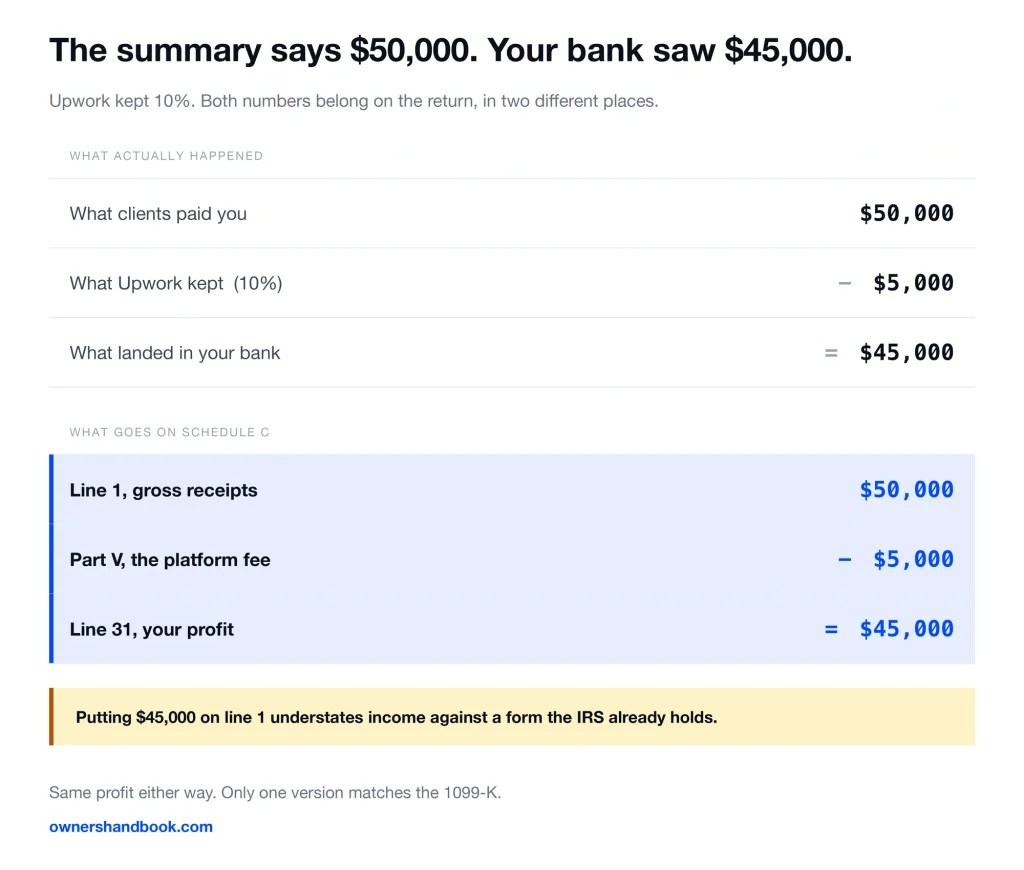
Your Upwork summary says $50,000. Your bank saw $45,000, because Upwork kept its 10%. The instinct is to report the $45,000 you actually touched.
Do not. Report $50,000 on line 1, then deduct the $5,000 fee as a business expense.
| Where it goes | What you put there |
|---|---|
| Line 1, gross receipts | $50,000 — what clients paid, before the cut |
| Part V, carried to line 27 | $5,000 — the platform’s commission |
| Line 31, your profit | $45,000 — same answer, correct paperwork |
The profit is identical either way. The paperwork is not.
The IRS already holds a copy of that 1099-K showing $50,000. A line 1 that comes in smaller than the form it holds is a gap someone has to explain.
There is a second reason to do it this way. Netting quietly hides the fee, and a fee you never wrote down is a fee you may forget to deduct at all.
The same applies to a driver’s summary showing gross fares before the service fee, and to an Etsy statement showing what buyers paid before listing and transaction fees.
Drivers live on mileage
For rideshare and delivery, mileage is usually the single largest deduction on the return. It is often larger than every other expense combined.
The 2026 standard mileage rate is 72.5 cents a mile through June 30, and 76 cents from July 1. The IRS raised it mid-year, so a log that crosses June 30 has to be split and multiplied in two halves.
Twenty thousand business miles evenly spread across 2026 is about $14,850 of deduction. That is often the difference between a large tax bill and a modest one.
Which miles count is where people lose money.
Miles between deliveries count. So do miles from one passenger drop-off toward the next request, and miles driven with the app on while you wait for one, as long as you are working rather than running errands.
The drive from your home to where you start the day is commuting, and commuting is personal driving. It does not count.
The drive home at the end of the shift is the same. Personal.
The platform’s own mileage number is usually only the miles with a passenger or an order in the car. Your deductible total is normally larger than that, and only your own log proves it.
Keep a contemporaneous log, meaning one written as you drive. A number rebuilt in April is not a record.
Sellers live on cost of goods
If you sell physical items on Etsy or eBay, your biggest number is what the inventory cost you.
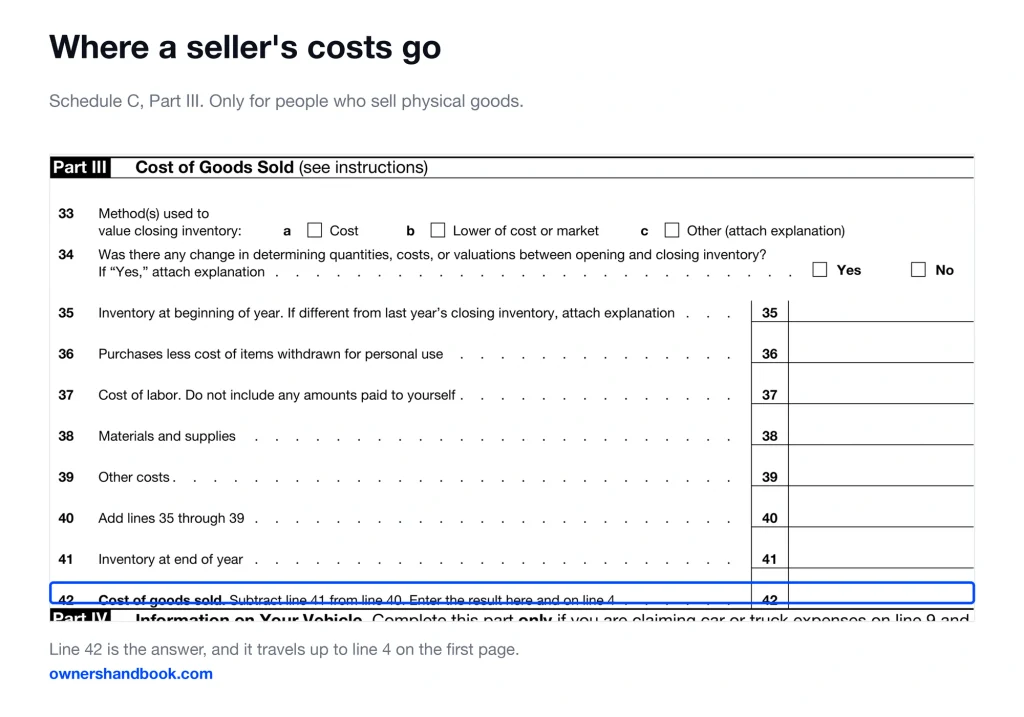
That goes in Part III of Schedule C, cost of goods sold. What you were holding on January 1, what you bought or made during the year, what was still on the shelf on December 31.
Part III produces one figure that carries up to line 4 and comes out of your receipts before any other expense is counted.
Materials, the finished goods you bought to resell, and the labor and freight to get them ready all belong there. Not your listing fees or shipping labels — those are ordinary expenses further down.
Selling your own used possessions is a different thing entirely. A couch you paid $1,200 for and sold for $400 is a $400 gross receipt and an $800 loss.
That loss is not taxable income and it is also not deductible. You report the sale so the 1099-K is accounted for, and it nets to zero.
Do not mix the two on one Schedule C. A business selling inventory and a person clearing out a garage are separate stories.
Marketplace freelancers live on the fee
On Upwork and Fiverr, the commission is the expense that dwarfs the rest, and it is the one most often left off.
It has no dedicated line on Schedule C. Write it in Part V with a plain label like “Upwork service fee” and let the total flow up to line 27.
Membership plans, connects, withdrawal charges, and currency conversion fees belong there too. All of it is real money you paid to do business.
Everything else follows normally. Your laptop, your software, your home office, the share of your phone bill you use for work.
One person, two platforms
Driving for a delivery app and selling handmade goods are two different lines of work. That is two Schedule Cs.
The Schedule C instructions are direct about it. If you owned more than one business, complete a separate Schedule C for each business.
Driving for both Uber and Lyft is not two businesses. It is one driving business with two customers, and one form covers it.
Same test for Upwork and Fiverr, or Etsy and eBay. Same work, one Schedule C.
The self-employment tax is figured once, on the combined result, no matter how many Schedule Cs feed it.
Frequently asked questions
Do I owe tax if the platform never sent me a form?
Yes. Income is taxable whether or not an information return reports it, and the IRS states that directly for gig work. A form is a notification, not the thing that creates the obligation.
The platform says I earned more than my bank deposits show. Which number do I report?
The larger one. Report gross on line 1, then deduct the platform’s commission as an expense. The profit comes out the same and the paperwork matches what the IRS already holds.
I drive for DoorDash and also sell on Etsy. One Schedule C or two?
Two. They are genuinely different lines of work, and the instructions ask for a separate Schedule C for each business.
Do the miles I drive while waiting for a request count?
Generally yes, if you are working and available rather than running a personal errand. The commute from home to where you start, and the drive home at the end, do not count.
I sold my old furniture on eBay and got a 1099-K. Is that income?
Not if you sold it for less than you paid. A loss on a personal item is not taxable income, and it is not deductible either. Report the sale so the form is accounted for.
Can I deduct the platform’s cut if the money never reached my account?
Yes. It was your income first, and the platform took its fee out of it. Report the full amount and deduct the fee.
Sources
IRS, Gig Economy Tax Center
https://www.irs.gov/businesses/gig-economy-tax-center
IRS, Manage Taxes for Your Gig Work
https://www.irs.gov/businesses/small-businesses-self-employed/manage-taxes-for-your-gig-work
IRS, Understanding Your Form 1099-K
https://www.irs.gov/businesses/understanding-your-form-1099-k
IRS, Form 1099-K Frequently Asked Questions, General Information
https://www.irs.gov/newsroom/form-1099-k-frequently-asked-questions-general
IRS, About Form 1099-NEC
https://www.irs.gov/forms-pubs/about-form-1099-nec
IRS, Instructions for Schedule C
https://www.irs.gov/instructions/i1040sc
IRS, About Schedule SE (Form 1040)
https://www.irs.gov/forms-pubs/about-schedule-se-form-1040
IRS, Standard Mileage Rates
https://www.irs.gov/tax-professionals/standard-mileage-rates
IRS, Publication 463, Travel, Gift, and Car Expenses