What a Freelance Contract Has to Say
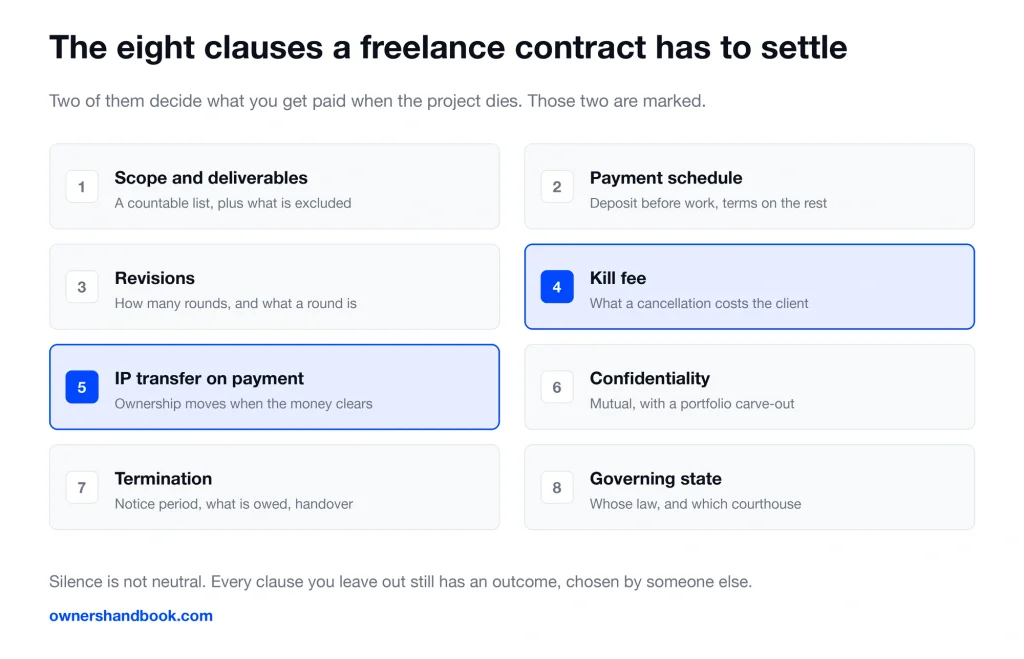
Eight clauses decide what happens when a freelance project goes wrong. Scope and deliverables, payment schedule, revisions, kill fee, IP transfer on final payment, confidentiality, termination, and governing state.
Everything else is furniture. Write two of them carefully and make it the IP clause and the kill fee, because those are what pay you when a project dies halfway.
This is general information about how these clauses work, not legal advice. An hour with a lawyer in your state is cheap next to the fight a bad clause creates.
The eight clauses, and what silence costs
A contract is not written for the project that goes well. On that one, nobody opens the file.
It is written for the argument you have not had yet. So the useful question is not “is this clause in there.” It is “what happens if it is not.”
| Clause | What it settles | If the contract says nothing |
|---|---|---|
| Scope and deliverables | What counts as finished | Finished is whatever the client says it is |
| Payment schedule | When money moves, not only how much | You are financing the project |
| Revisions | How many rounds, and what a round is | Unlimited |
| Kill fee | What a cancellation costs | Nothing beyond hours already billed |
| IP transfer | Who owns the files, and from when | You still own it, and the client has an argument instead of a transfer |
| Confidentiality | What each side may repeat | No duty either way, and no portfolio right either |
| Termination | How either side exits, with how much notice | Argued from scratch, by email, badly |
| Governing state | Whose law, and which courthouse | Their state, if they file first |
The silence column is never blank. Something still happens, on terms nobody chose.
Scope is a list, not a paragraph
“Design a website” is not a scope. It is a mood.
A scope is a countable list of objects. Five page templates. One logo delivered as SVG, PNG, and EPS. Three initial concepts, with two rounds of revision on the one selected.
Countable matters because it makes “done” a fact rather than an opinion.
Then add the half everyone skips: what is excluded. Copywriting, stock licensing, hosting setup, anything after launch.
Revisions need the same treatment, because the word alone means nothing. Define a round as one consolidated set of written feedback, delivered within five business days.
Then say what happens when they run out, in dollars. Additional revisions are billed at $95 per hour. Without that sentence, “one more small change” is free forever.
The payment schedule is the enforcement mechanism
Every other clause is a promise. The payment schedule is the only one that changes who is holding the money while the argument happens.
Which is why it belongs before the work. A 50% deposit that clears before you start fixes most of what goes wrong later, and it deserves its own page.
Then set the terms on the remainder. Net 15 or Net 30 from the invoice date, with a stated late fee. Payment terms are a subject of their own, and the wrong ones quietly cost you weeks.
The smallest clause does the most work. Write the timeline as running from the date the deposit clears. Then a client who delays payment delays their own launch, not yours.
The kill fee, and the sentence that makes it work
A kill fee is what a client owes for cancelling a project you already built most of. Not a penalty. Compensation for a blocked calendar and a replacement job you turned down.
Here is the sentence.
“If the Client terminates this Agreement before final delivery, the Client shall pay for all work completed as of the termination date, plus a kill fee equal to 30% of the remaining unbilled balance. The deposit is non-refundable and is credited against amounts owed.”
Three things are working in there. It says shall pay, not may be liable. It fixes a percentage instead of opening a negotiation. And it tells the deposit where to go, which is the part people forget.
| Cancelled when | What is owed | Why it is owed |
|---|---|---|
| Before work starts | The deposit | Dates were held, preparation was done |
| Partway through | Completed work, plus 25% to 50% of the unbilled balance | Your calendar was blocked and the replacement job is gone |
| After final delivery | The full amount | The work exists; approval is not a payment condition |
Thirty percent is the common middle. Editorial and photography run higher, because a booked shoot day cannot be resold.
Who owns the work, and when
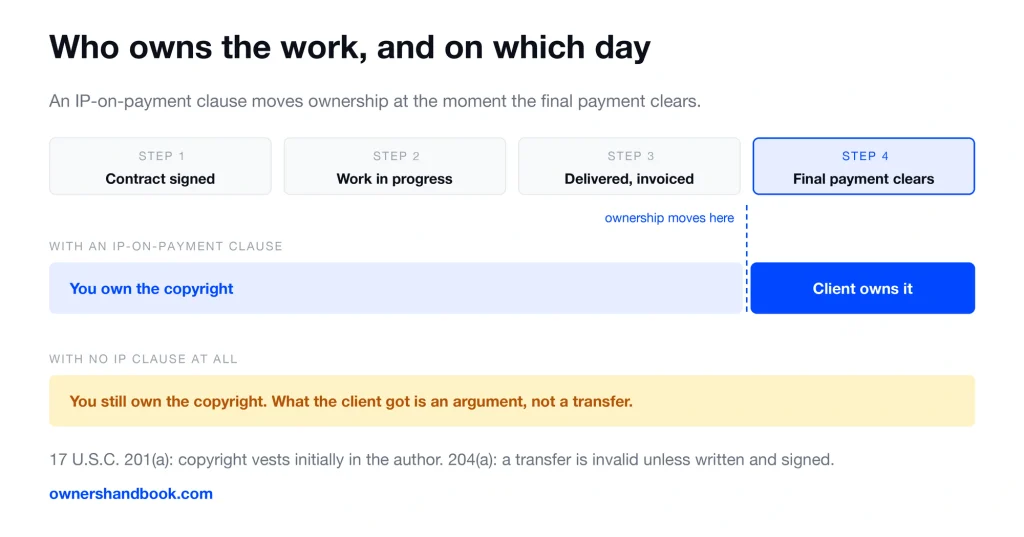
Start from the default, which is better than most freelancers think. Copyright vests initially in the author, and for freelance work the author is you.
The exception is work made for hire, and it is far narrower than the phrase suggests. Federal law defines it two ways.
One is a work made by an employee within the scope of employment. The other is a specially commissioned work that falls into one of nine listed categories and is covered by a signed written agreement saying so.
The nine are things like contributions to a collective work, parts of a motion picture, translations, compilations, and instructional texts. A logo is not on the list. Neither is a website, a brand deck, or a set of product photos.
So a “work for hire” line in a typical freelance contract often transfers nothing at all.
What moves ownership is an assignment, and the statute is strict. A transfer of copyright is not valid unless it is in writing and signed by the owner of the rights.
That strictness is your leverage. Attach the assignment to the money.
Here is the sentence.
“All intellectual property rights in the Deliverables remain with the Contractor until payment is received in full. Upon receipt of final payment, the Contractor assigns to the Client all right, title, and interest in the final Deliverables, including copyright. Preliminary concepts, working files, and unselected work are excluded.”
Read what that does to a client who goes quiet after delivery. They are not sitting on a paid asset. They are using a file they cannot register, resell, or defend.
That is a better position than sending a fourth reminder email. If it comes to that anyway, there is a sequence for getting an unpaid invoice actually paid.
Confidentiality, termination, and which state’s law
Confidentiality should be mutual. You are receiving their pricing and unlaunched product; they are receiving your process and your rates.
Carve out your portfolio explicitly, or you have quietly agreed never to show the work. “Contractor may display the Deliverables in portfolios and case studies after the Client’s public launch” is enough.
Termination needs two numbers and one list. How much written notice, what is owed on the notice date, and what gets handed over. Fourteen days is the usual notice period for ongoing work.
Governing state looks like boilerplate and decides where you would have to physically show up.
It also touches a choice you may not have connected to it. In California a natural person can sue in small claims for up to $12,500. A corporation or LLC is capped at $6,250 in the same court.
A sole proprietor is a natural person. Forming an LLC is usually still the right call, for unrelated reasons, but that ceiling is a real trade-off worth knowing first.
Name your own state, or at minimum one you could reach in a day.
An email thread can already be a contract
There is no rule that a freelance agreement must be a signed PDF. Most service agreements need not be in writing at all, and those that do can be satisfied by ordinary electronic text.
New York‘s statute of frauds says so directly. Text produced by “computer retrieval or other process by which electronic signals are transmitted” is a writing.
And “any symbol executed or adopted by a party with the present intention to authenticate a writing” is a signing.
Which means the email where you listed the scope and the price, and the client replied “looks good, start Monday,” may be your contract. A bad one, settling two of the eight clauses. But not nothing.
Electronic signatures are settled law. Under the federal E-SIGN Act, a signature or contract “may not be denied legal effect, validity, or enforceability solely because it is in electronic form.”
The same Act defines an electronic signature as any “sound, symbol, or process, attached to or logically associated with a contract,” adopted with the intent to sign.
Most states reached the same result independently by adopting the Uniform Electronic Transactions Act. California’s version is four lines: an electronic record satisfies a law requiring writing, and an electronic signature satisfies a law requiring a signature.
New York did not adopt UETA and has its own statute, giving an electronic signature “the same validity and effect as the use of a signature affixed by hand.”
E-SIGN carves out wills, divorce decrees, court orders, and foreclosure notices. It carves out nothing a freelancer signs.
So a typed name in a PDF, a DocuSign block, or a clicked “I agree” is a real signature. Keep a copy showing who signed and when, because the fight is never about validity. It is about proof.
Frequently asked questions
Do I need a lawyer to write my contract?
A good template you understand beats an expensive one you do not. Bring in a lawyer for large contracts, perpetual or exclusive licenses, indemnification clauses, or anything a client’s legal team rewrites.
Is a contract valid if only I signed it?
Often yes. Performance can show acceptance, and email confirmation can show agreement. But you have moved the argument from “what does the contract say” to “was there a contract,” which is worse ground.
Should I use work-for-hire language?
Only if the work genuinely falls in one of the nine statutory categories. Otherwise use an assignment clause, which works for any type of work and is what actually transfers ownership.
What if the client sends their own contract?
Read the IP, payment, and termination clauses first. Client templates usually assign all IP on signature rather than on payment, and drop the kill fee. Both are normal to negotiate.
Can I charge a kill fee the contract never mentioned?
You can bill for work completed. The kill fee itself is a contract term, so with no clause there is nothing to enforce. Add it before the next project.
Does an emailed PDF need to be notarized?
No. Notarization is required for a narrow set of documents such as deeds and some powers of attorney. A services agreement is not one of them.
Sources
U.S. Copyright Office, Circular 30: Works Made for Hire
https://www.copyright.gov/circs/circ30.pdf
17 U.S.C. 101, Definitions (work made for hire)
https://www.copyright.gov/title17/92chap1.html
17 U.S.C. 201 and 204, Ownership and Transfer of Copyright
https://www.copyright.gov/title17/92chap2.html
Electronic Signatures in Global and National Commerce Act, Public Law 106-229 (15 U.S.C. ch. 96)
https://www.govinfo.gov/content/pkg/PLAW-106publ229/html/PLAW-106publ229.htm
California Civil Code 1633.7, Uniform Electronic Transactions Act
https://leginfo.legislature.ca.gov/faces/codes_displaySection.xhtml?lawCode=CIV§ionNum=1633.7
New York General Obligations Law 5-701, Statute of Frauds
https://www.nysenate.gov/legislation/laws/GOB/5-701
New York State Technology Law 304, Use of Electronic Signatures
https://www.nysenate.gov/legislation/laws/STT/304
California Code of Civil Procedure 116.221, Small Claims Jurisdiction
https://leginfo.legislature.ca.gov/faces/codes_displaySection.xhtml?lawCode=CCP§ionNum=116.221
California Courts Self-Help Guide, Small Claims