Do You Owe Sales Tax on Freelance Work?
Most freelancers who sell pure services owe no sales tax. Consulting, writing, coaching, design labor — most states do not tax them at all. What catches people is digital products.
And this is a different tax from the two you already know. Income tax and self-employment tax come out of your profit. Sales tax was never your money — you collect it from the buyer and forward it to a state.
Templates, presets, stock files, ebooks, courses. A growing list of states taxes those, and the rate follows your buyer’s address, not yours.
This is not the tax you already know
Self-employment tax and income tax are calculated on what you kept. Sales tax is calculated on what the buyer paid, and it is added on top of your price.
It does not appear on Schedule C as income. It is money you are holding for a state that has not asked for it yet.
It is not state income tax either. Texas and Washington collect no income tax from individuals and still run sales tax regimes that reach freelancers.
Which is why forgetting it hurts. If a state later decides you should have been collecting, the tax comes out of your pocket, because the client is long gone.
Services are usually safe, and then they are not
Most states tax goods, then name specific services in statute. If your service is not on the list, it is not taxed.
Three states make that assumption dangerous.
South Dakota taxes services outright. Its revenue department says sales tax applies to “the sale of all services,” at a state rate of 4.2%.
New Mexico’s gross receipts tax reaches “performing services in New Mexico, and performing services outside of New Mexico, the product of which is initially used in New Mexico.”
Texas names sixteen categories, and two of them are full of freelancers: data processing services (web hosting, data storage, software-as-a-service) and information services.
Texas exempts 20% of the charge for both. Bill a Texas client $2,000 for hosting and $1,600 is taxable. At the 6.25% state rate that is $100.
The same invoice, two different answers
Maryland published an example that every freelancer should read once.
A photography company charges a Maryland client $10,000 to shoot the photos and send proofs for approval. Then $2,000 for the final image files, delivered electronically.
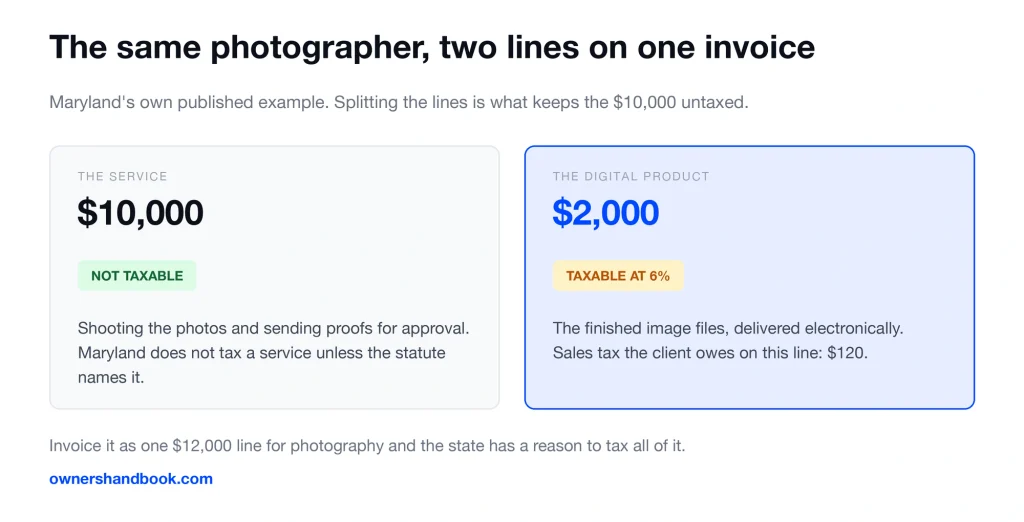
The $10,000 is a non-taxable service. The $2,000 is a digital product, taxed at Maryland’s 6% rate. The client owes $120 in sales tax.
The split is what makes it work. Maryland treats the service as non-taxable only “when separately charged from the digital product result of such services.”
Invoice it as one $12,000 line for photography and you have handed the state a reason to look at the whole amount. Six percent of $12,000 is $720.
| What you sell | Typical treatment |
|---|---|
| Consulting, writing, coaching, design labor | Not taxable in most states |
| Photography service, billed on its own line | Not taxable in Maryland |
| The finished files, delivered by download | Taxable in Maryland at 6% |
| Web hosting, data storage, SaaS | Taxable in Texas, 20% of the charge exempt |
| Any service at all | Taxable in South Dakota and New Mexico |
Digital products are where freelancers get caught
Maryland’s list of taxable digital products includes ebooks, online courses, design templates, stock files and images, and presets.
Washington is blunter. Its rule says the sale of digital products and digital codes “is generally subject to retail sales or use tax unless purchased for resale or some other exemption applies.”
South Dakota taxes “any product transferred electronically,” which is the same idea in five words.
California goes the other way. Its Regulation 1502 says a prewritten program transferred by download is not taxable if the buyer “does not obtain possession of any tangible personal property, such as storage media.”
So the same $49 Lightroom preset pack is taxable to a Maryland buyer and not taxable to a California one. Nothing about your business changed.
The tax follows the buyer, not you
Maryland states the rule plainly: a retail sale of a digital product “shall be presumed to be made in the state in which the customer tax address is located.”
You live in Austin. Your buyer lives in Baltimore. Maryland’s rules apply, at Maryland’s rate.
This is the part a plain Stripe checkout on your own website will not do for you. It takes the card and moves on.
The floor before any state can make you collect
In 2018 the Supreme Court decided South Dakota v. Wayfair and overruled the old rule that a state needed your physical presence before it could tax you.
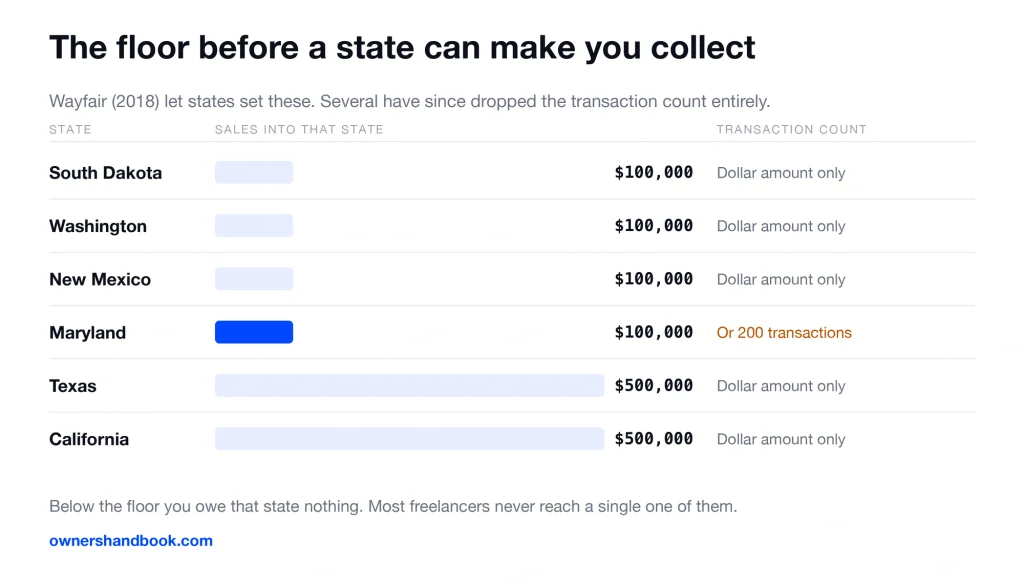
The South Dakota law it upheld applied to sellers who “deliver more than $100,000 of goods or services into the State or engage in 200 or more separate transactions.”
Every state then wrote its own version. Several, South Dakota included, have since dropped the transaction count and kept only the dollar figure.
| State | Sales into that state before you must collect |
|---|---|
| South Dakota | $100,000. No transaction count. |
| Washington | $100,000. No transaction count. |
| New Mexico | $100,000. No transaction count. |
| Maryland | $100,000, or 200 separate transactions |
| Texas | $500,000. No transaction count. |
| California | $500,000. No transaction count. |
Below the floor you owe that state nothing. Most freelancers never reach a single one.
But watch the count where it survives. Sell that $49 preset pack to 300 Maryland buyers and you have made $14,700 — nowhere near $100,000, and still over Maryland’s 200-transaction line.
What Etsy and Gumroad already handle
A marketplace facilitator is a platform that lists your product for sale and collects the buyer’s money. Etsy and Gumroad are the obvious ones. Uber and DoorDash work the same way for gig work.
States shifted the job to them. Maryland requires a marketplace facilitator to “collect the applicable sales and use tax due on a retail sale or sale for use by a marketplace seller to a buyer in Maryland.”
California is the same: the facilitator is the retailer for those sales and owes the tax.
One catch worth knowing. California still makes you count facilitated sales toward your own threshold, including “sales facilitated through a marketplace facilitator’s marketplace.”
So the platform pays the tax, but its volume can still push you over the line on everything you sell yourself.
What to actually do
Look at what you sell and split it into two buckets: labor, and files a buyer downloads. If the second bucket is empty, you are almost certainly done.
If it is not empty, put the digital deliverable on its own invoice line. Always. It costs nothing and it is the single change Maryland’s example turns on.
Pull a sales-by-state report from your payment processor once a year and compare it against the thresholds above. You are looking for one state, not fifty.
Keep selling through Etsy or Gumroad if the volume is small. They are already doing the filing you would otherwise have to do yourself.
Register only when a state’s threshold is actually crossed. Registering early means filing returns forever, including the months you sold nothing there.
Frequently asked questions
Do I charge sales tax on an hourly consulting invoice?
In most states, no. Check South Dakota, New Mexico, and Texas separately, because those three tax services either broadly or by named category.
Is sales tax part of my income?
No. It is collected from the buyer and passed to the state. It is not revenue on Schedule C, and it has nothing to do with self-employment tax.
Etsy collects for me. Do I still register anywhere?
Usually not for those sales. But California requires you to count marketplace sales toward your own economic nexus threshold, so track them even though you are not remitting them.
Which state’s rate applies to a download?
The buyer’s. Maryland presumes the sale happens at the customer’s tax address, and other states source digital sales the same way.
I sell a $29 ebook to buyers in forty states. What do I owe?
Almost certainly nothing, unless one state’s threshold is crossed. Thresholds are measured per state, not across all of them combined.
What if I should have been collecting and did not?
The state assesses the tax against you, plus interest. Contact that state’s revenue department about a voluntary disclosure before they contact you.
Sources
South Dakota v. Wayfair, Inc., 585 U.S. 162 (2018)
https://www.supremecourt.gov/opinions/17pdf/17-494_j4el.pdf
Comptroller of Maryland, Business Tax Tip #29, Sales of Digital Products and Digital Code
South Dakota Department of Revenue, Sales & Use Tax
https://dor.sd.gov/businesses/taxes/sales-use-tax
New Mexico Taxation and Revenue Department, Gross Receipts Overview
Washington Department of Revenue, Out-of-State Businesses Industry Guide
https://dor.wa.gov/education/industry-guides/out-state-businesses
Washington Administrative Code 458-20-15503, Digital Products
https://app.leg.wa.gov/WAC/default.aspx?cite=458-20-15503
Texas Comptroller, Remote Sellers
https://comptroller.texas.gov/taxes/sales/remote-sellers.php
Texas Comptroller, Taxable Services (Publication 96-259)
https://comptroller.texas.gov/taxes/publications/96-259.php
Texas Comptroller, Sales and Use Tax
https://comptroller.texas.gov/taxes/sales
California Department of Tax and Fee Administration, Use Tax Collection Requirements Based on Sales into California
https://www.cdtfa.ca.gov/industry/wayfair.htm
California Department of Tax and Fee Administration, Marketplace Facilitator Act
https://www.cdtfa.ca.gov/industry/MPFAct.htm
California Department of Tax and Fee Administration, Regulation 1502, Computers, Programs, and Data Processing