Georgia’s Rate Drops Every Year. Here Is What You Owe in 2026.
Georgia taxes your freelance profit at a flat 4.99% in 2026. A single filer with $90,000 of net profit owes the state about $3,425. That is Georgia tax, and it sits on top of United States federal tax.
The rate has now been cut three years running. If you are working from a number you read in a 2024 article, it is wrong, and estimating your quarterly payments from it costs you real money.
The number in the old law is not the number
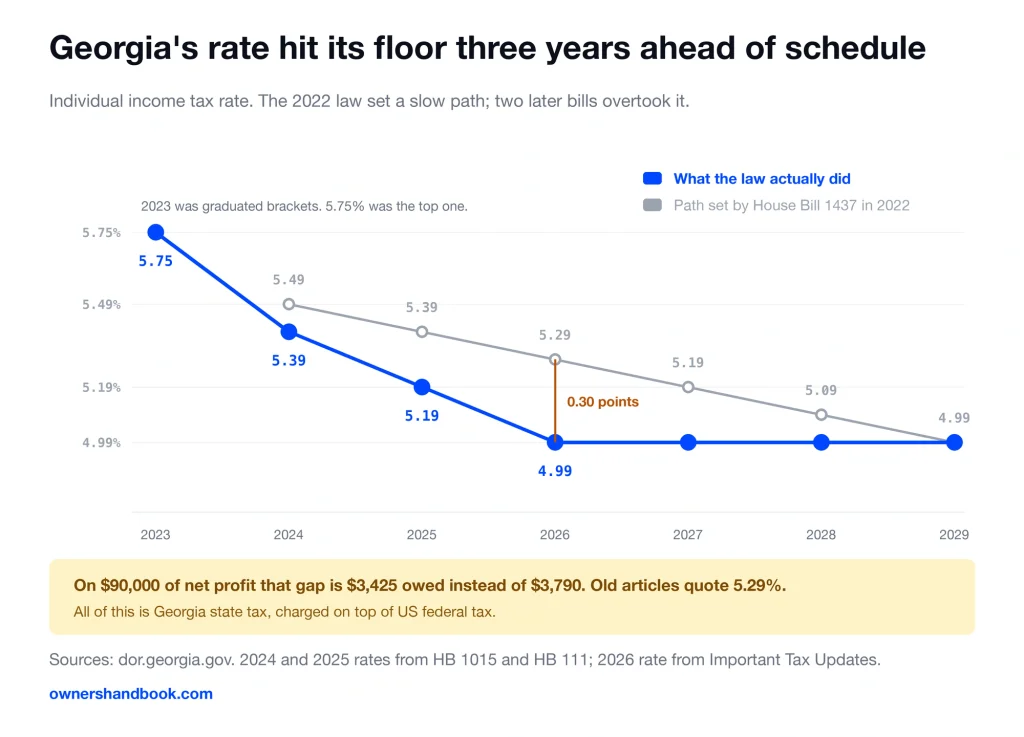
Georgia used graduated brackets through tax year 2023. The top bracket was 5.75% and it started at $7,000 of taxable income, so a freelancer paid 5.75% on nearly everything.
House Bill 1437, passed in 2022, replaced the brackets with a single flat rate beginning in 2024. It scheduled a slow walk down — 5.49% in 2024, then a tenth of a point a year, reaching 4.99% in 2029.
That schedule got overtaken. House Bill 1015 cut 2024 to 5.39%. House Bill 111 cut 2025 to 5.19% and set annual reductions running from 2026, subject to revenue triggers.
The Department of Revenue lists 2026 at 4.99%, as of September 2026. The floor arrived three years early.
| Tax year | Georgia rate | Tax on $90,000 of profit |
|---|---|---|
| 2023 | Graduated, 1% to 5.75% | $4,171 |
| 2024 | 5.39% flat | $3,862 |
| 2025 | 5.19% flat | $3,718 |
| 2026 | 4.99% flat | $3,425 |
Same profit, same filing status, four different years. The 2026 bill is $746 lighter than the 2023 one.
Where the $3,425 comes from
Georgia does not start from your Schedule C, the federal form where you report freelance profit and loss. It starts from your federal adjusted gross income, and copies it onto Line 8 of Form 500.
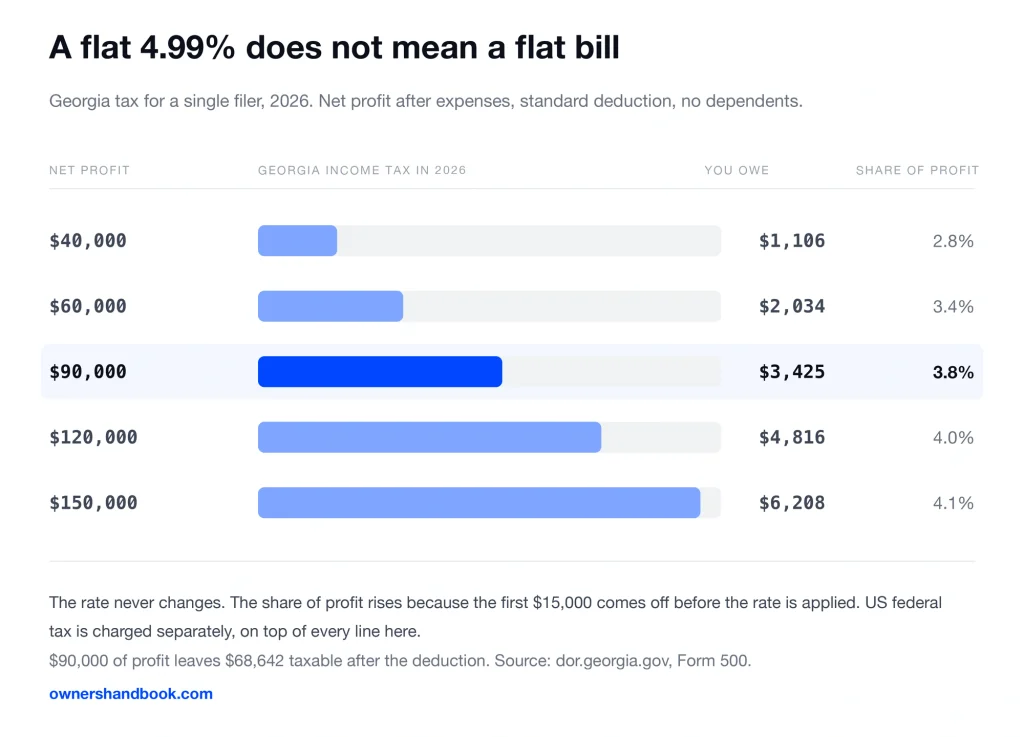
Take $90,000 of net profit. Federal self-employment tax on that is $12,717, and you deduct half of it, $6,358, on the way to AGI. Your federal AGI is $83,642.
Georgia then subtracts its own standard deduction. For 2026 that is $15,000 single, head of household, or married filing separately, and $30,000 married filing jointly.
$83,642 minus $15,000 leaves $68,642 of Georgia taxable income. At 4.99% that is $3,425, or $856 a quarter.
There is no longer a personal exemption for yourself or a spouse — Georgia repealed those after 2023. Dependents still count, at $4,000 each.
The deduction that stops at the state line
Most freelancers take the qualified business income deduction federally: 20% of profit, subtracted after AGI is already fixed.
Georgia does not allow it. The IT-511 booklet says so plainly, and notes that no adjustment is needed on your return, because the deduction never touched AGI in the first place.
The practical effect is that your Georgia taxable income is larger than your federal taxable income, usually by roughly a fifth of your profit.
Why last year’s rate overcharges you
Quarterly estimated taxes run on an estimate, and the easiest estimate anyone reaches for is last year’s return. Federally that is sound advice. In Georgia it is now systematically too high.
Our freelancer owed Georgia $3,718 for 2025. The same profit in 2026 costs $3,425. Four payments built on the 2025 figure hand the state $293 it never asked for.
That is not a penalty. It is an interest-free loan to Georgia that you get back at refund time, several months later.
The fix is one line of arithmetic. Multiply this year’s Georgia taxable income by 4.99%, not by last year’s rate, and divide by four.
Georgia’s safe harbor is not the federal one
A safe harbor is the amount you can pay and be immune from an underpayment penalty no matter what your final bill turns out to be. Georgia’s version lives on Form 500 UET.
Georgia asks for the lesser of two numbers. One is 100% of the immediately preceding year’s tax, provided that return covered a full 12 months. The other is 70% of this year’s balance due.
Seventy percent, where the federal rule is ninety. Georgia’s is genuinely looser, and the lesser of the two governs.
Run our freelancer through it. 100% of 2025’s $3,718 is $929.50 a quarter. 70% of 2026’s $3,425 is $2,397.50, which is $599.38 a quarter.
$599.38 is the smaller number, so that is the required installment. Pay it four times and no penalty can be assessed, then settle the remaining $1,027 when you file.
| Rule | Federal | Georgia |
|---|---|---|
| Current-year test | 90% of this year’s tax | 70% of this year’s balance due |
| Prior-year test | 100% of last year’s tax, 110% if prior-year AGI was over $150,000 | 100% of last year’s tax |
| Which applies | Whichever you choose | The lesser of the two |
| Underpayment charge | IRS interest, set quarterly | 9% a year |
| Form that computes it | Form 2210 | Form 500 UET |
The four due dates are April 15, June 15, September 15, and January 15 of the following year. The same dates as the IRS, printed on Form 500-ES.
You are required to file estimates if you expect gross income above your deductions plus $1,000 of income nobody is withholding on. Freelance profit clears that quickly.
Nobody else takes a cut
Georgia has no local income tax. Not Atlanta, not Savannah, not any county or school district.
This is worth saying out loud, because it is exactly what makes Georgia simpler than Ohio or Pennsylvania. In those states a self-employed person files with a municipality as well, on a separate form, to a separate collector.
Form 500 is the entire state and local story here. Georgia’s cities and counties raise their money from property tax and local sales tax instead.
The general state tax guide covers how other states handle this, and the quarterly estimated taxes guide covers the federal half of the schedule.
Over 62 and still taking client work
Georgia excludes a large slice of retirement income from tax, and a piece of that exclusion can be earned income.
The maximum is $35,000 if you are 62 to 64, or under 62 and permanently disabled to the point of being unable to work. It is $65,000 if you are 65 or older.
Each spouse qualifies separately, so a married couple who both qualify can claim the amounts twice.
Up to $5,000 of the maximum may be earned income, which includes self-employment profit. At 4.99% that is about $250 a year off your Georgia bill, claimed on Schedule 1 of Form 500.
Your LLC has its own April 1
If you registered a Georgia LLC, the Secretary of State wants an annual registration filed by April 1 of every year it is in business.
It has nothing to do with income tax and it does not go to the Department of Revenue. A filing postmarked after April 1 picks up a $25 late fee.
Keep skipping it and the state can administratively dissolve your LLC, which is a much more expensive problem than the registration was.
Frequently asked questions
Is 4.99% the last cut?
House Bill 111 set 4.99% as the floor of the reduction schedule, and 2026 reached it. There is no further scheduled cut, but check the Department of Revenue each January rather than assuming.
Does Georgia charge its own self-employment tax?
No. Social Security and Medicare are federal programs, and Schedule SE goes to the IRS alone. Georgia’s 4.99% is income tax and nothing else.
I also have a W-2 job. Does that help?
Yes. Form 500 UET treats Georgia tax withheld from a job as though it were paid equally across all four installments, whenever it actually came out. Raising withholding late in the year still counts as on time.
Do I have to file estimates at all?
Only if your expected gross income exceeds your deductions plus $1,000 of income not subject to withholding. Form 500-ES states the test.
How do I actually pay Georgia?
Through the Georgia Tax Center online, which is the practical route, or by mailing a Form 500-ES voucher to the Department’s processing center in Atlanta. The how to pay estimated taxes guide covers the federal side.
Is the standard deduction really $15,000 now?
Yes for 2026, up from $12,000, and $30,000 for joint filers. One catch: if you itemize on your federal return you must itemize on your Georgia return too, and the standard deduction is off the table.
Sources
Georgia Department of Revenue, Important Tax Updates (2026 rate of 4.99% and the $15,000 standard deduction)
https://dor.georgia.gov/taxes/important-tax-updates
Georgia Department of Revenue, Individual Taxes
https://dor.georgia.gov/taxes/individual-taxes
Georgia Department of Revenue, 2025 IT-511 Individual Income Tax Booklet
https://dor.georgia.gov/document/document/2025-it-511-individual-income-tax-booklet/download
Georgia Department of Revenue, 2023 IT-511 Individual Income Tax Booklet
https://dor.georgia.gov/document/document/2023-it-511-individual-income-tax-booklet/download
Georgia Department of Revenue, 2025 Summary of Enacted Legislation, House Bill 111
https://dor.georgia.gov/media/34396/download
Georgia Department of Revenue, 2024 Legislation Summary, House Bill 1015
https://dor.georgia.gov/document/document/2024-legislation/download
Georgia Department of Revenue, 2022 Legislation Summary, House Bill 1437
https://dor.georgia.gov/document/document/2022-legislation/download
Georgia Department of Revenue, Form 500 Individual Income Tax Return
https://dor.georgia.gov/500-individual-income-tax-return
Georgia Department of Revenue, Form 500-ES Estimated Tax for Individuals and Fiduciaries, 2026
Georgia Department of Revenue, Form 500 UET Underpayment of Estimated Tax
https://dor.georgia.gov/500-uet-underpayment-estimated-tax-individualfiduciary
Georgia Department of Revenue, Penalty and Interest Rates
https://dor.georgia.gov/penalty-and-interest-rates
Georgia.gov, Renew Your LLC
IRS, Self-Employment Tax
IRS, Estimated Taxes
https://www.irs.gov/businesses/small-businesses-self-employed/estimated-taxes