North Carolina’s Flat Rate Is Falling. What a Freelancer Owes in 2026.
North Carolina taxes your freelance profit at a flat 3.99% in 2026, down from 4.25% in 2025. On $85,000 of net profit a single filer owes about $2,643.
That is North Carolina state tax, charged on top of the federal tax you already owe the United States. Nothing here replaces the IRS, and nothing here is self-employment tax.
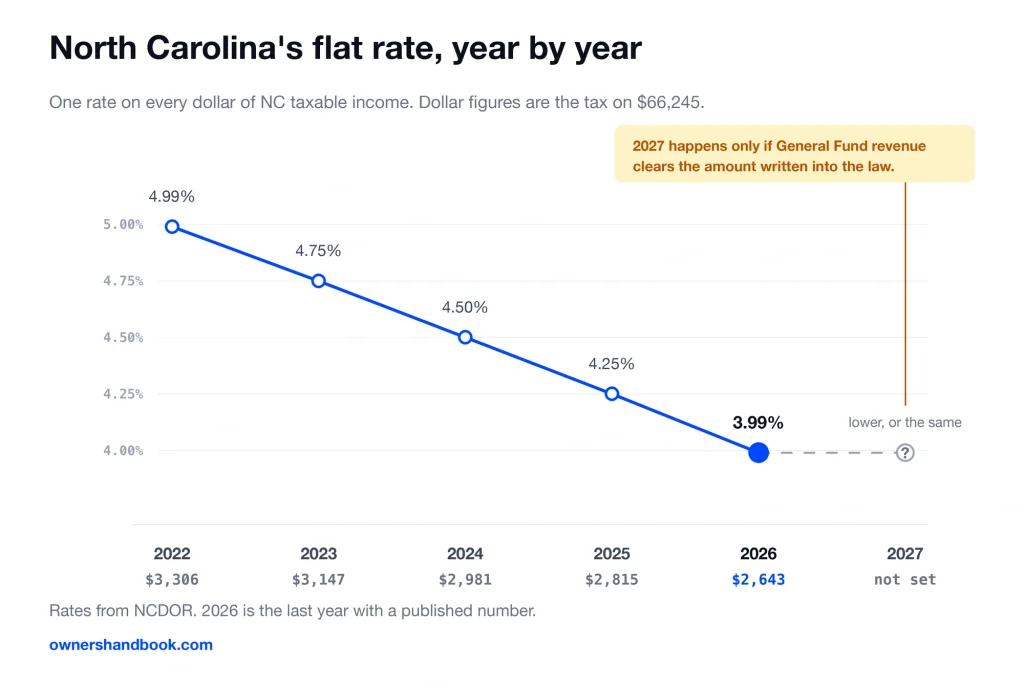
One rate, and it fell again this year
A single rate applies to every dollar of North Carolina taxable income. There are no brackets to climb.
A freelancer clearing $30,000 and one clearing $300,000 are taxed at the same 3.99%.
That rate has come down every year since 2021, on a path the General Assembly wrote into Session Law 2023-134. It is the reason so many pages about North Carolina tax are quietly wrong.
| Tax year | Flat rate | Tax on $66,245 of NC taxable income |
|---|---|---|
| 2022 | 4.99% | $3,306 |
| 2023 | 4.75% | $3,147 |
| 2024 | 4.50% | $2,981 |
| 2025 | 4.25% | $2,815 |
| 2026 | 3.99% | $2,643 |
| 2027 onward | Not set yet | Depends on revenue triggers |
Check the year on any article before you trust its number. A 2023 article quoting 4.75% was correct when it was written and is a quarter of a point off now.
What $85,000 of profit actually costs
Take a single filer with $85,000 of net profit on Schedule C and no other income.
Federal self-employment tax comes to $12,010 for the year. Half of it, $6,005, comes off before federal adjusted gross income, which is where North Carolina starts counting.
That leaves $78,995. Subtract the 2026 North Carolina standard deduction of $12,750 and you have $66,245 of North Carolina taxable income.
$66,245 at 3.99% is $2,643.
That is the entire state calculation. One subtraction, one multiplication, no rate schedule to read across.
At last year’s 4.25% the same profit would have cost $2,815. This year’s cut is worth $172 to this freelancer, which is real but is not the windfall the headlines suggested.
A revenue trigger is a cut that only happens if the state collects enough
North Carolina did not simply promise more cuts after 2026. It attached them to conditions.
A revenue trigger works like this. The law names a dollar amount of General Fund revenue for a given fiscal year. Collect more than that and the next scheduled cut takes effect. Collect less and the rate holds where it is.
So the rate below 3.99% is an option, not a promise. It depends on how the state’s own year goes.
NCDOR’s rate page stops at 2026 for exactly that reason. For later years it says only that “additional rate changes may apply to tax years beginning with 2027 based on certain rate reduction triggers.”
Any page quoting you a firm 2027 North Carolina rate is guessing. Check ncdor.gov each January instead.
The department also carries a banner about recently enacted laws, which is worth opening before you assume this year’s number held.
It did hold. The 2026 legislation in that notice, Session Laws 2026-31 and 2026-41, moved the Internal Revenue Code reference date, added a research-expense adjustment, allowed a timber casualty loss from Hurricane Helene, and permitted gambling losses as an itemized deduction.
None of it touched the rate, the schedule, or the triggers. The 2026 NC-40 worksheet still prints 3.99%.
Against the states next door
The same $85,000 of profit, run through four neighbours. Each state starts from federal adjusted gross income and applies its own deduction, so the taxable figure differs before the rate ever lands.
| State | 2026 deduction, single | Taxable income | 2026 rate | State tax |
|---|---|---|---|---|
| North Carolina | $12,750 | $66,245 | 3.99% flat | $2,643 |
| South Carolina | $15,000 | $63,995 | 1.99%, then 5.21% less $966 | $2,368 |
| Georgia | $15,000 | $63,995 | 4.99% flat | $3,193 |
| Virginia | $8,750 plus a $930 exemption | $69,315 | Up to 5.75% | $3,728 |
| Tennessee | None | None | No income tax | $0 |
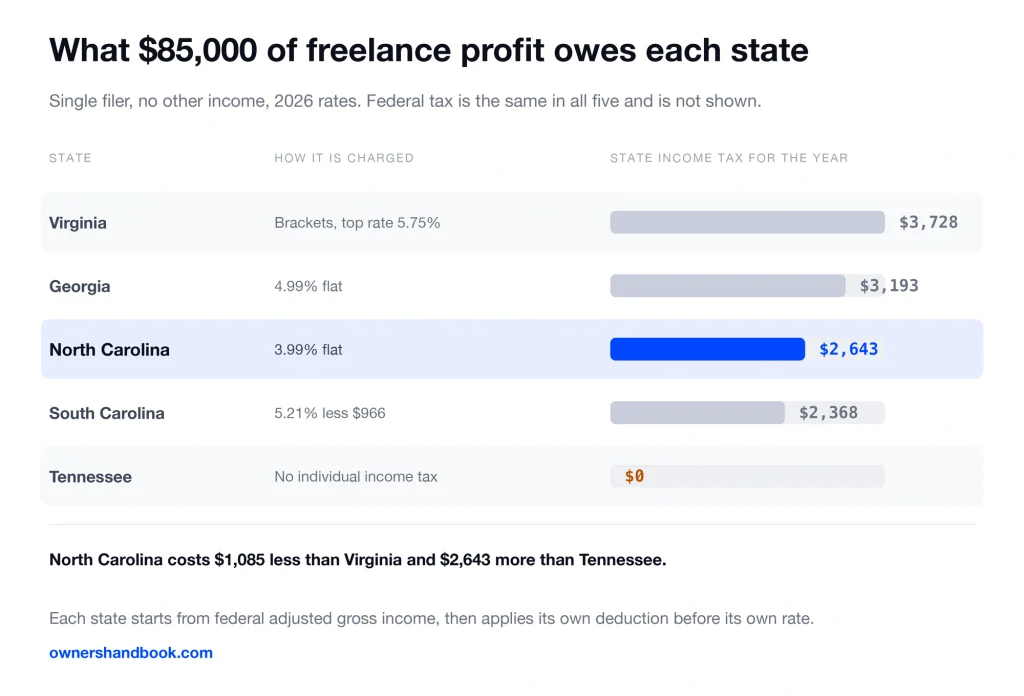
North Carolina sits in the middle. It is cheaper than Georgia and Virginia, more expensive than South Carolina, and $2,643 more than Tennessee.
South Carolina is the surprise. It rebuilt its brackets for 2026, and its $15,000 deduction now beats North Carolina’s by enough to offset the higher rate at this income.
Georgia raised its deduction to the same $15,000 this year. Its flat rate is a full point above North Carolina’s, so it still lands $550 higher on identical profit.
The standard deduction is North Carolina’s own number
You do not carry the federal standard deduction onto Form D-400. North Carolina has its own, and it is smaller.
For 2026 it is $12,750 single, $25,500 married filing jointly or surviving spouse, $19,125 head of household, and $12,750 married filing separately.
There is no extra amount for being 65 or older, and none for being blind. The federal version gives you both.
One trap sits underneath. If you are not eligible for the federal standard deduction at all, your North Carolina standard deduction is zero.
No city or county taxes your income
Form D-400 has one tax line. Nothing gets added underneath it.
No North Carolina municipality levies an individual income tax. Charlotte does not, Raleigh does not, Durham does not. There is no second return and no local registration to miss.
Counties do get their own sales tax, and those move. Mecklenburg County added 1% effective July 1, 2026, taking the combined rate there from 7.25% to 8.25%.
That reaches what you buy, and what you charge if you sell taxable goods. It does not reach your Schedule C profit.
NC-40 and the four dates
North Carolina wants its own quarterly estimated taxes. Paying the IRS does not pay Raleigh, and nothing is forwarded between them.
The form is NC-40. You owe estimated payments when the tax on your return, reduced by withholding and credits, will be $1,000 or more.
The dates match the federal ones. April 15, 2026, June 15, 2026, September 15, 2026, and January 15, 2027, in four equal amounts.
There is a shortcut at the end of the year. File your D-400 by January 31 and pay the whole balance, and the January 15 installment is not required at all.
Everything in the general guide to how to pay estimated taxes applies here, with a different portal at the end of it. NCDOR takes the payment online at eservices.dor.nc.gov.
The safe harbor stops at 100% here
A safe harbor is the rule that keeps you out of penalty territory without having to forecast the year correctly.
North Carolina’s version: pay 25% each quarter of the smaller of 90% of this year’s North Carolina tax, or 100% of last year’s, provided last year was a full 12 months.
Federal rules push that second figure to 110% once your prior-year adjusted gross income passes $150,000. North Carolina does not. It stays at 100% at every income level.
For a freelancer with one very good year, that gap matters. Your federal and state safe harbors come off the same prior-year returns at different percentages.
What you owe for missing an installment is interest, not a flat fine. Form D-422 computes it, and none is due if you had no North Carolina tax liability the previous year.
$200 a year if you registered an LLC
A North Carolina LLC files an annual report with the Secretary of State. It costs $200 on paper or $203 online, and it is due April 15 of every year after the year you formed.
A sole proprietor files nothing and pays nothing.
The fee is not income tax. It never appears on your D-400, and a year with no clients does not reduce it.
Frequently asked questions
Do I pay self-employment tax to North Carolina?
No. Social Security and Medicare are federal programs, so the 15.3% self-employment tax does not repeat at the state level. North Carolina charges income tax only.
Will the rate really drop below 3.99% in 2027?
Only if the revenue triggers in Session Law 2023-134 are met. NCDOR publishes no rate for 2027, and neither should anyone else. Check its rate page in January.
Does North Carolina follow the federal qualified business income deduction?
No. North Carolina starts from federal adjusted gross income, and the 20% deduction is taken after that on the federal return. The deduction for half your self-employment tax does carry over, because it lands above the line.
I moved to North Carolina in June. What do I file?
A part-year resident return, using Schedule PN alongside Form D-400. Your estimated payments should cover the North Carolina income from the months you were a resident.
Can I skip the January payment?
Yes, if you file your D-400 by January 31 and pay the full balance due at the same time. Otherwise the January 15 installment stands.
What if I will owe North Carolina less than $1,000?
No estimated payments are required. File and pay the balance with your return in April.
Sources
North Carolina Department of Revenue, Tax Rate Schedules
https://www.ncdor.gov/taxes-forms/individual-income-tax/tax-rate-schedules
North Carolina Department of Revenue, 2026 Form NC-40 Individual Estimated Income Tax
https://www.ncdor.gov/individual-estimated-income-tax-0
North Carolina Department of Revenue, Estimated Income Tax
https://www.ncdor.gov/taxes-forms/individual-income-tax/estimated-income-tax
North Carolina Department of Revenue, NC Standard Deduction or NC Itemized Deductions
North Carolina Department of Revenue, Form D-422 Underpayment of Estimated Tax by Individuals
https://www.ncdor.gov/2025-form-d-422-underpayment-estimated-tax-individuals-0
North Carolina Department of Revenue, Form D-400 Individual Income Tax Return
https://www.ncdor.gov/2025-d-400-individual-income-tax-return
North Carolina Department of Revenue, Important Notice on the Impact of Recently Enacted Laws
North Carolina Department of Revenue, Important Notice on the Mecklenburg County Sales and Use Tax Increase
North Carolina Secretary of State, Annual Report Due Dates and Fees
https://www.sosnc.gov/divisions/business_registration/annual_report_due_dates
South Carolina Department of Revenue, Individual Income Tax
https://dor.sc.gov/tax/individual-income
Georgia Department of Revenue, 2026 Employer’s Tax Guide
https://dor.georgia.gov/employers-tax-guide
Georgia Department of Revenue, Important Tax Updates
https://dor.georgia.gov/taxes/important-tax-updates
Virginia Department of Taxation, 2026 Form 760ES Estimated Income Tax
https://www.tax.virginia.gov/sites/default/files/taxforms/individual-income-tax/2026/760es-2026.pdf
Virginia Department of Taxation, Deductions
https://www.tax.virginia.gov/deductions
IRS, Self-Employment Tax