Michigan Is Flat 4.25%. Two Dozen Cities Add Their Own.
Michigan taxes your freelance profit at a flat 4.25%. Outside the two dozen cities that levy an income tax of their own, that is the entire state bill.
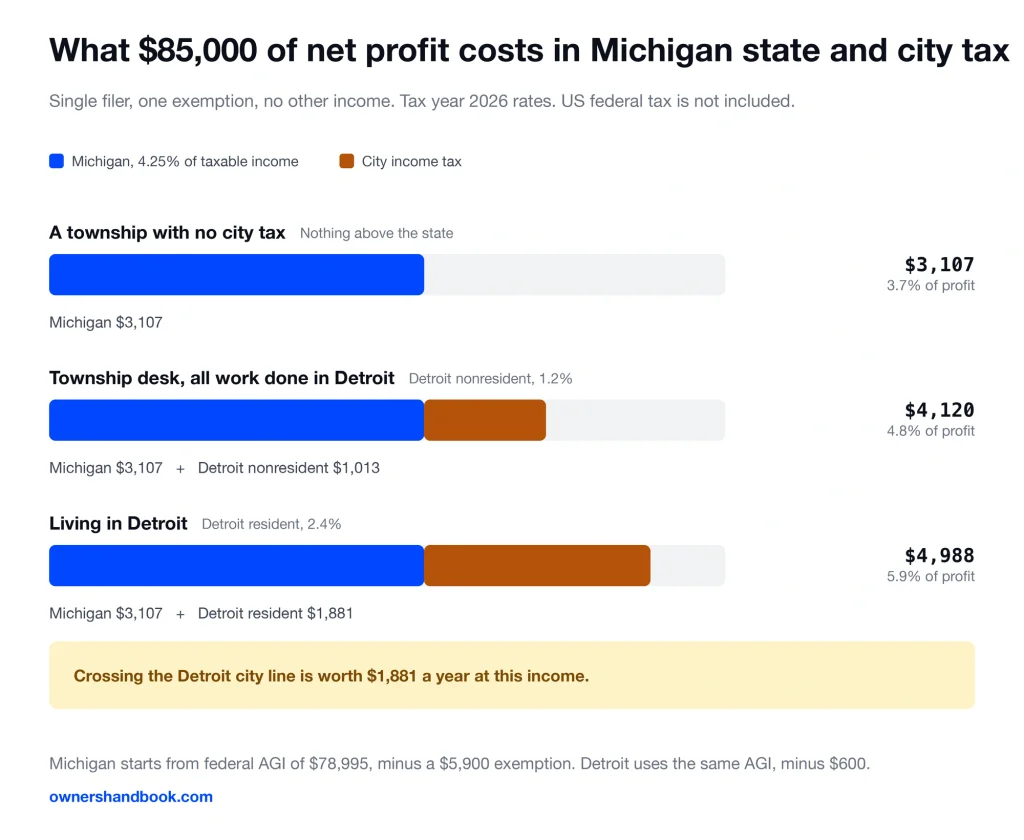
Inside Detroit, add 2.4% on top. On $85,000 of net profit that comes to $4,988 in combined Michigan state and city tax, against $3,107 for the same freelancer in a township. All of it sits above United States federal tax.
One flat rate, and what it lands on
Michigan has no brackets. One rate applies to every dollar of taxable income, whether you cleared $12,000 or $250,000.
That rate moved once recently, which is why older articles disagree. It was 4.05% for tax year 2023, went back to 4.25% for 2024, and stays at 4.25% for 2026.
Your MI-1040 opens at line 10 with adjusted gross income copied straight off your federal Form 1040. Your Schedule C profit is already folded into that number.
Michigan then subtracts a personal exemption — a flat per-person allowance, $5,900 for 2026 — and multiplies the remainder by 4.25%.
There is no Michigan standard deduction for a working-age filer. The exemption is the whole of it.
Two dozen cities run a second income tax
Treasury’s own count is twenty-four Michigan cities levying taxes related to income. Detroit is one. The other twenty-three administer their own forms, filings and payments.
Albion, Battle Creek, Benton Harbor, Big Rapids, East Lansing, Flint, Grand Rapids, Grayling, Hamtramck, Highland Park, Hudson, Ionia, Jackson, Lansing, Lapeer, Muskegon, Muskegon Heights, Pontiac, Port Huron, Portland, Saginaw, Springfield, Walker.
The common pair is 1% on a resident’s income and 0.5% on a nonresident’s. A handful of cities sit higher, and Detroit sits highest of all.
| City | Resident rate | Nonresident rate |
|---|---|---|
| Detroit | 2.4% | 1.2% |
| Highland Park | 2.0% | 1.0% |
| Grand Rapids | 1.5% | 0.75% |
| Saginaw | 1.5% | 0.75% |
| East Lansing | 1.0% | 0.5% |
Every other Michigan municipality — townships, villages, the suburbs where most of the state actually lives — charges nothing. There is no county income tax anywhere in Michigan.
Where the work happens decides who taxes it
City income tax is not billed to your mailing address. It follows the work.
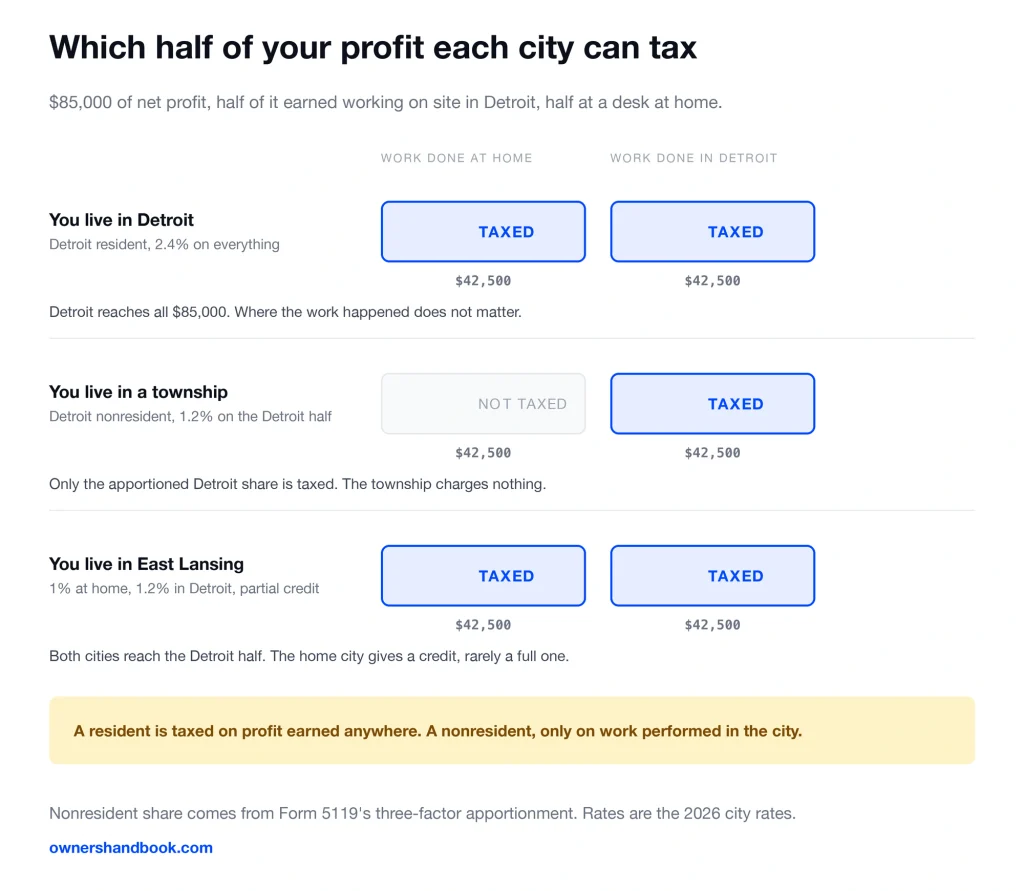
A resident owes tax on net profit from a business “regardless of where earned,” in Grand Rapids’ phrasing. Live in the city and everything you invoice is in scope, including the client three states away.
A nonresident owes tax only on profit from business activity conducted inside the city. Detroit’s instructions extend that to 1099 income when the work occurred inside city limits.
For a home-based freelancer those two rules collapse into one question: which municipality is your desk in.
For anyone who works on site — a photographer shooting downtown, a consultant embedded at a client’s office — they do not collapse. You can owe two cities.
When your profit is split, you apportion it
Apportionment is the arithmetic that decides how much of one business’s profit belongs to one city.
Detroit’s nonresident return, Form 5119, uses a three-factor formula. Property inside the city over property everywhere, payroll inside over payroll everywhere, revenue from services rendered inside over revenue everywhere.
Average those three percentages, apply the result to your Schedule C net profit, and that is your Detroit number.
A solo freelancer with no property and no employees is left with the revenue factor alone. The form handles that: divide by however many factors have a value above zero.
If every hour of the business happens inside the city, the percentage is 100 and there is nothing to apportion.
$85,000 in Detroit against $85,000 in a township
Take a single freelancer, one exemption, $85,000 of net profit and no other income.
Half of self-employment tax is deductible on the federal return, so federal adjusted gross income lands at $78,995. Both Michigan and Detroit start from that figure.
Michigan takes $78,995 less the $5,900 exemption, times 4.25%. That is $3,107, and it is the same in Detroit as it is in Kalamazoo Township.
Detroit takes $78,995 less a $600 exemption, times 2.4%. That is $1,881 more.
| Where the desk is | Michigan | City | Total | Share of $85,000 profit |
|---|---|---|---|---|
| Township, no city tax | $3,107 | — | $3,107 | 3.7% |
| Township, all work done in Detroit | $3,107 | $1,013 | $4,120 | 4.8% |
| Detroit resident | $3,107 | $1,881 | $4,988 | 5.9% |
The middle row is the nonresident case: $85,000 apportioned fully to Detroit, less the $600 exemption, at 1.2%.
Moving across the city line is worth $1,881 a year at this income. That is the entire Michigan city tax story in one number.
Two returns, and two sets of quarterly dates
Michigan wants estimated payments if you expect to owe more than $500 when you file. The vouchers are Form MI-1040ES.
The state’s four dates copy the federal ones exactly: April 15, June 15 and September 15 of 2026, then January 15, 2027.
Detroit’s threshold is lower. Form 5123 is required once you expect to owe more than $100, and it applies to residents and nonresidents alike.
Detroit’s four dates happen to match the state’s. Other cities pick their own, and that is where people get caught.
Grand Rapids wants its estimates on April 30, June 30, September 30 and January 31. Roughly two weeks later than the state’s, every quarter.
Annual returns drift too. Detroit’s is due April 15. Grand Rapids, Saginaw and East Lansing all say April 30.
Whichever city you are in, one calendar reminder will not cover both layers. The general guide to quarterly estimated taxes covers the federal schedule these sit on top of.
If you live in one city and work in another
Say you live in East Lansing and spend half your billable hours at a client’s office in Detroit.
East Lansing taxes all of your profit at 1%, because you live there. Detroit taxes the apportioned half at 1.2%, because the work happened there.
Your home city then gives you a credit for tax paid to the other one. Detroit’s return caps that credit at what a Detroit nonresident would have owed on the same income, and Highland Park’s does the same.
So the credit rarely erases the second bill. A city with a 1% resident rate crediting only at its own 0.5% nonresident rate leaves you paying the difference.
Two returns, two account numbers, two sets of estimates. Nobody sends you a notice about the second one.
What Michigan does not charge you
There is no state self-employment tax in Michigan, and no city version either. Social Security and Medicare are federal, and Schedule SE goes to the IRS alone.
Michigan’s local income tax exists only at the city level. No county levies one, so the two layers above are the whole of it.
One change is coming. Treasury takes over processing Flint’s individual returns on January 1, 2027, covering tax year 2026 and forward, the way it already handles Detroit’s.
If you are in one of the cities that still administers its own tax, call its income tax office in your first year and open an account. Doing it early costs an afternoon.
The general state tax guide explains how much to set aside. This page tells you who else is holding out a hand.
Frequently asked questions
I work from home in a township outside Detroit but all my clients are in the city. Do I owe Detroit?
Generally no. Detroit’s nonresident rules reach business activity conducted inside the city, not the location of your clients. Where you physically performed the work is what the apportionment formula measures.
Does the 4.25% replace federal tax?
No. It is Michigan state tax charged on top of federal income tax and the 15.3% federal self-employment tax. The city tax is a third layer on top of that.
Do I have to file a city return if I only owe a few dollars?
Usually yes. Detroit’s nonresident instructions say no tax is due when taxable income falls under $600, but the filing threshold and the payment threshold are separate questions. Ask the city.
How do I pay Detroit’s estimates?
Through Michigan Treasury, not the city. Detroit individual returns and payments have been processed by the state since tax year 2015, at michigan.gov/citytax. Everything about how to pay estimated taxes federally applies here in parallel.
Does an LLC change any of this?
Not by itself. A single-member LLC still files Schedule C, still flows into your MI-1040 at 4.25%, and still owes city tax on the same apportioned profit.
What happens if I ignore the city tax for a few years?
The city bills you for it later with penalty and interest. Detroit’s estimate penalty is 1% a month on the unpaid balance up to 25% of the tax, plus interest at 1% above the adjusted prime rate.
Sources
Michigan Department of Treasury, Withholding Tax Information by Calendar Year
https://www.michigan.gov/taxes/business-taxes/withholding/calendar-year-tax-information
Michigan Department of Treasury, Tax Year 2025 Information
https://www.michigan.gov/taxes/iit/tax-guidance/tax-year-info/tax-year-2025-guidance
Michigan Department of Treasury, 2026 MI-1040ES Estimated Income Tax for Individuals
https://www.michigan.gov/taxes/-/media/Project/Websites/taxes/Forms/IIT/TY2025/MI-1040ES-(2026).pdf
Michigan Department of Treasury, 2025 MI-1040 Individual Income Tax Return
https://www.michigan.gov/taxes/-/media/Project/Websites/taxes/Forms/IIT/TY2025/MI-1040.pdf
Michigan Department of Treasury, Which Cities Impose an Income Tax?
https://www.michigan.gov/taxes/citytax/what-cities-impose-an-income-tax
Michigan Department of Treasury, City Tax
https://www.michigan.gov/taxes/citytax
Michigan Department of Treasury, 2026 City Estimated Income Tax for Individuals, Form 5123
https://www.michigan.gov/taxes/-/media/Project/Websites/taxes/Forms/City-IIT/TY2026/5123_2026.pdf
Michigan Department of Treasury, City of Detroit Resident Income Tax Return, Form 5118
https://www.michigan.gov/taxes/-/media/Project/Websites/taxes/Forms/City-IIT/TY2025/5118.pdf
Michigan Department of Treasury, Form 5119 Instructions, City of Detroit Nonresident Income Tax Return
https://www.michigan.gov/taxes/-/media/Project/Websites/taxes/Forms/City-IIT/TY2025/5119-Instr.pdf
Michigan Department of Treasury, City of Detroit Individual Income Tax
https://www.michigan.gov/taxes/citytax/detroit/individual
City of Grand Rapids, Income Tax Guide for Individuals
City of Saginaw, Income Tax
https://www.saginaw-mi.com/416/Income-Tax
City of East Lansing, Income Tax
https://www.cityofeastlansing.com/1812/Income-Tax
City of Highland Park, HP-1040ES Estimated Payment Instructions