How to File Your Own Freelance Taxes, Step by Step
Reconcile your gross receipts against your 1099s before you open any software. Then go in this order: business profile, income, expenses, the four things the interview handles badly, and a verification pass. The four are home office, vehicle, health insurance, retirement.
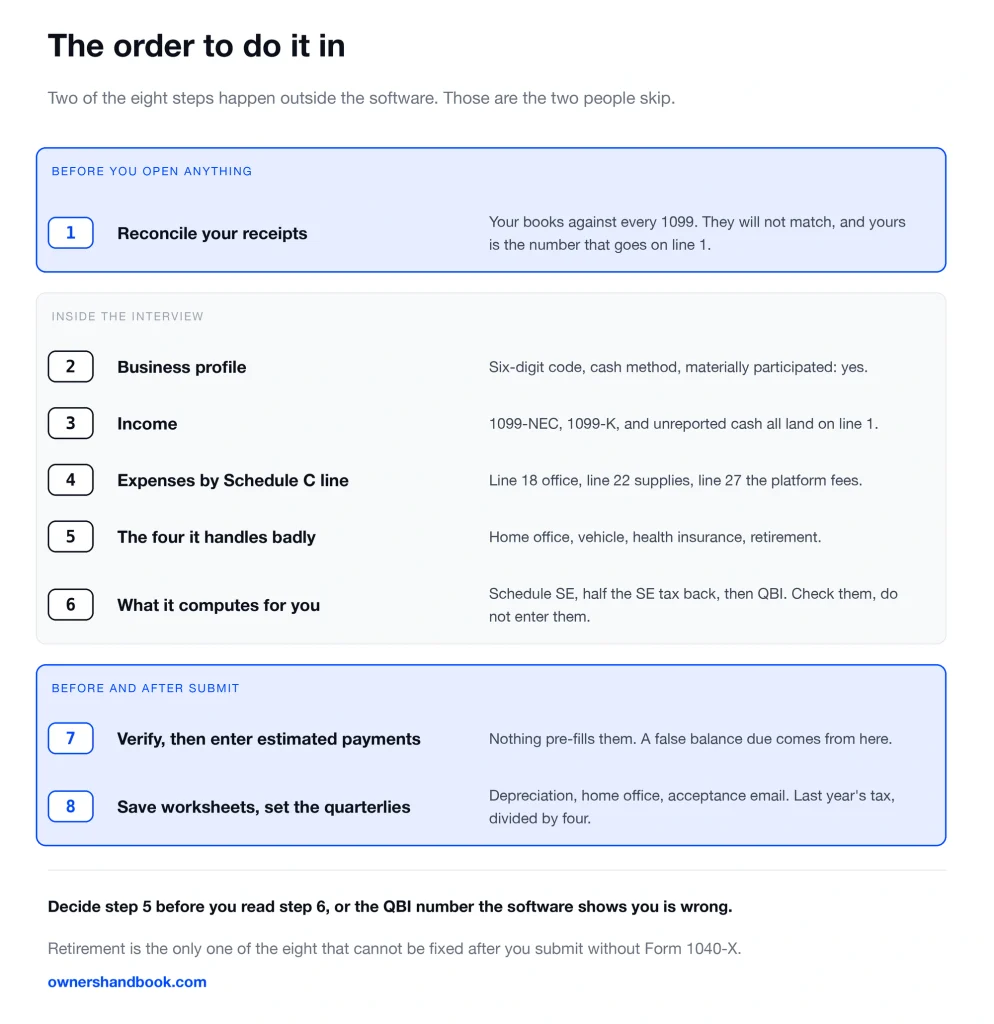
Your own number comes first, and no software will ask for it
Total what clients actually paid you during 2026. Gross receipts, meaning every dollar in before platform fees or refunds came out. Then add up the 1099s and compare.
They will not match. A client who paid you $1,800 sends nothing, because the 1099-NEC floor for 2026 payments is $2,000, and a platform files a 1099-K only above $20,000 and 200 transactions.
So books of $94,000 against forms totaling $71,000 is an ordinary year. You report $94,000, because the forms are a partial copy and your records are the source.
One timing trap. Cash-method income is what you constructively received, meaning made available without restriction, so a December 30 payout sitting in your Stripe balance is 2026 income.
If you change your mind and hire someone, what to give your CPA starts with this number.
The profile screen decides more than it looks like
Business code is a six-digit number from the chart at the end of the Schedule C instructions. 541400 for specialized design, 541510 for computer systems design, 711510 for independent artists and writers.
It changes nothing about your tax. It sorts your return into a statistical class, so pick the closest match.
Accounting method is cash. Income counts when you receive it, expenses when you pay them. Accrual is required only if you hold inventory and are not a small business taxpayer.
Did you materially participate. Yes. The first of the seven IRS tests is more than 500 hours in the activity during the year, and freelancing clears it by March.
Answering no labels the activity passive, which caps any loss you could claim. People check it wrong because the phrase sounds like it belongs on somebody else’s return.
Three kinds of income, one line
1099-NEC, 1099-K, and money nobody reported all land on Schedule C line 1. The software puts them on separate screens, which makes them feel like separate kinds of income.
Enter each 1099 digit for digit, payer identification number included. The IRS holds a copy of every one and matches on that number.
Then find the screen for income not reported on a form. It is usually labeled other self-employed income and often collapsed behind a link.
That is where your reconciliation lands. Books of $94,000 against entered forms of $71,000 means $23,000 goes there, and line 1 comes out right.
Expenses, in the form’s own words
The interview offers its own category names. Each maps to a numbered Schedule C line, and three of the labels mislead people every year.
Office expense is line 18: software subscriptions, postage, small recurring items. It is not your home office, which is line 30 and has a separate screen entirely.
Supplies is line 22, meaning things consumed doing the work. Your laptop is not supplies. At $2,500 or less it goes in Part V as other expenses, under the de minimis safe harbor. Above that it is line 13, depreciation and Section 179.
Other expenses is line 27, where platform fees, payment processing, bank charges, and professional dues go, each written out under a name you choose.
That is the most valuable blank space on the form. On $94,000 of receipts at 2.9%, processing fees alone run about $2,700, and nothing prompts you for them.
When you are unsure, the line-by-line map of Schedule C settles it faster than the interview will.
The two the software offers you badly
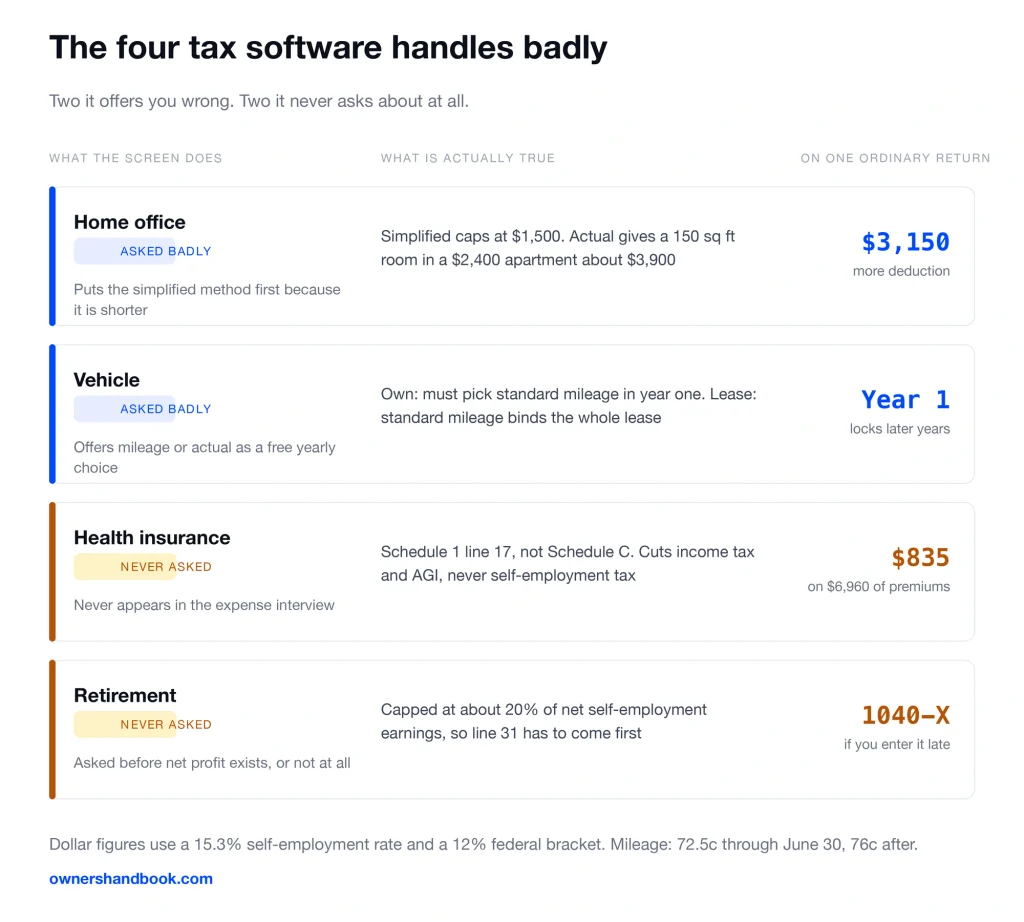
Home office first. The screen offers the simplified method at the top because it is shorter, not because it produces a bigger number.
Simplified is $5 a square foot capped at 300 square feet, so $1,500 is the ceiling. Actual takes what the home cost to run and gives you the business share.
A 150 square foot room is $750 simplified. The same room in a 1,200 square foot apartment renting at $2,400 a month is 12.5% of $28,800, plus that share of utilities, roughly $3,900.
That $3,150 gap is worth about $1,000 once self-employment tax and a 12% bracket come off it. Renters with a dedicated room lose most by taking the first option.
Vehicle second. It asks for total and business miles, then offers standard mileage or actual expenses as though the choice were free every year.
It is not. For a car you own, the IRS requires you to choose the standard mileage rate in the first year the car is available for business use to have the option at all.
For a leased car, year one binds the rest: choose the standard mileage rate and you must use it for the entire lease period, including renewals.
One thing the screen will not flag: the 2026 mileage rate changed mid-year, 72.5 cents through June 30 and 76 cents from July 1, so one annual figure gives the wrong answer.
The two it never asks about
Neither is a Schedule C expense, which is why the expense interview skips them and why people finish an otherwise correct return without either.
Health insurance is the first. Premiums go on Schedule 1, line 17, as the self-employed health insurance deduction, never into Part II of Schedule C.
The placement cuts both ways. It lowers income tax and adjusted gross income but not self-employment tax, and it is disallowed for any month you were eligible for a subsidized employer plan, yours or a spouse’s.
Premiums of $580 a month are $6,960 a year, about $835 of income tax at a 12% rate. Software files the question under a heading like less common deductions.
Retirement is the second, and it generates the amended returns. The contribution is capped off net profit, roughly 20% of net self-employment earnings for the employer piece, so the number does not exist until Schedule C is done.
A SEP IRA can be opened and funded as late as your return’s due date including extensions. A first-year Solo 401(k) must be adopted by the filing deadline without extensions.
So the order matters. Finish expenses, read line 31, decide the contribution, then enter it. Deciding a week after you submit means Form 1040-X.
Three things it computes without you
Once line 31 exists, three calculations run on their own. You enter nothing, but look at all three.
Schedule SE multiplies your profit by 92.35% and charges 15.3%. On $61,000 of profit that is self-employment tax of $8,619.
Then half comes back. The deductible part of self-employment tax appears on Schedule 1, line 15, about $4,310 here, and it lowers income tax rather than the self-employment tax itself.
The QBI deduction runs last. Up to 20% of qualified business income comes off before tax is figured, on Form 8995 if taxable income is under $201,750 single or $403,500 joint.
Sanity-check it by what it is not. The QBI deduction is not 20% of line 31, because profit is first reduced by the half-SE-tax deduction, health insurance, and the retirement contribution.
A QBI figure that looks too generous usually means one of those three was not entered yet.
The verification pass before you submit
| What to check | Where it comes from | What wrong looks like |
|---|---|---|
| Schedule C line 1 | Your own books, not the 1099 total | Smaller than the forms the IRS is holding |
| Schedule C line 31 | Line 7, minus Part II, minus line 30 | A profit you do not recognize |
| Estimated payments | IRS Online Account payment history | A balance due equal to what you already sent |
| Schedule 1, line 17 | Premiums you actually paid | Blank, when you bought your own coverage |
| Schedule 1, line 16 | The retirement contribution | Blank, or entered after you filed |
| Routing and account number | The check, read twice | A refund sent to a closed account |
Estimated payments are the most common omission on a self-prepared return, and the damage is a balance due that is not real.
Nothing pre-fills them. You sent $2,000 four times through Direct Pay and the software cannot know, so it shows $8,000 owed on money already gone.
Your IRS Online Account lists every payment with its date and amount. Copy from that screen, not memory, which is also how to pay estimated taxes without losing track of them.
What it costs, and where to stop
| Option | Federal | State | Self-employment income |
|---|---|---|---|
| IRS Free File guided software | $0 at $89,000 AGI or less | Varies by partner | Yes, but each offer sets its own rules |
| Free File Fillable Forms | $0, any income | Not offered | Yes, with no interview at all |
| Cash App Taxes | $0 | $0, one state only | Yes |
| FreeTaxUSA | $0 | $15.99 | Yes |
| TurboTax Premium | $139 | Charged separately | Yes |
IRS Free File guided software is free at $89,000 of adjusted gross income or less. A Schedule C does not disqualify you, though partner offers add their own limits.
Cash App Taxes needs a word, because the name sounds like a payments app and tells you nothing about the product. It was Credit Karma Tax until 2021, when the Justice Department made Intuit sell it as a condition of buying Credit Karma — the point of the order was to keep a free competitor to TurboTax alive. Block, which also owns Square and Cash App, bought it. Its own page states it is an Authorized IRS e-file provider, and it supports the whole freelance core: Schedule C, Schedule SE, depreciation, home office and the QBI deduction.
Three limits decide it. You have to install the Cash App mobile app and create an account to log in, though the filing itself then works in a browser. It will not file more than one state, a part-year state return, or a non-resident return — so if you moved during the year, or you owe a return in a state you do not live in, it is not an option at any price. And it does not support Form 2210, the underpayment of estimated tax form, which is what you need if you missed a quarterly payment. The IRS will calculate that penalty and bill you instead, so it is an inconvenience rather than a blocker.
Its form lists were last updated in January 2025 for tax year 2024, so check them against the season you are filing.
IRS Direct File is the option to stop planning around. Checked September 14, 2026: the IRS Direct File pages returned 404, the Direct File site did not resolve, and the IRS Free File page did not mention it anywhere.
Stop and get help at three points, all recognizable mid-return. A second state. A letter from the IRS. Anything you have now entered three ways to see which number looks better.
That last one is the signal that you stopped entering data and started making a judgment, which is what the tax software or a CPA decision was really about.
After you submit, save four things: the acceptance confirmation, the return PDF, the depreciation schedule, and the home office worksheet. Next year’s software reads from all four.
Find total tax on your 1040 and divide by four. That is the safe harbor for next year’s quarterly estimated taxes, or 110% of it if your AGI was over $150,000, or $75,000 married filing separately. The four dates go in your calendar now.
Frequently asked questions
Can I file a Schedule C with free software?
Yes. Free File guided software is free at $89,000 of adjusted gross income or less, Free File Fillable Forms has no income limit, and Cash App Taxes and FreeTaxUSA file federal at $0.
My 1099s add up to less than my income total. Which number do I enter?
Your own. Anyone who paid you under $2,000 in 2026 issued nothing, so the forms usually total less. Enter the difference on the screen for unreported income.
Does IRS Direct File handle self-employment income?
Checked September 14, 2026: the IRS Direct File pages returned 404, directfile.irs.gov did not resolve, and the IRS Free File page made no mention of it. Plan on a Free File partner or commercial software.
I filed and then made a retirement contribution. Can I still deduct it?
Only by amending, on Form 1040-X. A SEP IRA can be funded as late as the return due date including extensions, but the deduction has to be on the return.
Should I use the simplified home office method because it is offered first?
Only if it wins. It is capped at $1,500, while a 150 square foot room in a $2,400-a-month apartment runs about $3,900 under the actual method.
The software says I owe money I already paid. What happened?
You almost certainly did not enter your estimated payments, and nothing reports them to the software. Pull the dates and amounts from your IRS Online Account.
Software prices were read off the vendors’ own pages in September 2026 and change every filing season. The IRS figures are for the 2026 filing season. Check both before you rely on them.
Sources
IRS, Instructions for Schedule C (Form 1040)
https://www.irs.gov/instructions/i1040sc
IRS, About Schedule C (Form 1040)
https://www.irs.gov/forms-pubs/about-schedule-c-form-1040
IRS, Topic No. 510, Business use of car
https://www.irs.gov/taxtopics/tc510
IRS, Standard Mileage Rates
https://www.irs.gov/tax-professionals/standard-mileage-rates
IRS, Simplified Option for Home Office Deduction
IRS, Instructions for Form 8829
https://www.irs.gov/instructions/i8829
IRS, Self-Employment Tax
IRS, Qualified Business Income Deduction
https://www.irs.gov/newsroom/qualified-business-income-deduction
IRS, About Schedule 1 (Form 1040)
https://www.irs.gov/forms-pubs/about-schedule-1-form-1040
IRS, Retirement Plans for Self-Employed People
https://www.irs.gov/retirement-plans/retirement-plans-for-self-employed-people
IRS, Instructions for Forms 1099-MISC and 1099-NEC
https://www.irs.gov/instructions/i1099mec
IRS, Understanding Your Form 1099-K
https://www.irs.gov/businesses/understanding-your-form-1099-k
IRS, Free File: Do Your Taxes for Free
https://www.irs.gov/filing/irs-free-file-do-your-taxes-for-free
IRS, Your Online Account
https://www.irs.gov/payments/online-account
IRS, About Form 1040-X, Amended U.S. Individual Income Tax Return
https://www.irs.gov/forms-pubs/about-form-1040x
TurboTax, Premium online pricing
https://turbotax.intuit.com/personal-taxes/online/premium
FreeTaxUSA, Pricing
https://www.freetaxusa.com/pricing
Cash App Taxes