Invoice Late Fee Calculator: Four Ways to Count the Same Clause
Most late fee calculators give you one number. The problem is that the clause on your invoice supports four, and the gap between them on a $4,000 invoice is thirty-five percent. This one shows all four, so you can see which reading your contract is actually claiming.
Invoice late fee calculator
The same “1.5% per month” clause produces four different numbers. This shows all four.
The unpaid balance the fee applies to.
Counted from the day payment was due, not the invoice date.
Enter 1.5 for 1.5% a month.
Days after the due date before the fee begins.
If your contract does not say, this is the first thing a client will dispute.
| Invoice | $0 |
| Days the fee actually runs | 0 |
| Total now due | $0 |
The same clause, counted four ways
| Simple daily interest — annual rate ÷ 365, times days | $0 |
| Prorated monthly — a month and a fraction | $0 |
| Per month or part of a month — day 31 is a whole second month | $0 |
| Compounded monthly — the fee earns the fee | $0 |
Runs entirely in your browser — nothing you type is sent anywhere or stored.
This calculator is for informational purposes only and does not constitute legal advice.
Whether a late fee is enforceable depends on your contract and on your state’s law, including
its usury ceiling and the rule against penalty clauses. A rate that is lawful in one state may not be
in another, and a fee a court reads as a penalty rather than an estimate of real loss can void the whole
clause. Consult a lawyer licensed in your state before relying on a figure here.
Below: where the four numbers come from, and the two rules that can void the whole clause.
One sentence, four answers
“1.5% per month on overdue balances” is the line almost everyone copies. It does not say how to count a partial month, and that omission is where the arithmetic splits.
Take a $4,000 invoice, 45 days late.
| Reading | 45 days on $4,000 |
|---|---|
| Simple daily interest | $88.77 |
| Prorated monthly | $90.00 |
| Per month or part of a month | $120.00 |
| Compounded monthly | $90.34 |
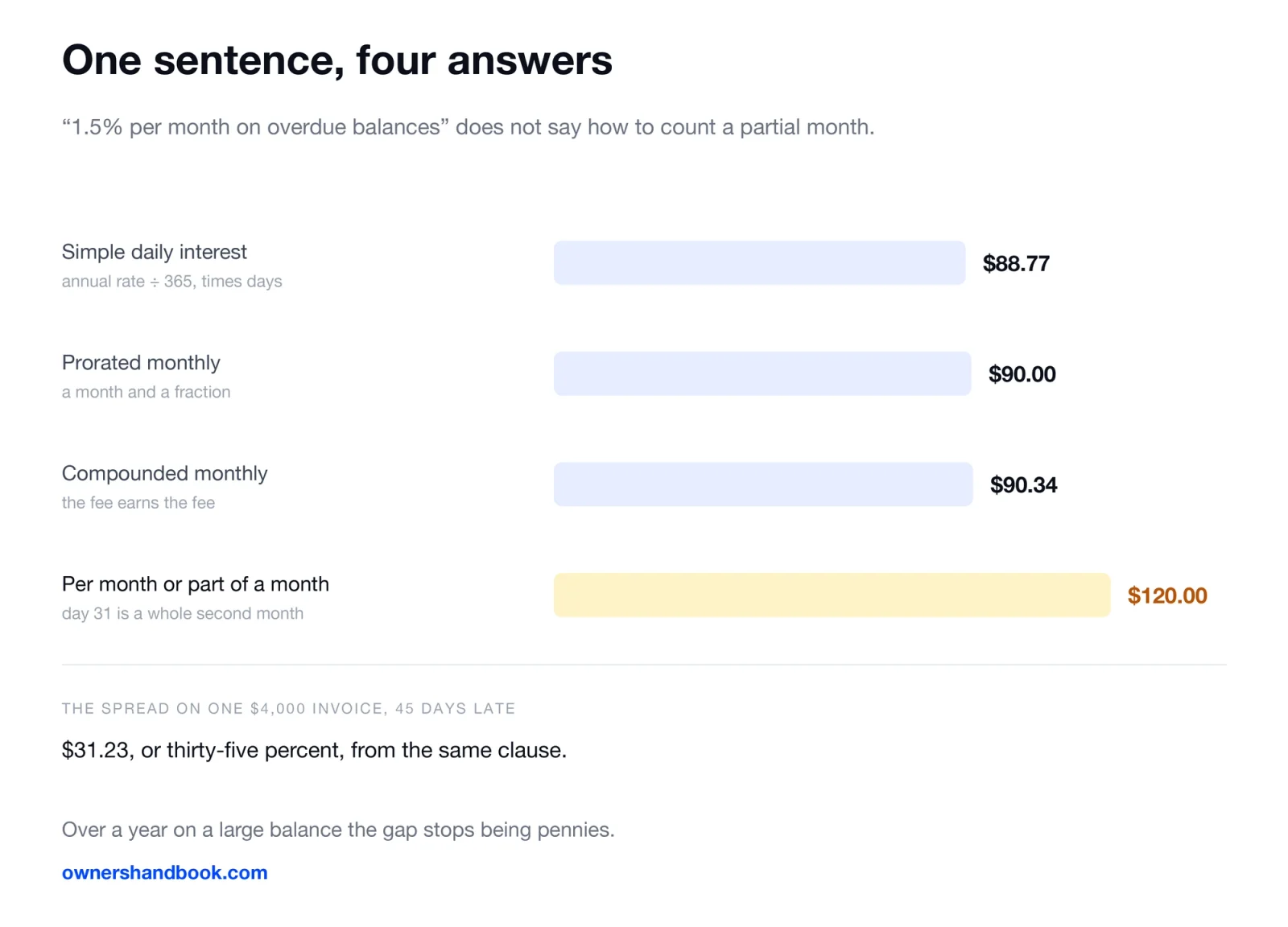
Simple daily interest treats 18% a year as $1.97 a day and bills 45 of them. Prorating the monthly rate gives you a month and a half of $60. “Per month or part of a month” counts day 31 as a whole second month, which is where the $120 comes from — thirty-five percent more than the first reading, from the same sentence.
Compounding is the fourth question the clause usually leaves open. 1.5% charged on a balance that already includes last month’s fee is 19.56% a year, not 18%.
Over 45 days the spread is pennies. Over a year on a large balance it is not — the same $4,000 runs $720 or $794 depending on which one you meant.
Pick one and write it down
A client who reads the invoice and disputes the arithmetic has just found a reason to delay another two weeks. That delay costs more than the fee.
| What the clause must say | What it settles |
|---|---|
| The rate, in words and as an annual figure | “1.5% per month (18% per year)” removes the first thing a client disputes |
| When it starts | Day one, or after a grace period. Silence means the client assumes the later one |
| How a partial month counts | The difference between billing $90 and billing $120 on the same invoice |
| Whether it compounds | Simple, or on the running balance |
Our guide to late payment fees goes through the wording line by line.
The fee has to exist before the work does
This is the part that catches people who add a fee to an invoice after it goes unpaid.
A late fee is a contract term. It binds the client if they agreed to it before the work started — in a signed agreement, in accepted terms, in a proposal they approved. It does not bind them because it appeared on an invoice after the fact.
Adding one retroactively is not enforceable, and it hands a client who was already slow a reason to argue rather than pay.
Two ceilings that can void the clause
An 18% clause is not automatically safe just because you wrote it.
Usury. Every state sets a legal maximum on interest. New York sets its general limit at 16% a year for loans and forbearances of money, under Banking Law 14-a. Whether an unpaid service invoice counts as a forbearance is fact-specific — but 18% sits above that line, and that is worth knowing before you print it on a contract.
The penalty rule. This one applies everywhere. Courts enforce a clause that is a genuine advance estimate of a real loss. They strike one that exists to punish. A fee you can explain as the cost of being unpaid survives. A fee that looks designed to hurt gets thrown out in full — and then you fall back to your state’s default rate, which is usually lower than what you wrote.
State caps vary enough that a national number would be useless. Look up your own, and if you work across state lines, look up the one named in your contract’s governing-law clause.
What the law gives you when the contract says nothing
If you never wrote a late fee clause, you are not at zero. You are at your state’s statutory rate, which is lower and starts later.
| What governs the rate | Rate | 45 days on $4,000 |
|---|---|---|
| Your contract, 1.5% per month | 18% a year | $88.77 |
| California, contract silent | 10% after breach | $49.32 |
| New York, contract silent | 9% prejudgment | $44.38 |
| Texas, contract silent | 6%, starting day 30 | $9.86 |
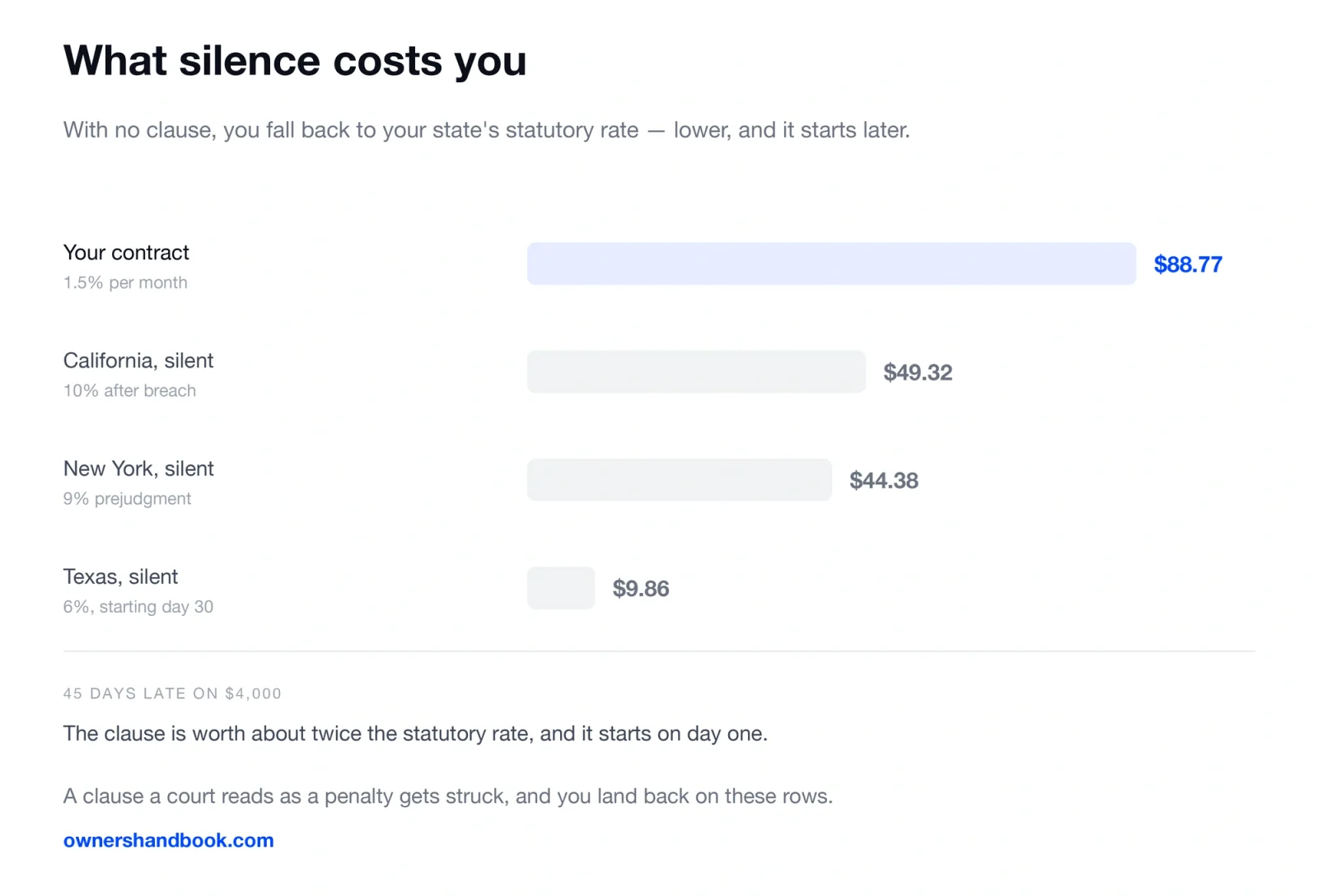
The contract rate is worth roughly twice the statutory one, and it starts on day one instead of after a waiting period. That is the argument for having the clause at all.
Why the fee rarely collects
Worth saying plainly, because it changes what you should spend effort on.
On a $4,000 invoice 45 days late, the fee is somewhere between $89 and $120. That is not what gets you paid. What gets you paid is that the invoice is unambiguous, that a named person received it, and that the next step after silence is already written down.
The fee’s real job is to make delay visible. It puts a growing number on the invoice, which gives the client’s accounts payable a reason to move you up the queue. Treat it as a signal, not as revenue.
If a client has stopped responding entirely, our guide on what to do when a client will not pay covers the sequence that actually works.
Frequently asked questions
Is 1.5% per month legal everywhere?
No. It works out to 18% a year, which is above the general usury ceiling in some states — New York’s is 16% under Banking Law 14-a. Whether that ceiling applies to an unpaid service invoice rather than a loan is fact-specific, which is exactly why it is worth checking your own state before printing the number.
Can I add a late fee to an invoice that is already overdue?
Not enforceably. The fee has to have been agreed before the work, in a contract or accepted terms. Adding it afterward gives a slow client something to argue about instead of something to pay.
Should the fee compound?
Usually not, and if it does, say so. 1.5% compounded monthly is 19.56% a year rather than 18%, which pushes you further above state ceilings for no meaningful gain on a normal invoice.
What if my contract does not mention late fees at all?
Your state’s statutory interest rate applies, typically between 6% and 10% and often starting only after a waiting period. Lower than a contract rate, but not nothing.
Does charging a late fee hurt the relationship?
Waiving it is a decision you can make once the invoice is paid. Having the clause and choosing not to enforce it costs nothing. Not having it means you have no lever at all.
Do I have to charge the fee every time?
No. The clause gives you the right, not the obligation. Many freelancers keep it in the contract, mention it once in a follow-up, and waive it when the invoice clears.
Sources
New York Banking Law section 14-a, maximum rate of interest
https://www.nysenate.gov/legislation/laws/BNK/14-A
California Civil Code section 3289, interest on breach of contract
https://leginfo.legislature.ca.gov/faces/codes_displaySection.xhtml?lawCode=CIV§ionNum=3289
New York Civil Practice Law and Rules section 5004, rate of interest
https://www.nysenate.gov/legislation/laws/CVP/5004
Texas Finance Code section 302.002, accrual of interest when no rate specified
https://statutes.capitol.texas.gov/Docs/FI/htm/FI.302.htm
U.S. Small Business Administration, How Net 30 accounts help conserve business cash flow
https://www.sba.gov/blog/how-net-30-accounts-help-conserve-business-cash-flow