Getting a Mortgage When You Are Self-Employed
A lender does not care what you invoiced. It cares what was left after your deductions — the net profit on line 31 of your Schedule C — and it averages that over two years. Which means the year you worked hardest to pay less tax is the year that qualifies you for the smallest mortgage.
Almost nobody says this out loud, because almost everybody writing about self-employed mortgages is selling one. Here is the trade-off, the arithmetic behind it, and the parts of your return a lender will quietly give back to you.
Revenue is not income, and net profit is
Schedule C works down from gross receipts to a single figure on line 31, “Net profit or (loss)”. That figure flows to Schedule 1 of your Form 1040, and it is the number a lender starts from.
Fannie Mae’s Selling Guide is explicit that the analysis begins there: the lender takes the net profit or loss shown on Schedule C and adjusts it to arrive at cash flow. Not gross receipts. Not the deposits in your bank account.
You are also treated as self-employed at a lower bar than most people assume:
Any individual who has a 25% or greater ownership interest in a business is considered to be self-employed.
A quarter of a side business does it, even if most of your income is a W-2 salary. Our walkthrough of what each part of Schedule C actually does maps the form line by line.
Why two years, and what happens when year two is lower
Fannie Mae states the reason plainly:
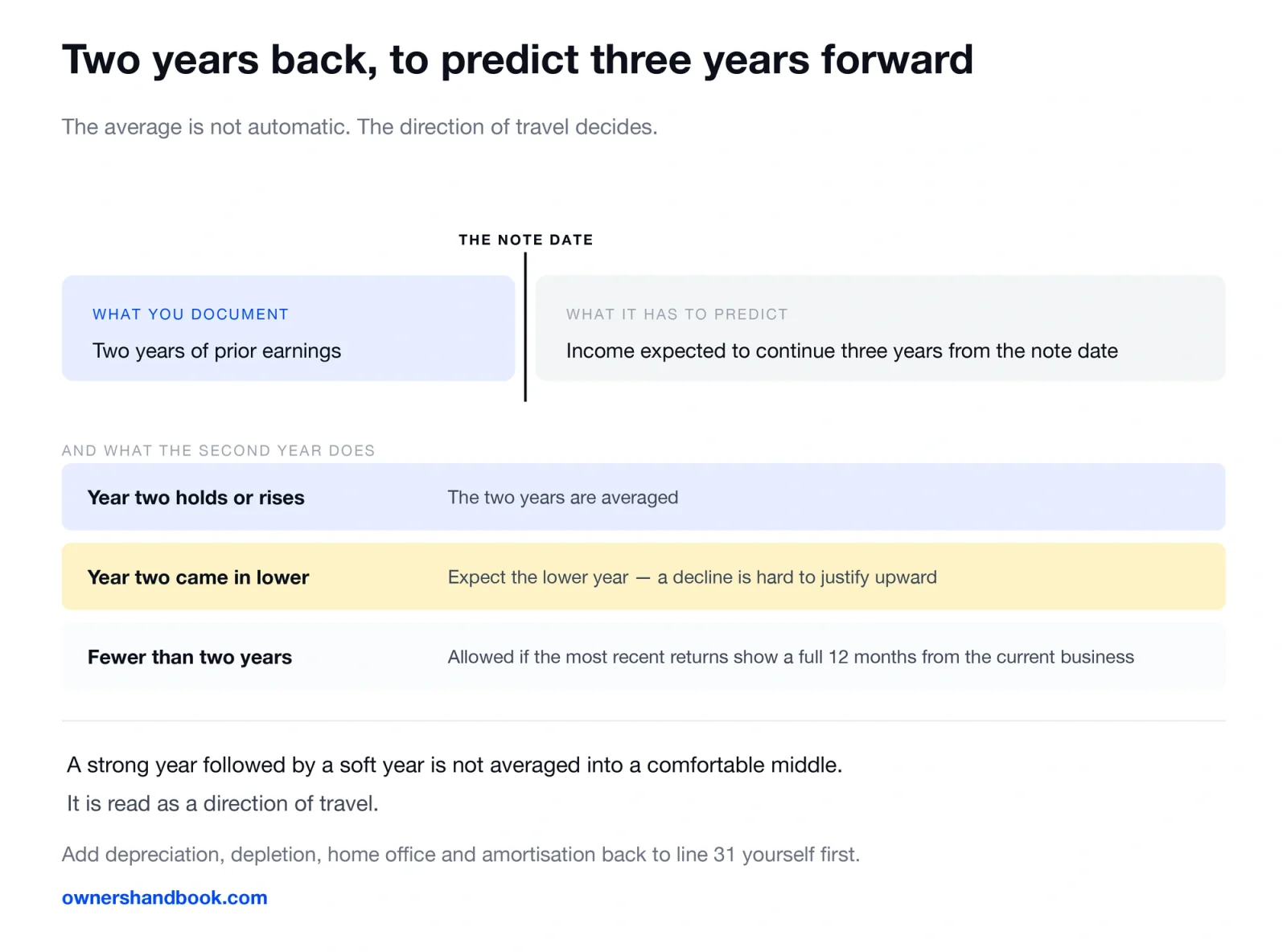
Fannie Mae generally requires lenders to obtain a two-year history of the borrower’s prior earnings as a means of demonstrating the likelihood that the income will continue to be received.
The guide elsewhere frames the test as whether the income can reasonably be expected to continue for at least three years from the note date. Two years back is used to predict three years forward.
There is a documented exception for a shorter history:
However, the income of a person who has less than a two-year history of self-employment may be considered, as long as the borrower’s most recent signed personal and business federal income tax returns reflect a full year (12 months) of self-employment income from the current business.
Freddie Mac takes a similar line, but allows a combined two-year history made up of the current self-employment and the job that preceded it — the route for someone who left a salaried role for the same kind of work.
Now the part that catches people. Two years are averaged when the trend supports it. If year two came in lower than year one, Freddie Mac requires the lender to analyse the decrease and justify that the income is stable and likely to continue — which a declining trend rarely survives. Expect the lower year to be used, or the income to be questioned entirely.
A strong year followed by a soft year is not averaged into a comfortable middle. It is read as a direction of travel.
The trade-off nobody puts in writing
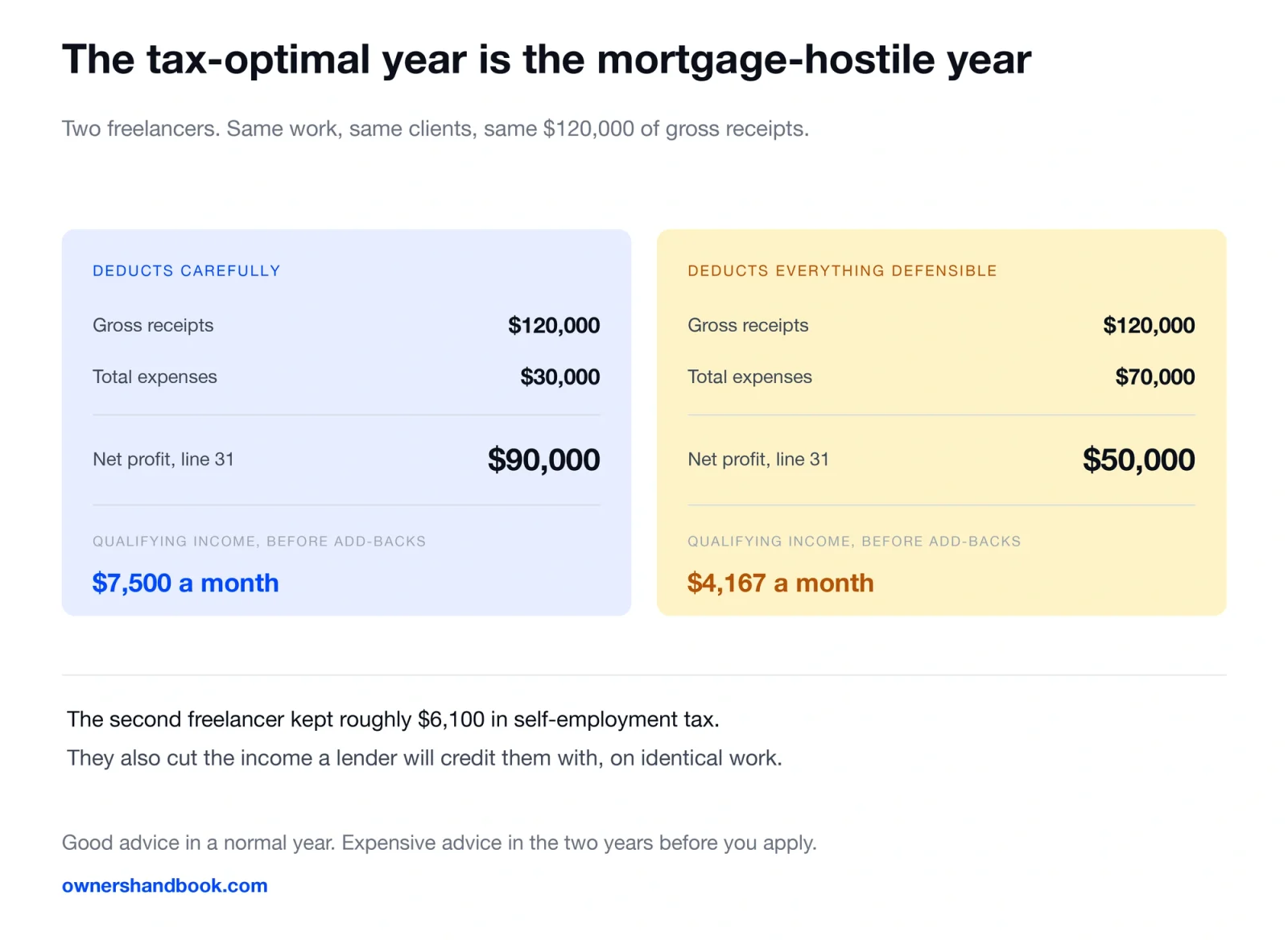
Two freelancers. Same work, same clients, same $120,000 of gross receipts. One deducts carefully. One deducts everything defensible.
| Figure | Careful deductions | Aggressive deductions |
|---|---|---|
| Gross receipts | $120,000 | $120,000 |
| Total expenses | $30,000 | $70,000 |
| Line 31 net profit | $90,000 | $50,000 |
The second freelancer saved real money. Self-employment tax alone runs at 15.3%, so on $40,000 of extra deductions roughly $6,100 stays in their pocket before any income tax saving on top.
They also cut their qualifying income, before add-backs, from $7,500 a month to $4,167.
That is the whole tension. Everything in our guide to deductions freelancers miss is good advice in a normal year and expensive advice in the two years before you apply.
Which deductions the lender gives back
Not all of them, but more than people expect. The logic is cash: a deduction that never cost you cash that year gets restored. Fannie Mae’s guide directs lenders to add back recurring non-cash items — depreciation, depletion, business use of a home, amortisation and casualty losses.
| Schedule C item | Line | Treatment |
|---|---|---|
| Depreciation and section 179 | 13 | Added back |
| Depletion | 12 | Added back |
| Business use of your home | 30 | Added back |
| Amortisation and casualty loss | Part V | Added back |
| Software, subscriptions, contractors, travel, phone | Part II | Not added back |
| Meals exclusion | — | Deducted again |
Depreciation is the classic add-back, which is why a heavy equipment year hurts your tax bill more than your mortgage application. Write a camera body off under section 179 and the deduction comes straight back into the lender’s figure — so on this one application, writing off equipment costs you nothing. The home office deduction is restored the same way, whichever method you used.
What does not come back is ordinary cash spending — software, contractors, flights, the phone bill. That money left your account, and the lender treats it as money you genuinely do not have. The meals line runs the other way: the portion you were not permitted to deduct is subtracted again, because you spent it even though your return ignored it.
The documents, and the one that surprises people
Commonly requested, and in most cases required outright:
| Document | Why |
|---|---|
| Two years of signed personal federal returns, all schedules | The core income evidence |
| Business returns where the entity files its own | Partnership, S corp or multi-member LLC |
| Form 4506-C | Lets the lender pull transcripts direct from the IRS |
| Year-to-date profit and loss | Commonly requested to show the current year holding up |
| Business bank statements | Commonly requested to corroborate the P&L |
Form 4506-C is titled “IVES Request for Transcript of Tax Return”. You sign it, and the lender receives from the IRS what you actually filed — which is why the copy on your laptop is not the document that matters. The transcript is. If your bookkeeping and your filed return disagree, the filed return wins.
One easing: Fannie permits a single year of personal and business returns where the business has existed for five years and you have held 25% or more throughout. A reward for a long record, not a general shortcut.
The extension problem
Filing an extension in a year you intend to borrow is a scheduling mistake, not a tax one. Fannie Mae defines the most recent year’s return as the last return scheduled to have been filed with the IRS, and works from the April and October dates in deciding which year is required. Between July 1 and October 14, a lender relying on an extension must obtain the filed Form 4868 — or proof of e-filing, or confirmation of the estimated payments.
The deeper problem is the transcript, which cannot show a return that has not been filed. The year you extended is a year the lender cannot independently verify, and if it is one of your two, the file stalls until you file. Our guide to the automatic extension covers what it does and does not buy you. If a mortgage is on the horizon, file in April.
If you have an LLC or an S corporation
The entity changes the paperwork more than the answer.
| Structure | What the lender reads | What changes |
|---|---|---|
| Sole proprietor or single-member LLC | Schedule C | Nothing — it is the same analysis |
| Multi-member LLC or partnership | Form 1065 and Schedule K-1 | Business return usually needed too |
| S corporation | Form 1120-S, Schedule K-1, plus your W-2 | Salary and distributions assessed separately |
Fannie Mae reads an LLC’s income through Form 1065 or Form 1120-S with each member’s share on a Schedule K-1. Forming one does not by itself create mortgage-friendly income; see LLC versus sole proprietor for what it does change.
The S corporation case is the one people get wrong. You now hold a W-2, which looks like employment income — but you remain a self-employed borrower, the corporation’s return is still read, and distributions are assessed for whether they are supportable rather than simply added to the salary. A salary set low to minimise payroll tax is a smaller number on that W-2. Our assessment of whether the S corp election is worth it covers the trade.
What to actually do about it
Decide the year before you decide the deductions. If you intend to buy within two years, the returns you file between now and then are the application.
Do not stop deducting what you genuinely spent. Understating expenses to inflate qualifying income is filing a false return. The legitimate room is in timing and method, not omission — our guide to lowering tax legally draws that line.
Compute your own add-backs first. Add depreciation, depletion, home office and amortisation back to line 31 yourself. That figure, averaged across two years, is roughly what you are working with.
File on time in any year that will be one of the two.
We are not lenders and none of this is an approval. Underwriting varies by lender, by programme and by the compensating factors in your file, and a portfolio lender may read the same return and reach a different answer.
Frequently asked questions
Do I really need two years of tax returns?
Usually. Fannie Mae’s general requirement is a two-year history, with a documented exception where the most recent returns show a full 12 months of self-employment income from the current business and prior earnings in the same or a similar field support it.
I went from W-2 to self-employed last year. Can I still buy?
Possibly. Freddie Mac allows a combined two-year history of the current self-employment and the prior job, which is written for exactly this move. Same field or similar occupation matters.
My second year was lower than my first. What happens?
Expect the lower figure rather than the average. Freddie Mac requires the lender to analyse an increase or decrease and justify that the income is stable, and a decline is hard to justify upward.
Does the lender see my gross revenue at all?
It is on the return, but it is not what qualifies you. Net profit after expenses, adjusted for add-backs, is the figure.
Can I amend a return to remove deductions and qualify for more?
Do not. Removing expenses you actually incurred misstates the return, and an amendment filed shortly before an application invites scrutiny of its own.
Sources
Fannie Mae Selling Guide, B3-3.2-01, Underwriting Factors and Documentation for a Self-Employed Borrower
Fannie Mae Selling Guide, B3-3.2-02, Business Structures
https://selling-guide.fanniemae.com/sel/b3-3.2-02/business-structures
Fannie Mae Selling Guide, B3-3.3-03, Income or Loss Reported on IRS Form 1040, Schedule C
https://selling-guide.fanniemae.com/sel/b3-3.3-03/income-or-loss-reported-irs-form-1040-schedule-c
Fannie Mae Selling Guide, B3-3.1-01, General Income Information
https://selling-guide.fanniemae.com/sel/b3-3.1-01/general-income-information
Fannie Mae Selling Guide, B1-1-03, Allowable Age of Credit Documents and Federal Income Tax Returns
Freddie Mac Single-Family Seller/Servicer Guide, Section 5304.1, Self-employed income
https://guide.freddiemac.com/app/guide/section/5304.1
IRS, Schedule C (Form 1040), Profit or Loss From Business
https://www.irs.gov/pub/irs-pdf/f1040sc.pdf
IRS, Form 4506-C, IVES Request for Transcript of Tax Return
https://www.irs.gov/pub/irs-pdf/f4506c.pdf
IRS, Self-Employment Tax (Social Security and Medicare Taxes)
IRS, Extension of Time To File Your Tax Return
https://www.irs.gov/forms-pubs/extension-of-time-to-file-your-tax-return