Does a Freelancer Need a Business License?
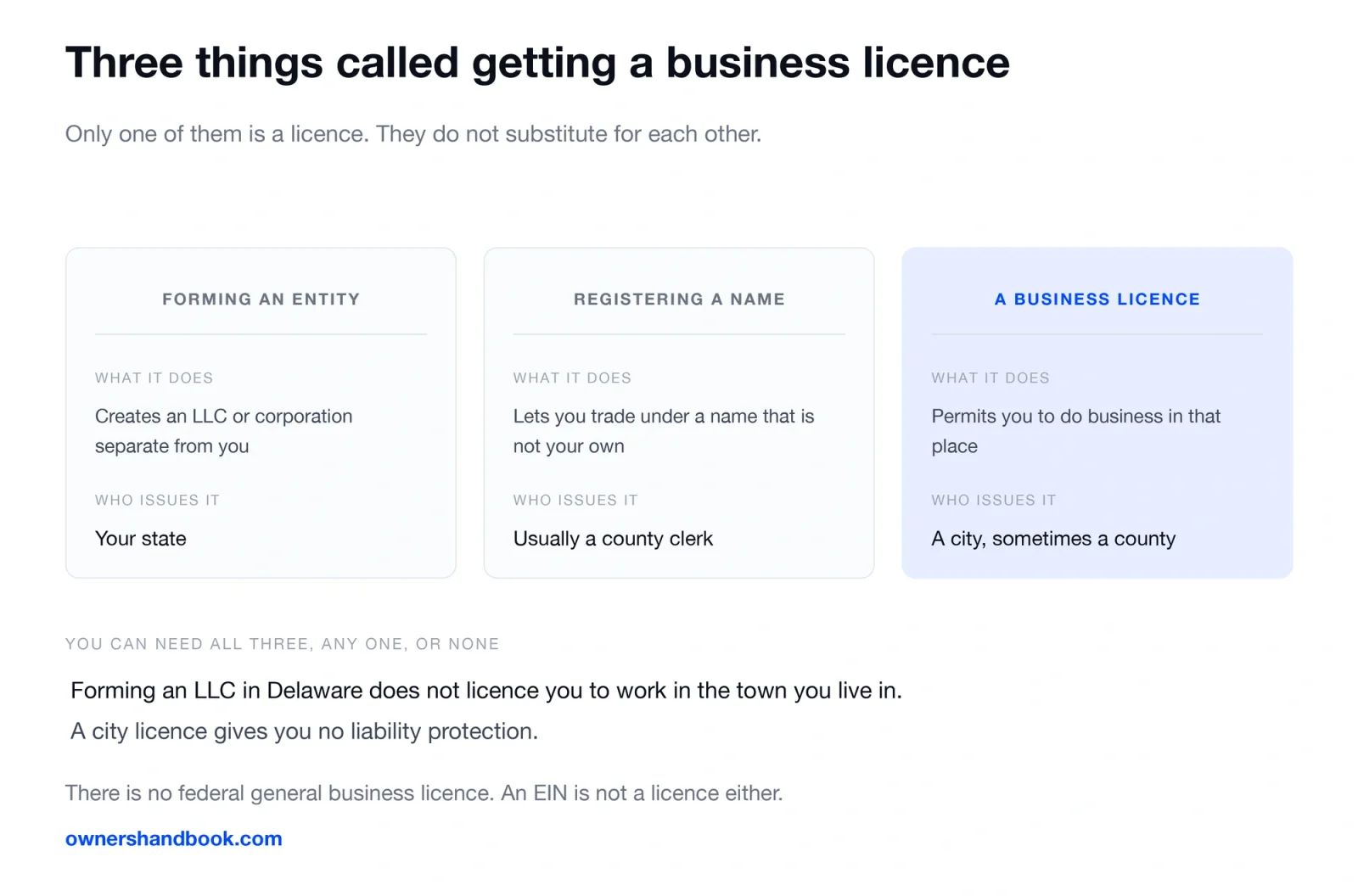
Three things get called “getting a business licence”, and only one of them is a licence. Forming an LLC is not. Registering a trading name is not. The licence itself is a piece of paper from your city, it usually costs less than the LLC people form instead of it, and it is the one most freelancers have never heard of.
So the honest answer is: probably, from a city, and possibly from more than one. Here is how to find out which, without trusting anybody’s list of cities.
The three things people conflate
| What it is | What it does | Who issues it |
|---|---|---|
| Forming an entity | Creates an LLC or corporation separate from you | Your state, usually the Secretary of State |
| Registering a name | Lets you trade under a name that is not your own | Usually a county clerk, sometimes the state |
| A business licence | Permits you to do business in that place | A city, sometimes a county |
You can need all three, any one, or none, and they do not substitute for each other. Forming an LLC in Delaware does not licence you to work in the town you live in, and a city licence gives you no liability protection. LLC versus sole proprietor and how to form an LLC cover the first. This post is about the other two.
There is no federal general business licence
None. The federal government licences specific regulated activities only, and the Small Business Administration’s whole list is aviation, alcohol, firearms and explosives, agriculture across state lines, fish and wildlife, commercial fisheries, maritime transport, mining and drilling on federal land, nuclear energy, broadcasting, and oversize vehicles.
Designers, writers, developers, consultants, photographers and editors appear nowhere on it. If a website offers to get you a “federal business licence”, it is selling you nothing. An EIN is not a licence either — it is a tax identification number, and getting an EIN and a business bank account covers what it does do.
The SBA puts the rest in one sentence:
The licenses and permits you need from the state, county, or city will depend on your business activities and business location.
How to find your own answer in ten minutes
Any list of city requirements is wrong for most readers by construction, because every city writes and revises its own. Learn the lookup instead.
Search for the ordinance, not the topic. Type `”business license” site:yourcity.gov`, substituting your city’s actual domain — some are `cityofX.org` or `X.us`. Skip every result that is not the city’s own domain; the commercial sites ranking above it sell filing services.
Know which office to ask for. Almost never the Secretary of State. Depending on the city it is the Department of Finance, the City Treasurer, the City Clerk, or a business licensing unit inside one of them. On unincorporated county land, ask the county.
Check whether your state runs a single portal. Some states let you apply for state registration and participating city licences in one filing. Washington is one, and its Department of Revenue describes it directly:
If your business is physically located in, or will travel to the cities listed, you can apply for their endorsements at the same time you file for your state licenses and registrations.
Ask the two questions that decide it. Does the requirement reach a business with no premises inside the city, and is there a revenue threshold below which it does not apply. Almost every disagreement about freelance licensing collapses into those two.
The multi-city question, which nothing else answers
You live in one city. Your clients are in four others. Do you need a licence in each?
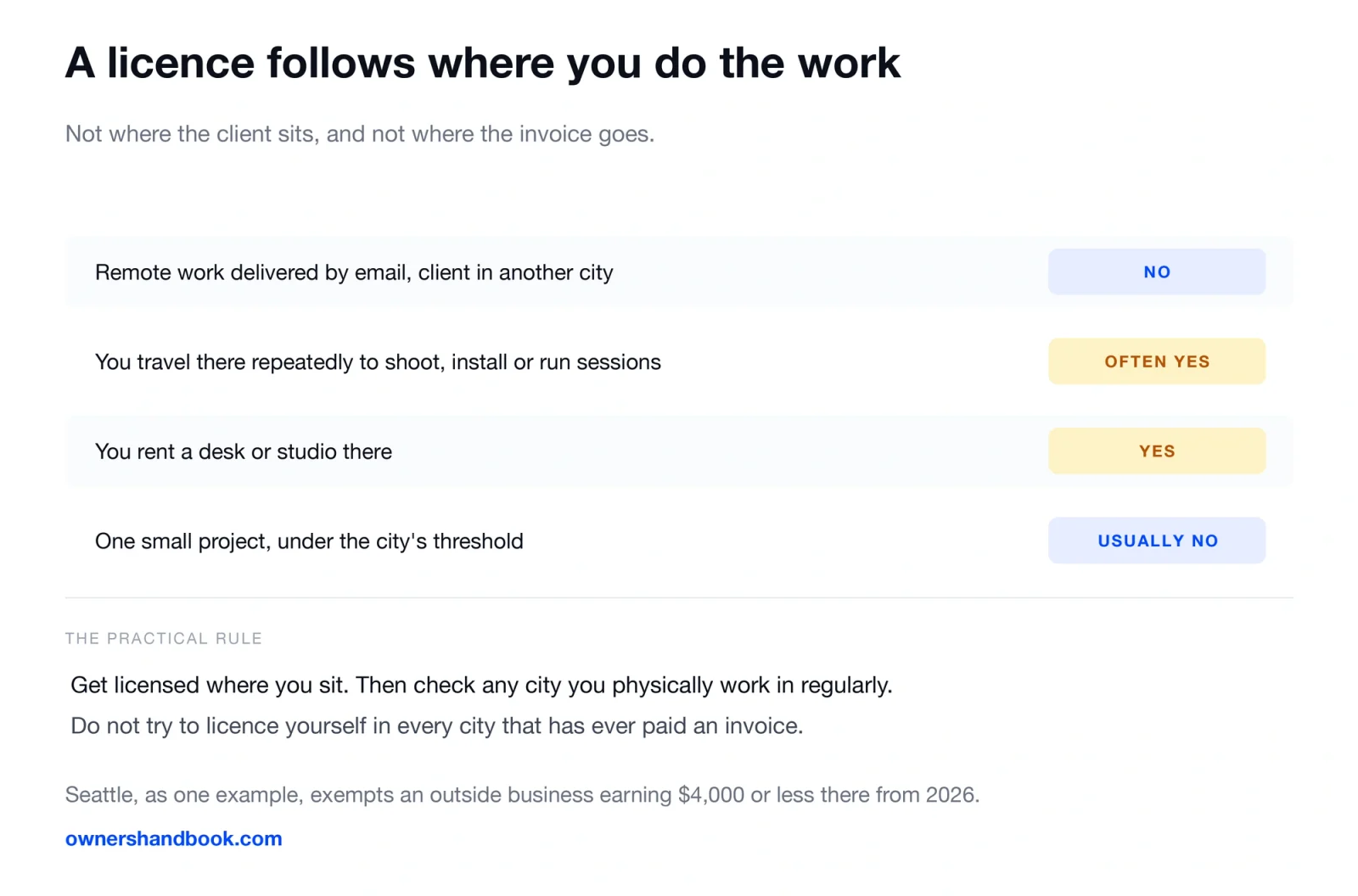
A city licence follows where you are doing business, and remote work for a distant client is usually not doing business in that client’s city. Physically going somewhere to perform the work often is.
Seattle is an example — one city, verified on its own page, not a rule for yours:
If your business is based outside Seattle and you do business within the city, then you must have a Seattle business license tax certificate. In other words, you need a license for where you conduct business; not just for where you’re located.
That sounds alarming until you read the threshold alongside it. Seattle exempts a business with no place of business in the city whose gross income there is at or below a set figure — $2,000 from 2019, rising to $4,000 from 2026. For most freelancers with one client in a city they never visit, that is the end of it.
| Your situation | Usually creates an obligation where the client is |
|---|---|
| Remote work, delivered by email, client in another city | No |
| You travel there repeatedly to shoot, install or run sessions | Often yes |
| You rent a desk or studio there | Yes |
| One small project, under the city’s threshold | Usually no, if the city has a threshold |
The practical rule: get licensed where you sit, then check any city you physically work in regularly. Do not try to licence yourself in every city that has ever paid an invoice. This is also a separate question from sales tax, which has its own rules and thresholds.
The home-occupation permit that catches renters
If you work from the place you live, your city’s zoning code may require a second document on top of the licence — usually called a home occupation permit, because residential zoning does not automatically permit commercial activity.
Washington, DC, is an example of a city requiring one before a home-based business is licensed. Its Department of Buildings defines the category broadly:
A home occupation is a business, profession or other economic activity conducted full- or part-time in the principal residence of the person conducting the business.
Typical conditions: the home is your primary residence, the business does not change the character of the property, and limits apply to employees, client visits, signage and sometimes floor area. A quiet laptop business clears all of them.
Two traps. Renters may need landlord acknowledgement, and a lease forbidding commercial use is a real obstacle. And the application puts your home address into a public record — the reason many freelancers use a different business address.
Trading names, and the sanction nobody mentions
If you invoice as “Rivera Design Studio” rather than as your own name, that is a fictitious business name — also called a DBA, trade name or assumed name. The SBA is blunt about what registering it buys you:
Registering your DBA name doesn’t provide legal protection by itself.
Registration is usually a county matter and usually cheap. California is an example: the statement must be filed not later than 40 days from the time the registrant commences to transact business, with the clerk of the county where the principal place of business sits.
California also sets out a consequence worth understanding wherever you live, because several states have an equivalent:
No person transacting business under a fictitious business name contrary to the provisions of this chapter, or his assignee, may maintain any action upon or on account of any contract made, or transaction had, in the fictitious business name in any court of this state until the fictitious business name statement has been executed, filed, and published as required by this chapter.
Read that carefully. An unregistered trading name can mean you cannot sue on your own contract until you fix it. For a freelancer chasing an unpaid invoice, that is not a filing detail. If you invoice under your own legal name, none of this applies to you.
Professional licences are a separate question again
A city licence permits you to do business. A professional or occupational licence permits you to do that particular work at all, and it comes from a state board — contractors, cosmetologists, therapists, accountants, real estate agents, some trades. One does not imply the other, and if your field is licensed you need both. Most creative and knowledge freelancing is not licensed at state level, but check your state’s board rather than assuming.
What happens if you never registered
Usually nothing, for a long time, and then something small and annoying. Cities find unlicensed businesses through routine channels: a complaint, a permit application, a zoning question, a state tax registration that shares data. The consequence is normally back fees for the unlicensed years, a penalty and interest — not enforcement action against a solo freelancer.
Your tax position does not change either way. The IRS treats you as self-employed whether or not any city has licensed you:
Generally, you are self-employed if any of the following apply to you. You carry on a trade or business as a sole proprietor or an independent contractor.
You file a Schedule C and owe self-employment tax on net earnings of $400 or more regardless. Being unlicensed does not make the income invisible; being licensed adds no tax. They are unrelated systems, which is exactly why people assume one covers the other.
What to do this week
Find your city’s own page with the site-restricted search above, and read only that page. Answer the two questions — does it apply without premises, and is there a threshold. Check home occupation if you work where you live. File a trading name only if you invoice under something other than your legal name. Check your state board if your field is licensed.
Then stop. Registering in a state you do not live in is a separate and usually bad idea, covered in choosing a state to register a business.
Frequently asked questions
Do I need a business licence if I am just a freelancer with no LLC?
Often yes. City licensing generally applies to sole proprietors too — the requirement attaches to doing business, not to having an entity. Whether it reaches you depends on your city’s rules and any revenue threshold.
Do I need a licence in every city my clients are in?
Generally no. A licence follows where you conduct business, and remote delivery to a client elsewhere usually is not that. Check the cities you travel to and work in regularly, and check their thresholds.
Does forming an LLC mean I do not need a licence?
No. Different systems at different levels of government. An LLC is state-level and concerns liability and structure; a licence is local and concerns permission to operate there. An EIN is not a licence either.
I have been freelancing for three years without one. What now?
Look up your city, and register. Most charge back fees for the unregistered period plus a penalty. That is a smaller problem than it feels like, and it shrinks the sooner you deal with it.
Do I need a licence for a side project earning a few hundred dollars?
Check your city’s threshold before assuming. Some exempt small revenue outright; others require registration at any amount. The tax side is separate — Schedule C applies either way.
Sources
U.S. Small Business Administration, Apply for licenses and permits
https://www.sba.gov/business-guide/launch-your-business/apply-licenses-permits
U.S. Small Business Administration, Choose your business name
https://www.sba.gov/business-guide/launch-your-business/choose-your-business-name
City of Seattle, Department of Finance and Administrative Services, Business licenses
https://www.seattle.gov/city-finance/business-taxes-and-licenses/business-licenses
Washington State Department of Revenue, City license endorsements
https://dor.wa.gov/manage-business/city-license-endorsements
District of Columbia Department of Buildings, Get a Home Occupation Permit
https://dob.dc.gov/node/1616176
California Business and Professions Code, Section 17910
https://leginfo.legislature.ca.gov/faces/codes_displaySection.xhtml?lawCode=BPC§ionNum=17910
California Business and Professions Code, Section 17915
https://leginfo.legislature.ca.gov/faces/codes_displaySection.xhtml?lawCode=BPC§ionNum=17915
California Business and Professions Code, Section 17918
https://leginfo.legislature.ca.gov/faces/codes_displaySection.xhtml?lawCode=BPC§ionNum=17918
IRS, Self-Employed Individuals Tax Center
https://www.irs.gov/businesses/small-businesses-self-employed/self-employed-individuals-tax-center