Salary to Contract Rate: What a 1099 Has to Pay
A $90,000 salary is not $43 an hour of contract work. It is closer to $105, and the gap is not greed — it is the things the job was paying for that nobody hands a contractor.
This converts a salary into the rate that leaves you where you were.
Salary to contract rate calculator
What a 1099 rate has to be to leave you where a salary left you. Tax year 2026.
Gross, before anything came out.
Health premiums the employer paid, retirement match, anything else you would now buy yourself.
Not 2,080. That number describes an employee with a manager finding the work.
Software, equipment, insurance, accountant. Things the job paid for.
| The salary you are replacing | $0 |
| Benefits you now buy yourself | $0 |
| Business costs the job used to absorb | $0 |
| The employer half of Social Security and Medicare (7.65%, now yours) | $0 |
| Total the contract has to produce | $0 |
| Divided by billable hours | 0 |
The number most calculators give you
| Salary ÷ 2,080 the usual shortcut | $0 |
| What that shortcut misses per hour | $0 |
The employer half of Social Security and Medicare is 7.65% of wages up to the
Social Security wage base; self-employment tax of 15.3% applies to 92.35% of net earnings, from
IRS Tax Topic 554
and Publication 505.
Runs entirely in your browser — nothing you type is sent anywhere or stored.
This calculator is for informational purposes only and does not constitute legal, accounting, or tax advice.
It compares cost, not risk: it does not price unpaid time between contracts, the absence of unemployment
insurance, paid leave, or the administrative work of running a business. Income tax is not modelled, because
the deductible half of self-employment tax and business expenses change it in both directions. Consult your
own tax advisor.
The two numbers every other calculator gets wrong
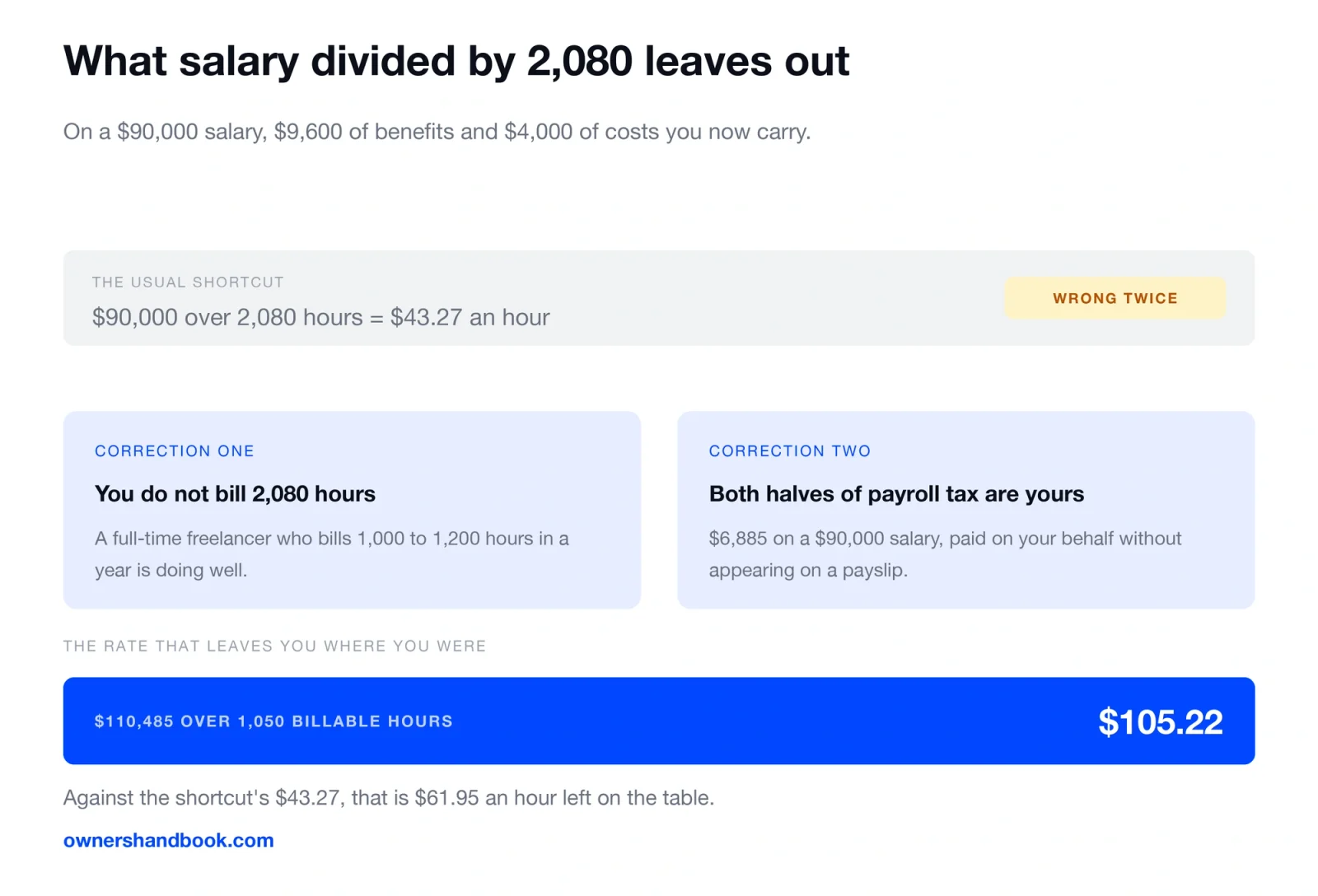
Divide a salary by 2,080 and you have the number most comparison pages produce. It is wrong twice, in the same direction.
You do not bill 2,080 hours. That figure describes an employee — someone with a manager assigning the work, a sales team finding it, and paid leave when they stop. A full-time freelancer who bills 1,000 to 1,200 hours in a year is doing well. Selling, admin, invoicing, proposals that go nowhere and gaps between contracts all come out of the other thousand.
You now pay the employer’s half of payroll tax. A job splits Social Security and Medicare with you — 7.65% each. As a contractor both halves are yours. On $90,000 that half is about $6,885, money that was being paid on your behalf every fortnight without appearing on your payslip.
| What changes | On a $90,000 salary |
|---|---|
| The salary itself | $90,000 |
| The employer’s half of payroll tax, now yours | $6,885 |
| Health premiums and retirement match you replace | Whatever the job was paying |
| Software, equipment, insurance, accountant | Whatever the job was buying |
| Billable hours | Not 2,080 |
Our guide to setting a freelance hourly rate works through the billable-hours problem in detail.
Worked through
Take the $90,000 salary, $9,600 of benefits the employer was paying, $4,000 of business costs you now carry, and 1,050 billable hours.
| Line | Amount |
|---|---|
| The salary you are replacing | $90,000 |
| Benefits you now buy yourself | $9,600 |
| Business costs the job used to absorb | $4,000 |
| The employer half of Social Security and Medicare | $6,885 |
| Total the contract has to produce | $110,485 |
| Divided by 1,050 billable hours | $105.22 |
Against the usual shortcut of $90,000 ÷ 2,080 = $43.27, that is $61.95 an hour the shortcut leaves on the table.
Change the hours and the answer moves hard. At 500 billable hours — a genuine part-time freelance year — the same total needs $220.97 an hour.
Why the billable-hours number does most of the work
Both corrections matter, but they are not the same size.
The employer half is a fixed addition: about 7.65% of the salary. Meaningful, but it does not change the shape of the answer.
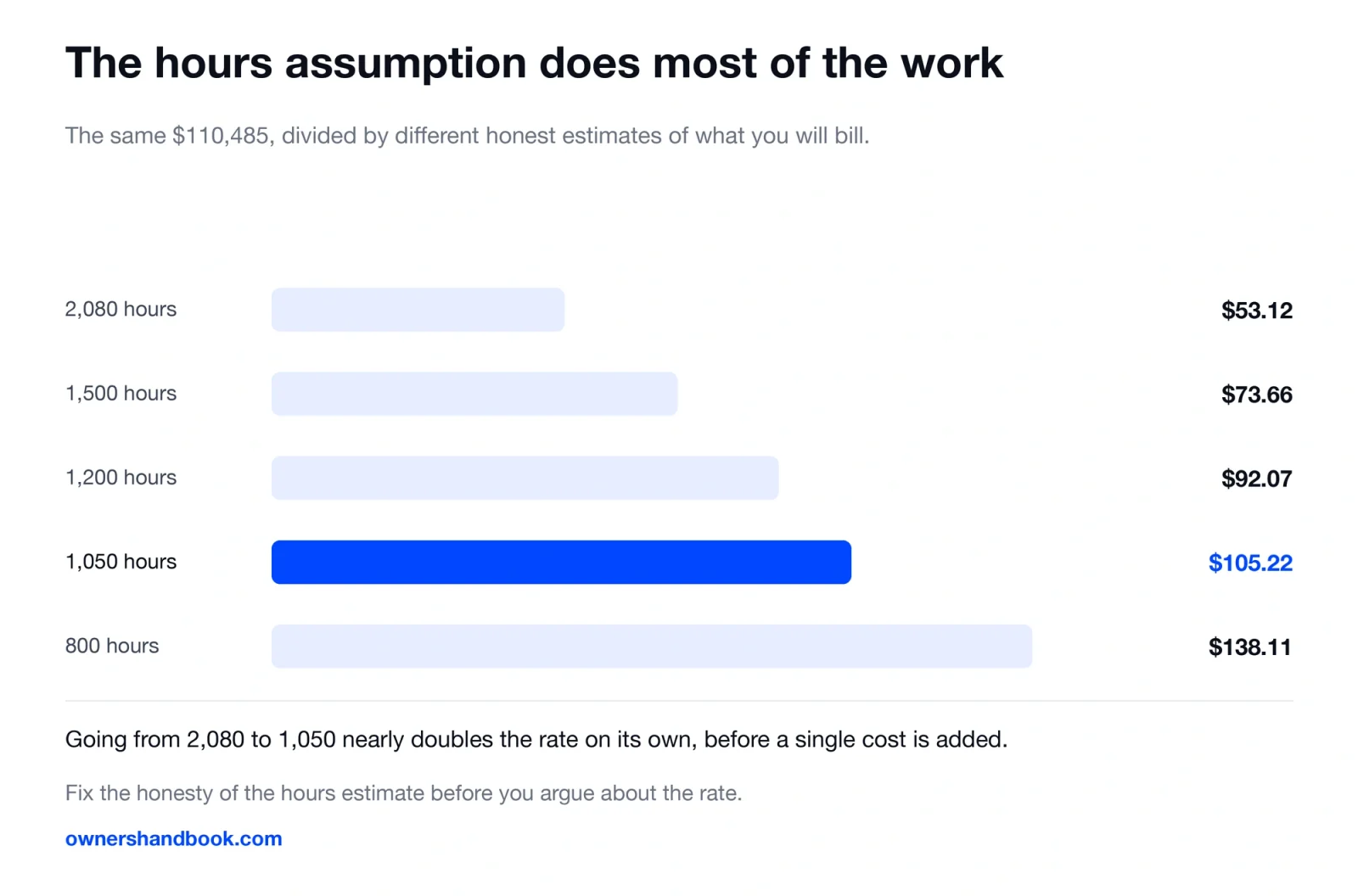
The hours divisor changes everything. Going from 2,080 to 1,050 nearly doubles the rate on its own, before a single benefit or cost is added.
| Billable hours assumed | Rate on the same $110,485 |
|---|---|
| 2,080 | $53.12 |
| 1,500 | $73.66 |
| 1,200 | $92.07 |
| 1,050 | $105.22 |
| 800 | $138.11 |
Which is why the first thing to fix is not the rate. It is the honesty of the hours estimate underneath it.
What the Social Security ceiling does at higher salaries
One detail the calculator handles and most do not.
The Social Security portion stops at a ceiling — $184,500 of earnings for 2026. The Medicare portion has no ceiling at all.
So on a $200,000 salary the employer half is not 7.65% of $200,000. It is 6.2% of the first $184,500 plus 1.45% of the whole $200,000, which comes to about $14,339 rather than $15,300.
The same ceiling is why a job changes your self-employment tax more than people expect, and why our self-employment tax calculator asks for W-2 wages.
What this does not price
The calculator compares cost. It does not compare risk, and the difference between those two is where most of the real decision sits.
| Not in the number | Why it matters |
|---|---|
| Unpaid time between contracts | A salary pays in a month with no work. A contract does not |
| No unemployment insurance | Generally unavailable to the self-employed |
| No paid leave | Sick days and holidays are now unpaid time, already inside the hours figure |
| Payment risk | Clients pay late, or dispute, or disappear |
| The administrative work | Invoicing, chasing, bookkeeping, a second set of tax filings |
Some of those argue for a higher rate than the break-even figure. None argues for a lower one.
Against that, the freelance side has real advantages the salary side does not: business expenses come off before tax on Schedule C, you choose the work, and you can raise your price. Our guide to raising freelance rates covers the second half of that.
Income tax, and why it is left out
Deliberately, because including it would make the comparison less accurate rather than more.
The two sides do not differ by a simple bracket. As a contractor you deduct half your self-employment tax, you deduct business expenses that a salaried person cannot, and you may qualify for the qualified business income deduction on the profit. Those push in the opposite direction from the extra payroll tax.
Modelling that properly needs your whole return, not a rate calculator. The figure above is the cost floor — what the contract has to produce before tax is considered at all.
Frequently asked questions
Is there a quick multiplier I can use instead?
The rough rule people repeat is to take the salary, divide by 2,080, and multiply by around 1.5 to 2. That lands in roughly the right area, but it hides both corrections rather than showing them — and it breaks the moment your billable hours are not 1,000 to 1,400.
What should I use for billable hours?
Count backwards from your actual year rather than forwards from 52 weeks. Take the weeks you will genuinely work, multiply by the hours you can genuinely bill in a week, and be pessimistic about the second number. Twenty billable hours a week is a real week.
Should I quote an hourly rate at all?
Not necessarily. The hourly figure is useful as a floor for checking whether a fixed price is sane, even if you never quote it. Our comparison of hourly and project pricing covers when to use which.
What if the client will not pay that rate?
Then the contract is worth less than the job was, and the calculator has told you something useful. That is a different answer from “my rate is too high.”
Does this work for a contract-to-hire offer?
It gives you the cost floor for the contract portion. If the salary at the end is the real prize, you may accept less during the contract — but you should know what you are giving up per hour.
Do I need an LLC to contract?
No. A sole proprietor invoices under their own name and reports on Schedule C. Our comparison of LLC and sole proprietor covers when forming one helps.
Sources
IRS, Topic no. 554, Self-employment tax
https://www.irs.gov/taxtopics/tc554
IRS, Publication 505, Tax Withholding and Estimated Tax
https://www.irs.gov/publications/p505
IRS, Instructions for Schedule SE (Form 1040)
https://www.irs.gov/pub/irs-pdf/i1040sse.pdf
IRS, Instructions for Schedule C (Form 1040)
https://www.irs.gov/instructions/i1040sc
Social Security Administration, Contribution and benefit base