Retirement Plans: Open by December 31 or Fund in April
A SEP-IRA can be opened and funded on the same afternoon in October 2027 and still deduct against your 2026 profit. A solo 401(k) generally cannot. That one difference is why the plan that shelters more money is the plan you have to decide about first.
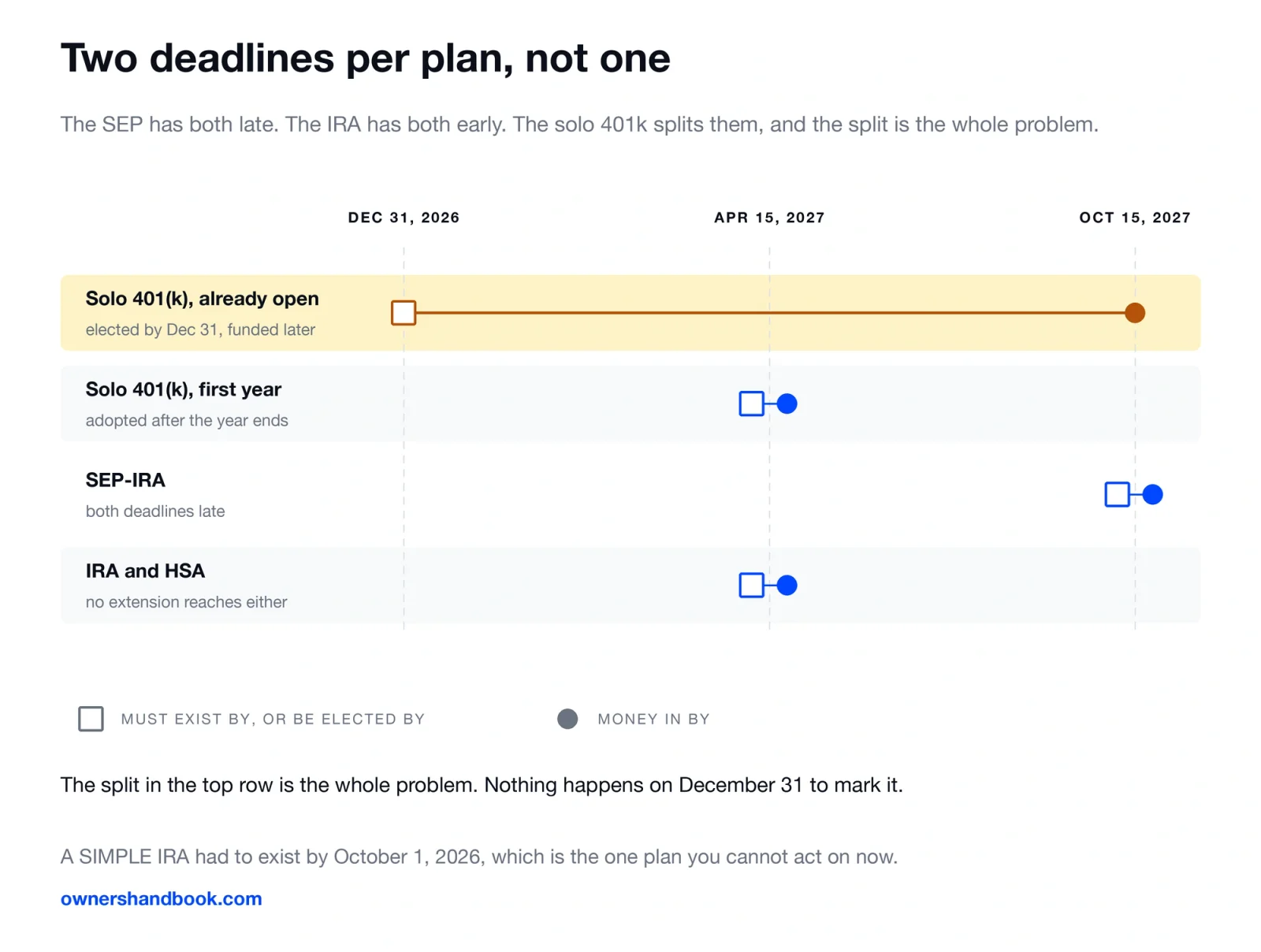
The confusion is structural. Every plan has two deadlines — a date by which it must exist and a date by which the money must arrive — and most writing on the subject reports one of them and calls it the deadline.
Which plan fits your income is a different question, answered in our comparison of solo 401(k) and SEP-IRA. This page is only dates.
The whole answer, in one table
Tax year 2026, calendar-year sole proprietor filing Form 1040.
| Plan | Must exist by | Money in by | 2026 limit |
|---|---|---|---|
| Solo 401(k) — plan you already have | Already open | Deferral elected by Dec 31, 2026, paid by the filing deadline including extensions | $72,000 total, of which $24,500 deferral |
| Solo 401(k) — first plan year, adopted after year end | April 15, 2027 if you want deferrals. Oct 15, 2027 for employer money only. | Same date as the adoption you are relying on | $72,000 total |
| SEP-IRA | Return due date, extensions included | Return due date, extensions included | $72,000 |
| SIMPLE IRA | October 1, 2026 — already past | Deferral within 30 days of the month; employer part by the filing deadline including extensions | $17,000 deferral generally |
| Traditional or Roth IRA | April 15, 2027 | April 15, 2027, no extensions | $7,500 |
| HSA — not a retirement plan, same calendar problem | April 15, 2027 | April 15, 2027, no extensions | $4,400 self-only, $8,750 family |
Four of those rows say something different from the others, and the rest of this page is why.
Open-by and fund-by are two different deadlines
A SEP-IRA is the plan where both dates are identical and both are late. Publication 560 states it directly: you can set up a SEP for any year as late as the due date, including extensions, of your income tax return for that year. The contribution deadline is the same date, on the authority of section 404(h)(1)(B).
So a SEP opened on October 14, 2027 and funded on October 15 is a valid 2026 deduction — the only meaningful retroactive tax lever a freelancer has once a year has closed.
An IRA and an HSA are the opposite case. Both deadlines are April 15 and neither moves. Publication 590-A: contributions can be made at any time during the year or by the due date for filing your return for that year, not including extensions. Publication 969 says the same for an HSA.
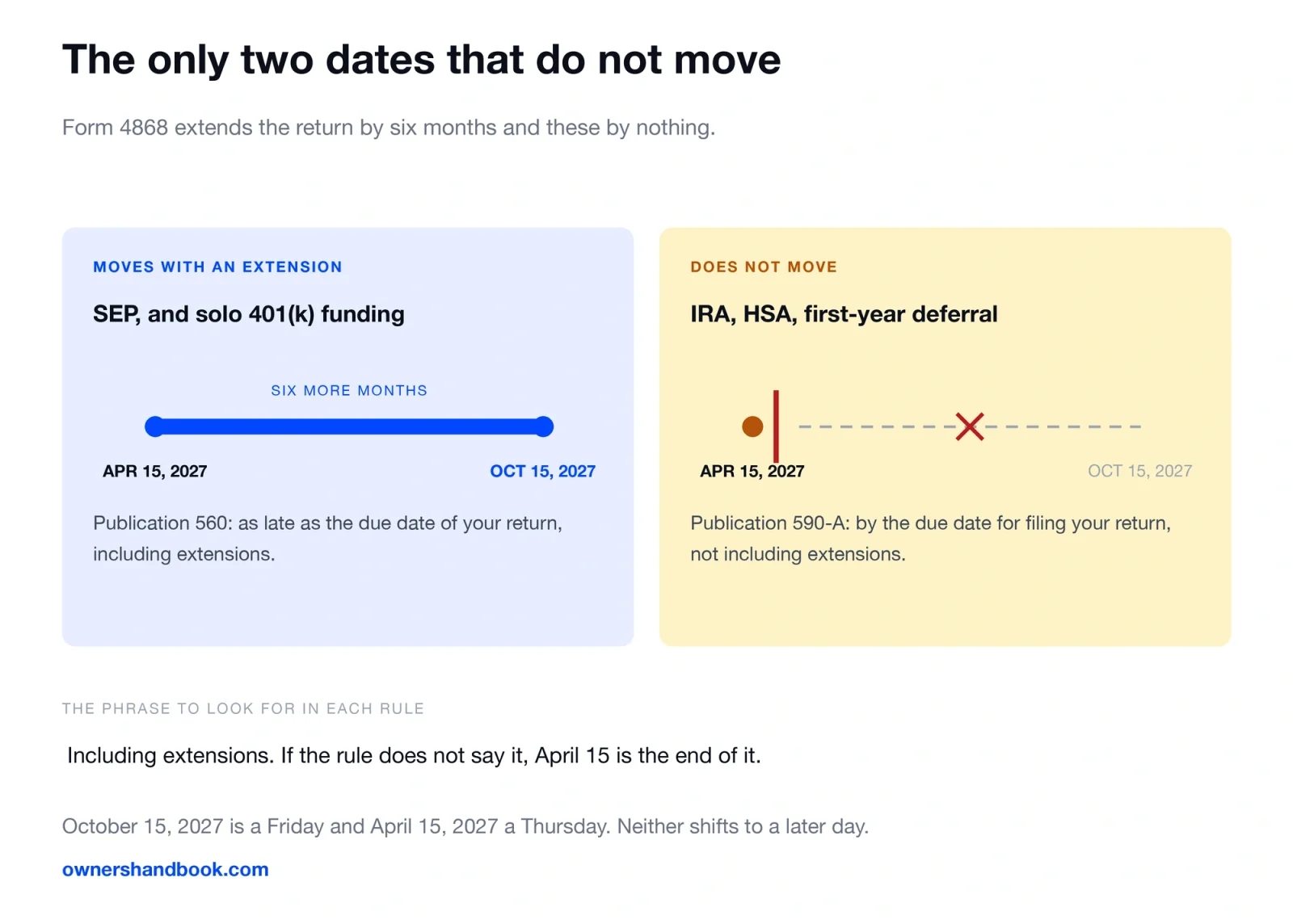
Form 4868 buys six months for the return and zero extra days for either. If you extended and assumed everything moved with the return, this is the pair that catches you — see what an extension actually gives you.
The December 31 rule on a solo 401(k) you already have
This is the costliest date in the category, and nothing happens on the day to mark it.
Publication 560 defines the elective deferral deadline by whether you are the owner. For owner-employees: the employee deferrals must be elected by the end of the tax year and can then be made by the tax return filing deadline, including extensions.
Read the halves separately. The decision is a December 31 item. The cash is an April or October item.
So the money is not the problem. The election is. For 2026 that is a decision worth up to $24,500, plus $8,000 more if you are 50 or older at the end of the year, or $11,250 instead if you turn 60, 61, 62, or 63 during 2026.
December 31, 2026 is a Thursday. No form is filed, no money moves, no notice arrives. You either made the election or you did not.
Plan adoption runs on the same date by default: to take a deduction for contributions for a tax year, your plan must be set up by the last day of that year — unless you fall inside the exception below.
The SECURE 2.0 exception, stated exactly
There is a real exception, it is narrow, and the precise words matter here.
Publication 560 gives the headline version. For 2023 and later years, a sole proprietor with no employees can adopt a section 401(k) plan after the end of the tax year, provided the plan is adopted by the tax filing deadline without regard to extensions.
The statute behind it is section 401(b)(2), and it has two sentences doing two different jobs.
If an employer adopts a stock bonus, pension, profit-sharing, or annuity plan after the close of a taxable year but before the time prescribed by law for filing the return of the employer for the taxable year (including extensions thereof), the employer may elect to treat the plan as having been adopted as of the last day of the taxable year.
That first sentence is the general retroactive adoption rule, and it runs all the way to the extended due date. On its own it gets you employer contributions and nothing else, because an elective deferral has to come out of pay you have not yet taken — and for a sole proprietor, the money you take is a draw rather than a wage.
In the case of an individual who owns the entire interest in an unincorporated trade or business, and who is the only employee of such trade or business, any elective deferrals (as defined in section 402(g)(3)) under a qualified cash or deferred arrangement to which the preceding sentence applies, which are made by such individual before the time for filing the return of such individual for the taxable year (determined without regard to any extensions) ending after or with the end of the plan’s first plan year, shall be treated as having been made before the end of such first plan year.
That second sentence is what SECURE 2.0 added, and it is the one freelancers care about. Four conditions sit inside it. You own the entire interest in an unincorporated business. You are its only employee. It is the plan’s first plan year. And the deferrals are actually paid in before the unextended return deadline.
What it allows: opening a solo 401(k) in, say, March 2027 and still making a 2026 employee deferral.
What it does not allow is where the rule gets misreported. It does not help in any year after the first. It does not reach the October date even if you extend — the deferral money has to be in by April 15, 2027. And it does not apply if you have an employee other than yourself.
The employer side is the part that still reaches October, which is the one place where the two halves of a solo 401(k) genuinely separate.
Why extensions move some of these and not others
The phrase to look for in each rule is whether extensions are mentioned.
| What you are doing | Extensions count | Latest date for tax year 2026 |
|---|---|---|
| Open and fund a SEP | Yes | October 15, 2027 |
| Pay an employer contribution to a solo 401(k) | Yes | October 15, 2027 |
| Pay a deferral you elected by Dec 31 | Yes | October 15, 2027 |
| Adopt a first-year solo 401(k) and defer | No | April 15, 2027 |
| Fund an IRA | No | April 15, 2027 |
| Fund an HSA | No | April 15, 2027 |
October 15, 2027 is a Friday and April 15, 2027 is a Thursday, so none of these shift to a following business day.
One practical consequence worth naming. If your plan is to extend and decide in September, that plan works for a SEP and fails for a first-year solo 401(k). The two look interchangeable until you need the later date.
The 2026 numbers, and what 2027 does not have yet
The limits in the table come from Notice 2025-67, the annual retirement cost-of-living notice.
| 2026 limit | Amount | Code section |
|---|---|---|
| Total additions to a SEP or solo 401(k) | $72,000 | 415(c)(1)(A) |
| Employee deferral | $24,500 | 402(g)(1) |
| Catch-up, age 50 and over | $8,000 | 414(v)(2)(B)(i) |
| Catch-up, ages 60 to 63 | $11,250 | 414(v)(2)(E)(i) |
| IRA catch-up, age 50 and over | $1,100 | 219(b)(5)(B)(ii) |
| Compensation that can be counted | $360,000 | 401(a)(17) |
For 2027, none of this is published. The inflation revenue procedure for 2027 does not exist yet, and neither does the 2027 retirement notice. A page quoting 2027 contribution limits today is guessing.
A one-participant 401(k) also picks up a filing obligation once it grows: Form 5500-EZ is generally required if the plan holds $250,000 or more at the end of the plan year. A SEP has no annual filing at all.
The SIMPLE IRA deadline for 2026 has already gone
A SIMPLE IRA has to be established between January 1 and October 1 of the calendar year it covers. For a business that came into existence after October 1, the rule is as soon as administratively feasible.
That date is behind us for 2026, which makes the SIMPLE the one plan here you cannot act on this December at all.
What has nothing to do with a deadline
Two things get filed into the year-end panic that do not belong there.
The 20% deduction for self-employed income is not elected and has no deadline. It is computed on the return from the profit you actually had — the point of our QBI walkthrough.
The same is true of the self-employed health insurance deduction. What December *can* change is your adjusted gross income, and AGI feeds the premium tax credit, which for 2026 stops at the eligibility threshold rather than tapering. If you buy your own coverage, that interaction is in health insurance in 2026 — and it is where the size of a contribution changes something other than tax.
For the rest of the December list — the W-9s, the Q4 estimated payment, the S corp election — see what actually expires on December 31. For what a contribution is worth against the alternatives, lowering your freelance tax legally runs the comparison.
Frequently asked questions
I do not have a solo 401(k) yet. Is December 31 still my deadline?
No, and this is the useful half of the rule. As a sole proprietor with no employees you can adopt one after the year ends and still make a 2026 employee deferral, provided the plan is adopted and the deferral paid in by April 15, 2027. December 31 binds people who already have a plan.
Can I open a solo 401(k) in September 2027 if I extend my return?
For the employer contribution, yes — the general retroactive adoption rule in section 401(b)(2) runs to the extended due date. For the employee deferral, no. That half is tied to the unextended deadline.
Does filing an extension give me longer to fund my IRA?
No. The IRA deadline is the due date of the return not including extensions, which is April 15, 2027 for tax year 2026. The HSA works the same way.
I already have a SEP. Should I switch to a solo 401(k) for 2026?
If you want a 2026 employee deferral out of a brand-new solo 401(k), the first-plan-year rule gives you until April 15, 2027 to adopt it. What you cannot do is recharacterize a SEP contribution already made for a closed year.
What if my 2026 profit turns out lower than I planned for?
Both plans cap at a percentage of net earnings, so the limit falls with the profit rather than creating an excess. This is the argument for the SEP in a volatile year: you set the number in October 2027 knowing what the year actually was, rather than committing to a December election on an estimate.
Is there a penalty for missing these dates?
No. That is what makes them dangerous. Nothing is assessed and no notice arrives. You simply pay tax on income you could have sheltered.
Sources
IRS, Notice 2025-67, 2026 amounts relating to retirement plans and IRAs
https://www.irs.gov/pub/irs-drop/n-25-67.pdf
IRS, Publication 560, Retirement Plans for Small Business
https://www.irs.gov/pub/irs-pdf/p560.pdf
Office of the Law Revision Counsel, 26 U.S.C. 401, Qualified pension, profit-sharing, and stock bonus plans
Legal Information Institute, 26 U.S.C. 404
https://www.law.cornell.edu/uscode/text/26/404
IRS, Publication 590-A, Contributions to Individual Retirement Arrangements
https://www.irs.gov/pub/irs-pdf/p590a.pdf
IRS, Publication 969, Health Savings Accounts and Other Tax-Favored Health Plans
https://www.irs.gov/pub/irs-pdf/p969.pdf
IRS, Revenue Procedure 2025-19, 2026 HSA inflation adjusted amounts
https://www.irs.gov/pub/irs-drop/rp-25-19.pdf
IRS, One-participant 401(k) plans
https://www.irs.gov/retirement-plans/one-participant-401k-plans