Schedule C Explained: What Goes on Each Line
Schedule C is one page with two halves. The top half is what came in. The bottom half is what went out. Subtract one from the other and you get line 31, your profit — and that single number is the only thing that ever leaves the page.
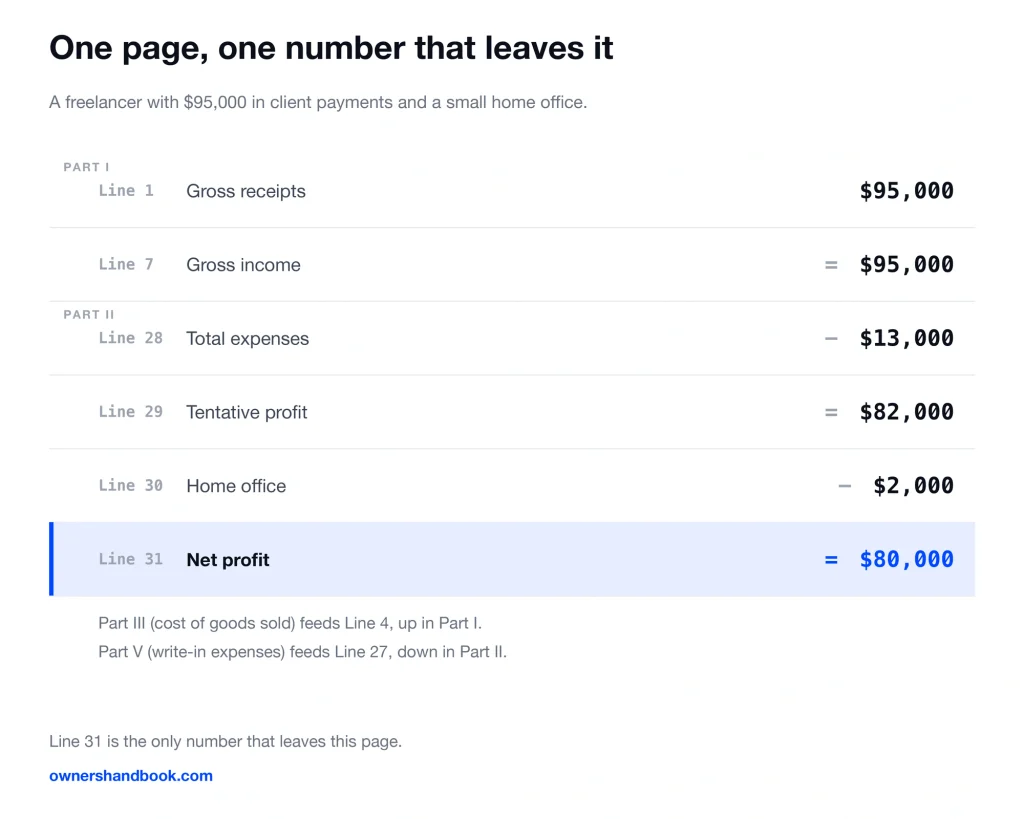
The shape of the page
Before any line numbers, get the shape. It makes the rest obvious.
Part I is income. Seven lines, and most people use two of them.
Part II is expenses. Twenty categories, each one a kind of spending the IRS expects to see.
Part I minus Part II, then one more subtraction for a home office, and you are done.
Parts III, IV, and V exist for specific situations. If you sell your time rather than physical goods, you will skip at least one of them.
One thing to know going in. The form reads top to bottom, but the math does not flow that way. Part III feeds a line near the top. Part V feeds a line near the bottom. Everything eventually lands on line 31.
Before Part I: the header, A through J
Ten lettered boxes sit above the income section. Most take a moment, two decide things.
| Box | What it asks | What to put |
|---|---|---|
| A | Principal business or profession, including product or service | Plain words. “Graphic design,” not “creative services provider” |
| B | Enter code from instructions | The six-digit activity code from the instruction list |
| C | Business name. If no separate business name, leave blank | Blank is normal for a sole proprietor |
| D | Employer ID number (EIN) | Blank unless you have one. Your SSN is already at the top |
| E | Business address | Your home address, if that is where you work |
| F | Accounting method: Cash, Accrual, or Other | Cash for nearly every freelancer — you count income when it arrives |
| G | Did you “materially participate” in the operation of this business? | Yes, if you do the work |
| H | If you started or acquired this business during the year, check here | First year only |
| I | Did you make any payments that would require you to file Form(s) 1099? | See below |
| J | If “Yes,” did you or will you file required Form(s) 1099? | See below |
Boxes I and J are the ones that catch people. They are asked on the form you file in April, but the 1099s themselves were due to your contractors in January. By the time you read box I, being late is already decided.
The threshold moved. For tax years beginning after 2025 the minimum for reporting on these forms rose from $600 to $2,000, and the IRS says it “may be adjusted for inflation beginning in calendar year 2027.”
Cash or accrual: which to put in box F
Box F offers three choices and almost every freelancer wants the first one.
Cash method counts income when the money arrives and expenses when you pay them. Invoice a client in December, get paid in January, and it is January’s income. Accrual counts income when you earn it and expenses when you incur them, so that same invoice belongs to December whether or not anyone paid.
Cash is the default for a reason. It matches how a one-person business actually experiences money, it needs no separate ledger of what is owed to you, and it lets you move income across a year boundary by timing when you send an invoice. That last point is a real planning tool: hold a December invoice until January and the income lands in the following tax year.
Accrual is worth it if you carry inventory, if you routinely bill work months before payment and want the books to show what you have earned rather than collected, or if a lender wants statements on that basis.
Two things to know once you have chosen. The method applies to the whole business rather than to individual transactions. And changing it later is not a box you re-tick — it generally requires filing Form 3115 and an adjustment to stop income or expenses being counted twice or skipped. Pick cash, and stay with it unless something real changes.
Part I: what came in, line by line
Seven lines. Most freelancers use two of them.
| Line | What the form says | What it means for you |
|---|---|---|
| 1 | Gross receipts or sales | Everything you were paid, before anything came out |
| 2 | Returns and allowances | Refunds you gave. See below |
| 3 | Subtract line 2 from line 1 | Arithmetic |
| 4 | Cost of goods sold (from line 42) | Comes up from Part III. Blank if you sell services |
| 5 | Gross profit. Subtract line 4 from line 3 | Arithmetic |
| 6 | Other income, including federal and state gasoline or fuel tax credit or refund | Interest on a business account, a rebate, a credit |
| 7 | Gross income. Add lines 5 and 6 | What Part II starts eating into |
Line 1 is gross receipts. Everything you were paid for work, before anything came out of it.
The word gross is doing real work there. If a client paid $5,000 and Stripe kept $150, line 1 is $5,000. Not $4,850.
The $150 is a real expense and you will deduct it further down.
But netting it out at the top is the most common mistake on this form, and the one most likely to generate a letter.
The IRS already holds copies of your 1099s. When your line 1 comes in smaller than the forms it has, that gap has to be explained.
What are returns and allowances on Schedule C
Line 2 is returns and allowances, and it is narrower than it sounds. The IRS defines both halves in the instructions: “A sales return is a cash or credit refund you gave to customers who returned defective, damaged, or unwanted products. A sales allowance is a reduction in the selling price of products, instead of a cash or credit refund.”
Read the word products twice. Both definitions are about physical goods going back or being discounted. If you sell your time and you refunded a client, that is not a sales return — reduce what you report as received, or treat it as a business expense, rather than putting it here.
Report the figure as a positive number. The form subtracts it for you on line 3.
Most freelancers leave line 2 blank, and that is correct rather than lazy.
Line 4 is cost of goods sold, and it comes up from Part III. If you sell physical products, this is what the inventory cost you. If you sell services, skip it.
Line 6 is other income. Interest on a business account, a credit or rebate, that kind of thing.
Line 7 is gross income. That is Part I’s answer, and it is the number Part II starts eating into.
Part II: what went out
Lines 8 through 27b. You will not use most of them, and that is normal.
| Line | What the form says | What goes there |
|---|---|---|
| 8 | Advertising | Your website, business cards, ads you actually ran |
| 9 | Car and truck expenses | Mileage or actual costs. One or the other, never both |
| 10 | Commissions and fees | Referral fees, agency cuts, sales commissions you paid |
| 11 | Contract labor | What you paid other freelancers. See the 1099 note below |
| 12 | Depletion | Natural resources. Not you |
| 13 | Depreciation and section 179 expense deduction | Equipment over $2,500, spread over years or taken at once |
| 14 | Employee benefit programs (other than on line 19) | Only if you have employees |
| 15 | Insurance (other than health) | Business liability, equipment. Health insurance is not here |
| 16a | Interest: Mortgage (paid to banks, etc.) | Business property mortgage |
| 16b | Interest: Other | Business loan or business credit card interest |
| 17 | Legal and professional services | Your accountant, your attorney |
| 18 | Office expense | Software, postage, the small recurring things |
| 19 | Pension and profit-sharing plans | Plans for employees, not your own solo 401(k) |
| 20a | Rent or lease: Vehicles, machinery, and equipment | A rented camera, a leased van |
| 20b | Rent or lease: Other business property | Studio or office space |
| 21 | Repairs and maintenance | Fixing what you already own |
| 22 | Supplies (not included in Part III) | Things you use up doing the work |
| 23 | Taxes and licenses | Business licenses, some state fees. See below |
| 24a | Travel | Airfare, hotels, getting there |
| 24b | Deductible meals | Usually half. See below |
| 25 | Utilities | For a separate business space, not your apartment |
| 26 | Wages (less employment credits) | Employees on payroll. Not money you pay yourself |
| 27a | Energy efficient commercial bldgs deduction | Attach Form 7205. Almost never a freelancer |
| 27b | Other expenses (from line 48) | Everything written out in Part V |
Two of those are commonly misread. **Line 27a is not the write-in line** — it is a building energy deduction that needs its own form. The write-in total comes in on **27b**, from Part V. And **line 19 is not your solo 401(k)**; your own retirement contribution comes off later on Schedule 1, not here.
Three lines sit close enough together to cause real confusion.
| If you bought | It goes on | Why |
|---|---|---|
| A $40 ream of paper, a $12 monthly app | 22 supplies, or 18 office expense | Consumed or recurring |
| A $900 camera lens | 22 supplies | The instructions allow “books, professional instruments, equipment, etc., if you normally use them within a year” |
| A $1,800 laptop | Part V, then 27b | At or below $2,500 the de minimis safe harbor lets you expense it outright |
| A $3,200 laptop | 13 depreciation and Section 179 | Above $2,500 it becomes a depreciation decision |
The IRS draws the line by useful life: “if their usefulness extends substantially beyond a year, you must generally recover their costs through depreciation.”
If you paid a single contractor $2,000 or more, line 11 comes with a second obligation: you owe that person a Form 1099-NEC. The floor was $600 for years. The IRS instructions state that for tax years beginning after 2025 the minimum “increased to $2,000 and may be adjusted for inflation beginning in calendar year 2027.”
That form goes to the contractor and the IRS in January, months before you sit down with Schedule C. Boxes I and J at the top of the form ask whether you did it.
Two lines have exclusions worth knowing exactly.
**Line 23, taxes and licenses.** The instructions list what belongs — state and local sales tax you charged, property tax on business assets, annual business licenses, the employer half of payroll taxes if you have staff. Then they list what does not: “Federal income taxes, including your self-employment tax.” Your self-employment tax is not a business expense. Half of it comes off later, on Schedule 1.
**Line 24b, deductible meals.** The instructions say “in most cases, you can deduct only 50% of your business meal expenses, including meals incurred while away from home on business.” One exception exists and it is narrow: people under Department of Transportation hours-of-service limits — pilots, interstate truck drivers, certain merchant mariners — deduct 80%. Entertainment does not go here at all.
Two more deserve a warning.
Health insurance is not a Schedule C expense. It comes off later, on Schedule 1, and the difference matters: putting it here would also shrink your self-employment tax, and the rules do not allow that.
Money you pay yourself is not on this form at all. That transfer is an owner’s draw, not an expense, and the profit is already yours the moment you earn it.
The parts most people skip
Part III is cost of goods sold, lines 33 through 42. Line 33 asks how you valued closing inventory — cost, lower of cost or market, or other. Then it walks through opening inventory (35), purchases less anything you took for personal use (36), cost of labor (37), materials and supplies (38), other costs (39), and closing inventory (41). Line 42 is the answer, and it travels up to line 4.
Line 37 carries a warning printed on the form itself: “Do not include any amounts paid to yourself.”
Sell services and every line here stays blank.
Part IV asks about your vehicle, lines 43 through 47b. The form tells you when to fill it in: only if you are claiming car or truck expenses on line 9 and are not required to file Form 4562.
Line 43 is the date you placed the vehicle in service. Line 44 splits your total miles three ways — business, commuting, and other — and the split matters, because commuting is not deductible. Lines 45 and 46 ask about personal use and whether another vehicle is available.
Then lines 47a and 47b, which are the whole substantiation question in two questions: “Do you have evidence to support your deduction?” and “If ‘Yes,’ is the evidence written?”
Answer those honestly before April, because the honest answer is decided during the year.
Part V is the write-in section, and it is the one worth your attention.
Bank fees. Payment processor fees. Platform commissions. Professional dues. Continuing education. Anything real that has no line of its own goes here, with a label you choose, and the total comes back up to line 27.
Part V is where most freelancers recover money they would otherwise leave on the table. Stripe’s 2.9%. Upwork’s cut. The subscription that renews quietly every month. Give each one a plain name and a number.
Line 31 goes to exactly two places
Line 28 totals lines 8 through 27b. Line 29 subtracts that from line 7 — your profit before the home office.
Line 30 is the home office, and the form gives you two routes. Attach Form 8829 for the actual method, or use the simplified method and enter two square footages right on line 30: your whole home, and the part used for business.
The simplified method is arithmetic you can do in your head. The instructions: multiply “the area (measured in square feet) used regularly and exclusively for business” by $5, and “the area you use to figure your deduction cannot exceed 300 square feet.” So the ceiling is $1,500, and a 120-square-foot room is $600.
Line 31 is what survives.
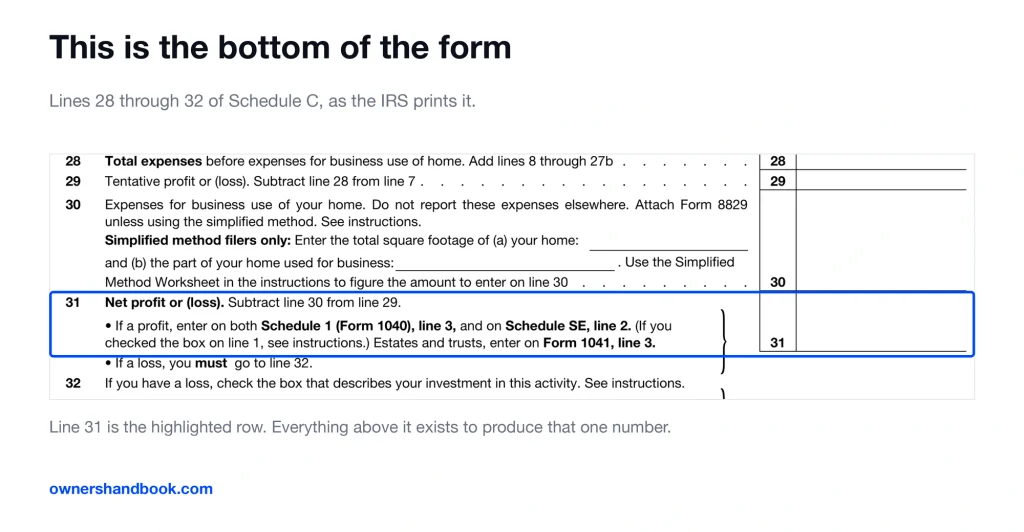
Then line 31 splits in two.
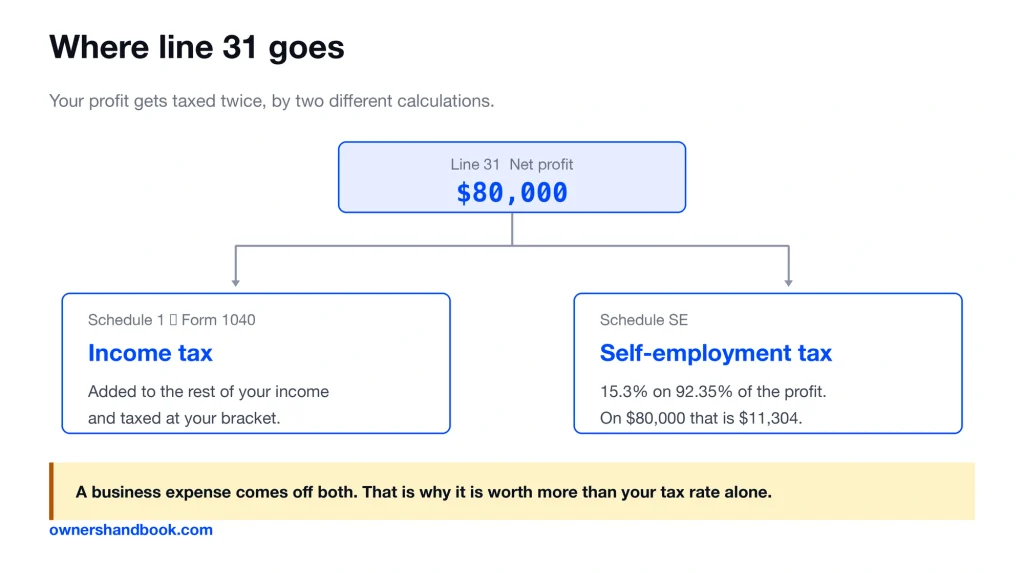
One copy goes to Schedule 1, which feeds your Form 1040. That is where income tax gets calculated on it, at whatever rate your total income lands in.
The other copy goes to Schedule SE, which charges self-employment tax — 15.3% on 92.35% of the number.
| Where line 31 goes | Which form | What it costs you |
|---|---|---|
| Your regular income | Schedule 1, then Form 1040 | Income tax at whatever bracket your total income lands in |
| Self-employment tax | Schedule SE | 15.3% on 92.35% of the profit. On $80,000 that is $11,304. |
That split is why a dollar of legitimate expense is worth more to you than it first appears. It comes off both calculations, not one.
One more thing happens to that number further down the return. Up to 20% of it can come off again as the qualified business income deduction, which is calculated after your other income is added in.
A loss is allowed
If line 31 comes out negative, that is a loss, and a loss is not a red flag on its own. First years often lose money. So do years you bought a lot of equipment.
A business loss can offset other income on your return. If you hold a job and your side business lost $4,000, that $4,000 generally comes off your wages before tax is figured.
Two limits worth knowing.
You have to be running a business rather than a hobby. The IRS has a test for the difference, and it turns on whether you are actually trying to make money.
And if you did not have your own money at risk in the business, there are rules that cap what you can claim. That is what the checkbox just under line 31 is asking about.
For most freelancers the answer is simple: all of it was at risk, because all of it was theirs.
What trips people up
Netting fees out of line 1. Report gross, deduct the fee below. Every time.
One form for two unrelated businesses. If you drive for a delivery app and also do graphic design, that is two Schedule Cs.
Guessing at mileage. Line 9 needs a mileage log kept as you drive. A number reconstructed in April is not a record, and the 2026 mileage rate changed in the middle of the year.
Forgetting Part V. This is where the subscriptions and platform fees live, and it is blank on a lot of returns that should not have it blank.
Deducting your own labor. A sole proprietor cannot pay themselves a salary and write it off.
Frequently asked questions
Do I file a separate Schedule C for each client?
No. One form covers one business, however many clients it has. Ten clients, one Schedule C.
I run two different businesses. One form or two?
Two, if they are genuinely different lines of work. A photographer who also drives for a delivery app files two. A photographer who shoots both weddings and headshots files one.
Do I have to file if I lost money?
If your gross income met the filing threshold, yes. And you usually want to — a loss can reduce tax on your other income.
What if my 1099s add up to more than my line 1?
Then something is wrong, and it is usually one of two things: you netted fees out of your income, or the same payment got reported twice by two different issuers. Start from your own records and reconcile.
Is Schedule C the same as being an LLC?
No. A single-member LLC files Schedule C by default, exactly like a sole proprietor. The form does not change when you form an LLC.
Do I attach receipts?
No. You keep them. You produce them only if you are asked, which is why the record matters more than the receipt looking official.
Sources
IRS, About Schedule C (Form 1040)
https://www.irs.gov/forms-pubs/about-schedule-c-form-1040
IRS, Instructions for Schedule C
https://www.irs.gov/instructions/i1040sc
IRS, Schedule SE, Self-Employment Tax
https://www.irs.gov/forms-pubs/about-schedule-se-form-1040
IRS, Schedule 1 (Form 1040)
https://www.irs.gov/forms-pubs/about-schedule-1-form-1040
IRS, Deducting Business Expenses
https://www.irs.gov/businesses/small-businesses-self-employed/deducting-business-expenses