The Real Cost of Getting Paid: Every Fee, Added Up
The freelancer losing “almost 7% of all my earnings to PayPal as fees” is neither exaggerating nor being overcharged. PayPal’s published rate is 3.49% plus a fixed fee. Everything between that number and seven per cent is a second, third and fourth charge that no comparison article adds up, because comparison articles stop at the headline rate.
Here is the whole stack, every figure read off the vendors’ own pricing pages, and the arithmetic that gets you to seven.
The headline rate is the smallest number on the page
Start with what the comparison posts do cover. These are the US rates for an invoice paid online.
| Processor | Card rate | ACH or bank transfer | Separate invoicing fee |
|---|---|---|---|
| Stripe | 2.9% + 30¢ | 0.8%, capped at $5.00 | 0.4%, capped at $2.00 per invoice |
| PayPal invoicing | 2.99% + $0.49 by card, 3.49% + $0.49 via PayPal | 1%, capped at $10.00 | None |
| Square | 3.3% + 30¢ online, free plan | 1%, $1 minimum, $10 cap on invoices | None |
Three things a headline comparison hides are already visible. Stripe’s advertised 2.9% is not the whole charge on an invoice. PayPal has two invoicing rates, not one. And the ACH column is a different order of magnitude from the card column.
The fee that depends on which button your client clicks
This is the PayPal detail that produces most of the confusion, and PayPal publishes it plainly.
An invoice paid through PayPal’s checkout or Venmo is charged at 3.49% + $0.49. The same invoice, sent to the same client, paid by entering a card is charged at 2.99% + $0.49.
Half a percentage point, decided by which button the client taps on a screen you never see. On a $3,000 invoice that is $15 you cannot forecast and did not choose.
It also explains the gap people report between the rate they think they pay and what the statement says. Both numbers are real. They apply to different clicks.
The separate invoicing fee, and its cap
Stripe charges for invoicing on top of processing. Its invoicing pricing page is direct:
Stripe Invoicing has no fixed fees or setup costs, but Stripe Payments pricing will apply
The Starter tier is 0.4% per paid invoice and the Plus tier 0.5%. Stripe’s main pricing page shows the 0.4% figure with a $2.00 cap per invoice.
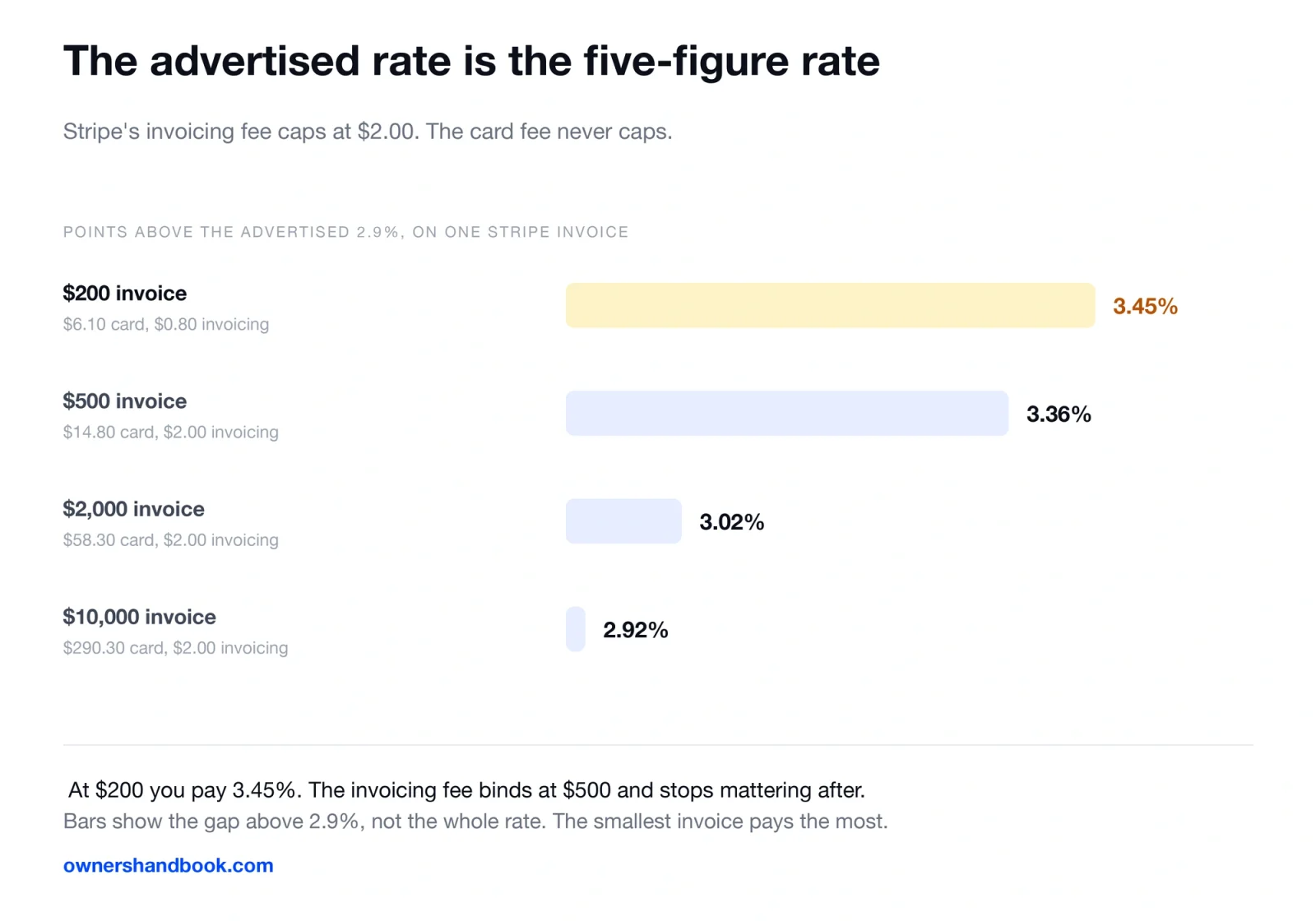
The cap inverts who the fee hurts. At 0.4% it binds at $500: below that you pay the percentage, above it a flat $2. The invoicing fee is therefore a real cost on small invoices and a rounding error on large ones — the opposite shape to the card fee, which scales forever.
| Invoice | Stripe card fee | Stripe invoicing fee | Total | Effective rate |
|---|---|---|---|---|
| $200 | $6.10 | $0.80 | $6.90 | 3.45% |
| $500 | $14.80 | $2.00 | $16.80 | 3.36% |
| $2,000 | $58.30 | $2.00 | $60.30 | 3.02% |
| $10,000 | $290.30 | $2.00 | $292.30 | 2.92% |
The advertised 2.9% is only approached at five figures. At $200 you pay 3.45%.
ACH versus card, and where the caps change the answer
This is the largest lever available to you, and the one comparison pages skip because it does not fit a two-column rate table.
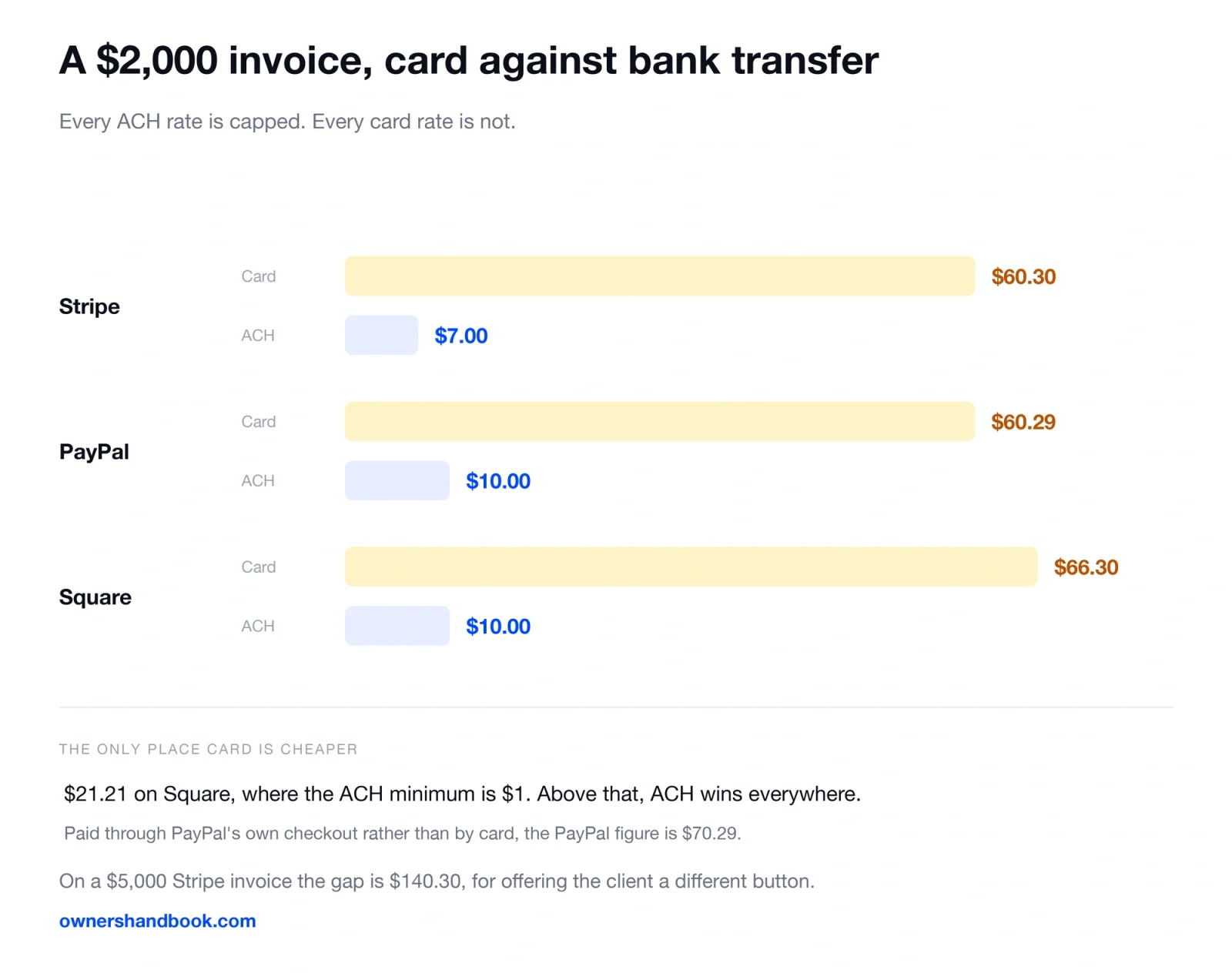
Every ACH rate above is capped. Every card rate is uncapped. That structural difference decides everything past about a thousand dollars. The caps bind here:
| Processor | ACH rate | Cap | Invoice size where the cap starts |
|---|---|---|---|
| Stripe | 0.8% | $5.00 | $625 |
| PayPal | 1% | $10.00 | $1,000 |
| Square | 1% | $10.00 | $1,000 |
Above those figures the ACH charge stops growing while the card charge carries on at roughly three per cent for ever. On one invoice:
| $2,000 invoice | Card | ACH | You keep, by paying attention |
|---|---|---|---|
| Stripe | $60.30 | $7.00 | $53.30 |
| PayPal | $70.29 via PayPal, $60.29 by card | $10.00 | $50.29 to $60.29 |
| Square | $66.30 | $10.00 | $56.30 |
On a $5,000 Stripe invoice the card path costs $147.30 and the ACH path costs $7.00. That is $140.30 for offering the client a different button.
Is there any point where card is cheaper? One, and only because of a minimum rather than a rate. Square’s invoice ACH has a $1 floor; Square’s online card rate is 3.3% + 30¢. Set them equal — 0.033X + 0.30 = 1.00 — and X = 0.70 / 0.033 = $21.21.
Below about $21 on Square, the card beats the ACH minimum. Above it, ACH wins and keeps winning. Stripe and PayPal publish no ACH minimum on these rates, so on those two ACH is cheaper from the first dollar.
That is the whole crossover. For any invoice a freelancer would actually send, bank transfer is the cheaper rail by a factor of five to twenty.
Getting the money out is a separate charge
You have been paid. The money sits in the processor’s balance, not your bank. Moving it quickly costs again.
| Payout | Published fee |
|---|---|
| PayPal instant transfer, business | 1.50% of the amount transferred, $0.50 minimum |
| PayPal instant transfer, consumer fee schedule | 1.75%, $0.25 minimum, $25.00 maximum |
| Stripe Instant Payouts | 1.5% of Instant Payouts volume, 50¢ minimum |
| PayPal standard bank transfer | No fee, where no currency conversion is involved |
An instant payout habit adds one and a half points to every payment you receive. It is the easiest charge on this list to stop paying. Standard transfer is free on PayPal; the only cost is waiting.
Cross-border and currency conversion
Two separate charges, frequently mistaken for one.
| Charge | Stripe | PayPal |
|---|---|---|
| International card | +1.5% | +1.50% |
| Currency conversion | +1% | 4.00%, or 3.00% on other transactions |
PayPal’s conversion spread is the largest single percentage anywhere in this article. Four per cent, applied to the whole amount, on top of a cross-border rate already applied to the whole amount.
If much of your work is for overseas clients, this is worth restructuring rather than absorbing. Our guide to international client payments covers holding the currency instead of converting at the platform’s spread.
Disputes, which are a flat charge on a variable invoice
| Event | PayPal | Stripe |
|---|---|---|
| Chargeback | $20.00 | Not listed separately |
| Dispute | $15.00 standard dispute fee | $15.00 received, $15.00 to respond manually |
Small numbers until you read them as a percentage of the invoice they attach to. A $20 chargeback fee on a $400 invoice is five per cent of that job, on top of everything else. One disputed invoice can cost more than a month of processing.
That argues for the boring defences rather than a cheaper processor: clear payment terms in writing, a deposit before you start, and a paper trail. Our guide to what to do when a client will not pay covers the sequence.
How you actually reach almost seven per cent
Nothing unusual is required. A $300 invoice to a client in the UK, paid through PayPal’s checkout, withdrawn instantly.
| Step | Charge | Running total |
|---|---|---|
| Base invoicing rate, 3.49% + $0.49 | $10.96 | $10.96 |
| International transaction, +1.50% | $4.50 | $15.46 |
| Instant transfer of the $284.54 balance, 1.50% | $4.27 | $19.73 |
$19.73 on $300 is 6.58%. Every figure is PayPal’s own published rate, nothing went wrong, and no comparison table predicts it — the table says 3.49%.
Add a currency conversion at 4.00% and the same invoice passes ten per cent. Shrink the invoice instead and the fixed fee does the damage alone: $0.49 on a $25 invoice is nearly two per cent before any rate applies, taking it to 5.45%.
| Invoice, PayPal checkout | Fee | Effective rate |
|---|---|---|
| $25 | $1.36 | 5.45% |
| $100 | $3.98 | 3.98% |
| $500 | $17.94 | 3.59% |
| $5,000 | $174.99 | 3.50% |
The fixed fee is why invoicing monthly beats invoicing weekly, and why splitting one project into six small payments costs real money.
What to change, in order of effect
Offer ACH and make it the default. The largest saving available — $50 to $165 on a $2,000 invoice, depending on the processor.
Stop using instant payouts. One and a half points on everything, for a delay measured in days.
Invoice in larger, less frequent amounts. The per-transaction fixed fee is regressive against small invoices.
**Avoid converting currency at the platform spread.**
Match the processor to your invoice size. Small invoices favour the lower fixed fee; large ones favour the lower percentage and the lower ACH cap. Our comparison of invoicing software and of accounting software for freelancers covers what else the fee buys.
Every one of these is deductible
Payment processing fees are ordinary business expenses. They go on Schedule C and reduce your taxable profit, along with the rest of your freelance tax deductions.
One practical consequence. A 1099-K reports the gross the platform settled, before any fee came out. Report the net figure you saw in your bank account and your return will not match the form — and you will have silently given up the deduction. Report the gross, deduct the fees.
At a 3.5% effective rate on $60,000 of invoicing, that deduction is $2,100 of expense. Worth claiming.
Frequently asked questions
Why is my PayPal rate different on different invoices?
Because PayPal charges 3.49% + $0.49 when the invoice is paid through PayPal or Venmo and 2.99% + $0.49 when it is paid by card. The client’s choice, not yours.
Is ACH always cheaper than card?
On Stripe and PayPal, yes, at every amount — neither publishes an ACH minimum on these rates. On Square the $1 ACH minimum makes card marginally cheaper below about $21.21. Above that ACH wins everywhere, and the gap widens past the cap.
What is the cheapest way to get paid by a US client?
A bank transfer you do not instantly withdraw. On Stripe that is a capped $5 plus the $2 invoicing cap, whatever the invoice size.
Does the fixed fee matter?
Only on small invoices, where it matters a lot. $0.49 is 2% of a $25 invoice and 0.01% of a $5,000 one. It is the reason to batch.
Can I pass the fee on to the client?
Sometimes, and it is more restricted than people assume. PayPal’s User Agreement prohibits surcharging for accepting PayPal outright, before state law or card network rules are even reached.
Are chargeback fees refunded if I win?
Refund conditions vary by processor and are set out in the agreement you accepted. The published fees are $20.00 for a PayPal chargeback and $15.00 for a Stripe dispute received.
Should I charge late fees to cover this?
They are separate problems. Processing fees are a cost of the transaction; late payment fees address a client holding your money. The late fee calculator works out a figure for the second.
Sources
Stripe, Pricing
Stripe, Invoicing Pricing
https://stripe.com/invoicing/pricing
PayPal, Merchant Fees
https://www.paypal.com/us/webapps/mpp/merchant-fees
PayPal, Consumer Fees
https://www.paypal.com/us/webapps/mpp/paypal-fees
PayPal, User Agreement for PayPal Services
https://www.paypal.com/us/legalhub/useragreement-full
Square, Our Fees