Stop Putting Your SSN on W-9s
An EIN is a nine-digit federal tax ID for a business. It is free, you apply for it at irs.gov, and the online application issues the number on the spot. You do not need employees, an LLC, or any particular income to have one. A sole proprietor can get an EIN for no reason other than not wanting to write a Social Security number on one more W-9.
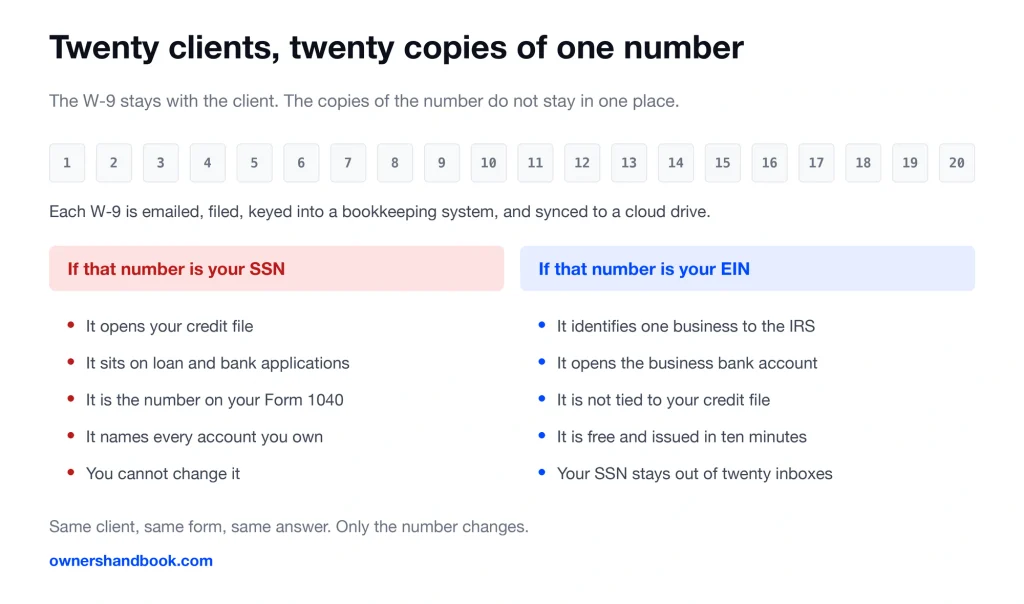
Count your clients
Twenty clients in a year is an ordinary year. That is twenty W-9s.
Each one asked for a name and a taxpayer identification number, and most freelancers wrote the only number they own.
So your Social Security number is now sitting in twenty companies’ records.
Not twenty filing cabinets, either. Each copy was emailed, keyed into an accounts payable system, forwarded to a bookkeeper, and synced to somebody’s cloud drive.
None of those places is under your control, and there is no way to ask for the copies back.
You also cannot rotate the number the way you rotate a password. It is the same one on your credit file, your loan applications, and your Form 1040.
An EIN answers the same question, on the same line, for free, in about ten minutes.
What an EIN is, and who needs one
EIN stands for employer identification number, which is a misleading name. Employees are one reason to get one, not the only reason.
It is nine digits, written like 12-3456789, and the IRS uses it to identify a business the way an SSN identifies a person.
It is not a business license. It is not an LLC. It is not a tax status.
Getting one changes nothing about how you are taxed. Same Schedule C, same self-employment tax, same quarterly payments, same everything.
A sole proprietor with an EIN is still a sole proprietor. That is a normal thing to be.
What changes is which number you hand to strangers.
Most freelancers are not required to have an EIN. The IRS lists the cases that require one, and they are specific.
You need an EIN if you have employees, if you will pay employment, excise, or alcohol, tobacco and firearms taxes, or if you withhold tax on non-wage income paid to a non-resident alien.
You also need one to operate as a partnership or a corporation, and certain retirement plans are issued their own.
If none of that describes you, the IRS is direct about the rest. You can still request one for banking or state tax purposes.
| Situation | Required | Why |
|---|---|---|
| Sole proprietor, no employees | No, but you may request one | The IRS allows a request for banking or state tax purposes |
| You hire your first employee | Yes | Employment tax returns are filed under an EIN |
| You will pay excise taxes | Yes | Listed by the IRS as a required case |
| You withhold on payments to a non-resident alien | Yes | Listed by the IRS as a required case |
| You form a partnership | Yes | The partnership files its own return |
| You form a corporation | Yes | The entity files its own return |
| Single-member LLC with no employees | No, unless it files employment or excise tax | Otherwise it uses the owner’s number |
| You want your SSN off client paperwork | No, and it is a fine reason | The W-9 permits either number |
Ten minutes at irs.gov
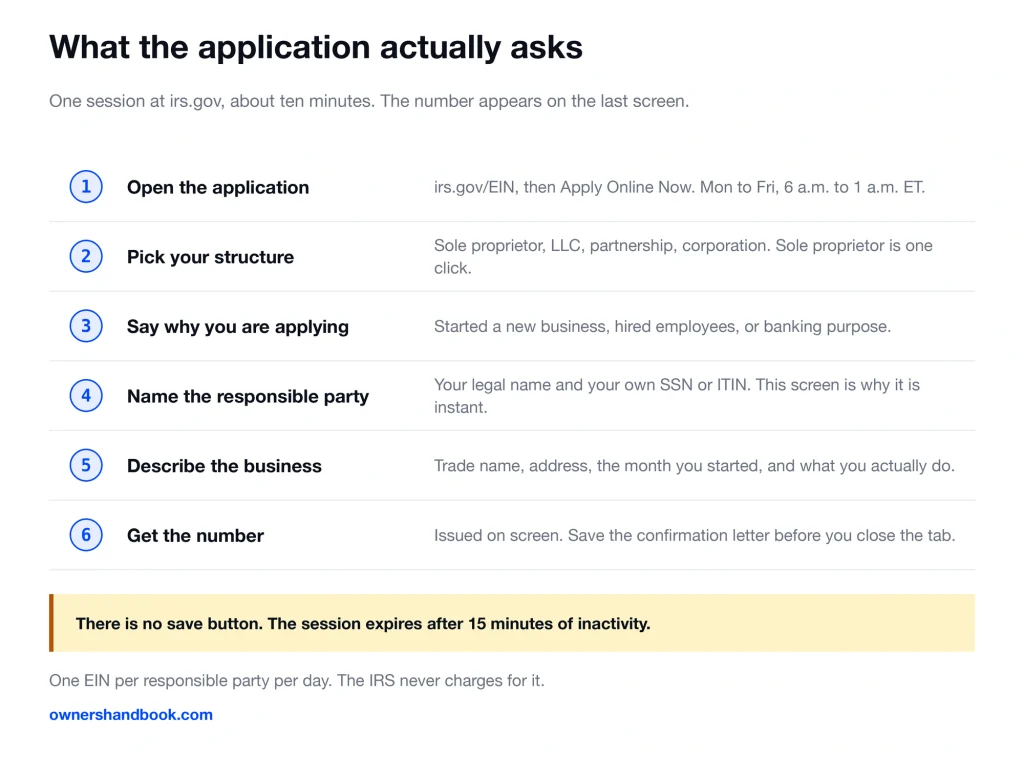
The application lives at irs.gov/EIN. The link you want says Apply Online Now.
It is not open around the clock. Monday through Friday, 6 a.m. to 1 a.m. Eastern. Saturday, 6 a.m. to 9 p.m. Sunday, 6 p.m. to midnight.
You have to finish in one sitting. There is no save button, and the session expires after 15 minutes of inactivity.
The screens ask for your structure, your reason for applying, the responsible party, and a plain description of what the business does.
The responsible party is you. That screen wants your own SSN or ITIN, which is how the IRS confirms who you are without mailing anything.
So yes, you type your SSN once, into an IRS form, at an agency that already has it. That is a different thing from typing it into twenty client onboarding portals.
If the application is approved, the number is issued immediately on screen. Save or print the confirmation letter before you close the tab.
One more limit worth knowing. The IRS issues only one EIN per responsible party per day.
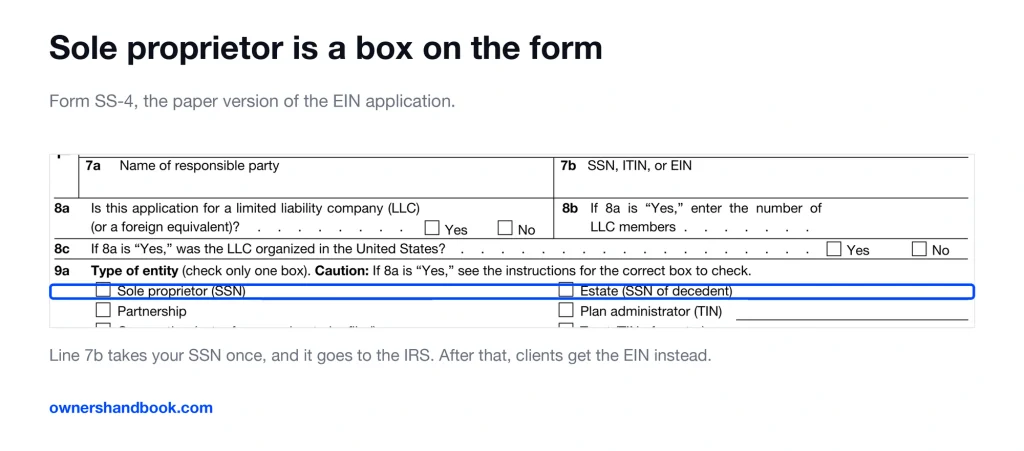
If you cannot use the online tool, Form SS-4 is the same application on paper.
By fax you generally get the number back within about four business days. By mail it takes roughly four weeks, so the instructions tell you to send it four to five weeks ahead.
Applicants with no legal residence or place of business in the United States can apply by phone at 267-941-1099, weekdays, 6 a.m. to 11 p.m. Eastern.
Nobody should be charging you for this
Search for EIN and the paid filing services rank above the IRS. They charge anywhere from $50 to a few hundred dollars.
The IRS says it in one line on its own page: beware of websites that charge for an EIN, and you never have to pay a fee for an EIN.
Those sites are not committing a crime. They are charging you for a free form, and several of them are designed to look like a government page.
Start at irs.gov. Type the address yourself.
Putting it in the TIN box on the W-9
Part I of the W-9 is two boxes, Social security number and Employer identification number. You fill exactly one of them.
The instructions permit the swap in a single sentence. If you are a sole proprietor and you have an EIN, you may enter either your SSN or EIN.
Line 1 does not change. Your legal name stays there, because the IRS matches that name against whichever number you wrote.
A single-member LLC that is disregarded enters the owner’s SSN, or the owner’s EIN if the owner has one. The LLC’s own EIN is not the answer on that line.
One honest caveat. A footnote in the same instructions says the IRS encourages you to use your SSN. That is a preference stated after the rule, not the rule.
Then send a fresh W-9 to the clients you already have. They will issue next January’s 1099 against whatever number is on file.
A separate account is the other half
The EIN keeps your SSN off the paperwork. A separate bank account keeps your business out of your grocery receipts.
A sole proprietor is not legally required to have one. Nothing in the tax code says your work needs its own checking account.
It is still the highest-leverage hour you will spend on your books all year.
Here is the mechanical reason. Schedule C makes you sort a year of spending into twenty expense categories.
With one account, you do that by reading every line of twelve statements and deciding from memory which charges were work. That is a weekend.
With two accounts, you export one statement and most of the sorting already happened, every time you reached for the right card. That is an hour.
The Small Business Administration puts the other reason plainly. Business banking offers limited personal liability protection by keeping your business funds separate from your personal funds.
For an LLC, that sentence carries more weight than it looks like it does.
An LLC’s liability shield is a creature of state law, and a court can look past it when the owner treated the company as an extension of themselves.
Paying personal bills out of the business account is the textbook version of that argument. The word for it is commingling.
Nobody loses a shield over one transfer. They lose it when there was never a line to cross in the first place.
| What you are doing | One account for everything | A separate business account |
|---|---|---|
| Filling in Schedule C | Read twelve statements line by line, from memory | Export one statement, mostly sorted |
| Explaining a charge from March | Reconstruct it a year later | The account it sits in is the answer |
| Handing records to an accountant | A pile, billed by the hour | One file |
| Seeing what the business earned | An estimate | The balance |
| Showing an LLC was separate | The weakest fact you can offer | A clean, boring record |
If you have an LLC, open the account in the LLC’s name. If you are a sole proprietor, a second personal checking account used only for work does most of the job.
The bank will ask for your EIN, or your SSN if you are a sole proprietor without one. That is one more reason the ten minutes are worth it.
Money you move from the business account to your own is an owner’s draw. It is not a paycheck and it is not an expense.
When you need a new one
An EIN belongs to the business, not to you, so changing the business can break it.
A sole proprietor needs a new EIN after incorporating, forming a partnership, or declaring bankruptcy.
A sole proprietor does not need a new one for changing the business name, moving, or owning multiple businesses.
That last one catches people. The SS-4 instructions are blunt: a sole proprietor should file only one Form SS-4 and needs only one EIN, regardless of the number of businesses operated.
An LLC that terminates and forms a new entity needs a new EIN. An LLC that elects corporation or S corporation treatment keeps the one it has.
If you misplace the number, check the notice the IRS sent when it was issued, ask the bank holding the account, or look at a past business return.
The IRS will also look it up for you at 800-829-4933, Monday through Friday, 7 a.m. to 7 p.m. local time.
Frequently asked questions
Does getting an EIN change how much tax I pay?
No. It is an identifier, not a structure. You file the same Schedule C and owe the same self-employment tax as the day before you got it.
Do I need an LLC before I can get an EIN?
No. A sole proprietor with no LLC and no employees can apply, and the IRS explicitly allows requesting one for banking purposes.
Can I really put an EIN on a W-9 instead of my SSN?
Yes. The W-9 instructions say a sole proprietor with an EIN may enter either number. Line 1 still shows your legal name.
I already gave a dozen clients my SSN. Is it too late to bother?
Those copies are out, and an EIN does not recall them. It stops the number from spreading to the next dozen, which is the part you still control.
Do I have to open a business bank account?
Not as a sole proprietor. As an LLC owner, separate accounts are part of what keeps the liability shield credible, and either way it turns a weekend of bookkeeping into an hour.
How much does an EIN cost?
Nothing. The IRS charges no fee and states on its own site that you never have to pay for one. Any site quoting a price is reselling a free form.
One caution. Getting an EIN is free and takes minutes at irs.gov, and any site charging you for one is selling something the IRS gives away. Nothing here is legal or tax advice.
Sources
IRS, Employer identification number
https://www.irs.gov/businesses/employer-identification-number
IRS, Get an employer identification number
https://www.irs.gov/businesses/small-businesses-self-employed/get-an-employer-identification-number
IRS, Do you need a new EIN?
https://www.irs.gov/businesses/small-businesses-self-employed/do-you-need-a-new-ein
IRS, About Form SS-4, Application for Employer Identification Number
https://www.irs.gov/forms-pubs/about-form-ss-4
IRS, Instructions for Form SS-4
https://www.irs.gov/instructions/iss4
IRS, Form W-9 (Rev. March 2024)
https://www.irs.gov/pub/irs-pdf/fw9.pdf
U.S. Small Business Administration, Open a business bank account
https://www.sba.gov/business-guide/launch-your-business/open-business-bank-account