What Actually Triggers an IRS Audit When You Work for Yourself
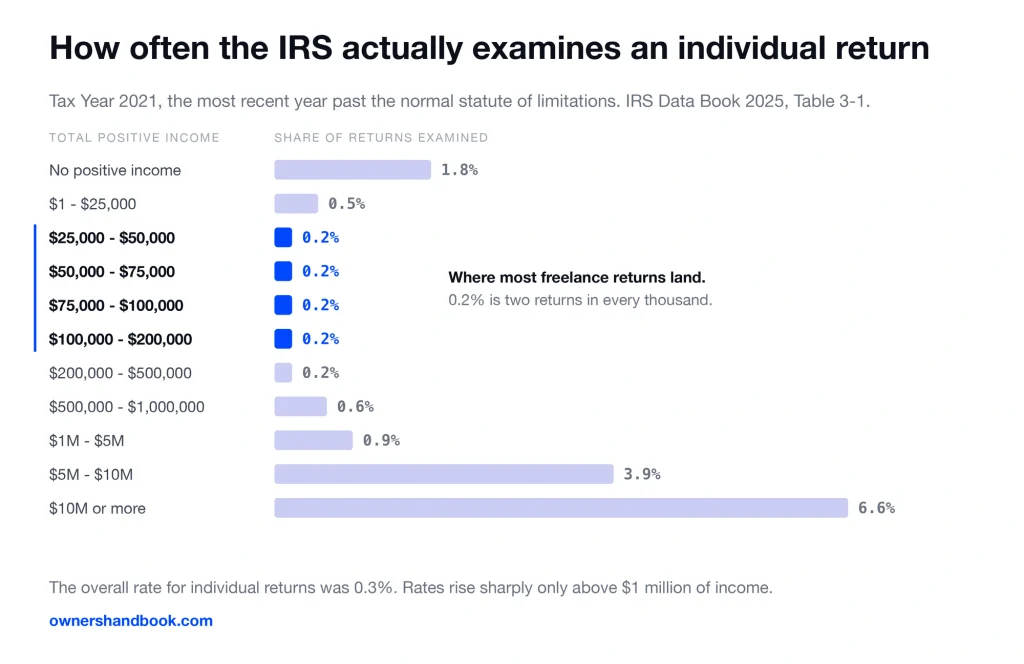
The IRS examined 0.3% of individual income tax returns filed for tax year 2021, the most recent year past the normal statute of limitations.
In the bands where most freelancers file, the rate was 0.2% — two returns in every thousand.
What raises your odds is rarely that you work for yourself. It is a number a computer can already see does not match.
Start with the base rate
The IRS Data Book is the agency’s own annual count of what it did. The most recent published edition covers Fiscal Year 2025, which ran October 1, 2024 through September 30, 2025.
Audit rates in it are reported by tax year, not fiscal year, because an examination can open years after a return is filed.
The Data Book flags Tax Year 2021 as the most recent year outside the normal statute period, so those rates are close to final.
For Tax Year 2021, about 161.2 million individual returns were filed and roughly 510,000 were examined. That is 0.3%.
Break it out by total positive income and the picture gets calmer, not scarier. Between $25,000 and $500,000, every band sits at 0.2%.
Say your Schedule C shows $92,000 of gross receipts and $68,000 of profit. You are in the $75,000 to $100,000 band. About two returns in every thousand there were examined.
The rate does not really move until $1 million. At $5 million to $10 million it is 3.9%, and at $10 million or more it is 6.6%.
Most IRS mail is not an audit
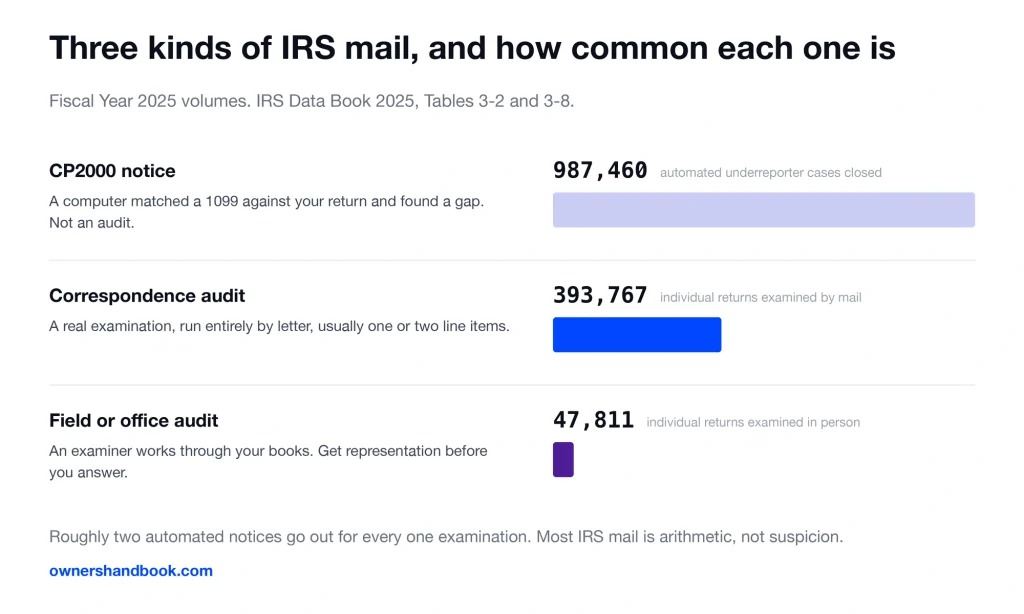
In Fiscal Year 2025 the IRS closed 497,621 tax return audits across every return type. In the same year it closed 987,460 cases under the Automated Underreporter Program.
That second program is the CP2000 machine. It compares the 1099s, W-2s and 1098s that third parties filed against what your return says, and when the totals disagree it sends a letter.
Two automated notices go out for roughly every one examination. The odds that IRS mail is arithmetic rather than suspicion are good.
The IRS is explicit about what a CP2000 is not. In its own words the notice “isn’t a bill,” and it does not open an examination. It proposes a change and asks you to agree or disagree.
The money follows the same shape. Automated Underreporter cases produced $5.9 billion in additional assessments in FY 2025. Examinations produced $26.8 billion.
The three letters, and what each one means
Of the 441,578 individual returns examined in FY 2025, 393,767 were handled entirely by mail. Only 47,811 involved a person.
That is 89% by correspondence. A correspondence audit is a real examination, but it is a letter asking for proof of one or two specific lines, not someone going through your books.
| What arrives | What it actually is | Your first move |
|---|---|---|
| CP2000 notice | A computer matched a third-party form to your return and found a gap. Not an audit, not a bill. | Reply by the date printed on the notice, agreeing or disagreeing in writing |
| Correspondence audit | An examination run by mail, usually limited to one or two line items | Send copies of the records for those lines only. Nothing else. |
| Office audit | In person at an IRS office, broader scope | Bring exactly what the letter lists. Consider bringing a representative. |
| Field audit | An examiner comes to your home or business | Get a CPA, enrolled agent or attorney involved before you answer anything |
One rule covers all four. The IRS opens contact by mail. It does not open with a phone call, a text or an email, so anything that does is not the IRS.
The 1099 mismatch is close to automatic
This is the single most common reason a self-employed person hears from the IRS, and it has nothing to do with judgment.
Gross receipts on line 1 of your Schedule C must be at least the sum of every 1099-NEC and 1099-K reporting money paid to you. If it is less, the computer notices.
Here is where freelancers get caught. A client pays you $8,000 through a platform that keeps a $400 fee, so $7,600 lands in your account. The 1099 says $8,000.
Report $7,600 and you have a $400 gap on paper. Report $8,000 and deduct the $400 as a fee, and you owe tax on the same amount with no mismatch.
The 1099-K version is worse. You can receive a 1099-K from the platform and a 1099-NEC from the client for the same dollars.
Report your real income once, then reconcile the forms against your own books so you can explain the difference if asked.
The reverse gap is fine. Clients who paid you under the $2,000 1099-NEC threshold for 2026 send no form at all, and you still report that income. Reporting more than the forms show never triggers a notice.
The deductions that get a second look
None of these are forbidden. Each one is a claim that is often true and sometimes obviously not, which is exactly what a screening system looks for.
100% business use of a vehicle. If you own one car and no other, a claim that none of its miles were personal is hard to believe.
The 2026 standard mileage rate is 72.5 cents through June 30 and 76 cents from July 1, so 9,000 business miles is worth roughly $6,700. Log them and claim the real percentage.
A home office on a space that is not exclusive. The IRS requirement is that you “regularly use part of your home exclusively for conducting business.”
A dining table you also eat at fails that test no matter how many hours you work there. The simplified method pays $5 a square foot up to 300 square feet, capping at $1,500.
Business meals that are large next to revenue. Meals come off at 50%. Nine thousand dollars of meals against $60,000 of gross receipts is 15% of the business going to lunch, and that ratio is visible on the return.
Round numbers. Real bookkeeping produces $4,317, not $5,000. A Schedule C with $12,000 of supplies, $5,000 of meals and $3,000 of office expense reads as estimated rather than recorded.
Losing money three years running
A business that never makes money looks like a hobby with deductions attached, and losses that offset W-2 wages are the version the IRS cares about most.
The statute gives a presumption, not a rule. Show a profit in three of five consecutive years and your activity is presumed to be carried on for profit.
Below that, the presumption is gone. You can still be a business — plenty of real ones lose money for years — but the burden of showing a profit motive moves to you.
What carries that burden is ordinary evidence. Separate bank account, written invoices, a record of changing what was not working, marketing you actually paid for.
What to save, and how long
The audit window is not open forever, and the record retention rules follow it exactly.
| Situation | How long the IRS can assess | How long to keep records |
|---|---|---|
| Return filed on time, no large omission | 3 years from the due date | 3 years |
| Income understated by more than 25% of gross income shown | 6 years | 6 years |
| Return never filed | No limit | Indefinitely |
| Fraudulent return | No limit | Indefinitely |
In practice the IRS says it usually does not go back more than six years, and it focuses on the last two.
Keep the four things that answer a correspondence audit on their own. Bank and card statements, the 1099s you received, your invoices, and a contemporaneous mileage log.
A bank statement alone proves a payment happened, not that it was for business. Write the purpose on the receipt or in your bookkeeping the week it happens, because reconstructing it two years later is the part that fails.
What to do the day one arrives
Read it before you pay it. A surprising share of CP2000 notices are wrong, most often because a 1099-K and a 1099-NEC reported the same money twice.
Respond by the date on the letter even if your answer is “I disagree, here is why.” Silence turns a proposal into an assessment, and interest runs from the original due date either way.
Send copies, never originals, and send only what was requested. Volunteering three extra years of records invites three extra years of questions.
For anything in person, get representation before the first meeting. Form 2848 lets a CPA, enrolled agent or attorney deal with the examiner directly, and it is the cheapest insurance in this entire article.
Frequently asked questions
Does claiming a home office make an audit more likely?
There is no published IRS data showing the home office deduction by itself raises audit odds. What creates exposure is claiming space that fails the exclusive-use test, because that is the part an examiner can disprove.
I got a CP2000. Do I need a CPA?
Usually not. If the notice is right, you agree and pay. If it double-counted a 1099-K and a 1099-NEC, a one-page letter with your income summary attached generally resolves it.
My 1099 shows more than I actually received. What do I report?
Report your actual income, and report the gross amount the 1099 shows on line 1 with the difference taken as an expense. Ask the payer for a corrected form if the number is simply wrong.
How far back can the IRS go?
Generally three years from when the return was due. Six years if income was understated by more than 25% of the gross income shown. No limit at all if you never filed or filed fraudulently.
Does filing an extension raise my odds?
Nothing in the IRS description of how returns are selected mentions filing dates. Selection runs on computer screening against statistical norms, third-party document matching, and related examinations.
Is an LLC or S corp audited less than a Schedule C?
The published rates are lower. For Tax Year 2021, partnership and S corporation returns were each examined at 0.1% against 0.3% for individual returns. That is a weak reason to change entity structure on its own.
Sources
IRS, SOI Tax Stats — IRS Data Book
https://www.irs.gov/statistics/soi-tax-stats-irs-data-book
IRS Data Book 2025, Publication 55-B (Tables 3-1, 3-2, 3-8)
https://www.irs.gov/pub/irs-pdf/p55b.pdf
IRS, IRS Audits
https://www.irs.gov/businesses/small-businesses-self-employed/irs-audits
IRS, Understanding Your CP2000 Notice
https://www.irs.gov/individuals/understanding-your-cp2000-notice
IRS, How Long Should I Keep Records
https://www.irs.gov/businesses/small-businesses-self-employed/how-long-should-i-keep-records
IRS, Home Office Deduction
https://www.irs.gov/businesses/small-businesses-self-employed/home-office-deduction
IRS, Publication 587, Business Use of Your Home
https://www.irs.gov/forms-pubs/about-publication-587
IRS, Publication 556, Examination of Returns, Appeal Rights, and Claims for Refund
https://www.irs.gov/forms-pubs/about-publication-556
IRS, Form 2848, Power of Attorney and Declaration of Representative
https://www.irs.gov/forms-pubs/about-form-2848
Legal Information Institute, 26 U.S.C. 6501, Limitations on Assessment and Collection
https://www.law.cornell.edu/uscode/text/26/6501
Legal Information Institute, 26 U.S.C. 183, Activities Not Engaged in for Profit