New Jersey Freelancers: The Rules Are Different From New York’s
New Jersey taxes your freelance profit from 1.4% to 10.75%. That is New Jersey state tax, charged on top of the US federal tax you already owe the IRS.
Two rules catch people. A business loss does not shelter your other income. And New York clients do not automatically mean New York tax.
What the state actually charges
New Jersey’s gross income tax is graduated. For 2026 a single filer runs from 1.4% on the first $20,000 to 10.75% above $1 million.
There is no New Jersey version of self-employment tax. Social Security and Medicare are federal, and that 15.3% does not repeat here.
| Taxable income, single | Rate | The tax |
|---|---|---|
| $0 to $20,000 | 1.4% | 1.4% of the amount |
| $20,000 to $35,000 | 1.75% | The amount x .0175, minus $70 |
| $35,000 to $40,000 | 3.5% | The amount x .035, minus $682.50 |
| $40,000 to $75,000 | 5.525% | The amount x .05525, minus $1,492.50 |
| $75,000 to $500,000 | 6.37% | The amount x .0637, minus $2,126.25 |
| $500,000 to $1,000,000 | 8.97% | The amount x .0897, minus $15,126.25 |
| Over $1,000,000 | 10.75% | The amount x .1075, minus $32,926.25 |
New Jersey has no standard deduction. You get a $1,000 personal exemption, $1,000 more at 65, and $1,500 per dependent.
It also starts from its own definition of income, not from your federal adjusted gross income. The deduction for half your self-employment tax does not carry over. Neither does the qualified business income deduction.
New Jersey sorts income into buckets, and losses stay in their bucket
Category of income — New Jersey sorts income into buckets and mostly will not let a loss in one bucket reduce another.
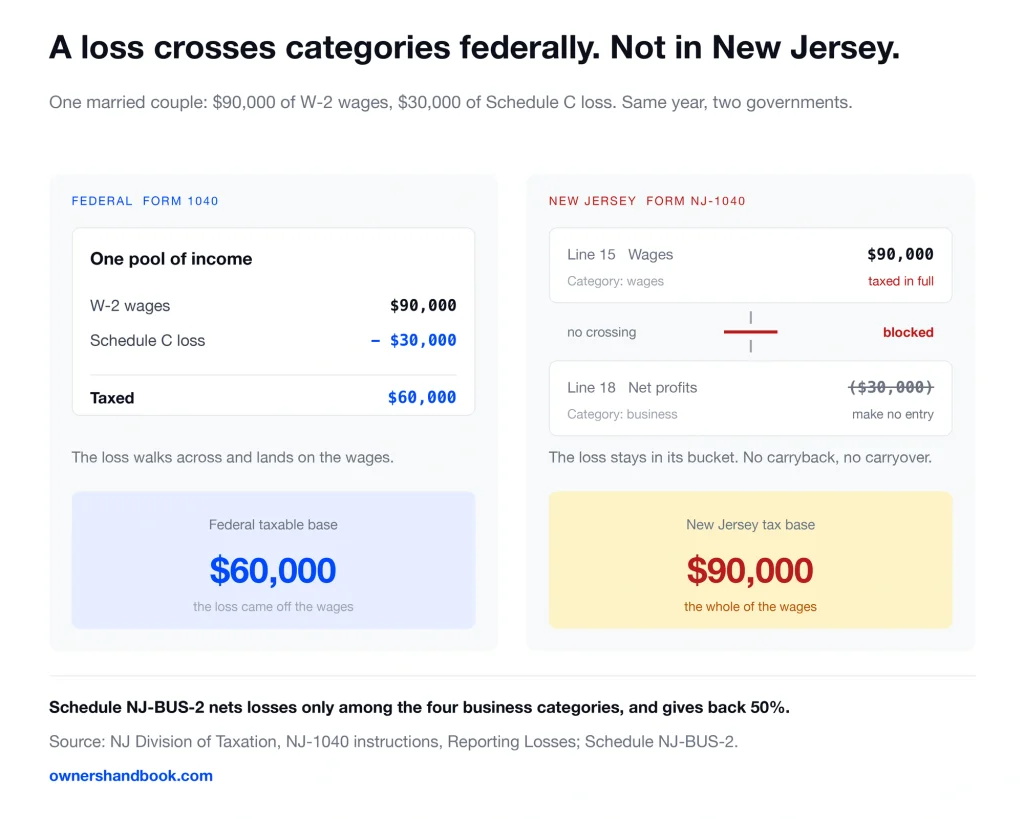
The instructions say it flatly: you cannot apply a net loss in one category of income against income or gains in a different category.
Federal tax does not work this way. On Form 1040, a $30,000 Schedule C loss walks straight across and cuts your spouse’s wages by $30,000.
In New Jersey it does not move. Net profits from business is line 18. Wages are line 15. The loss sits on line 18 and stops there.
And you do not even write it down. If your business ran a loss, you make no entry on line 18. Not a zero, not a number in parentheses. Nothing.
There is no carryback and no carryover of losses on the NJ-1040. A brutal year buys you nothing next year.
So a couple where one spouse earns $90,000 in wages and the other loses $30,000 freelancing pays New Jersey tax on the full $90,000.
The alternative business calculation adjustment gives back half
There is one escape hatch, and it is narrower than it sounds. Schedule NJ-BUS-2 lets you net losses across the four business categories: sole proprietorship profits, partnership distributive share, S corporation share, and rents and royalties. Not against wages.
Take the total you actually reported, subtract the netted business figure, and deduct 50% of the difference. The adjustment percentage on line 10 is fixed at 0.50.
Unused losses carry forward on this schedule for up to 20 years, but only to compute future adjustments.
So a freelancer with $60,000 of Schedule C profit and a $20,000 rental loss deducts $10,000, not $20,000. Half of the offset, and only inside the business buckets.
New York clients are not New York income
New York taxes a nonresident on a business carried on in New York State. Carried on means you have, maintain, operate or occupy desk space, an office, a shop or other place in New York where you regularly transact your business.
It is about where you sit, not where your clients sit. Work from an apartment in Jersey City for a dozen Manhattan agencies and none of that profit is New York source income.
Note the parenthetical in New York’s own definition: not including personal service as an employee. New York’s convenience of the employer rule is a rule about W-2 jobs. A 1099 freelancer with no New York workspace is outside it.
Rent a desk in Manhattan two days a week and the picture changes. Now part of the business is carried on in New York, and you file Form IT-203 as a nonresident.
One Jersey City freelancer at $110,000, worked two ways
Single, $110,000 of net profit on Schedule C, all clients in New York City, no other income.
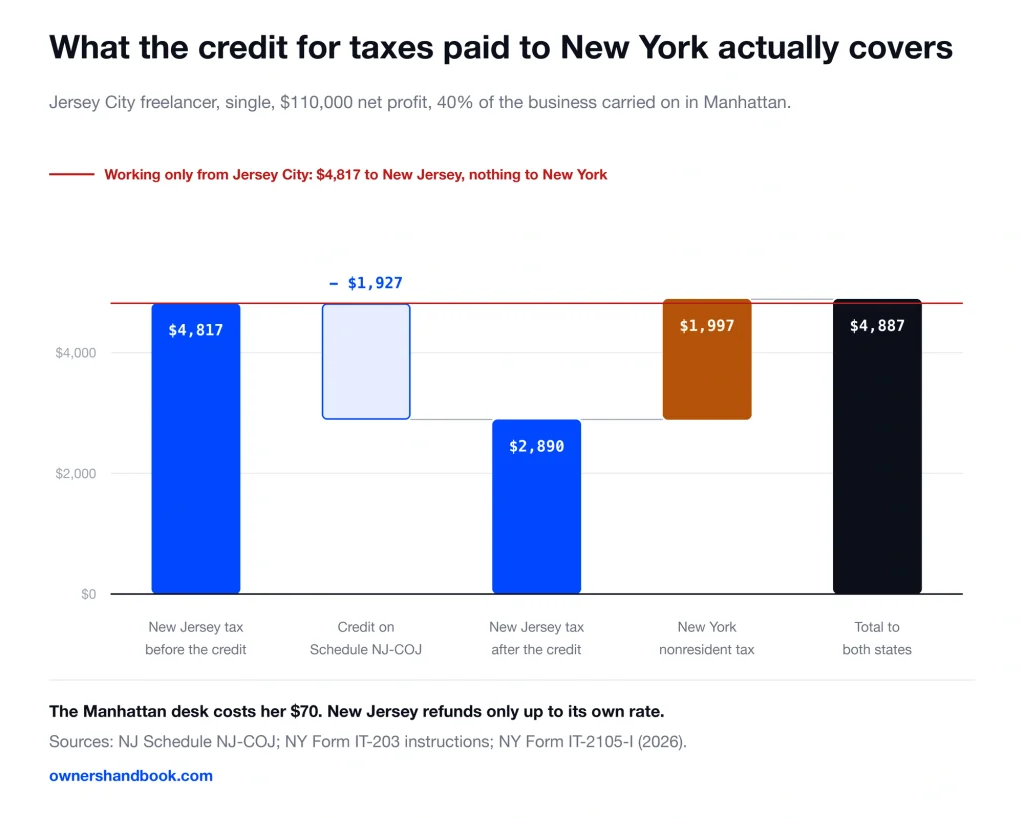
Her New Jersey tax is the same in both versions. Gross income $110,000, minus the $1,000 exemption, is $109,000 of taxable income. At 6.37% minus $2,126.25 that is $4,817.
Version one: she works only from her Jersey City apartment. No New York workspace, so no New York source income, no IT-203, and nothing to claim a credit for. She pays $4,817 and is done.
Version two: she rents a desk in Manhattan and allocates 40% of the business there. New York now wants $44,000 worth.
New York computes the tax as if she were a resident, then charges her share. Federal AGI is $102,229 after half her self-employment tax, less the $8,000 New York standard deduction, leaving $94,229.
That produces a base tax of $4,191 plus 5.90% of the excess over $80,650, which is $4,992. Multiply by the 40% New York share and New York’s bill is about $1,997.
The credit is a percentage, not a refund
Schedule NJ-COJ, Credit for Income or Wage Taxes Paid to Other Jurisdictions. New Jersey’s own instructions warn that it is not necessarily a dollar-for-dollar credit.
The math is a ratio. Divide the income taxed by both states by your New Jersey gross income, then apply that percentage to your New Jersey tax.
$44,000 divided by $110,000 is 40%. Forty percent of $4,817 is $1,927. Your credit is the lesser of that figure and the tax you actually paid New York.
| The $110,000 example | Works only in Jersey City | Manhattan desk, 40% allocated |
|---|---|---|
| Income New York taxes | $0 | $44,000 |
| New York nonresident tax | $0 | about $1,997 |
| New Jersey tax before the credit | $4,817 | $4,817 |
| Credit on Schedule NJ-COJ | $0 | $1,927 |
| New Jersey tax after the credit | $4,817 | $2,890 |
| Total state tax | $4,817 | $4,887 |
The $70 gap is the whole lesson. New York taxed that slice at a slightly higher rate than New Jersey would have, and New Jersey only refunds up to its own rate.
You do not owe New York City anything
New York City’s income tax is charged on New York City residents. Live in New Jersey and it does not reach you, no matter how many days you spend in Manhattan.
The city’s unincorporated business tax is different. It can reach a nonresident, because it taxes a business carried on in the city rather than a person. The New York guide covers it.
No New Jersey municipality taxes individual income. The NJ-1040 has no city line on it, because there is no city tax to collect.
Newark’s payroll tax is charged to employers on the wages they pay. A one-person business with no payroll never meets it.
Four dates, a $400 line, and a safe harbor
If you expect to owe more than $400 to New Jersey after withholding and credits, you are required to make estimated payments on Form NJ-1040-ES.
For 2026 the dates are April 15, June 15, September 15, and January 15, 2027. The same four dates the IRS uses, but paying the IRS does not pay Trenton.
Our freelancer owes $4,817, well over the line. Four installments of about $1,204.
Two ways to avoid the interest charge. Pay at least 80% of this year’s tax, or pay 100% of last year’s tax, provided last year’s return covered a full 12 months.
New Jersey calls it Exception 1 on Form NJ-2210, and if you meet it you do not file the form at all. Interest runs at the prime rate plus 3%, compounded annually.
LLC: the annual report and the per-partner fee
An annual report goes to the Division of Revenue and Enterprise Services every year. For an LLC it costs $75. Forming one costs $100, and reinstating a revoked one costs $75 again.
The partnership filing fee is the number that surprises people. $150 per owner, up to $250,000, plus a 50% installment toward next year’s fee at the same time.
Read the trigger carefully. It applies to entities with more than two owners. A single-member LLC files no NJ-1065 at all, and a two-member LLC owes no filing fee.
Three partners is where it starts: $450, due the 15th day of the fourth month after the close of the year, which is April 15 for calendar-year filers.
None of this is income tax. The fee is charged to the entity, and your share of the profit still lands on your NJ-1040, on line 21 rather than line 18.
Frequently asked questions
My freelance business lost money. Can I use it against my W-2 job?
No. Wages and net profits from business are different categories of income, and New Jersey does not let a loss in one reduce the other. Make no entry on line 18.
All my clients are in New York. Do I file a New York return?
Only if the business is carried on in New York, meaning you regularly work from a place there. Working from home in New Jersey for New York clients is New Jersey income.
Does New Jersey tax me on the same income New York already taxed?
Yes, but Schedule NJ-COJ credits you for it. The credit is your New Jersey tax multiplied by the share of income both states taxed, capped at what you actually paid New York.
Do I pay New York City tax if I commute to Manhattan?
No. New York City’s income tax applies to city residents. The city’s unincorporated business tax is separate and can reach a nonresident who carries on a business there.
I have a single-member LLC. Do I owe the $150 per-partner fee?
No. The filing fee applies to entities treated as partnerships with more than two owners. A single-member LLC is a sole proprietorship for tax purposes and files Schedule C.
What happens if I skip a quarterly payment?
Interest on the shortfall at the prime rate plus 3%, compounded annually, calculated on Form NJ-2210. Paying 100% of last year’s tax stops it regardless of what you end up owing.
For the federal layer underneath all of this, see the guides on self-employment tax, quarterly estimated taxes, how to pay estimated taxes, what belongs on Schedule C, and how state tax works in the other states.
Sources
New Jersey Division of Taxation, Instructions for Form NJ-1040 (Resident Return), including Reporting Losses, Schedule NJ-BUS-1, and Schedule NJ-COJ
https://www.nj.gov/treasury/taxation/pdf/current/1040i.pdf
New Jersey Division of Taxation, Form NJ-1040 (Resident Income Tax Return)
https://www.nj.gov/treasury/taxation/pdf/current/1040.pdf
New Jersey Division of Taxation, Form NJ-1040-ES, Estimated Tax Vouchers and Instructions (2026)
https://www.nj.gov/treasury/taxation/pdf/current/1040esi.pdf
New Jersey Division of Taxation, Estimated Tax Payments
https://www.nj.gov/treasury/taxation/njit20.shtml
New Jersey Division of Taxation, Form NJ-2210, Underpayment of Estimated Tax by Individuals, Estates, or Trusts
https://www.nj.gov/treasury/taxation/pdf/current/2210.pdf
New Jersey Division of Taxation, Schedule NJ-BUS-2, Alternative Business Calculation Adjustment
https://www.nj.gov/treasury/taxation/pdf/current/resbus2.pdf
New Jersey Division of Taxation, Instructions for Form NJ-1065, Partnership Return and Filing Fee
https://www.nj.gov/treasury/taxation/pdf/current/1065i.pdf
New Jersey Division of Revenue and Enterprise Services, Registry Fee Schedules
https://www.nj.gov/treasury/revenue/fees.shtml
New Jersey Division of Revenue and Enterprise Services, Annual Reports and Change Services
https://www.njportal.com/DOR/AnnualReports
New York State Department of Taxation and Finance, Instructions for Form IT-203, Nonresident and Part-Year Resident Income Tax Return
https://www.tax.ny.gov/pdf/current_forms/it/it203i.pdf
New York State Department of Taxation and Finance, Instructions for Form IT-2105, Estimated Tax Payment Voucher for Individuals (2026)
https://www.tax.ny.gov/pdf/current_forms/it/it2105i.pdf
New York State Department of Taxation and Finance, New York City and Yonkers Tax