Oregon Has No Sales Tax. Portland Freelancers Pay for It Elsewhere.
Oregon charges no sales tax. It pays for that with an income tax that hits 8.75% before you clear $12,000 of taxable income, and a Portland freelancer stacks four more taxes on top of that.
All of it is Oregon state and local tax, on top of what you already owe the IRS. None of it replaces federal self-employment tax or federal income tax.
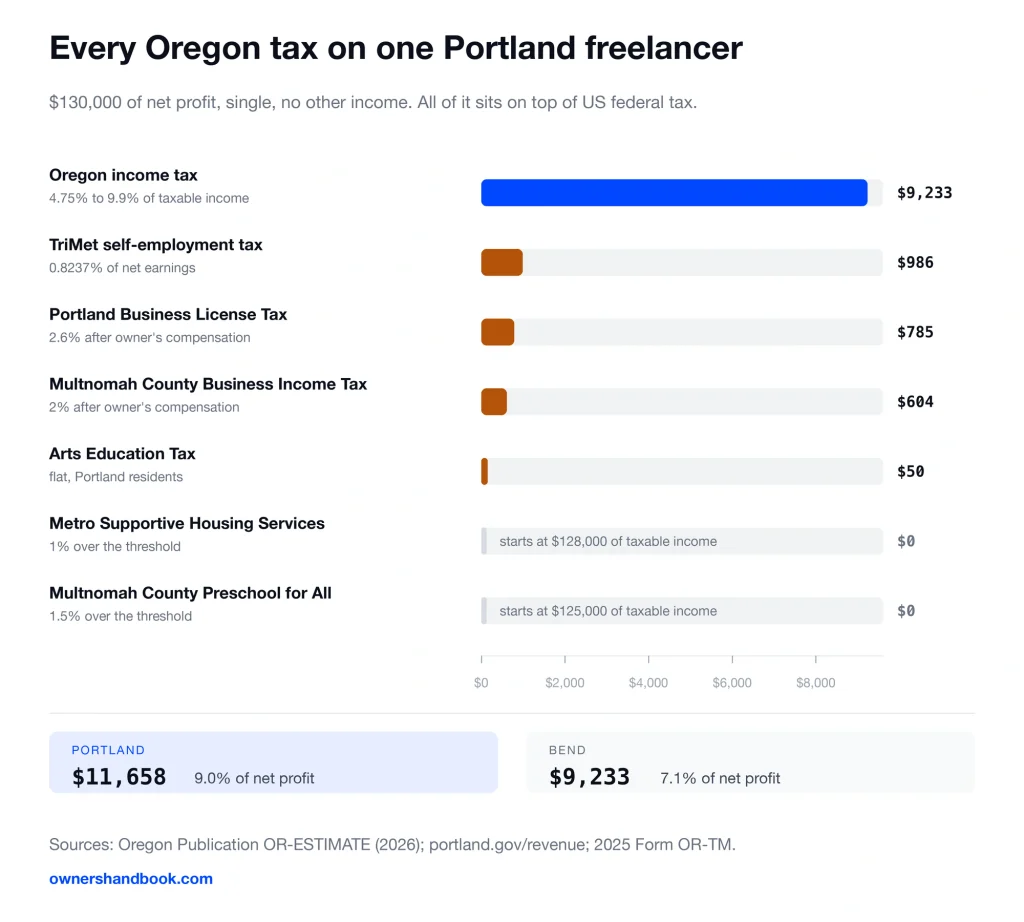
A single freelancer with $130,000 of net profit, working from a Portland apartment, owes Oregon and its local governments about $11,658. The same person in Bend owes $9,233.
No sales tax is real, and it is the whole pitch
Oregon has “no general sales tax or transaction tax.” That is the Department of Revenue’s own wording, and the only exceptions are two taxes on new vehicles.
For a freelancer that is worth more than it sounds. Every camera body, laptop, monitor and desk you buy in Oregon costs exactly its sticker price.
The income tax is what you pay instead
Oregon taxes income on four brackets. For 2026 a single filer pays 4.75% on the first $4,550, 6.75% to $11,400, then 8.75% on everything up to $125,000, then 9.9%.
The standard deduction is small too: $2,900 single and $5,800 married filing jointly for 2026. Oregon does not copy the much larger federal figure.
One rule works in your favor. Oregon lets you subtract your federal income tax liability, up to $8,750 for 2026, before applying its rates.
That subtraction shrinks as income climbs. On the 2025 table it starts phasing out at $125,000 of adjusted gross income for a single filer and hits zero at $145,000.
There is no Oregon version of self-employment tax. Social Security and Medicare are federal programs, and that 15.3% does not repeat here.
Two Portland income taxes that probably miss you
Greater Portland has two local personal income taxes. Both go to the City of Portland Revenue Division, and neither one rides along on your Oregon return.
The Metro Supportive Housing Services tax is 1% on Metro taxable income above a threshold. For 2026 that is $128,000 single and $205,000 joint, and starting this year it moves with inflation.
The Multnomah County Preschool for All tax is 1.5% above $125,000 single or $200,000 joint, plus another 1.5% above $250,000 single or $400,000 joint. Those thresholds are not indexed.
Both tests run on taxable income, not on what your clients paid you and not on your net profit.
Our $130,000 freelancer has $109,166 of Oregon taxable income after the standard deduction and the federal tax subtraction. Both local income taxes come to zero.
For a single filer they switch on around $145,000 of net profit, depending on what else is on your return.
Above that line the stack is steep. 8.75% state plus 1% Metro plus 1.5% Preschool for All is 11.25% of every additional dollar, before the IRS takes anything.
| Layer | What it taxes | Rate | Switches on at |
|---|---|---|---|
| Oregon income tax | Oregon taxable income | 4.75% to 9.9% | Income above the standard deduction |
| TriMet transit self-employment tax | Net earnings from self-employment | 0.8237% | $400 of net earnings |
| Portland Business License Tax | Your business’s net income | 2.6% | $75,000 of gross receipts in 2026 |
| Multnomah County Business Income Tax | Your business’s net income | 2% | $100,000 of gross receipts |
| Metro Supportive Housing Services | Metro taxable income | 1% | $128,000 single, $205,000 joint |
| Multnomah County Preschool for All | County taxable income | 1.5%, then 3% | $125,000 single, then $250,000 |
TriMet charges self-employed people directly
This one appears in almost no Portland guide, and it starts at $400 of profit.
The district covers Clackamas, Multnomah and Washington counties. More than $400 of net self-employment earnings from work delivered inside it means you file Form OR-TM.
The rate is 0.8237% of net earnings from self-employment — Schedule SE line 3 — minus a $400 exclusion. TriMet’s tax page still carried that rate in February 2026.
On $120,055 of net earnings that comes to $986. Not large, not optional, and a separate return to the Oregon Department of Revenue.
Portland taxes you again, as a business
The Portland Business License Tax and the Multnomah County Business Income Tax are not income taxes on you. They are taxes on the business, and sole proprietors and single-member LLCs are squarely inside them.
Portland charges 2.6% and Multnomah County charges 2%. You are exempt from Portland below $75,000 of gross receipts everywhere for 2026, and from the county below $100,000.
Exempt does not mean finished. You still have to file a Business Tax Return, with its supporting tax pages, to claim the exemption. Registration is due within 60 days of starting.
What actually saves you is the owner’s compensation deduction. You subtract up to 75% of your net business income, capped per owner, which was $156,000 for Portland in 2024.
So only a quarter of your profit reaches the rate. On $120,816 of adjusted net income that leaves $30,204 subject to tax: $785 to Portland and $604 to the county.
The Arts Education Tax adds $50 for 2026, for a single Portland resident with $20,000 or more of Oregon taxable income.
One Portland freelancer at $130,000
Single, no other income, working from an apartment inside Portland, Multnomah County and the Metro boundary. Every project is delivered from that desk.
Net earnings from self-employment are $120,055, which is 92.35% of $130,000. Federal self-employment tax on that is $18,368, and half of it, $9,184, comes off adjusted gross income.
| Layer | Charged on | Portland | Bend |
|---|---|---|---|
| Oregon income tax | $109,166 taxable income | $9,233 | $9,233 |
| TriMet self-employment tax | $119,655 net earnings | $986 | $0 |
| Portland Business License Tax | $30,204 after owner’s comp | $785 | $0 |
| Multnomah County Business Income Tax | $30,204 after owner’s comp | $604 | $0 |
| Arts Education Tax | Portland residency | $50 | $0 |
| Metro Supportive Housing Services | Under the $128,000 line | $0 | $0 |
| Multnomah County Preschool for All | Under the $125,000 line | $0 | $0 |
| Total Oregon state and local | $11,658 | $9,233 | |
| Share of net profit | 9.0% | 7.1% |
The two taxes Portland is famous for cost this person nothing. The two nobody has heard of cost $1,389, plus two extra returns.
The same person in Bend
Bend sits in Deschutes County: outside Metro, outside Multnomah County, outside the TriMet district, and with no city tax on business income. So the Bend freelancer pays the state rate and stops.
$2,425 a year is the address premium at this income. It widens sharply past $145,000, when the Metro and Preschool for All taxes finally switch on.
What the missing sales tax would have to be worth
Here is the honest test. Convert the income tax bill into the spending it would take to generate that much sales tax somewhere else.
Washington’s state sales tax rate is 6.5%. Our Portland freelancer’s $11,658 is what that rate collects on about $179,000 of purchases.
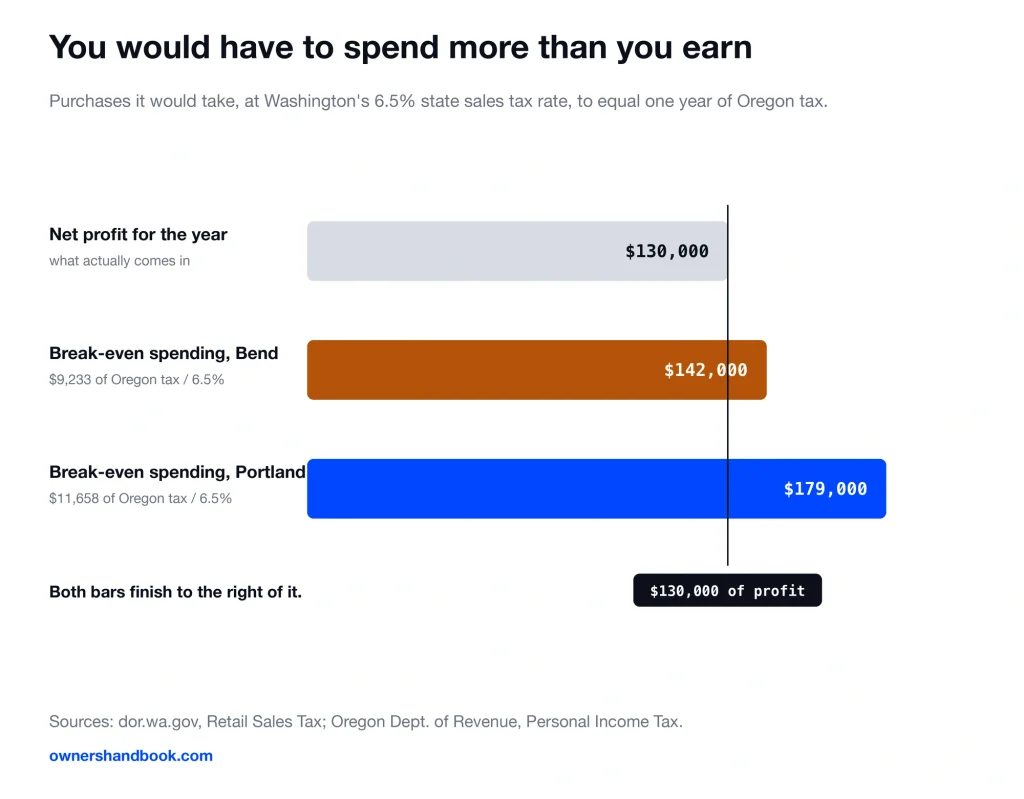
You would need to spend $179,000 out of $130,000 of profit to break even. Bend needs $142,000. Neither is possible.
That is the answer. No sales tax is a fine deal for people who spend most of what they earn, and Oregon’s rates make sure a profitable freelancer is not one of them.
Four dates, four governments
Oregon estimated payments are due April 15, June 15 and September 15 of 2026, then January 15, 2027. You must make them if you expect to owe $1,000 or more after credits and withholding.
Oregon’s safe harbor — the rule that blocks an underpayment charge whatever you end up owing — is 100% of the tax after credits on your 2025 return.
The Portland Revenue Division runs the same four dates on its own schedule. For 2026 its trigger jumped: $5,000 of liability this year and $5,000 last year for the SHS and Preschool for All taxes.
The Portland and Multnomah County business taxes still trigger at $1,000 in both years. All of it goes to the Revenue Division, not to Salem.
TriMet is the exception that helps. No estimated payments at all. Form OR-TM and the money are due once a year, alongside your return.
Paying the IRS does not pay Salem. Paying Salem does not pay the Revenue Division. Nothing is forwarded in either direction.
Frequently asked questions
Do I owe the Metro and Preschool for All taxes on $130,000 of profit?
Probably not. Both run on taxable income, and $130,000 of profit leaves about $109,000 after the standard deduction and the federal tax subtraction. They start nearer $145,000 of profit.
My gross receipts were only $60,000. Do I still have to file a Portland business tax return?
Yes. You are under both gross receipts thresholds, but the exemption is claimed on a filed Business Tax Return with its supporting tax pages.
Does forming an LLC change any of this?
No. A single-member LLC is disregarded, so its income goes on the business tax return you file personally. Electing S corporation status moves you to a different form and ends the transit tax.
All my clients are in California. Can I take that income out of the Portland business tax?
Generally no. Portland and Multnomah County allow apportionment only when you carry on regular business activity outside those jurisdictions. The TriMet tax is different: it sources receipts to where the service is delivered, and Schedule OR-TSE-AP apportions them out.
I live in Vancouver, Washington and work for Portland clients. Do I owe Oregon?
On Oregon-source income, yes. A nonresident owes Oregon tax on income from a trade or business carried on in Oregon, and on services performed there.
Is there really no sales tax on anything?
No general sales tax. Oregon does charge a privilege tax on new vehicles sold in the state and a use tax on new vehicles residents buy outside it.
For the federal layer underneath all of this, see the guides on self-employment tax, quarterly estimated taxes, how to pay estimated taxes, sales tax for freelancers, and how state tax works everywhere else.
Sources
Oregon Department of Revenue, Personal Income Tax
https://www.oregon.gov/dor/programs/individuals/Pages/PIT.aspx
Oregon Department of Revenue, Publication OR-ESTIMATE, Oregon Estimated Income Tax Instructions (2026)
https://www.oregon.gov/dor/forms/FormsPubs/publication-or-estimate_101-026_2026.pdf
Oregon Department of Revenue, 2025 Form OR-40 Instructions
https://www.oregon.gov/dor/forms/FormsPubs/form-or-40-inst_101-040-1_2025.pdf
Oregon Department of Revenue, Transit Self-employment Taxes
https://www.oregon.gov/dor/programs/businesses/Pages/self-employment.aspx
Oregon Department of Revenue, 2025 Form OR-TM, TriMet Transit District Self-employment Tax Return
https://www.oregon.gov/dor/forms/FormsPubs/form-or-tm_555-001_2025.pdf
TriMet, Tax Information
City of Portland Revenue Division, Personal Income Tax Filing and Payment Information
https://www.portland.gov/revenue/personal-tax
City of Portland Revenue Division, Business Tax Filing and Payment Information
https://www.portland.gov/revenue/business-tax
City of Portland Revenue Division, Instructions for Form SP-2024, Business Tax Return for Individuals
https://www.portland.gov/revenue/documents/instructions-form-sp-2024/download
City of Portland Revenue Division, Arts Education Tax Filing and Payment Information
https://www.portland.gov/revenue/arts-tax
Washington State Department of Revenue, Retail Sales Tax