Creator Write-Offs: Camera Yes, Clothes No
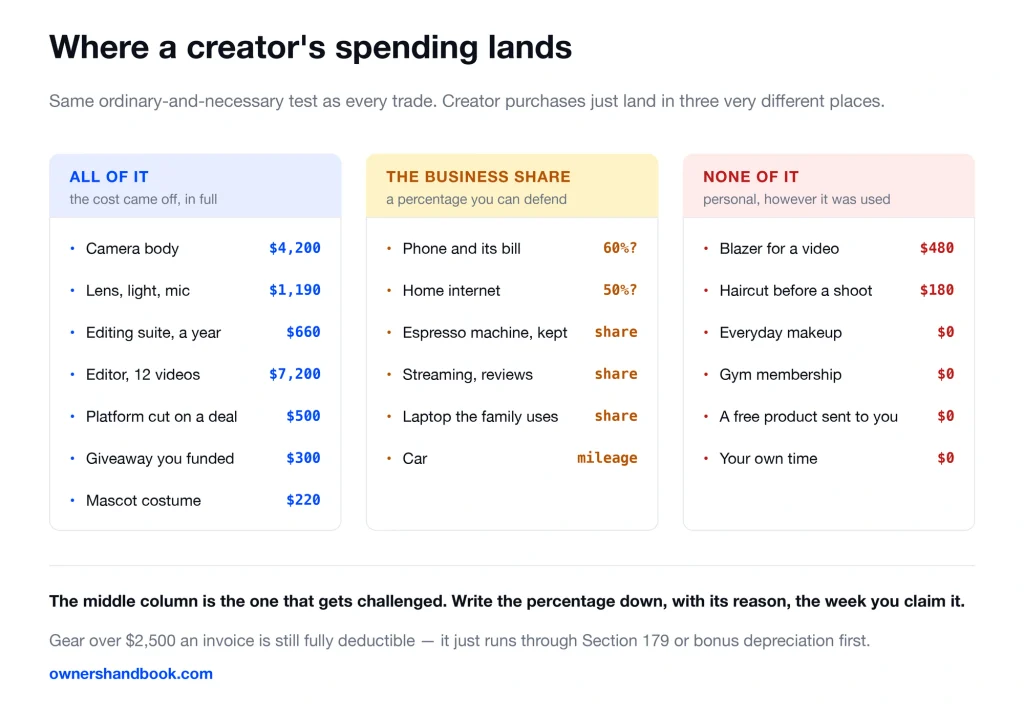
A camera comes off in full. The shirt you wore in the video almost never does. Creator spending runs through the same test as every trade, but lands in stranger places, because much of what you buy is also just life.
Gear is the easy part
Cameras, lenses, lights, microphones, a machine fast enough to render. All of it is ordinary and necessary for this work, and none of it is controversial.
What changes is the timing, and the line is $2,500.
A $310 microphone, a $700 lens, a $180 light panel — under $2,500 per invoice, each comes off in the year you bought it under the de minimis safe harbor.
A $4,200 cinema body crosses that line and becomes an asset. Section 179 or bonus depreciation can still take it in one year. Writing off equipment covers the mechanics.
One thing carries over. Cameras and video equipment are listed property, which means stricter proof of how much you actually used them for work.
Software and subscriptions
These are the cleanest deductions you own, and creators forget half because they arrive as small charges.
Editing suites, stock music and footage licenses, cloud storage, a scheduler, an AI writing or upscaling tool, your domain, your email host.
Run the numbers. An editing suite at $660 a year, a music library at $180, 2TB of storage at $120, a scheduler at $228, an AI tool at $240. That is $1,428 you already spent.
The boundary is the subscription you would pay for anyway. Netflix is personal, even if you reference a show.
It flips when consuming the thing is the product. A film-review channel has a real argument for the streaming bill, and should still deduct a share.
Clothing is the one almost everyone gets wrong
Here is the standard, from the IRS Entertainment Audit Technique Guide — the manual its examiners use on this industry.
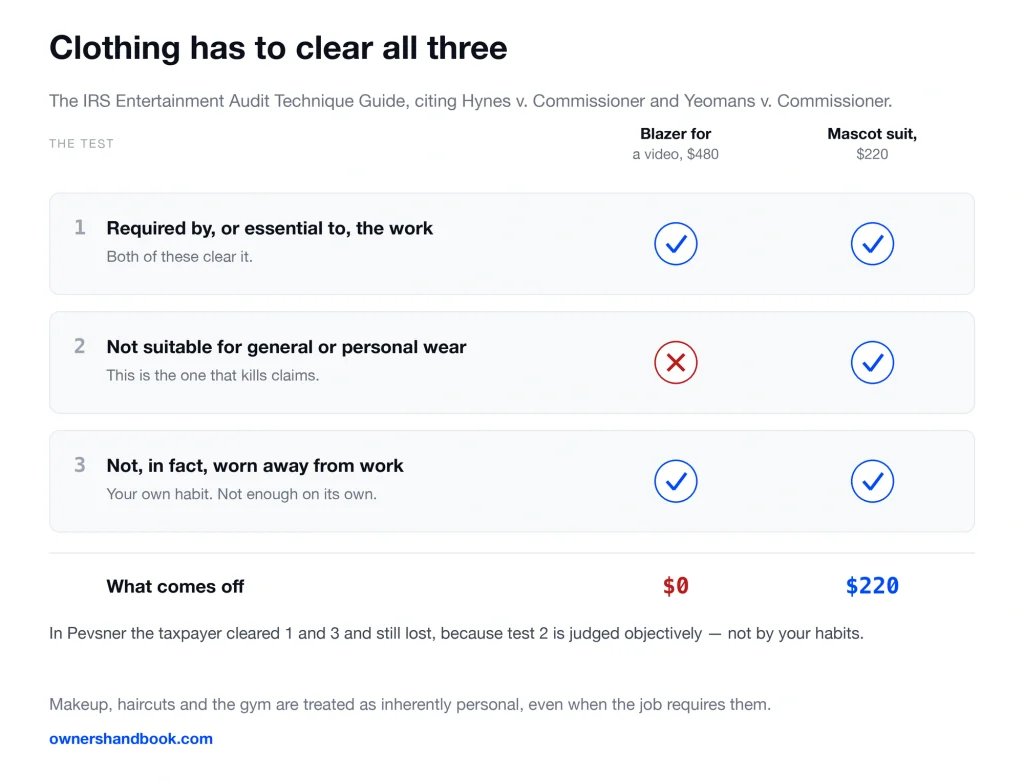
Clothing is deductible only where it is required by or essential to the work, is not suitable for general or personal wear, and was not in fact worn away from work.
All three, not any one. The guide cites Hynes v. Commissioner and Yeomans v. Commissioner for the rule.
The middle condition is what kills claims, and it is judged objectively.
In Pevsner v. Commissioner, a boutique manager had to wear expensive designer clothing and testified she never wore it outside work. The Fifth Circuit denied the deduction anyway, because the clothes were objectively suitable for general wear.
Read that again. She met condition one and condition three, and still lost.
So a $480 jacket bought to look right on camera is $0, no matter how strictly you keep it in the closet between shoots.
A $220 mascot suit or a period costume is deductible, because nobody wears it to the grocery store.
| What you bought for the channel | Comes off | Why |
|---|---|---|
| Blazer bought for an interview video | None | Suitable for general wear |
| Sneakers you review and then wear | None | Same |
| Branded polo, logo across the chest | Usually | Closer to a uniform than to clothes |
| Mascot costume, period costume, wig | All of it | Cannot be worn in ordinary life |
| Stunt padding, welding sleeves, a smock | All of it | Protective, replaces nothing |
Clothing your work is unusually hard on is still not deductible. An auto salesman lost on suits that got greasy on the job.
And merch is a different question entirely. Shirts you buy to sell are inventory. Shirts you give away are promotion. Neither is a clothing deduction.
Makeup, hair, and the cost of an image
The guide is blunt. No deduction is allowed for wardrobe, general makeup, or hairstyles for auditions, job interviews, or to maintain an image.
A $180 cut and color before a shoot is $0. Haircuts were held nondeductible even when the job required them in Drake v. Commissioner, and grooming was called inherently personal in Hynes.
Drugstore foundation is $0 too. The narrow exception is stage makeup that is not an over-the-counter product, that you had to buy, and that you never wore offstage.
A $140 prosthetic kit for a horror short clears it. Your concealer does not.
The gym goes too. A news anchor who claimed clothing, hair, makeup and a gym membership lost all of it in Hamper v. Commissioner as inherently personal.
The room you film in
The home office rules apply to a studio exactly as to a desk. The exclusive-use requirement is where filming setups fail.
You must use a specific area of your home only for the business. The IRS example is an attorney’s den the family also uses for recreation — the deduction is not reduced, it is gone.
So a corner of your bedroom with the bed in frame does not qualify. A spare room that holds nothing but your set does.
The space needs no permanent partition, which helps. A separate filming area inside a larger room can work if it is genuinely never used for anything else.
Numbers. A 120-square-foot spare room under the simplified method is $5 per square foot, so $600. That method stops at 300 square feet.
The regular method takes that share of rent, utilities and insurance instead. Either way it lands on Schedule C. The home office deduction article walks both.
A trip that is half content, half vacation
The trip has to be primarily business, measured in business days against personal days.
Five days at a creator conference plus two to see the city: the airfare deducts in full, five hotel nights deduct, the two extra nights do not.
Flip it. Five beach days with one sponsor meeting in the middle is a personal trip, and the airfare and hotel are gone. Only the meeting’s own costs survive.
Filming there does not convert a vacation. What survives a challenge is a calendar of what you did each day. Meals and travel covers the rest.
Props you consume, props you keep, and products you got free
Split every purchase by what is left when the video posts.
Consumed on camera is a supply. $40 of ingredients for a recipe video, a $60 gadget destroyed in a durability test, $95 of craft materials used in a build.
Kept is different. A $1,200 espresso machine you reviewed and now use every morning is mixed-use, and you deduct the business share, not the price.
| The item | What comes off |
|---|---|
| Ingredients cooked and eaten on camera | The production share, as a supply |
| The half your family ate after filming | None |
| A gadget destroyed in the video | All of it |
| A product you review and keep using | The business percentage only |
| A product sent to you free | None. You paid nothing. |
| That free product, if you reported its value as income | Its fair market value, as basis |
The last two rows matter. A $900 lens a brand sends you is not a $900 deduction, because a deduction is for money that left your hands.
If the lens was payment for the review, its fair market value is income to you — and that inclusion is what gives you basis to depreciate. Income in, deduction out, roughly a wash. Creator income covers the reporting side.
The people you pay, and when you owe them a 1099
An editor at $600 a video across twelve videos is $7,200 off your income. A thumbnail designer at $45 each, an assistant, a translator — all contract labor on Schedule C.
Your own time is not. A sole proprietor cannot deduct their own wage.
Pay one person $2,000 or more during 2026 and you owe them a Form 1099-NEC by January 31. That floor was $600 for seventy years and moved this year.
The payment method decides it. Pay that editor through PayPal or a credit card and you file nothing, because the processor reports it instead. Issuing 1099s covers the flow, starting with a W-9 before the first payment.
Fees, giveaways, and proving a mixed-use split
Platform and processing fees are the most-missed deduction here, and the reason is mechanical. The money never landed, so it never entered your bookkeeping as an expense.
A $10,000 sponsorship run through a network that keeps $500 pays you $9,500. Your income is $10,000 and your expense is $500.
Same profit either way. But your 1099-K reports the gross, so reporting $9,500 with no fee expense earns a letter.
Giveaways you fund are promotion, not gifts. A $300 camera to a contest winner is advertising. The $25-per-recipient gift limit covers gifts to a business contact, not a public prize.
Hand one winner $2,000 or more in prizes during 2026 and a Form 1099-MISC is due.
For anything mixed, write the percentage down with a reason behind it. Which of this year’s 44 videos used the lens, a month of logs, a calendar you could show someone.
Receipts explains what a record has to contain. A number you invented in April is not one.
Frequently asked questions
Can I deduct clothes if I only wear them on camera?
Generally no. The test asks whether the item is objectively suitable for general wear, not whether you personally wear it. Pevsner lost on exactly that point.
Are business meals still 50% deductible in 2026?
Yes. The general limit is 50% of what you spent. The temporary 100% restaurant deduction covered 2021 and 2022 only. Meals and travel covers the details.
My channel has not made money yet. Do I still get these deductions?
Only if it is a business and not a hobby. The IRS weighs whether you run it in a businesslike way and genuinely intend to profit. A hobby deducts nothing.
I got a free product and reviewed it. Do I deduct its value?
No. You paid nothing, so there is nothing to deduct. If you reported its fair market value as income, that amount becomes your basis and depreciates like any other asset.
Does my phone count if I shoot everything on it?
Deduct the business share of the device and the bill, not the whole thing. A second phone that only ever touches the channel is 100% and needs no estimate.
My studio is also the guest room. Can I still claim it?
Not for the nights it is a guest room. Exclusive use means only business use, and occasional personal use disqualifies the whole space rather than shrinking the deduction.
Sources
IRS, Publication 5774, Entertainment Audit Technique Guide
https://www.irs.gov/pub/irs-pdf/p5774.pdf
IRS, Publication 463, Travel, Gift, and Car Expenses
https://www.irs.gov/publications/p463
IRS, Publication 587, Business Use of Your Home
https://www.irs.gov/publications/p587
IRS, Simplified Option for Home Office Deduction
IRS, Publication 334, Tax Guide for Small Business
https://www.irs.gov/publications/p334
IRS, Publication 529, Miscellaneous Deductions
https://www.irs.gov/publications/p529
IRS, Tangible Property Final Regulations
https://www.irs.gov/businesses/small-businesses-self-employed/tangible-property-final-regulations
IRS, Publication 946, How To Depreciate Property
https://www.irs.gov/publications/p946
IRS, Instructions for Forms 1099-MISC and 1099-NEC
https://www.irs.gov/instructions/i1099mec
IRS, Deducting Business Expenses
https://www.irs.gov/businesses/small-businesses-self-employed/deducting-business-expenses
IRS, Instructions for Schedule C
https://www.irs.gov/instructions/i1040sc
IRS, Recordkeeping
https://www.irs.gov/businesses/small-businesses-self-employed/recordkeeping