Airbnb Taxes: The Seven-Day Rule Does Not Decide Schedule C
Search this and you will be told that an average stay of seven days or less puts you on Schedule C. That is wrong, and it is wrong on nearly every page that ranks for it. The seven-day rule is real and it is written down, but it answers a different question — whether your activity is passive for the loss rules.
What decides Schedule C, and with it self-employment tax, is whether you provide substantial services to your guests. The two tests are related but separate, and a short-term rental can easily land on one side of one and the other side of the other.
Where the seven-day rule actually comes from
It is in the temporary regulations under section 469, the passive activity loss rules, which set out when an activity involving tangible property is not a rental activity:
(ii) Exceptions. For purposes of this paragraph (e)(3), an activity involving the use of tangible property is not a rental activity for a taxable year if for such taxable year— (A) The average period of customer use for such property is seven days or less;
And separately, at thirty days:
(B) The average period of customer use for such property is 30 days or less, and significant personal services (within the meaning of paragraph (e)(3)(iv) of this section) are provided by or on behalf of the owner of the property in connection with making the property available for use by customers;
Read what those sentences do. They take your activity out of the definition of a rental activity. That matters because section 469 treats rental activities as passive per se, however hard you work at them. Escape the definition and you are judged on material participation instead — and if you materially participate, your losses are not passive and can offset other income.
That is the whole prize, and nothing in either sentence mentions Schedule C, Schedule E or self-employment tax.
What actually decides the schedule
A different rule, in a different part of the code. Section 1402(a)(1) excludes rent from self-employment income:
there shall be excluded rentals from real estate and from personal property leased with the real estate … together with the deductions attributable thereto, unless such rentals are received in the course of a trade or business as a real estate dealer
The regulation then carves out accommodation where services come with the room:
Payments for the use or occupancy of rooms or other space where services are also rendered to the occupant, such as for the use or occupancy of rooms or other quarters in hotels, boarding houses, or apartment houses furnishing hotel services, or in tourist camps or tourist homes … do not constitute rentals from real estate; consequently, such payments are included in determining net earnings from self-employment.
And it tells you where the line falls:
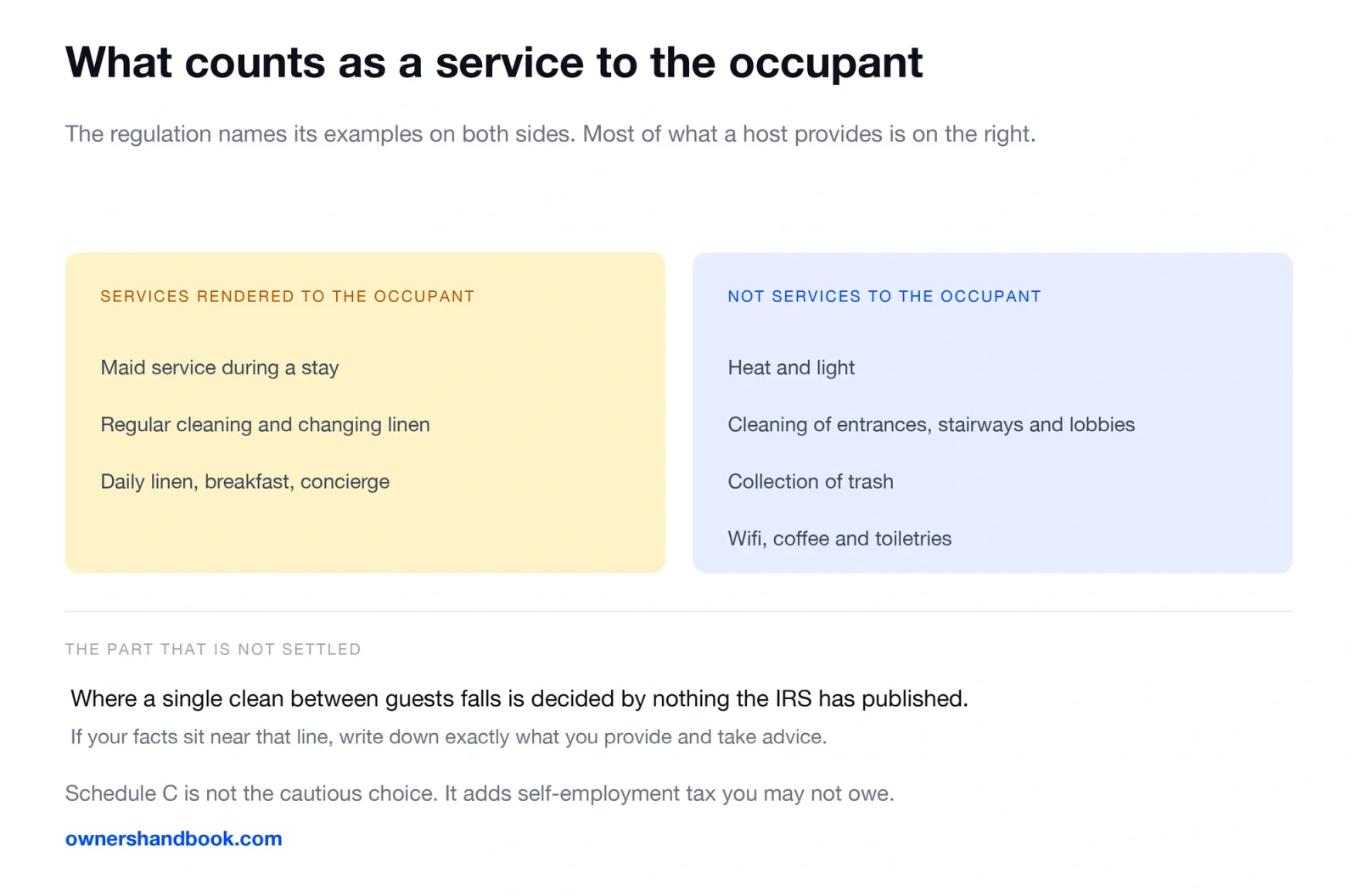
The supplying of maid service, for example, constitutes such service; whereas the furnishing of heat and light, the cleaning of public entrances, exits, stairways and lobbies, the collection of trash, and so forth, are not considered as services rendered to the occupant.
Publication 527 states the consequence in one sentence: “If you provide substantial services that are primarily for your tenant’s convenience, such as regular cleaning, changing linen, or maid service, you report your rental income and expenses on Schedule C.”
So the test is services rendered to the occupant, primarily for their convenience, beyond what comes with occupancy alone. Not stay length.
One honest caveat. Publication 527 lists “regular cleaning” among its examples, and much short-term rental commentary reads that as making every turnover clean a substantial service. The underlying regulation is narrower — its example is maid service, and it expressly excludes cleaning of public entrances, stairways and lobbies. Where a single clean between guests falls is not settled by anything the IRS has published in terms. If your facts sit near that line, write down exactly what you provide and take advice rather than assuming.
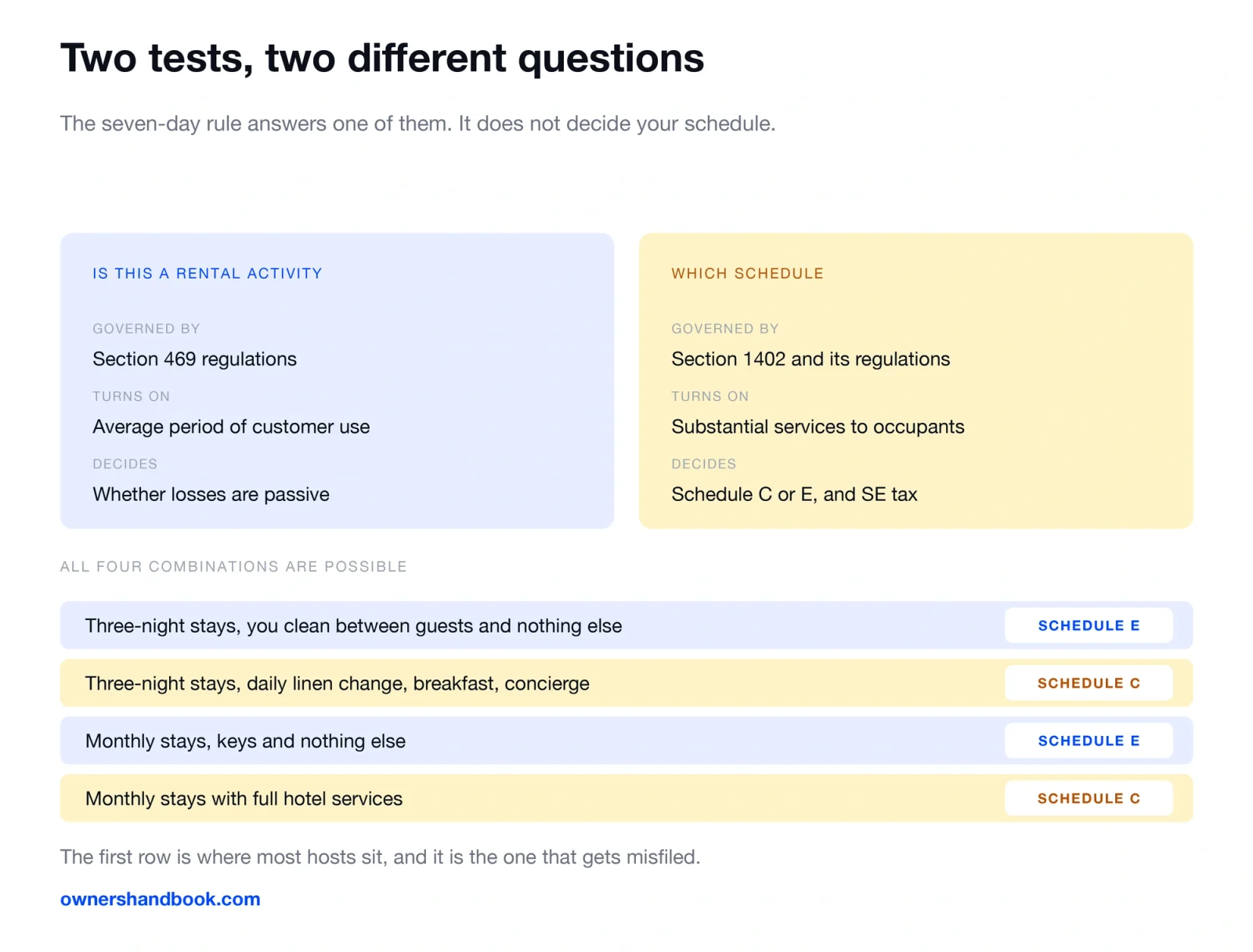
The two questions side by side
| Question | Governed by | Turns on | What it decides |
|---|---|---|---|
| Is this a rental activity | Section 469 regulations | Average period of customer use | Whether losses are passive |
| Which schedule | Section 1402 and its regulations | Substantial services to occupants | Schedule C or E, and self-employment tax |
All four combinations are possible:
| Your situation | Rental activity under 469 | Schedule |
|---|---|---|
| Three-night stays, you clean between guests and nothing else | No, average use under seven days | E |
| Three-night stays, daily linen change, breakfast, concierge | No, average use under seven days | C |
| Monthly stays, keys and nothing else | Yes | E |
| Monthly stays with full hotel services | No, under the 30-day exception | C |
The first row is where most hosts sit, and it is the one that gets misfiled.
Self-employment tax is the whole stake
This is why the distinction is worth an hour of your attention.
Rental real estate income generally is not included in net earnings from self-employment. Schedule C income is, at 15.3% — 12.4% for Social Security and 2.9% for Medicare — applied to 92.35% of net profit, with the Social Security half applying only to the first $184,500 of combined wages and net earnings in 2026.
On $30,000 of net profit, that is the difference between nothing and roughly $4,240. Our self-employment tax guide covers the mechanics and the self-employment tax calculator will run your own numbers. Schedule C also brings quarterly instalments, since nothing is withheld — see quarterly estimated taxes. The business code is 721100, Traveler accommodation; Schedule C explained and Schedule C business codes cover the form.
The fourteen-day rule, which overrides everything above
If you use the place as a home and rent it for a short enough period, the income disappears from the return entirely:
If you use a dwelling unit as a home and you rent it less than 15 days during the year, its primary function isn’t considered to be rental and it shouldn’t be reported on Schedule E (Form 1040). You aren’t required to report the rental income and rental expenses from this activity.
Fourteen nights or fewer, in a home you also use personally, and you report nothing. The expenses are not deductible either — mortgage interest and property taxes go to Schedule A as they normally would.
“Used as a home” has its own definition: personal use exceeding the greater of 14 days or 10% of the days rented at a fair rental price. Days you let friends or family stay free count as personal use.
What the platform sends you
Short-term rental platforms report through Form 1099-K. The de minimis threshold is back where it was before the 2021 changes:
The gross amount of total reportable payment transactions exceeds $20,000, and … the total number of such transactions exceeds 200
Both conditions, not either. Many hosts will receive nothing, and the income is reportable regardless — a missing form is not an exemption.
Read the figure carefully when it does arrive. The instructions define what box 1a contains:
“Gross amount” means the total dollar amount of total reportable payment transactions for each participating payee without regard to any adjustments for credits, cash equivalents, discount amounts, fees, refunded amounts, shipping amounts, or any other amounts.
So the figure includes the platform’s service fee and any refunds you issued. It will exceed what reached your bank account, and the difference is a deduction, not a reason to report a smaller number. See 1099-NEC versus 1099-K on why the same dollar sometimes appears twice.
Depreciation, and the bill you have already agreed to
Residential rental property is depreciated straight-line over 27.5 years. On a building basis of $275,000 that is $10,000 a year, and land is not depreciable, so the purchase price has to be split.
The part people do not plan for arrives at sale. Your basis is reduced by depreciation allowed or allowable — reduced whether or not you actually claimed it. Skipping the deduction does not preserve your basis; it wastes the deduction.
And the recaptured portion is not taxed at long-term capital gains rates. The IRS puts it plainly: “The portion of any unrecaptured section 1250 gain from selling section 1250 real property is taxed at a maximum 25% rate.”
So a decade of $10,000 deductions comes back as $100,000 of gain taxed at up to 25%. That is often still a good trade — you had the money for ten years and the rate is capped. But it is a deferral, not a forgiveness, and it belongs in the arithmetic before you sell. Keep the depreciation schedule with your permanent records — see record keeping.
The state and local side is a separate problem
Everything above is federal. Occupancy taxes, transient lodging taxes, tourist development taxes and short-term rental registration are imposed by states, counties and cities, and they do not follow the federal rules.
Some platforms collect and remit local occupancy tax in some jurisdictions and not others. Many cities require a permit, a licence number on the listing, or a cap on nights per year. Some prohibit the activity outright in certain zones. None of that follows from which schedule you file — check your own city and county directly, and see state taxes for the self-employed for the income tax layer.
Frequently asked questions
My average stay is four nights. Am I on Schedule C?
Not on that basis alone. Four-night stays take you out of the definition of a rental activity for section 469, which affects your losses. The schedule turns on whether you provide services to guests beyond making the property available.
Does cleaning between guests count as substantial services?
Generally no. Turnover cleaning prepares the unit for the next occupant. The regulation’s example of a qualifying service is maid service during a stay, and it expressly excludes heat, light, cleaning of common areas and trash collection. Coffee, toiletries and wifi are amenities that come with the room. Publication 334 gives the broader standard: services are substantial if the compensation for them makes up a material part of what the guest pays.
Can I be non-passive under section 469 and still file Schedule E?
Yes, and for short-term hosts that combination is common — and often the best of both: losses that are not trapped as passive, and income outside self-employment tax.
Do I still report if the platform sends no 1099-K?
Yes. The $20,000 and 200-transaction thresholds govern the platform’s filing obligation, not yours.
Should I just file Schedule C to be safe?
No. Schedule C is not the cautious choice — it adds self-employment tax you may not owe. File the schedule the facts support, and write down what services you did and did not provide.
Sources
26 CFR § 1.469-1T, General rules (temporary)
https://www.law.cornell.edu/cfr/text/26/1.469-1T
26 U.S. Code § 1402, Definitions
https://www.law.cornell.edu/uscode/text/26/1402
26 CFR § 1.1402(a)-4, Rentals from real estate
https://www.law.cornell.edu/cfr/text/26/1.1402(a)-4
IRS, Publication 527, Residential Rental Property
https://www.irs.gov/publications/p527
IRS, Publication 334, Tax Guide for Small Business
https://www.irs.gov/publications/p334
IRS, Instructions for Form 1099-K
https://www.irs.gov/instructions/i1099k
IRS, Topic no. 409, Capital gains and losses
https://www.irs.gov/taxtopics/tc409
IRS, Self-employment tax (Social Security and Medicare taxes)
Social Security Administration, Contribution and benefit base
https://www.ssa.gov/oact/cola/cbb.html
IRS, Instructions for Schedule C (Form 1040)