The SALT Cap in 2027, and the New Itemized Haircut
Two things changed about itemized deductions, and the honest answer for most readers of this site is that neither one touches you. If your mortgage interest, state taxes and charitable giving do not add up to more than the standard deduction — $16,100 single or $32,200 joint for 2026 — you do not itemize, and both of these changes are about itemizing.
For the minority who do itemize, they matter. The state and local tax cap, $10,000 since 2018, is $40,400 for 2026 and computes to $40,804 for 2027 under a formula written into the statute. And a rewritten section 68 begins shaving itemized deductions on the 2026 return for high earners, at a rate that works out to almost exactly 2% of the deductions it reaches.
Here is who is actually inside each rule, with the statutory text and the arithmetic.
Who this applies to
Three tests, all of which have to be true before any of this changes your tax.
You itemize — your Schedule A total beats your standard deduction. For a freelancer with no mortgage, it almost never does.
Your state and local taxes exceed $40,400. At the state income tax rates in state taxes for the self-employed, a single filer usually needs income well into six figures plus substantial property tax.
And for section 68, your taxable income exceeds where the 37% bracket starts — $640,600 for a 2026 single filer.
Fail any of the three and nothing below changes your return. Clear all three and the rest of this page is about you, with the second rule being the one your software applies without telling you.
The SALT cap, year by year, from the statute
Section 70120 of Public Law 119-21 replaced the flat $10,000 with a schedule. The new section 164(b)(7)(A) defines the “applicable limitation amount”:
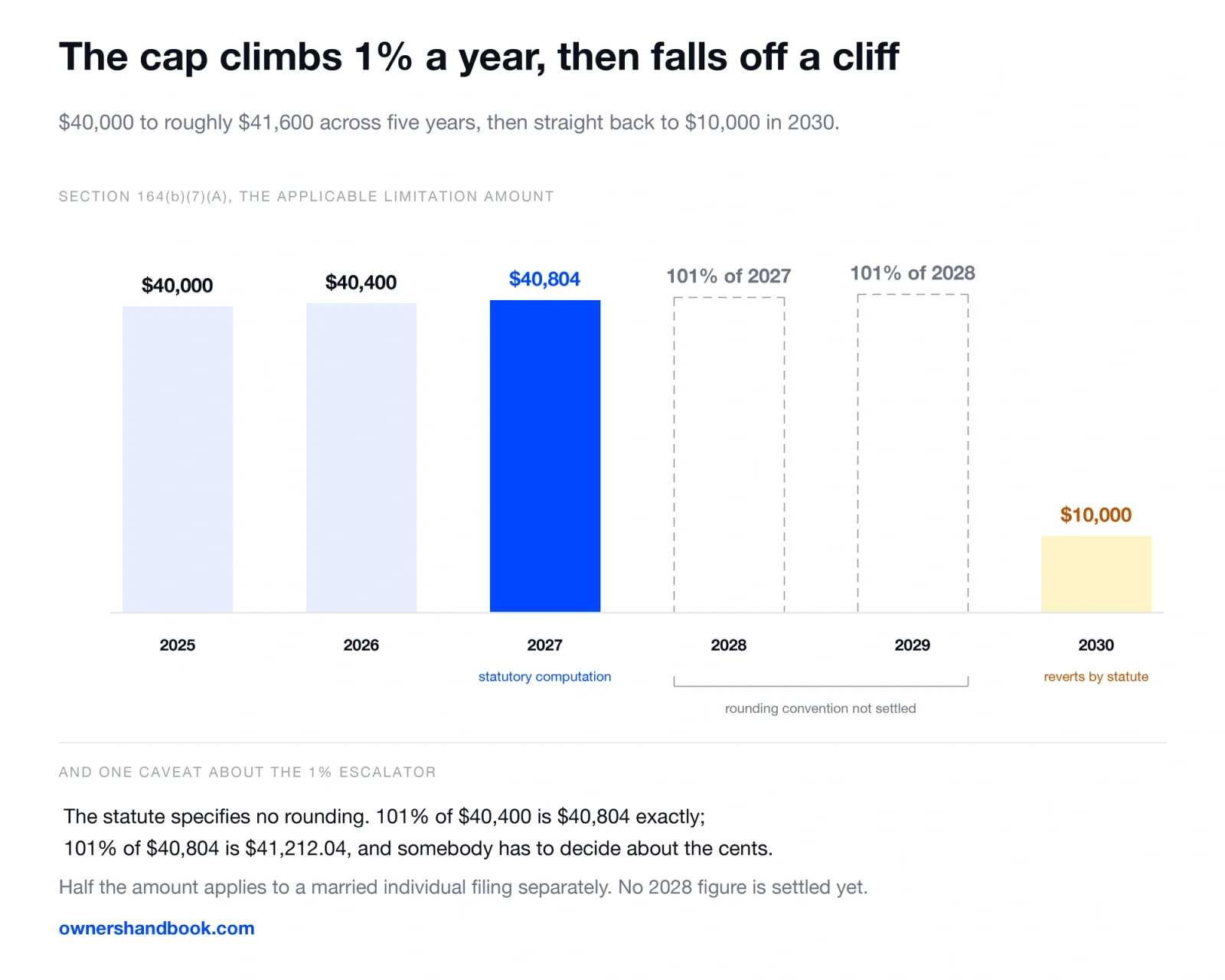
(i) in the case of any taxable year beginning in calendar year 2025, $40,000, (ii) in the case of any taxable year beginning in calendar year 2026, $40,400, (iii) in the case of any taxable year beginning after calendar year 2026 and before 2030, 101 percent of the dollar amount in effect under this subparagraph for taxable years beginning in the preceding calendar year, and (iv) in the case of any taxable year beginning after calendar year 2029, $10,000.
That is a complete answer for every year without any IRS publication, because Congress wrote the escalator into the law.
| Tax year | SALT cap | Source |
|---|---|---|
| 2025 | $40,000 | §164(b)(7)(A)(i), and the 2025 Schedule A instructions |
| 2026 | $40,400 | §164(b)(7)(A)(ii) |
| 2027 | $40,804 | 101% of $40,400, computed under §164(b)(7)(A)(iii) |
| 2028 | 101% of 2027 | §164(b)(7)(A)(iii) |
| 2029 | 101% of 2028 | §164(b)(7)(A)(iii) |
| 2030 onward | $10,000 | §164(b)(7)(A)(iv) |
Call $40,804 what it is: the statutory computation, not an IRS-published figure. The 2027 inflation revenue procedure does not exist yet — the most recent is Revenue Procedure 2026-32 — and the cap would not appear in it anyway, because it is not an inflation adjustment.
One caveat, and it is why that distinction matters. The statute specifies no rounding convention for the 101% computation. For 2027 that is harmless: 101% of $40,400 is $40,804 exactly, no cents to round. It stops being harmless in 2028, where 101% of $40,804 is $41,212.04 and somebody has to decide about the four cents. Treat no 2028 figure as settled.
Half the amount applies to a married individual filing separately — $20,200 for 2026, $20,402 as computed for 2027.
The phasedown above $510,050
The higher cap is withdrawn as income rises. Section 164(b)(7)(B)(i):
the applicable limitation amount shall be reduced by 30 percent of the excess (if any) of the taxpayer’s modified adjusted gross income over the threshold amount (half the threshold amount in the case of a married individual filing a separate return)
The threshold is $500,000 for 2025, $505,000 for 2026, and 101% of the prior year after that — so $510,050 computed for 2027. Clause (iii) sets a floor: “The reduction under clause (i) shall not result in the applicable limitation amount being less than $10,000.”
The floor tells you how wide the phasedown band is. For 2027, falling from a $40,804 cap to the $10,000 floor is a reduction of $30,804, and at 30 cents per dollar of excess that takes $102,680 of income above the threshold. The band runs from $510,050 to $612,730.
| 2027 figure | Amount | Computation |
|---|---|---|
| Applicable limitation amount | $40,804 | 101% of $40,400 |
| Phasedown threshold | $510,050 | 101% of $505,000 |
| Phasedown rate | 30% of the excess | §164(b)(7)(B)(i) |
| Floor | $10,000 | §164(b)(7)(B)(iii) |
| MAGI at which the floor is reached | $612,730 | $510,050 + ($30,804 ÷ 0.30) |
Inside that band, each additional dollar of income costs you 30 cents of deduction. At a 35% marginal rate that is an extra 10.5 cents of tax on the dollar, on top of the 35. It is the kind of thing that makes a December invoice worth deferring, and the only lever that moves it is MAGI itself.
Modified adjusted gross income here means AGI plus amounts excluded under sections 911, 931 or 933 — so for almost everyone, plain AGI.
The new section 68, and what 2/37 means
Section 70111 of the same Act rewrote section 68 from scratch. The whole operative rule:
In the case of an individual, the amount of the itemized deductions otherwise allowable for the taxable year (determined without regard to this section) shall be reduced by 2/37 of the lesser of — (1) such amount of itemized deductions, or (2) so much of the taxable income of the taxpayer for the taxable year (determined without regard to this section and increased by such amount of itemized deductions) as exceeds the dollar amount at which the 37 percent rate bracket under section 1 begins with respect to the taxpayer.
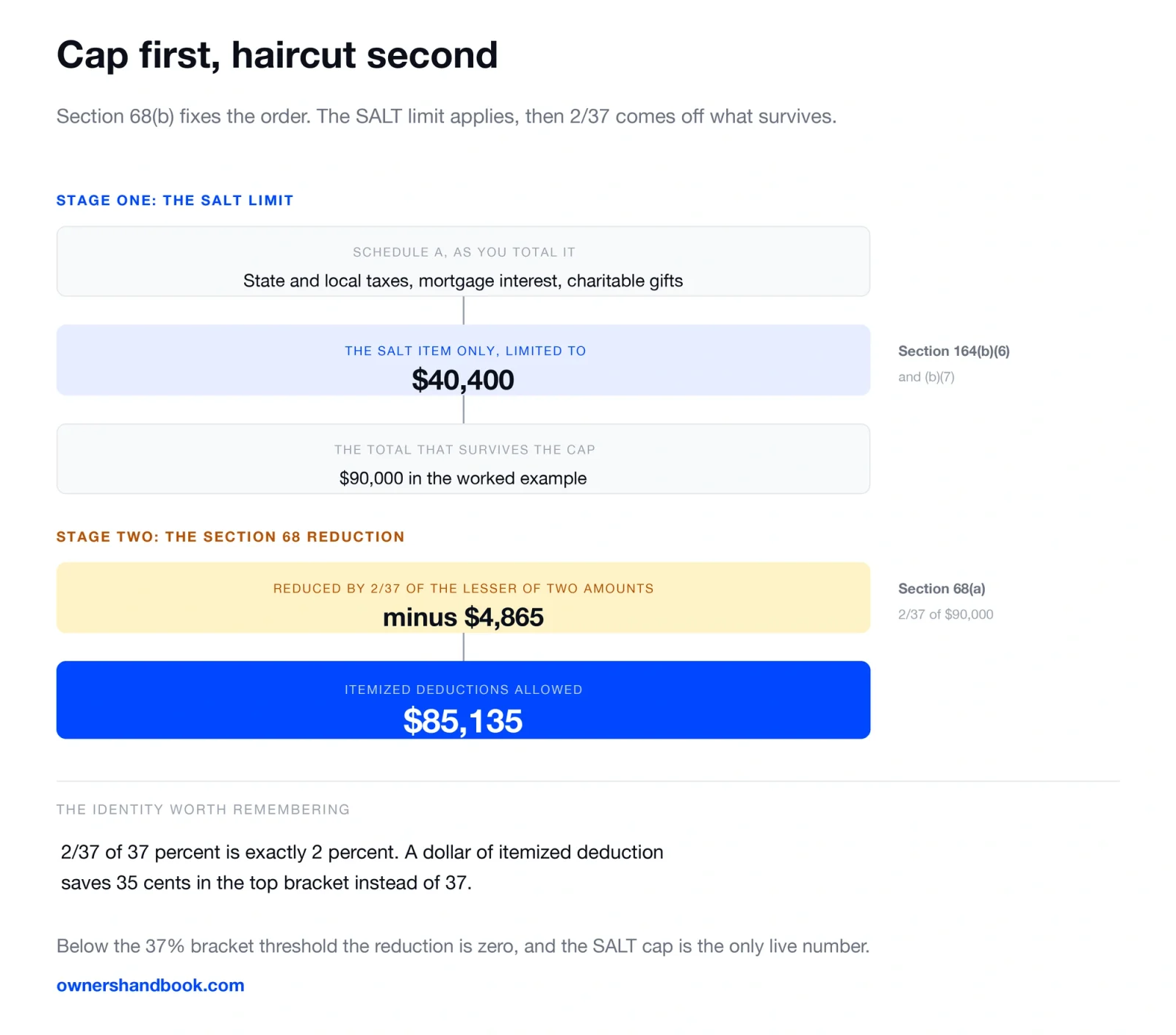
Two-thirty-sevenths looks arbitrary until you multiply it by the top rate. Two thirty-sevenths of 37% is exactly 2%. The provision is built so that a dollar of itemized deduction, for someone in the top bracket, is worth 35 cents instead of 37.
Section 70111(c) applies it to taxable years beginning after December 31, 2025 — the 2026 return, the one you will file in 2027. No Schedule A line exists for it yet; the published Schedule A instructions are still the 2025 edition, which has no section 68 computation in it at all.
The 37% bracket starts here, from Revenue Procedure 2025-32.
| 2026 filing status | 37% bracket begins at |
|---|---|
| Single | $640,600 |
| Married filing jointly | $768,700 |
| Head of household | $640,600 |
| Married filing separately | $384,350 |
Limb (2) is the phase-in; limb (1) is the ceiling. Below the bracket threshold the reduction is zero. Above it, it grows by 2/37 of each additional dollar until the excess passes your total itemized deductions, then stops growing and sits at 2/37 of the whole Schedule A total.
Note also section 68(b): “This section shall be applied after the application of any other limitation on the allowance of any itemized deduction.” The SALT cap is applied first. Section 68 then shaves the already-capped number.
$90,000 of deductions, $1,800 of tax
A single filer, 2026, AGI of $800,000, itemizing $90,000 — the $40,400 SALT cap, $35,000 of mortgage interest, $14,600 of charitable gifts. No QBI deduction, because at that income a specified service trade or business gets none.
| Step | Amount |
|---|---|
| Adjusted gross income | $800,000 |
| Itemized deductions before §68 | $90,000 |
| Taxable income without §68 | $710,000 |
| Add back itemized deductions, per §68(a)(2) | $800,000 |
| Excess over the 37% threshold of $640,600 | $159,400 |
| Lesser of $90,000 and $159,400 | $90,000 |
| §68 reduction, 2/37 of $90,000 | −$4,865 |
| Itemized deductions allowed | $85,135 |
| Taxable income | $714,865 |
The reduction is $4,865. At 37% the extra tax is $1,800, which is 2% of the $90,000 of deductions. That identity holds whenever limb (1) binds and you are in the top bracket.
Scale it down and it stays small. The same filer with $60,000 of itemized deductions loses $3,243 of deduction and about $1,200 of tax. This is a real cost. It is not a cliff, and nothing about it changes whether itemizing beats the standard deduction.
Your QBI deduction is computed as if section 68 did not exist
Section 70111(b)(1) amended section 199A(e)(1) by inserting “without regard to section 68 and” after “shall be computed.”
Section 199A has a limb equal to 20% of taxable income. Without that amendment, a section 68 haircut would raise taxable income, which would raise that limb, and the two provisions would interact in a way nobody intended. Congress cut the link: for the QBI deduction, taxable income is computed as if section 68 were not there. So the haircut costs you deduction and tax, but does not also distort your 20%. Section 70111(b)(2) does the same for the agricultural cooperative version in section 199A(g)(2)(B).
What the SALT cap does not reach
The cap is on taxes taken into account as itemized deductions. Section 164(b)(6) carves out the business side in its own flush language:
The preceding sentence shall not apply to any foreign taxes described in subsection (a)(3) or to any taxes described in paragraph (1) and (2) of subsection (a) which are paid or accrued in carrying on a trade or business or an activity described in section 212.
State and local taxes you pay in carrying on your business are outside the cap by the statute’s own terms, and they are not itemized deductions in the first place. The full version of that distinction is in business expenses are not itemized deductions, and where each kind of cost belongs is in Schedule C explained.
Three consequences for a self-employed itemizer in a high-tax state.
Your state income tax on business profit is a personal tax and sits inside the cap. The gross receipts tax, business licence fee or franchise tax your entity pays does not.
If you claim a home office, the business-use share of your property tax is not an itemized deduction at all. It goes on Form 8829, line 11, and only the personal share lands on Schedule A inside the cap — which means a larger office percentage moves more of your property tax outside the cap. Form 8829 line by line walks the allocation.
And a state-by-state read matters more than the federal cap, because the cap only binds where state rates are high. The arithmetic for the three states where this comes up most is in California, New York and New Jersey.
What to do with this
If you take the standard deduction, nothing. Keep filling in Schedule C completely, which is where your money actually is.
If you itemize and your income is below the 37% bracket threshold, the only live number is the cap. Add up your state income tax and property tax; if the total is under $40,400 for 2026 you have headroom, and prepaying a property tax instalment in December is the usual way to use it. If you are over, the excess is lost. The rest of the December list is in lowering your freelance tax legally.
If you itemize and you are above the threshold, run the two-step in order. Cap first, section 68 second, and expect roughly 2% of your Schedule A total to disappear. That is also the point where this stops being a do-it-yourself question; see what to give your CPA and the threshold in tax software or a CPA.
And watch 2030. The cap reverts to $10,000 for taxable years beginning after calendar year 2029 unless Congress acts. Anything written about 2030 today is a prediction.
Frequently asked questions
Is $40,804 an official IRS number for 2027?
No. It is what section 164(b)(7)(A)(iii) computes — 101% of the 2026 amount of $40,400. The 2027 inflation revenue procedure has not been issued, and the SALT cap would not be in it anyway, because the statute sets the schedule rather than indexing it.
Does the SALT cap affect me if I take the standard deduction?
No. The cap limits a deduction on Schedule A, and you only reach Schedule A if you itemize.
Does section 68 reduce my business expenses?
No. It reduces itemized deductions. Business expenses come off on Schedule C, several steps earlier, and are not itemized deductions.
I pay state tax on my freelance profit. Is that inside the cap?
Your personal state income tax is, including the part attributable to business profit. Taxes paid in carrying on the trade or business are excluded by the flush language of section 164(b)(6) and belong on Schedule C instead.
When does the section 68 reduction first appear on a return?
The 2026 return. Section 70111(c) applies it to taxable years beginning after December 31, 2025, and there is no published Schedule A line for it yet.
Does section 68 shrink my QBI deduction too?
No. Section 70111(b) amended section 199A(e)(1) so that taxable income for the QBI computation is figured without regard to section 68.
What happens to the cap after 2029?
Section 164(b)(7)(A)(iv) sets it back to $10,000 for taxable years beginning after calendar year 2029.
Sources
U.S. Government Publishing Office, Public Law 119-21, sections 70111 and 70120
https://www.govinfo.gov/content/pkg/PLAW-119publ21/pdf/PLAW-119publ21.pdf
Legal Information Institute, 26 U.S. Code § 164
https://www.law.cornell.edu/uscode/text/26/164
Legal Information Institute, 26 U.S. Code § 68
https://www.law.cornell.edu/uscode/text/26/68
IRS, Revenue Procedure 2025-32, inflation adjustments for tax year 2026
https://www.irs.gov/pub/irs-drop/rp-25-32.pdf
IRS, Instructions for Schedule A (Form 1040)
https://www.irs.gov/pub/irs-pdf/i1040sca.pdf
IRS, Tax inflation adjustments for tax year 2026
IRS, Form 8829, Expenses for Business Use of Your Home