Texas Has No Income Tax. Your LLC Still Has a Deadline.
Texas has no personal income tax. A freelancer with $95,000 of profit owes the state nothing on it, and that part of the reputation is accurate.
What changes when you form an LLC is not the tax. It is a report due May 15 every year, and missing it can cost you the entity.
This is a state layer on top of US federal tax
Nothing on this page reduces what you send the IRS. Self-employment tax is a United States federal tax, and it does not care which state you sleep in.
On $95,000 of profit, self-employment tax is $13,423. Multiply profit by 92.35%, then by 15.3%. That number is identical in Austin, Los Angeles, and Brooklyn.
Federal income tax sits on top of it, also unchanged. What Texas removes is the third layer, the state income tax return that most other states require.
The Comptroller puts it in one line in its own field guide. Texans pay federal income taxes but not state or local income taxes.
A sole proprietor has nothing to file with Texas
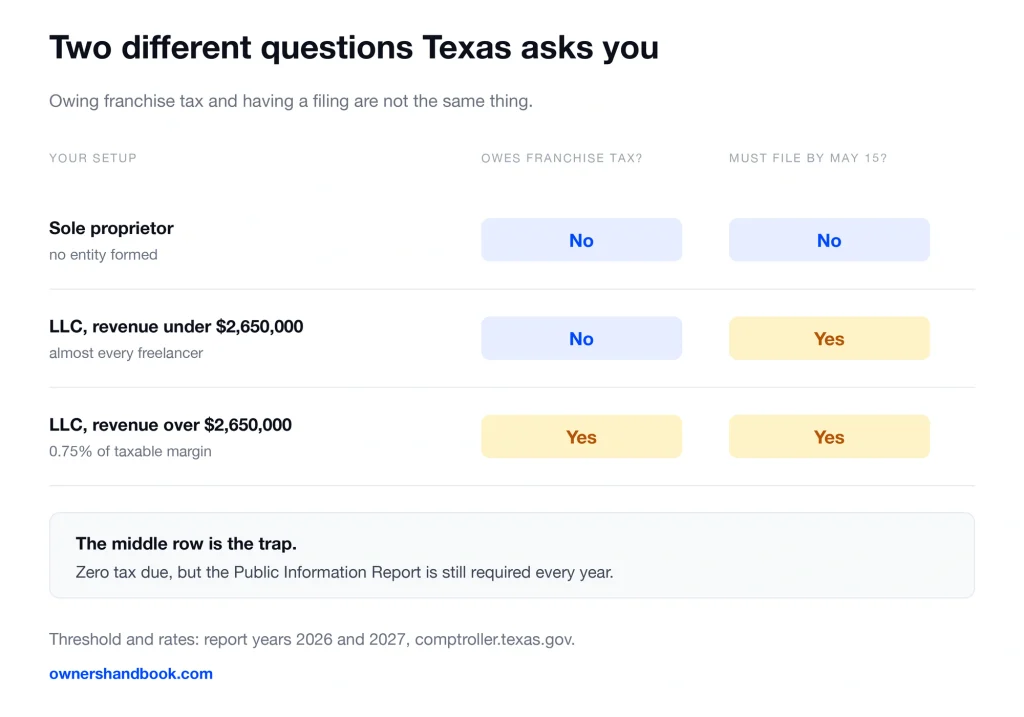
If you never formed anything, you are a sole proprietor. The Comptroller’s list of entities not subject to franchise tax names sole proprietorships, except single member LLCs.
So there is no Texas business tax return, no state income tax return, and no annual report. Your entire state obligation is whatever sales tax you collect, if any.
That is genuinely unusual. Most one-person businesses in Texas can go a whole career without filing anything with the state.
Franchise tax, defined
Franchise tax is a tax for the privilege of existing as a business entity in Texas, not a tax on your profit. The Comptroller also calls it the margin tax.
It applies to taxable margin, a figure built from total revenue minus one of several allowed subtractions. Revenue, not profit, is what gets measured against the threshold.
| Report years 2026 and 2027 | Amount |
|---|---|
| No tax due threshold | $2,650,000 |
| Rate, retail or wholesale | 0.375% |
| Rate, everything else | 0.75% |
| Compensation deduction limit | $480,000 |
| Annual report due | May 15 |
Read the first row again. At or below $2,650,000 in annualized total revenue, the franchise tax due is zero.
Almost no solo freelancer is near that. Invoice $200,000 in a year and you are at eight percent of the threshold.
Owing nothing and filing nothing are different things
Here is the trap. The threshold switches off the tax. It does not switch off the paperwork.
Through report year 2023, an entity under the threshold filed a No Tax Due Report. For report year 2024 and later, that report was discontinued.
What replaced it is not nothing. An LLC under the threshold must still file Form 05-102, the Public Information Report, once a year.
The Comptroller states it plainly. The report is due even if the entity does not have to file a franchise tax report because its revenue is at or below the threshold.
Entities that are not corporations, LLCs, limited partnerships, professional associations, or financial institutions file Form 05-167, the Ownership Information Report, instead.
Both are due May 15. Both are free to file through Webfile. Neither takes more than ten minutes for a one-person LLC.
What forfeiture actually means
Skip the report and the Comptroller mails Form 05-211, a Notice of Intent to Forfeit Right to Transact Business. It is a warning with a deadline printed on it.
Ignore that, and the forfeiture happens. Two things follow, and both are worse than a late fee.
First, the entity is generally denied the right to sue or defend in a Texas court. A client who stops paying becomes very hard to chase.
Second, each officer, director, partner, member, or owner becomes liable for certain debts of the entity. The liability shield you formed the LLC to get stops doing its job.
Then the registration is forfeited with the Secretary of State. On paper your LLC is no longer an entity in good standing.
There is a wrinkle worth knowing. The $50 late penalty attaches to a franchise tax report, and the Comptroller says there is no $50 penalty for a late PIR or OIR.
So the missed report costs nothing in penalty. It just walks you quietly toward forfeiture, which is the expensive part.
Getting a forfeited LLC back
Reinstatement is a defined process, not a negotiation. Four steps, and it costs money you never needed to spend.
File every outstanding annual franchise tax and information report. Pay the tax, penalties, and interest. Request a tax clearance letter using Webfile or Form 05-391.
Then file Form 801 with the Secretary of State, the application for reinstatement and request to set aside tax forfeiture. The fee is $75.
For scale, filing the certificate of formation to create a Texas LLC costs $300. Forfeiting and reinstating adds a quarter of that, on top of the reports you already owed.
Texas, California, and New York on the same $95,000
Now the honest comparison. Same freelancer, same $95,000 of profit, single filer, an LLC in each state.
| On $95,000 of profit | Texas | California | New York |
|---|---|---|---|
| State income tax | $0 | $3,966 | $4,251 |
| Annual entity charge | $0 | $800 | $25 |
| Total to the state | $0 | $4,766 | $4,276 |
| Federal self-employment tax | $13,423 | $13,423 | $13,423 |
California costs more than New York here, which surprises people. Its 9.3% bracket starts at $72,724 of taxable income, while New York is still charging 5.5% at that level.
And California charges the $800 whether you earned $95,000 or nothing at all. It is a minimum annual tax, due every year the LLC exists.
New York’s fee for a single-member LLC treated as a disregarded entity is $25, on Form IT-204-LL. Small, but it is a separate deadline in March.
Texas is the only column where keeping the entity alive costs nothing. The report is still due, and that is the whole point of this page.
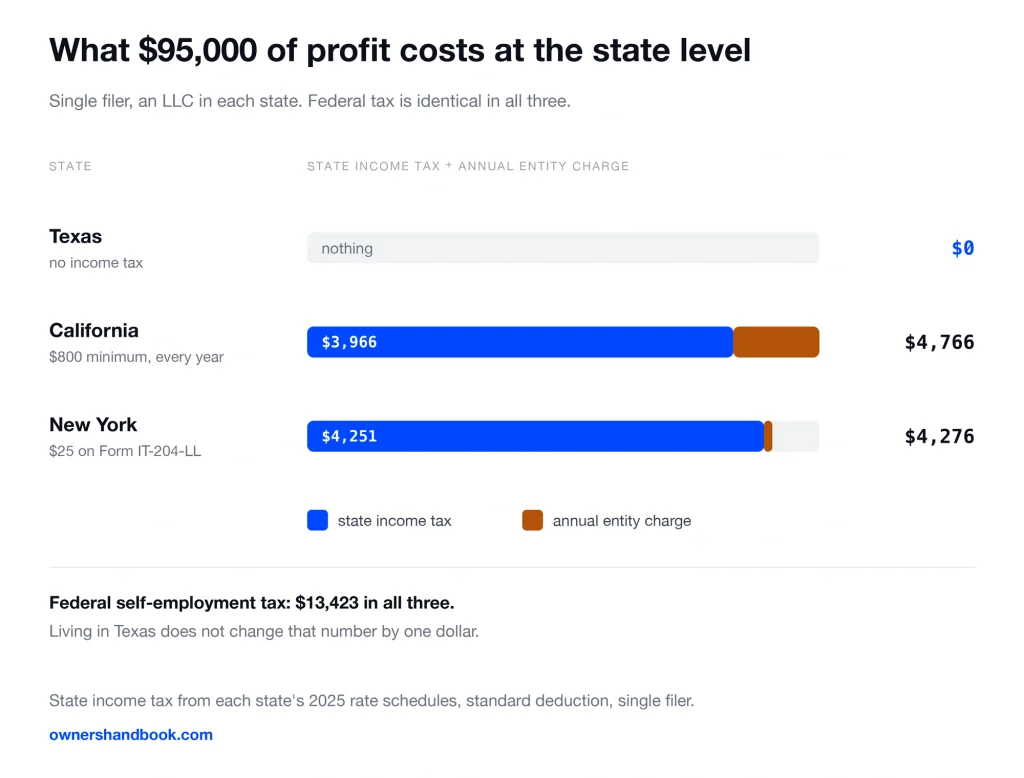
The state income tax figures use each state’s 2025 rate schedules, the most recent published, with the standard deduction and single filing status. Your own numbers will differ.
What Texas does still charge you
No income tax does not mean no tax. Texas funds itself largely through sales tax and property tax, and one of those reaches freelancers directly.
The state sales tax rate is 6.25%, and local jurisdictions add up to 2% more, for a maximum combined rate of 8.25%.
Texas taxes some services that other states leave alone. Data processing and information services are the two that catch web, design, and marketing freelancers.
If what you sell is taxable, you need a sales tax permit and a filing schedule of its own. That is a separate obligation from anything on this page.
Your Texas calendar
If you are a sole proprietor with no taxable sales, your state calendar is empty. Four federal quarterly dates and nothing else.
If you have an LLC, add exactly one line. May 15, Public Information Report, filed through Webfile.
Set the reminder for May 1. The report is free, the filing is short, and the downside of forgetting is the one thing an LLC was supposed to protect you from.
Whether to be an LLC or a sole proprietor is a liability decision before it is a tax decision. In Texas the tax side of that choice is close to a wash.
Frequently asked questions
Does living in Texas lower my self-employment tax?
No. Self-employment tax is federal, 15.3% of 92.35% of profit, and it is the same everywhere in the United States. On $95,000 of profit it is $13,423 in Dallas and $13,423 in San Diego.
I have an LLC that earned nothing this year. Do I still file?
Yes. The Public Information Report is due May 15 regardless of revenue, including zero revenue. There is no dollar floor that turns the filing off.
Do I owe franchise tax as a single-member LLC?
Only if annualized total revenue is above $2,650,000 for report years 2026 and 2027. Below that the tax due is zero, and the report is still required.
What is the difference between the PIR and the OIR?
Form 05-102, the Public Information Report, is for corporations, LLCs, limited partnerships, professional associations, and financial institutions. Form 05-167, the Ownership Information Report, covers other taxable entities.
My LLC was forfeited. Is it gone for good?
No. File the outstanding reports, pay what is owed, request a tax clearance letter with Form 05-391, then file Form 801 with the Secretary of State and pay the $75 fee.
Should I form an LLC in Texas just because there is no income tax?
The no income tax part is true either way, sole proprietor or LLC. Forming one adds a $300 filing fee and a permanent May 15 deadline without changing your federal tax at all.
Sources
Texas Comptroller, Franchise Tax
https://comptroller.texas.gov/taxes/franchise
Texas Comptroller, Franchise Tax Overview, Publication 98-806
https://comptroller.texas.gov/taxes/publications/98-806.php
Texas Comptroller, Public and Ownership Information Reports
https://comptroller.texas.gov/taxes/franchise/pir-oir-filing-req.php
Texas Comptroller, Reporting and Payment Requirements
https://comptroller.texas.gov/taxes/franchise/filing-requirements.php
Texas Comptroller, Making Your Account Current
https://comptroller.texas.gov/taxes/franchise/current-2024.php
Texas Comptroller, Tax Notices and Resolving Problems With Your Account
https://comptroller.texas.gov/taxes/franchise/notices.php
Texas Comptroller, Close or Reinstate a Business
https://comptroller.texas.gov/taxes/franchise/reinstate-terminate.php
Texas Comptroller, Taxes of Texas: A Field Guide
https://comptroller.texas.gov/transparency/revenue/docs/96-1774.pdf
Texas Comptroller, Sales and Use Tax
https://comptroller.texas.gov/taxes/sales
Texas Secretary of State, Business Filing Fee Schedule
https://direct.sos.state.tx.us/help/help-corp.asp?pg=fee
California Franchise Tax Board, Limited Liability Company
https://www.ftb.ca.gov/file/business/types/limited-liability-company/index.html
California Franchise Tax Board, 2025 Form 540 Booklet and Tax Rate Schedules
https://www.ftb.ca.gov/forms/2025/2025-540-booklet.pdf
New York State Department of Taxation and Finance, Form IT-201-I Instructions
https://www.tax.ny.gov/pdf/current_forms/it/it201i.pdf
New York State Department of Taxation and Finance, Form IT-204-LL-I Instructions
https://www.tax.ny.gov/forms/current-forms/it/it204lli.htm
IRS, Self-Employment Tax