Wyoming, Texas, Delaware: Which State for Your LLC?
Forming your LLC in a state you do not live in is perfectly legal, and thousands of people do it deliberately. It pays in four narrow situations. Outside them it buys a second annual fee and changes nothing you owe.
The reason it usually does not pay is that two different things get filed under one question.
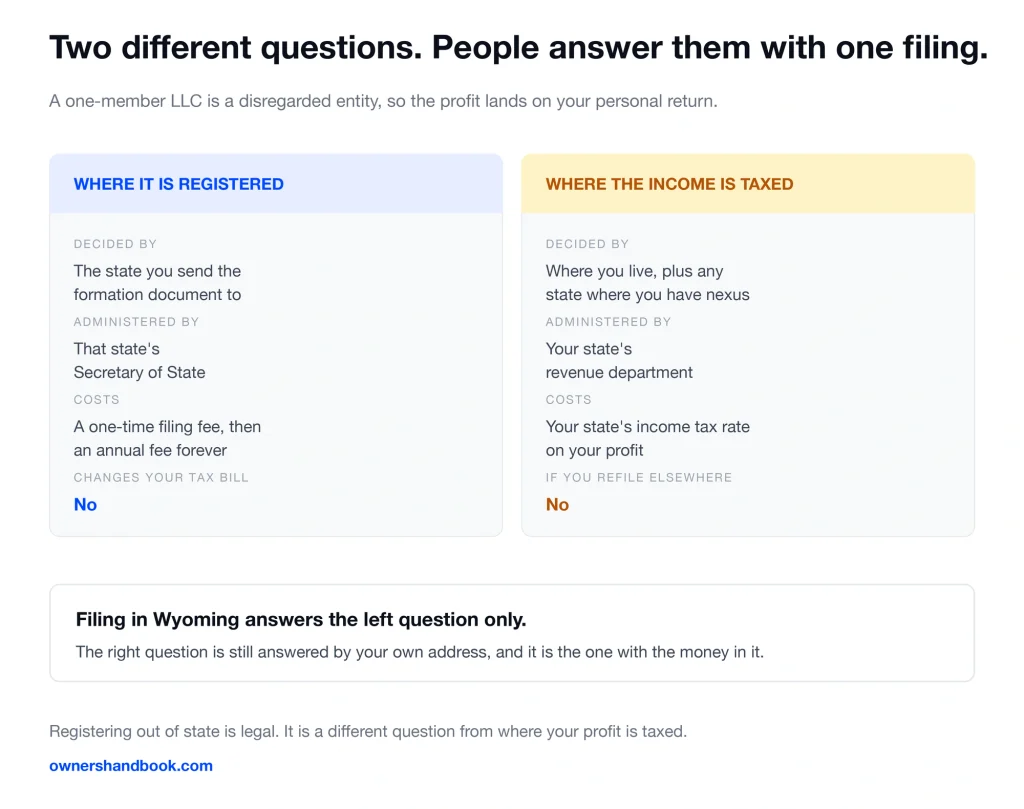
Where the entity is registered is an administrative act. Where the income is taxed is a separate question with a separate answer, and for most freelancers that answer follows your own front door.
Two questions that sound like one
Registration is paperwork. You send a formation document and a fee to one Secretary of State, and that state now carries your entity on its books.
Taxation follows nexus — the connection that gives a state the right to tax you. Physical presence, employees, property, and in many states a revenue threshold each create it.
For a one-member LLC that connection is usually just you. The IRS treats it as a disregarded entity, meaning the LLC files no return of its own and the profit lands on your personal return.
Your personal return goes to the state you live in. Which Secretary of State holds your formation document never enters that calculation.
| The question | What decides it | Who you deal with |
|---|---|---|
| Which state is my LLC registered in | The state where you filed the formation document | That state’s Secretary of State |
| Which state taxes the profit | Where you live, plus any state where you have nexus | Your state’s revenue department |
| Where else must I register | Every state where you actually transact business | Each of those Secretaries of State |
Read the middle row twice. It is the whole article.
What the popular states actually charge
Wyoming is the name people reach for first, and its numbers hold up. Articles of organization cost $100, and the annual report license tax is $60 or two-tenths of a mill on Wyoming assets, whichever is greater.
For a freelancer with a laptop and no property in the state, that means $60 a year. The current fee schedule took effect July 1, 2026, which is itself a reminder that these numbers move.
Delaware charges every LLC a flat $400 a year and does not ask for an annual report at all. Whether that $400 buys a freelancer anything is the subject of its own page.
Nevada and New Mexico come up constantly in the same conversation, and this page does not price them. Nevada’s Secretary of State blocks automated access, so its figures could not be read from the source, and nothing here is worth quoting from an article that did not read it either.
What is worth knowing before you look them up yourself: Nevada charges a separate state business licence on top of the formation and annual list fees, so the number to compare is the total of all three, not the filing fee that gets advertised. Price it at nvsos.gov before you decide.
| State | Every year after you form | What the state asks for |
|---|---|---|
| Texas | $0 | No Secretary of State annual report |
| Wyoming | $60 minimum | An annual report, due in your anniversary month |
| Delaware | $400 | Nothing else. The tax is the whole obligation. |
| California | $800 | A Statement of Information every two years |
Texas costs $300 to open and nothing to keep. California costs $70 to open and $800 every year it exists.
Wyoming’s privacy is real, and narrower than it sounds
Look at Wyoming’s own articles of organization form. It asks for the company name, a registered agent with a physical Wyoming address, a mailing address, a principal office, and an organizer’s signature.
It does not ask who the members are. That is a genuine difference from states that publish managers and members, and for some people it is the entire reason to file there.
What it does not do is hide you from the IRS, from your home state’s revenue department, or from anyone who sues you. It keeps your name out of one searchable database.
Decide whether that is worth a second annual fee. Price it as privacy, not as a tax strategy.
Four situations where out of state genuinely pays
One: you have no fixed state nexus. Full-time travelers, people living aboard a boat or an RV, and US citizens resident abroad genuinely have to pick a state, and picking one without an income tax is rational.
That choice is not made by filing an LLC. It is made by establishing domicile, and that is a good deal more demanding than a mailing address.
Two: you are not a US resident and you are forming a US entity with no US physical presence. There is no home state to default to, so the filing state is a real decision.
Three: you hold real property or intellectual property through an entity. Property is generally held in the state where it sits, and that has nothing to do with where you live.
Four: you have co-owners in different states and want one neutral body of law governing the operating agreement. This is the original reason Delaware exists, and at that point the law matters more than the fee.
Cases two, three and four are not do-it-yourself projects. Pay a lawyer once. The fee is small next to what an unwound structure costs later.
The thing that actually lowers a state tax bill
Move. Not the LLC. You.
A freelancer with $120,000 of California taxable income owes $3,201.97 plus 9.3% of the amount over $72,724 on the 2025 single schedule. That is $7,599, every year.
The same person, genuinely resident in Texas or Florida, owes that state nothing on the same income. Florida’s revenue department publishes the full list of taxes it administers and individual income tax is not on it.
This is legal, ordinary, and the only lever on this page that moves real money. It is also the one that requires changing your life rather than your paperwork.
Federal tax does not move with you. Self-employment tax is the same 15.3% in every state, and your federal return does not care.
What a real move requires
California defines domicile as the place where you voluntarily establish yourself and family, with the present intention of making it your true, fixed, permanent home and principal establishment.
Changing it requires all three of: abandoning the prior domicile, physically moving to and residing in the new place, and intent to remain indefinitely as demonstrated by your actions.
Those actions are specific and the state lists them. Days in versus out, where your spouse and children are, your principal residence, driver’s licence, vehicle registration, professional licences, voter registration, bank branches, doctors and dentists.
New York runs a second test alongside domicile. Keep a permanent place of abode there for substantially all of the year and spend 184 days or more in the state, and you are a resident regardless of intent.
California’s own guidance includes a worked example of a paper move. Declare Nevada residency, keep the California house, spend six or seven months a year in it, and the state’s determination is that you never left.
Count your days and keep the record. Departing-state audits are real, and a mail-forwarding address attached to a house you still sleep in is precisely the pattern they are looking for.
Foreign qualification, and the second set of fees
Operating in your home state with an out-of-state LLC means registering in your home state too, as a foreign entity. Foreign here means out-of-state, not overseas.
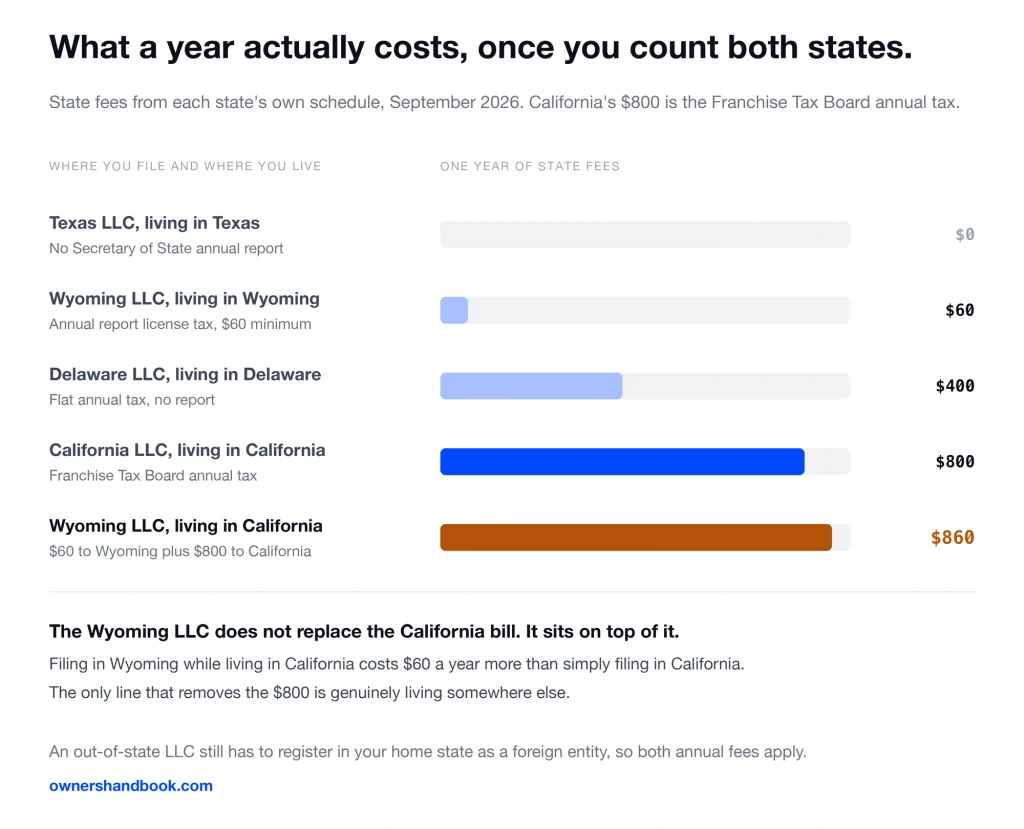
So you pay twice, every year, forever. A Wyoming LLC run by someone living in California owes Wyoming $60 and still owes California its $800.
That $800 is not a technicality. California’s Franchise Tax Board says every LLC doing business or organized in California must pay the annual tax, and doing business is where you work, not where you filed.
Texas prices the failure to register in plain numbers. Registering a foreign LLC costs $750, and an entity that transacted business first owes a late fee of that same $750 for each year it waited.
A foreign LLC that has not registered in California also cannot maintain an action in a California court. You can still be sued. You just cannot sue.
Three things that are not what they look like
A registered agent in Wyoming is a Wyoming address for legal papers. It is not a Wyoming connection for you, and no state treats it as one.
A virtual mailbox is a place to receive mail. Every factor on the residency list above is about where your life is, and none of them is satisfied by a box.
An LLC does not change what you owe. It is a liability wrapper, and if you are still deciding between it and staying a sole proprietor, that is a separate question from which state.
This page is general information about how the rules work, not advice about your situation.
If you are in cases two through four above, or planning a move a state is likely to look at, talk to someone who can see your whole picture.
Frequently asked questions
Can I form an LLC in a state where I do not live?
Yes. Any state will accept your filing and your fee. What it does not do is move where your income is taxed, and it usually obliges you to register in your home state as well.
Does a Wyoming LLC mean I stop paying my state’s income tax?
No. State income tax follows your residence and your nexus. A single-member LLC is a disregarded entity, so the profit lands on your personal return in the state where you live.
Which state is genuinely cheapest to keep an LLC in?
Of the states here, Texas: $300 to form and no Secretary of State annual report afterward. Wyoming’s $60 minimum is next. Neither helps if you live somewhere else and have to register there too.
How much does keeping two registrations actually cost?
Both annual fees, forever. A Wyoming LLC held by a California resident is $60 to Wyoming plus $800 to California, which is $60 a year more than simply forming in California.
What happens if I operate in a state without registering there?
States price it. Texas charges a $750 late registration fee for each year of delay on top of the $750 registration, and California blocks an unregistered foreign LLC from bringing a lawsuit.
Do I have to move for a whole year before my old state stops taxing me?
No, but the move has to be real from the date you claim it. You are taxed as a resident for the part of the year you were one, and the facts have to support the date you give.
Sources
IRS, Single Member Limited Liability Companies
Wyoming Secretary of State, Business Division Filing Fee Schedule, effective July 1, 2026
https://sos.wyo.gov/Business/docs/BusinessFees.pdf
Wyoming Secretary of State, Limited Liability Company Articles of Organization
https://sos.wyo.gov/Forms/Business/LLC/LLC-ArticlesOrganization.pdf
Delaware Division of Corporations, LLC/LP/GP Franchise Tax Instructions
Texas Secretary of State, Form 205, Certificate of Formation, Limited Liability Company
https://www.sos.state.tx.us/corp/forms/205_boc.pdf
Texas Secretary of State, Foreign or Out-of-State Entities
https://www.sos.state.tx.us/corp/foreign_outofstate.shtml
Texas Comptroller, Franchise Tax
https://comptroller.texas.gov/taxes/franchise
California Secretary of State, Limited Liability Companies (Domestic) forms and fees
California Franchise Tax Board, Limited Liability Company annual tax
https://www.ftb.ca.gov/file/business/types/limited-liability-company/index.html
California Franchise Tax Board, 2025 California Tax Rate Schedules
https://www.ftb.ca.gov/forms/2025/2025-540-tax-rate-schedules.pdf
California Franchise Tax Board, Publication 1031, Guidelines for Determining Resident Status
https://www.ftb.ca.gov/forms/2025/2025-1031-publication.pdf
California Corporations Code section 17708.07
https://leginfo.legislature.ca.gov/faces/codes_displaySection.xhtml?lawCode=CORP§ionNum=17708.07
New York State Department of Taxation and Finance, Frequently asked questions about filing requirements, residency, and telecommuting
https://www.tax.ny.gov/pit/file/nonresident-faqs.htm
Florida Department of Revenue, Taxes and Fees or Refunds
https://floridarevenue.com/taxes/taxesfees/Pages/default.aspx