Nevada LLC for Freelancers: What It Really Costs a Year
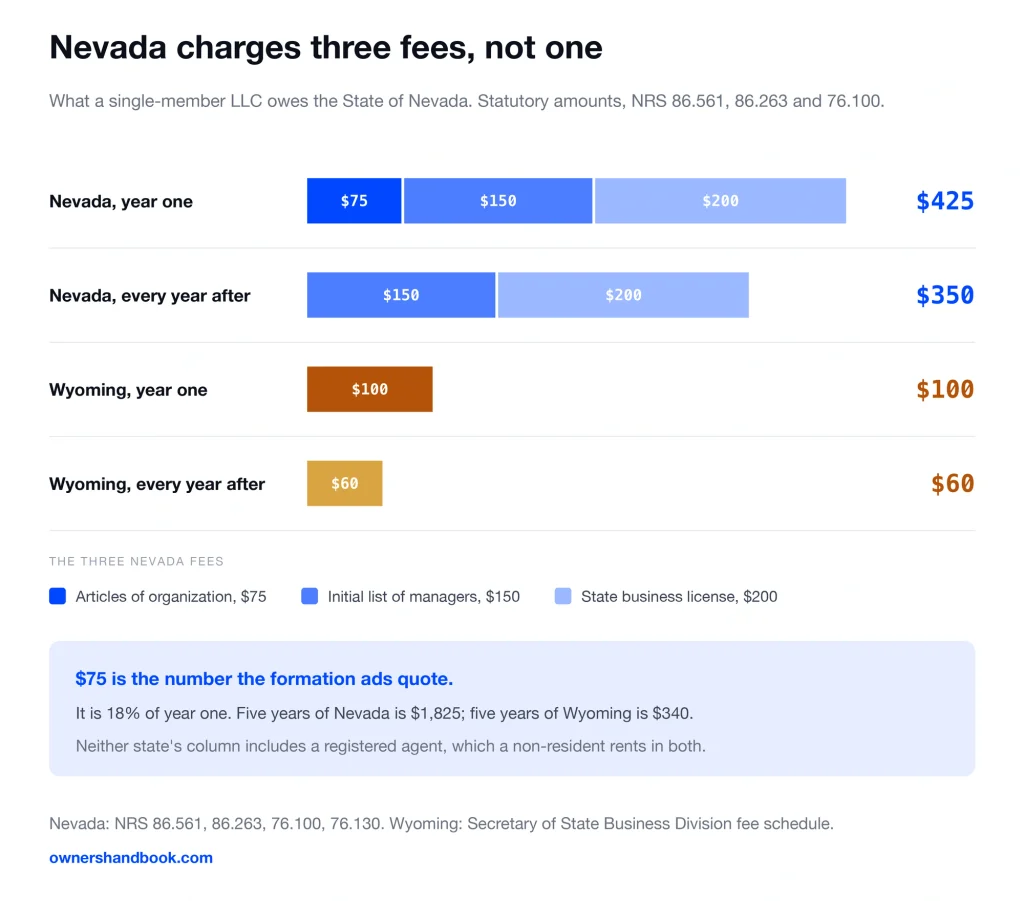
$425 in year one, then $350 every year after. That is what Nevada’s own statutes charge a single-member LLC, and it is three separate fees rather than the single number formation ads quote.
If you live anywhere else, all of it sits on top of what your home state already charges. Nevada’s missing income tax does not travel home with the certificate.
Nevada is the second most-searched state for out-of-state formation, behind Delaware. It is sold on three claims. Each one deserves to be checked rather than repeated.
No personal income tax, and it is in the constitution
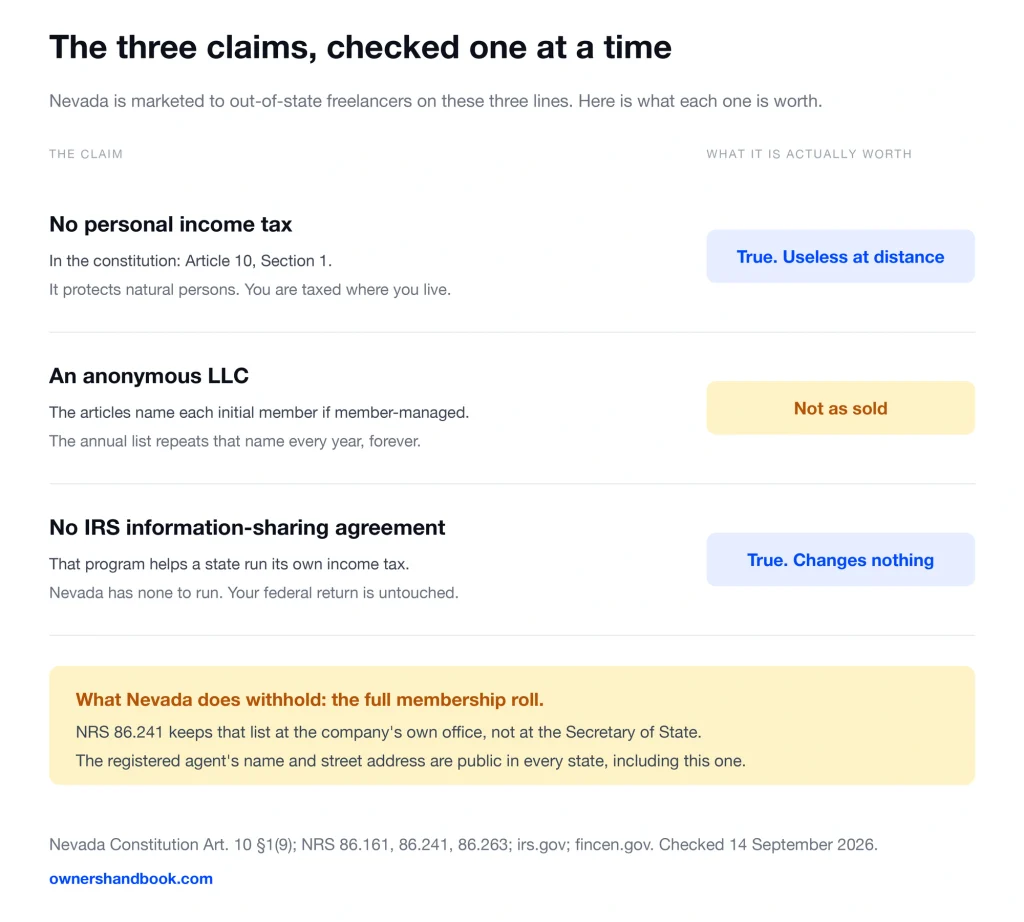
This claim is true, and it is sturdier than most state tax advantages, because it is not a statute some future legislature can quietly amend.
Article 10, Section 1 of the Nevada Constitution, subsection 9: “No income tax shall be levied upon the wages or personal income of natural persons.”
A Nevada resident genuinely keeps the 3% to 10% that a California or New York resident hands over. That is a large number and it is real.
Now read the sentence once more. It protects natural persons — people. Not certificates of organization.
Your state taxes you, not your paperwork
A single-member LLC is what the IRS calls a disregarded entity. The agency looks straight through the company to the owner.
An LLC with only one member is “treated as an entity disregarded as separate from its owner.” The profit lands on the owner’s Schedule C, and self-employment tax applies “in the same manner as a sole proprietorship.”
So the company has no income of its own to relocate. Your profit is your income, taxed by the state you were sitting in when you earned it.
The Delaware article works this mechanism out in full, including the foreign-qualification rules that force a second registration at home. Nevada is the same machine with different numbers on it.
The cost stack nobody adds up
Here is what gets buried. Nevada does not charge one fee. It charges three at formation, then two every year after that.
| What you pay | Amount | Authority | When |
|---|---|---|---|
| Articles of organization | $75 | NRS 86.561 | Once, at formation |
| Initial list of managers or managing members | $150 | NRS 86.263 | With the articles |
| State business license | $200 | NRS 76.100 | With the initial list |
| Annual list | $150 | NRS 86.263 | Every year, anniversary month |
| State business license renewal | $200 | NRS 76.130 | With the annual list |
| Year one | $425 | ||
| Every year after | $350 |
The $75 is the figure the formation companies advertise. It is 18% of what the first year actually costs.
A word on where those numbers come from. Nevada’s Secretary of State and its business portal both refuse automated requests, so every dollar above was read from the Nevada Revised Statutes rather than from a fee-schedule page.
Miss a deadline and each recurring item carries its own penalty: $75 added to the annual list under NRS 86.272, and $100 added to the business license under NRS 76.130.
Leave the company in default and the charter is revoked on the first anniversary of the month the filing was due. Reinstatement then costs $300 on top of everything already owed.
None of this includes a registered agent. NRS 86.231 requires one with a Nevada street address, so a non-resident rents that address every year, at whatever the agent charges.
Nevada against Wyoming, on the line that repeats
Formation fees are paid once, and almost nobody should pick a state on them. The recurring line is the one that compounds.
| Line item | Nevada LLC | Wyoming LLC |
|---|---|---|
| Formation filing | $75 | $100 |
| Due at formation, beyond that filing | $350 | $0 |
| Recurring, every year | $350 | $60 |
| Year one, state charges | $425 | $100 |
| Five years of state charges | $1,825 | $340 |
Wyoming charges an annual license tax of $60, or two-tenths of one mill on assets located and employed in Wyoming, whichever is greater. A freelancer with a laptop pays the $60.
Nevada therefore costs close to six times Wyoming every year, indefinitely, for a liability wall that does the same job.
That gap is most of the answer to the which-state question. It is also why Nevada’s marketing talks about privacy rather than price.
The privacy claim, read against the statute
“Anonymous LLC” is a marketing phrase, not a legal status. The only thing that matters is which names the state publishes.
Nevada publishes more than people expect. NRS 86.161 requires the articles of organization to give the name and address of each initial manager — or, if the company is managed by its members, of each initial member.
A one-person LLC with no separate manager is member-managed. Your own name and address therefore enter a public state filing on the day you form it.
NRS 86.263 then requires an annual list naming every manager, or if there are none, every managing member, with an address for each. That repeats for as long as the company exists.
Nevada also shut the obvious workaround. Each list carries a declaration under penalty of perjury that nobody was named on it “with the fraudulent intent of concealing the identity” of whoever actually exercises control.
What Nevada does withhold is the full membership roll. NRS 86.241 keeps that list at the company’s own office or with its custodian of records, not at the Secretary of State.
New Mexico goes further by asking for no annual report from an LLC at all, and Wyoming’s annual report reports assets rather than a roster of people. Nevada sits at the disclosing end of that range, not the private end.
And the registered agent is public in every state, without exception. A public name and street address to serve papers on is the entire function of a registered agent.
The IRS information-sharing claim
This one turns up throughout Nevada formation marketing, usually phrased as “Nevada has no information-sharing agreement with the IRS.”
The program behind it is real. The IRS Office of Governmental Liaison builds partnerships with “state and local taxing agencies” to improve “voluntary compliance” and “the efficiency of tax administration.”
Read what that is for. It helps a state administer the state’s own income tax. Nevada has no personal income tax to administer, so there is nothing for the two sides to trade.
The absence is a consequence of that constitutional provision. It is not a shield, and it was never aimed at your federal return in the first place.
Federal obligations do not route through any state. Your clients file Forms 1099-NEC with the IRS, payment platforms file 1099-K, and neither one asks a state for permission.
The EIN closes the loop. Form SS-4 demands a responsible party — an individual who “ultimately owns or controls the entity” — identified by SSN or ITIN.
Beneficial ownership reporting is a separate federal question, and also not a Nevada one. Under the FinCEN rule effective August 14, 2026, entities created in the United States are exempt from filing beneficial ownership information.
Commerce Tax, and why you will not owe it
Nevada does tax business revenue. The Commerce Tax applies to Nevada gross revenue above $4,000,000 in a fiscal year.
The Department of Taxation states the test for one-person businesses directly: file Schedule C, and if your Nevada gross revenue exceeds $4,000,000, a Commerce Tax return is due.
A freelancer billing $150,000 sits at 3.75% of that threshold. Below it you file nothing and owe nothing.
When Nevada actually is the right answer
Two situations, and both are narrow.
You live in Nevada. The constitutional provision then applies to you, the $350 a year is your only recurring state charge, and there is no second state to register in.
You hold Nevada real property, or run something with a genuine physical presence there. That is nexus, and it is a question for a lawyer rather than a blog post.
Notice what is absent from both. Neither is a non-resident buying Nevada’s tax law by mail.
What to do instead
Form the LLC in the state where you live. One filing, one annual obligation, one registered agent — and you can be your own, at your own address, for nothing.
Settle first whether you need one at all, because LLC or sole proprietor is a liability question rather than a tax question. Then follow the steps to form an LLC at home.
If your own state’s fees look steep, measure them against $350 a year plus a Nevada agent plus your home state’s charges regardless. A detour adds; it never subtracts.
This page is general information, not legal or tax advice for your situation. Fees and filing rules change, and the statutes cited here were read on September 14, 2026.
Frequently asked questions
Can I form a Nevada LLC if I live in another state?
Yes, and it buys you a second set of bills. Nevada wants $350 a year plus a registered agent, your home state still wants its own filings, and your state income tax is decided by where you live.
Does a Nevada LLC lower my federal tax?
No. A one-member LLC is a disregarded entity, so the same Schedule C and the same self-employment tax apply to the same profit, in Nevada or anywhere else.
Is a Nevada LLC anonymous?
No. The articles name each initial manager, or each initial member if the company is member-managed, and the annual list repeats that every year. Nevada withholds the full membership roll, not the people running it.
What happens if I miss the Nevada annual list?
The annual list adds a $75 penalty and the business license adds $100. If it stays unfiled, the charter is revoked on the first anniversary of the due month, and reinstatement costs $300 plus everything outstanding.
Do I have to file a Nevada Commerce Tax return?
Only above $4,000,000 of Nevada gross revenue in a fiscal year. Below that, there is no return and no tax, which covers essentially every freelancer.
Is Wyoming cheaper than Nevada?
Yes, by a wide margin. Wyoming charges $100 to form and $60 a year after; Nevada charges $425 in year one and $350 a year after. Both are still second states if you do not live there.
Sources
Nevada Constitution, Article 10, Section 1 (Internet Archive capture of leg.state.nv.us, which blocks automated requests)
https://web.archive.org/web/20250815034101/https://www.leg.state.nv.us/Const/NvConst.html
NRS Chapter 86, Limited-Liability Companies, Rev. 4/15/2026 (Internet Archive capture of leg.state.nv.us)
https://web.archive.org/web/20260828230817/https://www.leg.state.nv.us/nrs/nrs-086.html
NRS Chapter 76, State Business Licenses, Rev. 4/15/2026 (Internet Archive capture of leg.state.nv.us)
https://web.archive.org/web/20260804120327/https://www.leg.state.nv.us/nrs/nrs-076.html
Nevada Legislature, Nevada Revised Statutes (live site, blocks automated access)
https://www.leg.state.nv.us/nrs
Nevada Secretary of State, State Business License Requirements
https://www.nvsos.gov/sos/licensing/state-business-license
Nevada Department of Taxation, Commerce Tax
https://tax.nv.gov/commerce-tax
Nevada Department of Taxation, Commerce Tax FAQs
https://tax.nv.gov/commerce-tax/commerce-tax-faq
Wyoming Secretary of State, Business Division Fee Schedule
https://sos.wyo.gov/Business/docs/BusinessFees.pdf
Wyoming Secretary of State, Business Division FAQs
https://sos.wyo.gov/faqs.aspx?root=BUS
New Mexico Secretary of State, Business Services
IRS, Single Member Limited Liability Companies
IRS, Instructions for Form SS-4
https://www.irs.gov/instructions/iss4
IRS, Governmental Liaisons
https://www.irs.gov/government-entities/governmental-liaisons
FinCEN, Beneficial Ownership Information Reporting