Self-Employment Tax Calculator With W-2 Income
Most self-employment tax calculators ask for one number. That works until you also have a job, at which point the answer they give you can be three times too high.
Self-employment tax calculator
Federal self-employment tax only, for tax year 2026. Not income tax, not state tax.
Revenue minus business expenses — Schedule C line 31, not what clients paid you.
From a job, if you have one.
Only affects the 0.9% surtax.
| Net earnings subject to the tax (92.35%) | $0 |
| Social Security, 12.4% | $0 |
| Medicare, 2.9% | $0 |
| Additional Medicare, 0.9% | $0 |
| Deductible half (comes off your income tax) | $0 |
Figures current for tax year 2026. Social Security wage base $184,500, from
IRS Publication 505.
Runs entirely in your browser — nothing you type is sent anywhere or stored.
This calculator is for informational purposes only and does not constitute legal, accounting, or tax advice.
It estimates federal self-employment tax for the 2026 tax year and does not account for income tax,
state or local taxes, credits, or your individual circumstances. Consult your own tax advisor for guidance
on your situation.
This one asks for your W-2 wages because they change the answer. Everything below explains why.
The number most calculators get wrong
Self-employment tax is 15.3%, which is 12.4% for Social Security and 2.9% for Medicare. The 12.4% stops at a ceiling — $184,500 of earnings in 2026. The 2.9% has no ceiling at all.
Here is the part that matters if you have a job. Your W-2 wages fill that ceiling first. Whatever is left is what your freelance profit gets charged the 12.4% on.
| Your situation | Simple 15.3% says | Actually owed |
|---|---|---|
| $40,000 freelance, no job | $5,652 | $5,652 |
| $40,000 freelance, $60,000 job | $5,652 | $5,652 |
| $40,000 freelance, $180,000 job | $5,652 | $1,782 |
| $40,000 freelance, $190,000 job | $5,652 | $1,314 |
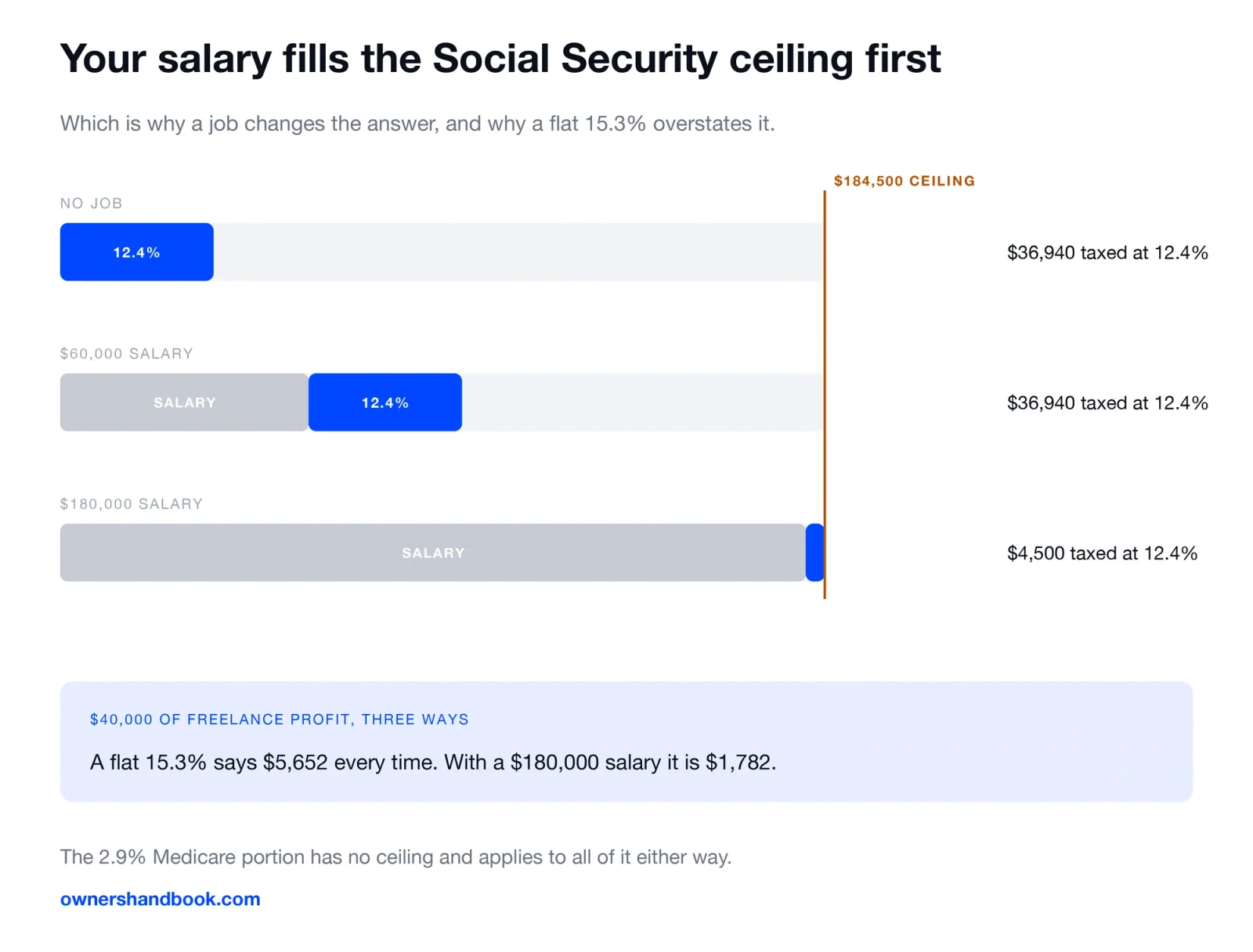
The third row is the one worth looking at. A $180,000 salary uses all but $4,500 of the Social Security ceiling, so only $4,500 of freelance profit pays the 12.4%. The rest pays Medicare only.
Multiply by 15.3% and you overstate the bill by more than three times.
Where the 92.35% comes from
The tax is not charged on your profit. It is charged on 92.35% of it.
An employee and their employer split these taxes. The employer’s half is a business expense for the employer, so the employee never pays tax on that portion. Working for yourself, you pay both halves — and the 92.35% multiplier is the adjustment that puts you back in roughly the same position.
So $80,000 of profit becomes $73,880 of net earnings, and the rates apply to that.
There is a matching adjustment at the other end: half of the self-employment tax you pay comes off your income before income tax is figured. The calculator shows that figure, because it reduces a different bill than the one it just calculated.
The 0.9% nobody mentions
On top of the 2.9% Medicare, there is an additional 0.9% on combined wages and self-employment income above a threshold.
| Filing status | Threshold |
|---|---|
| Single | $200,000 |
| Head of household | $200,000 |
| Married filing jointly | $250,000 |
| Married filing separately | $125,000 |
Two things about it. It applies to the combined figure, so wages and freelance income are added together before the threshold is tested — which is why the calculator asks for both. And it is not deductible, unlike the other two portions, so it does not appear in the deductible-half line.
The thresholds are not adjusted for inflation. They have been the same since the tax was introduced, which means more people cross them every year.
The $400 floor
Below $400 of net earnings there is no self-employment tax at all.
It is a genuine floor rather than an exemption on the first $400 — cross it and the whole amount is taxed, not just the part above.
Income tax is a separate question. Profit under $400 can still be taxable income; it just does not carry the 15.3%.
What this is not
It is not income tax. Self-employment tax funds Social Security and Medicare. Income tax is calculated separately, on the same profit, at whatever rate your total income lands in. Both bills arrive.
This is why the usual advice is to set aside 25% to 30% of every payment rather than 15.3%. The 15.3% covers one of the two.
It is not state tax. Some states tax self-employment income, some do not, and a few have their own business taxes on top. Add 3% to 6% if your state taxes income.
It is not what you send each quarter. The quarterly payment covers income tax and self-employment tax together, and it is based on a safe harbor rather than on this year’s actual figures.
What counts as profit
The figure to enter is net profit — line 31 of Schedule C. Revenue minus business expenses.
It is not what clients paid you, and it is not what landed in your bank account. If a client paid $5,000 and the platform kept $150, revenue is $5,000 and the $150 is an expense. Both go on the form, and profit is what comes out the other end.
That distinction matters for this calculation because expenses reduce the tax twice — once here, and again on the income tax that sits on top.
Why the effective rate falls as you earn more
Because the 12.4% stops and the 2.9% does not.
| Profit | Self-employment tax | Effective rate |
|---|---|---|
| $40,000 | $5,652 | 14.1% |
| $100,000 | $14,130 | 14.1% |
| $200,000 | $28,234 | 14.1% |
| $400,000 | $35,115 | 8.8% |
Below the ceiling the effective rate is a flat 14.13% — which is 15.3% of 92.35%. The $200,000 row still reads 14.1% because the 0.9% surtax that kicks in there roughly cancels out the Social Security portion that has stopped.
Past that the ceiling dominates, and by $400,000 the effective rate has fallen to 8.8%.
This is also the shape that makes an S corp election worth considering at higher profits, since the mechanism there is to move part of the income out of self-employment tax entirely.
Frequently asked questions
Do I pay self-employment tax if I already pay Social Security through my job?
Yes, but possibly less than you expect. Your wages fill the Social Security ceiling first, so if they already reach $184,500 no part of your freelance profit pays the 12.4%. The 2.9% Medicare portion applies either way, with no ceiling.
Is self-employment tax on top of income tax?
Yes. They are two separate calculations on the same profit, and both are due.
Can I deduct it?
Half of it, and not against this tax. One-half of your self-employment tax comes off your income before income tax is figured. The additional 0.9% Medicare tax is not deductible.
What if I have a loss?
No self-employment tax. A business loss can also offset other income on your return, subject to limits.
Does an LLC change this?
No. A single-member LLC files Schedule C by default and pays self-employment tax exactly as a sole proprietor does. An S corp election is what changes the calculation, and that is a different decision with its own costs.
Does the calculator send my numbers anywhere?
No. It runs entirely in your browser. Nothing you type is transmitted or stored.
Sources
IRS, Self-Employment Tax
IRS, Topic 554, Self-Employment Tax
https://www.irs.gov/taxtopics/tc554
IRS, Topic 751, Social Security and Medicare Withholding Rates
https://www.irs.gov/taxtopics/tc751
IRS, Publication 505, Tax Withholding and Estimated Tax
https://www.irs.gov/pub/irs-pdf/p505.pdf
IRS, Publication 15, Employer’s Tax Guide
https://www.irs.gov/pub/irs-pdf/p15.pdf
IRS, Schedule SE, Self-Employment Tax