Self-Employed Health Insurance Deduction Calculator (2026)
Your health insurance premiums are deductible, but not all of them, and not always. Two limits decide how much — one tied to what the business earned, one tied to whether a job was available to you. This calculator applies both.
Self-employed health insurance deduction calculator
How much of your premiums you can actually deduct for tax year 2026, and what happens to the rest.
For you, your spouse, your dependents, and your children who were under 27 at the end of the year. Medicare premiums count too.
Qualified long-term care only. These are capped by age, and the part above the cap is lost.
Sets the long-term care cap. Ignored if you paid none.
Schedule C line 31, for the business the plan is established under.
SEP-IRA, SIMPLE or solo 401(k). Your own, not an employee’s.
Months you were eligible for a subsidized plan through your own, your spouse’s, your dependent’s or your under-27 child’s employer. Eligible, not enrolled — and one day contaminates the whole month.
Changes the SE tax figure that comes off your limit.
| Long-term care allowed | $0 |
| Premiums for months you can claim (12 of 12) | $0 |
| Net profit | $0 |
| Less the deductible half of self-employment tax | $0 |
| Less retirement contributions | $0 |
| Your earned income ceiling | $0 |
| Premiums above the ceiling (Schedule A instead) | $0 |
| Long-term care above the age cap (lost, not Schedule A) | $0 |
Figures current for tax year 2026. The deduction and its earned income limit come from
Internal Revenue Code section 162(l);
the figure itself is worked out on
Form 7206,
which replaced the retired Publication 535 worksheet. Long-term care caps from
Rev. Proc. 2025-32,
section 4.27.
Runs entirely in your browser — nothing you type is sent anywhere or stored.
This calculator is for informational purposes only and does not constitute legal, accounting, or tax advice.
It does not handle the circular calculation that applies when you buy through the Marketplace and receive
advance premium tax credits — that case needs the worksheets in IRS Publication 974. It also does not
apply the age-banded caps on long-term care premiums, or the separate W-2 reporting rule for S corporation
shareholders owning more than 2%. Consult your own tax advisor for guidance on your situation.
Everything below explains the two limits, and what happens to the part you cannot deduct.
Where this deduction actually goes
Whatever you pay for coverage is deductible. It just does not sit on Schedule C with your other business expenses.
It goes on Schedule 1, line 17, as the self-employed health insurance deduction, authorized by section 162(l) of the tax code. The figure itself is worked out on Form 7206 — which matters, because most of what is written about this deduction still points at Worksheet 6A in Publication 535, and the IRS retired that publication after 2022.
That placement makes it an above-the-line deduction — it comes off before your AGI is figured rather than after. You do not need to itemize to take it.
It covers medical, dental, vision and qualified long-term care premiums, for you, your spouse, your dependents, and your children who were under 27 at the end of the year. The under-27 rule is worth knowing: the child does not have to be your dependent. Medicare premiums count too, if you pay them voluntarily for coverage in your own name.
It does not reduce self-employment tax
This is the most common wrong assumption about this deduction, and it costs people real money in planning decisions.
Self-employment tax is charged on your net profit from Schedule C. This deduction is not on Schedule C. It is on Schedule 1, one layer later.
| What it lowers | What it does not |
|---|---|
| Income tax | Self-employment tax |
| Your AGI | Your Schedule C profit |
| What flows to state returns based on AGI | The 15.3% on your net earnings |
One IRS page says otherwise, and it is wrong. The agency’s own self-employment tax page still states that this deduction “is taken into account when calculating net earnings from self-employment,” citing section 2042 of the Small Business Jobs Act. That rule existed for one year only — tax year 2010. You can see it in the forms: the 2010 Schedule SE line 3 told you to subtract the deduction, and the 2011 Schedule SE dropped that instruction. It has never come back. The 2026 draft Schedule SE line 3 reads simply “Combine lines 1a, 1b, and 2.”
That page was last reviewed in June 2026 and the error survived the review. If you find it and it contradicts what you read here, this is why.
So on $12,000 of premiums, a freelancer in the 22% bracket saves income tax and exactly $0 of self-employment tax. Only Schedule C expenses cut both.
And the income tax saving is smaller than 22% of $12,000. This deduction reduces qualified business income, so it shrinks your QBI deduction alongside it. For most freelancers who qualify for QBI, the real saving is closer to four fifths of the headline figure — about $2,100 rather than $2,640.
The first limit: what the business earned
The deduction cannot exceed your earned income from the business the plan is established under. That sounds simple and then gets specific.
It is not net profit. It is net profit after two subtractions:
| Start with | Schedule C line 31, net profit |
|---|---|
| Subtract | The deductible half of your self-employment tax |
| Subtract | SEP-IRA, SIMPLE or solo 401(k) contributions for yourself |
| Equals | Your ceiling for this deduction |
On $50,000 of net profit with no retirement contributions, the deductible half of self-employment tax is about $3,532, so the ceiling is roughly $46,468. Premiums under that are fully deductible. Premiums over it are not.
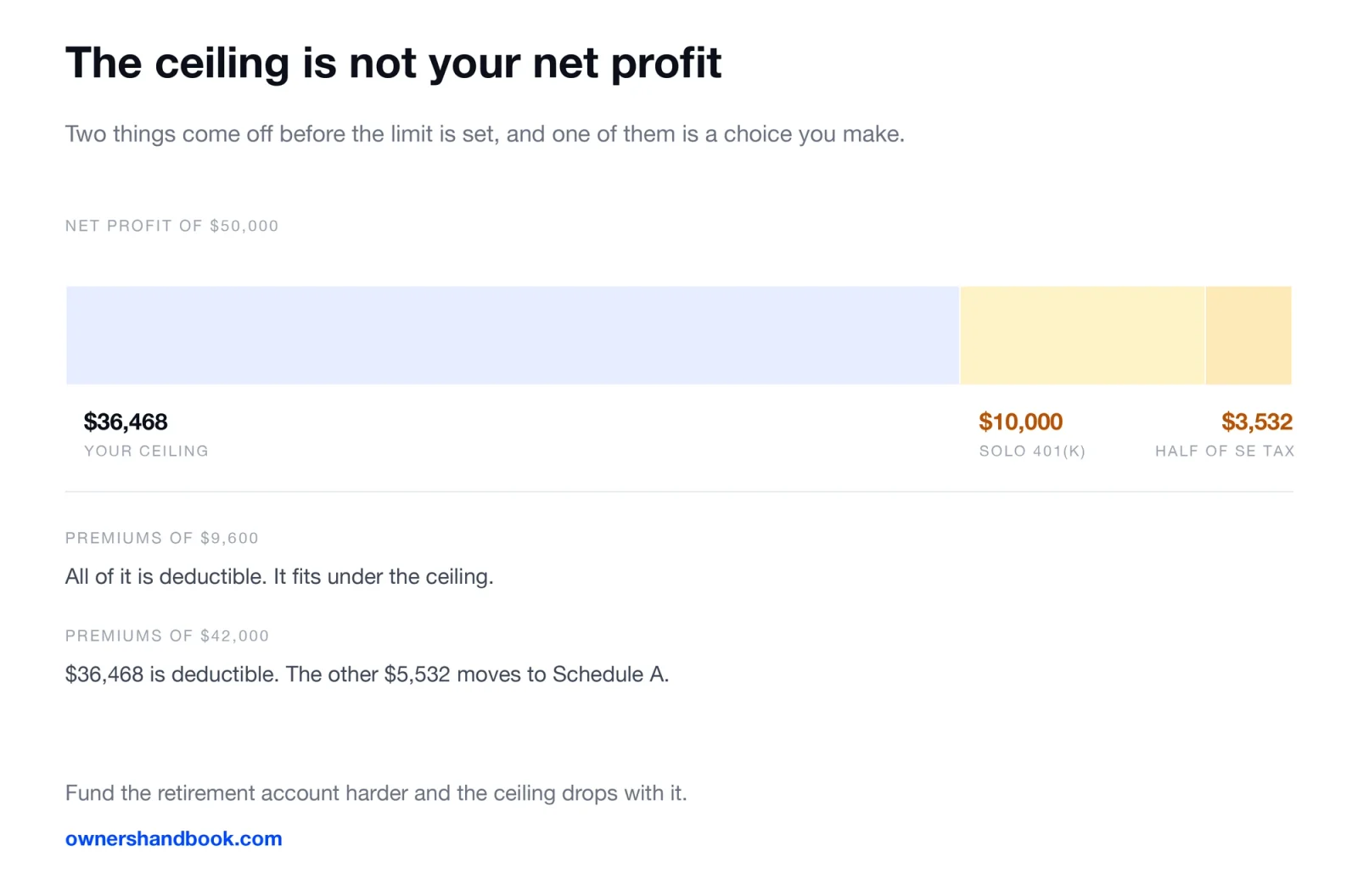
The retirement subtraction is the one that surprises people. Fund a solo 401(k) heavily in a modest year and you can push your own health insurance deduction down. On $50,000 of profit with $40,000 going into a solo 401(k), the ceiling drops to about $6,468 — and premiums of $10,000 no longer fit.
If the year ended in a loss, the ceiling is zero and the deduction is zero.
The second limit: months a job was available
This one catches people who change jobs mid-year, and it is stricter than it first reads.
You cannot take the deduction for any month you were eligible to participate in a subsidized health plan through your own employer, your spouse’s employer, your dependent’s employer, or the employer of your child who was under 27 at the end of the year. A QSEHRA counts as a subsidized employer plan for this purpose.
Eligible, not enrolled. Declining your spouse’s plan does not hand the deduction back to you. Staying on your own marketplace policy because you prefer it does not either. The test is whether the plan was available.
It is figured month by month, and a single day contaminates the whole month. The IRS gives its own example: eligible through a spouse’s employer from September 30, and September through December are all gone. One day of September, four months lost.
Take a W-2 job with benefits on September 1 and the deduction covers January through August — eight twelfths of what you paid.
| Situation | Months you can claim |
|---|---|
| No job, no spouse’s plan, all year | 12 |
| Took a job with benefits on September 1 | 8 |
| Spouse’s employer offered coverage all year | 0 |
| Spouse’s employer offered coverage from July | 6 |
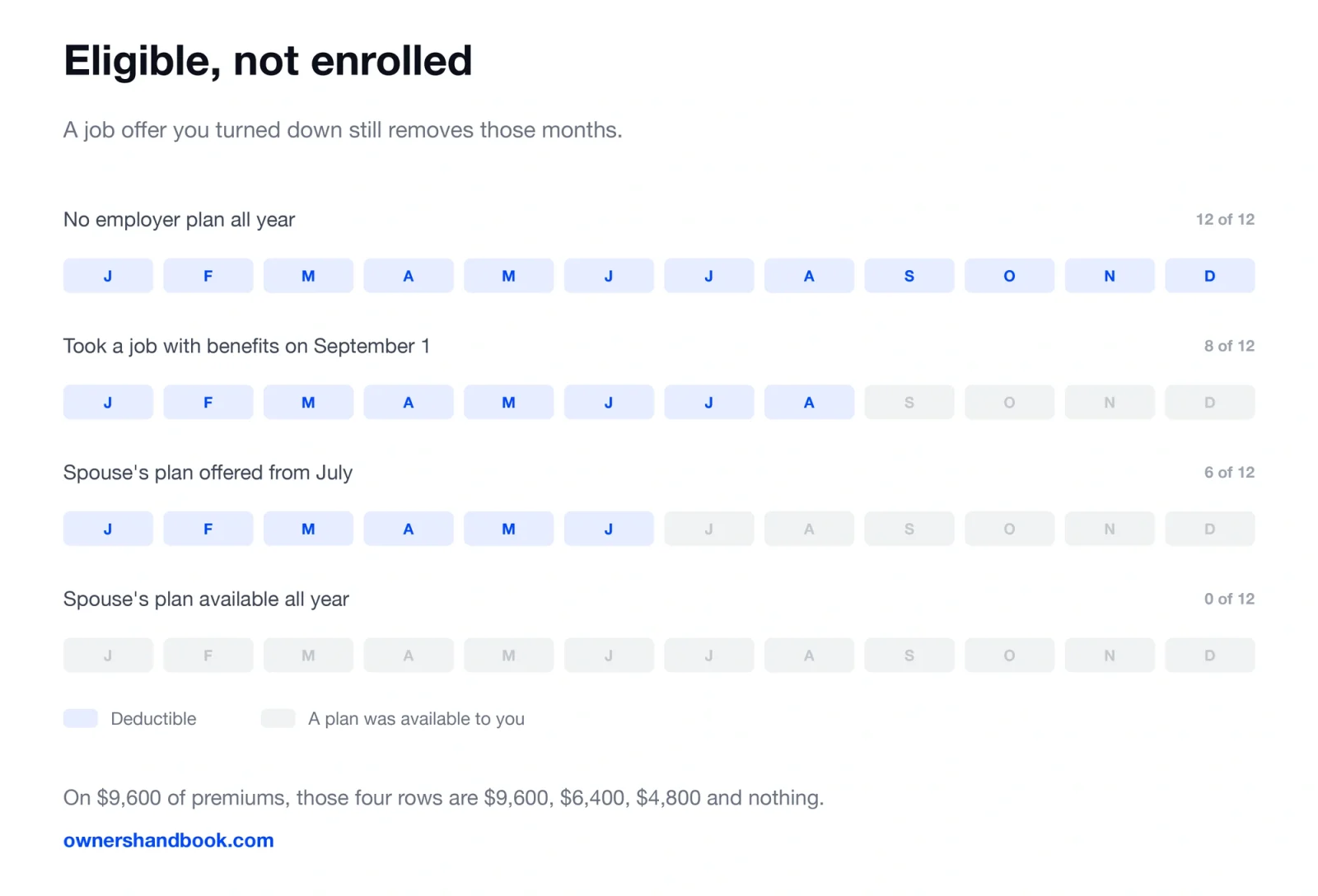
The calculator asks for the number of months rather than the dates, because that is the figure the rule actually turns on.
What happens to the part you cannot deduct
Medical premiums above the ceiling are not lost. They move to Schedule A as a medical expense.
That is a real deduction, but a much weaker one. It only counts to the extent your total medical expenses exceed 7.5% of your AGI, and you only get it at all if you itemize. Most freelancers take the standard deduction, which means in practice the excess often produces nothing at all.
Which is why the ceiling is worth planning around rather than discovering in April.
Long-term care is different, and this one really is lost
Long-term care premiums are capped by age before they ever reach this deduction. The cap is not a rule about self-employment — it is section 213(d)(10) deciding how much of a long-term care premium counts as medical care in the first place.
| Your age at the end of 2026 | Most you can count |
|---|---|
| 40 or under | $500 |
| 41 to 50 | $930 |
| 51 to 60 | $1,860 |
| 61 to 70 | $4,960 |
| Over 70 | $6,200 |
Because the cap decides what is medical care at all, the part above it does not fall through to Schedule A the way excess medical premiums do. It is simply gone.
A 55-year-old paying $3,000 in long-term care premiums counts $1,860. The other $1,140 is not deductible here, not deductible on Schedule A, not carried forward. That is the one place on this page where money genuinely disappears.
Claiming long-term care premiums also means you have to use Form 7206 rather than the shorter worksheet in the Form 1040 instructions.
If you buy through the Marketplace with a subsidy
This is the one case this calculator does not handle, and the reason is that the math is genuinely circular.
The premium tax credit is based on your household income. This deduction lowers your household income. A lower income means a bigger credit. A bigger credit means smaller net premiums. Smaller premiums mean a smaller deduction — which raises your income again.
Each answer changes the other. The IRS publishes iterative worksheets in Publication 974 for exactly this, and there is no single formula that resolves it.
If you receive advance premium tax credits, treat the number above as an upper bound and use the Publication 974 worksheets, or let tax software run the iteration. Everything else on this page still applies to you — the two limits, the month rule, the long-term care cap, the Schedule A fallback. Only the final figure needs the worksheet.
Note the word *and*. Buying through the Marketplace does not by itself put you in this group. If you took no advance credit and are not claiming the premium tax credit, the calculator above works for you normally.
Our guide to health insurance for the self-employed covers the subsidy side, including the income cliff that makes this worth planning before December 31.
If you have an S corporation
More than 2% shareholders follow a different path. The corporation pays the premiums, reports them as wages on your W-2, and you then deduct them on Schedule 1.
The deduction ends up in the same place. The reporting step is what people miss — if the premiums never appeared on a W-2, the IRS position is that the plan was not established by the corporation at all, and the deduction is not available. If you elected S corporation status, check the W-2 before filing.
Your ceiling is a different number too. Form 7206 tells S corporation shareholders to skip the net-profit lines entirely and use Medicare wages from box 5 of the W-2. Not K-1 income, not distributions. The calculator above follows the net-profit path, so it does not apply to you.
One more trap: the 2% test uses the attribution rules in section 318, so shares held by your spouse or children count as yours.
Frequently asked questions
Do I need to itemize to take this deduction?
No. It is an above-the-line deduction on Schedule 1, which means you take it whether you itemize or take the standard deduction. Only the excess above your ceiling has to go to Schedule A, and that part does require itemizing.
Can I deduct premiums for my spouse and children?
Yes — your spouse, your dependents, and your children who were under 27 at the end of the year. The child does not need to be your dependent for the under-27 rule.
My spouse has employer coverage but I stayed on my own plan. Can I deduct it?
No, not for the months that coverage was available to you. The rule tests eligibility, not enrollment. This is the single most common way the deduction gets disallowed.
Does this deduction lower my quarterly estimated payments?
It lowers the income tax portion of what you owe, so it lowers what you should be setting aside, but it leaves the self-employment tax portion untouched. If you are working out what to send each quarter, our quarterly tax calculator handles the safe harbor separately.
What if my premiums are more than my profit?
Then your deduction is capped at your ceiling and the excess medical premiums go to Schedule A. If the business lost money, all of your medical premiums go there. Long-term care premiums above the age cap are the exception — those do not move to Schedule A at all.
My long-term care premiums are more than the age cap. Where does the rest go?
Nowhere. The age cap in section 213(d)(10) decides how much of a long-term care premium counts as medical care at all, so the part above it is not deductible here, not deductible on Schedule A, and not carried forward. This is different from excess medical premiums, which do move to Schedule A.
Can I deduct health insurance as a business expense on Schedule C instead?
Not for yourself. Premiums for your own coverage go on Schedule 1. Premiums you pay for employees are a genuine Schedule C expense, and those do reduce self-employment tax.
Sources
Internal Revenue Code section 162(l), special rules for health insurance costs of self-employed individuals
https://www.law.cornell.edu/uscode/text/26/162
IRS, Publication 502, Medical and Dental Expenses
https://www.irs.gov/publications/p502
IRS, Publication 974, Premium Tax Credit
https://www.irs.gov/publications/p974
IRS, Topic no. 502, Medical and dental expenses
https://www.irs.gov/taxtopics/tc502
IRS, About Form 7206, Self-Employed Health Insurance Deduction
https://www.irs.gov/forms-pubs/about-form-7206
IRS, Revenue Procedure 2025-32, section 4.27, eligible long-term care premiums for 2026
https://www.irs.gov/pub/irs-drop/rp-25-32.pdf
IRS, Notice 2008-1, health insurance of 2-percent shareholder-employees
https://www.irs.gov/pub/irs-drop/n-08-01.pdf
IRS, Publication 535 discontinued notice, replaced by Form 7206
https://www.irs.gov/publications/p535
IRS, Schedule SE 2010, showing the one-year subtraction
https://www.irs.gov/pub/irs-prior/f1040sse–2010.pdf
IRS, Schedule SE 2011, with the subtraction removed