Estimated Taxes When One Spouse Is Self-Employed
One of you has a W-2. The other has 1099s, or a Stripe balance, or nothing that reports itself at all. You file one joint return, so there is one tax bill — and almost everything people get wrong here comes from forgetting that. The safe harbour is measured against the tax on the joint return, not against either income separately, and the payment is credited under one Social Security number: whichever of you is listed first.
Here is how the IRS actually treats a household like yours, including the questions the calculators do not answer.
One return, one number to hit
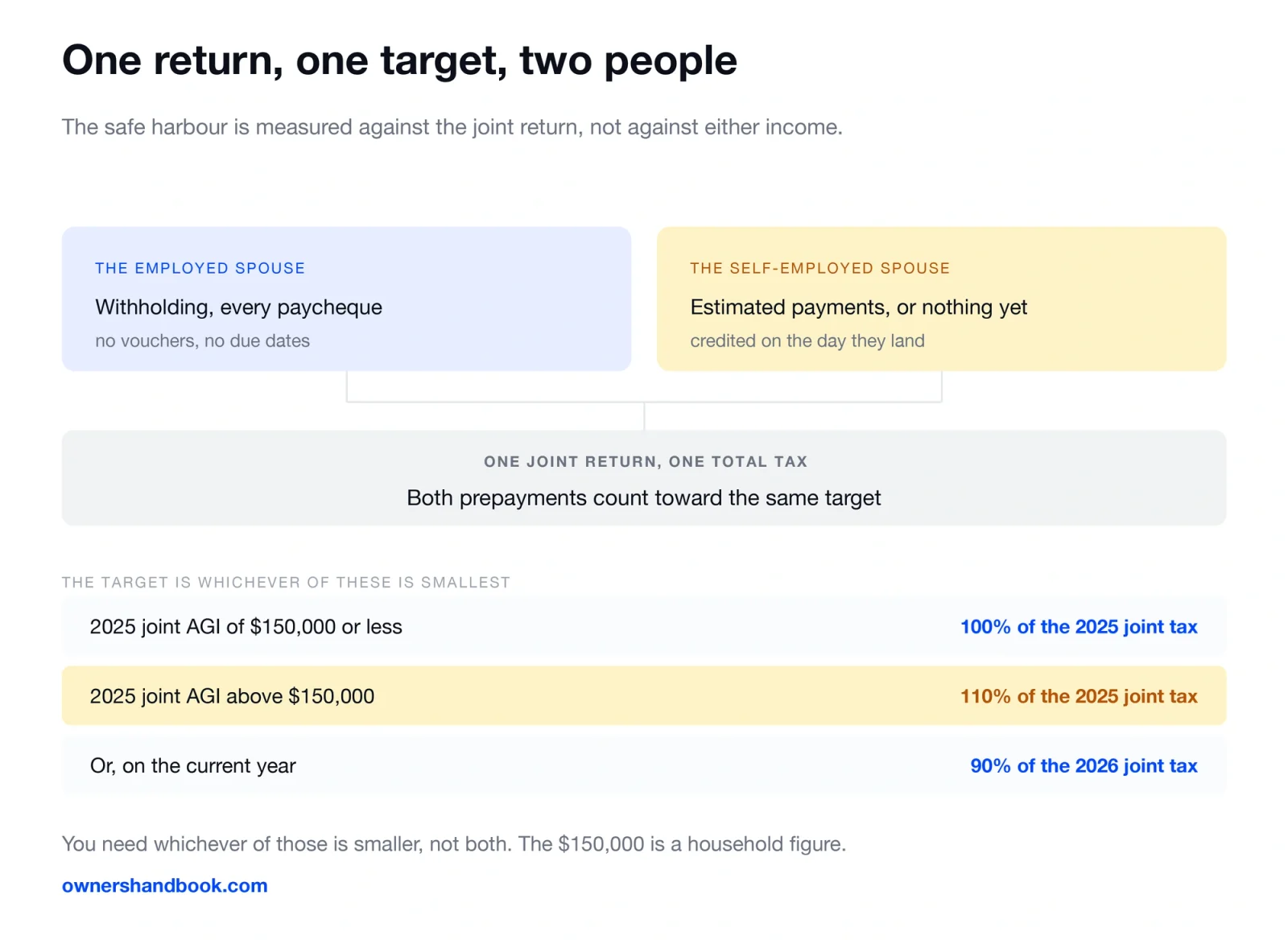
Form 1040-ES states the test in terms of the return, not the person. You must pay estimated tax if you expect to owe at least $1,000 for 2026 after withholding and refundable credits, and your withholding and credits will be less than the smaller of:
90% of the tax to be shown on your 2026 tax return, or … 100% of the tax shown on your 2025 tax return.
Read “your 2026 tax return” as the joint one, because that is what it means. The employed spouse’s withholding counts toward the same target the self-employed spouse’s payments count toward. There is no separate scorecard, and no rule that freelance income must be covered by freelance payments.
For higher earners the prior-year figure moves:
If your adjusted gross income (AGI) for 2025 was more than $150,000 ($75,000 if your filing status for 2026 is married filing separately), substitute 110% for 100%
| Safe harbour | What the joint household must pay in |
|---|---|
| Prior year, 2025 joint AGI of $150,000 or less | 100% of the tax shown on the 2025 joint return |
| Prior year, 2025 joint AGI above $150,000 | 110% of the tax shown on the 2025 joint return |
| Current year | 90% of the tax to be shown on the 2026 joint return |
You need whichever of those is smaller, not both. The $150,000 is the AGI on the joint return — a household figure, not a per-person one, which catches out couples where neither income looks large on its own. Our guide to quarterly estimated taxes works through choosing between the two routes.
Whose Social Security number goes on the payment
This question generates the most anxiety and has the shortest answer. The IRS instruction for paying online is:
If married filing jointly: Enter information for the spouse whose name is listed first on the tax return.
Even when it is the second-listed spouse doing the paying:
If you filed jointly and your name was listed second on the tax return, you can make a payment for your spouse. … Enter information for the spouse whose name is listed first on the tax return. This lets us correctly credit the payment to your account.
So if your spouse is listed first and you are the freelancer, the payment goes in under their SSN. It is not their payment in any meaningful sense — it is the household’s, and it lands on the account your joint return will be matched against.
Paper vouchers follow the same logic:
If filing a joint voucher, also enter your spouse’s name and SSN. List the names and SSNs in the same order on the joint voucher as you will list them on your joint return.
Our walkthrough of how to pay estimated taxes covers the mechanics of each payment channel.
One payment or two
One. A married couple filing jointly makes one estimated tax payment per due date, under the first-listed SSN.
Two payments under two SSNs is not forbidden and the money is not lost, but you have given the IRS two places to look for one return’s payments and gained nothing. The exception is stated plainly in Form 1040-ES:
If you and your spouse plan to file separate returns, file separate vouchers instead of a joint voucher.
And joint payments are not available at all in three situations:
You can’t make joint estimated tax payments if you or your spouse is a nonresident alien, you are separated under a decree of divorce or separate maintenance, or you and your spouse have different tax years.
One thing stays separate even inside a joint payment. Self-employment tax is an individual calculation:
If you and your spouse make joint estimated tax payments and both of you have self-employment income, figure the self-employment tax for each of you separately.
That matters when both of you freelance: you cannot pool your net earnings before applying the rate. Our explanation of self-employment tax covers why.
Can the employed spouse just raise their withholding instead
Yes, and for a lot of couples this is the better answer. Form 1040-ES says so directly:
If you also receive salaries and wages, you may be able to avoid having to make estimated tax payments on your other income by asking your employer to take more tax out of your earnings. To do this, file a new Form W-4, Employee’s Withholding Certificate, with your employer.
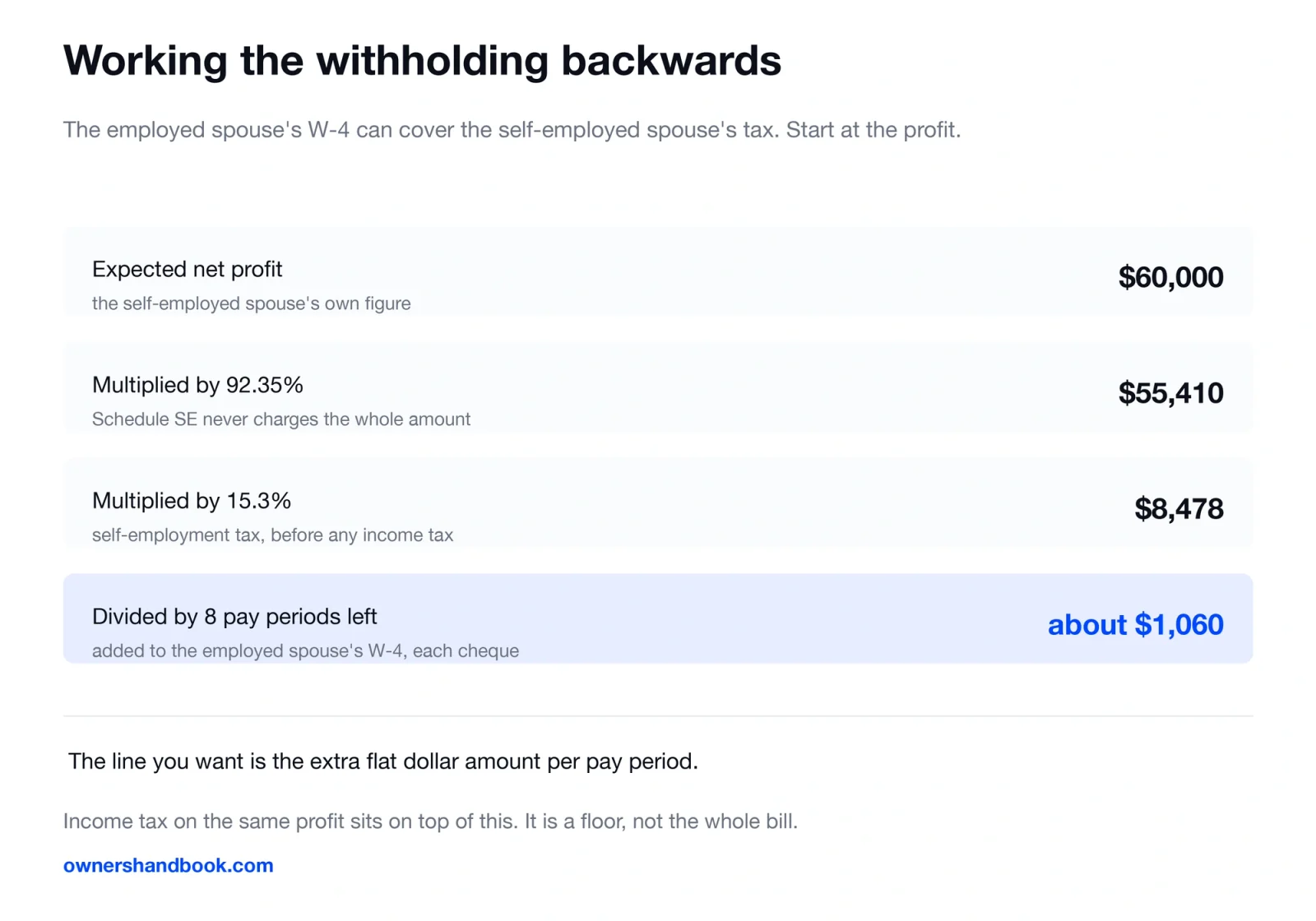
The W-4 has a line for an extra flat dollar amount per paycheck. That is the line you want — not the dependants or deductions sections, which solve a different problem.
Work it backwards. Say the self-employed spouse expects a net profit of $60,000. Self-employment tax is charged at 15.3% on 92.35% of net earnings, so $60,000 becomes $55,410, and 15.3% of that is $8,478.
That is self-employment tax alone, before income tax on the same profit. With eight pay periods left in the year, adding about $1,060 per paycheck to the employed spouse’s withholding covers it — no vouchers, no due dates, nothing to remember. Our self-employment tax calculator runs the same arithmetic on your own figures.
| How you cover it | When it counts as paid | Suits |
|---|---|---|
| Estimated payments from the self-employed spouse | The date you actually pay | Income that arrives in lumps |
| Extra withholding on the employed spouse’s W-4 | Spread evenly across the four due dates | Steady freelance income, or catching up late |
| Both | Each on its own rule | Most couples, in practice |
The timing advantage nobody mentions
Withholding and estimated payments are not credited the same way, and the difference is worth real money if you are behind. The Form 2210 instructions:
For withheld federal income tax and excess social security or tier 1 RRTA, you are considered to have paid one-fourth of these amounts on each payment due date unless you can show otherwise.
Withholding is deemed paid evenly across the year, whatever month it actually came out of a paycheck. An estimated payment is credited on the day you make it, and nothing about a January payment can repair an April shortfall.
A couple who reaches October and realises the freelance income was never covered therefore has a repair available that a single self-employed person does not: raise the W-4 withholding hard for the rest of the year, and a quarter of it is treated as having arrived back in April. If you are already behind, read that alongside our guide to missed estimated tax payments. The penalty, when one lands, is charged on each underpayment for the number of days it stays unpaid — so closing the gap early is worth more than closing it neatly.
If you later file separately
Joint payments do not have to stay joint. Publication 504:
If you and your spouse made joint estimated tax payments for 2025 but file separate returns, either of you can claim all of your payments, or you can divide them in any way on which you both agree. If you can’t agree, the estimated tax you can claim equals the total estimated tax paid times the tax shown on your separate return for 2025, divided by the total of the tax shown on your 2025 return and your spouse’s 2025 return.
The IRS asks you to show both SSNs on the separate returns, and suggests attaching an explanation of how you split the payments. Your prior-year safe harbour has to be rebuilt when filing status changes. Filed jointly for 2025 but separately for 2026: work out what each of you would have paid on separate 2025 returns, then apportion the joint tax by that ratio. Going the other way, add the two 2025 tax figures together.
Divorce or separation during the year
Until a decree of divorce or separate maintenance exists you can keep making joint payments. Once it exists you cannot, per the caution above. For the year the divorce happens, Publication 504 gives the step people miss:
If you got divorced in 2025 and you made joint estimated tax payments with your former spouse, enter your former spouse’s SSN in the space provided on line 26.
That line is how the IRS connects payments made under one SSN to a return filed under another. Skip it and the payments look missing.
Separated but not divorced, with no decree, you still have a choice of filing status and therefore a choice about payments — and whoever made them is not automatically the one who gets credit for them. Agree the split in writing before April, not during it.
The 2026 dates
| Payment | Due |
|---|---|
| 1st | April 15, 2026 |
| 2nd | June 15, 2026 |
| 3rd | Sept. 15, 2026 |
| 4th | Jan. 15, 2027 |
Form 1040-ES lets you skip the January payment entirely if you file your 2026 return by February 1, 2027 and pay the whole balance with it. State deadlines do not always match. Our guide to state taxes for the self-employed covers which states run their own schedule.
Frequently asked questions
Do we each need our own estimated tax payments?
No. Filing jointly means one payment per due date, credited under the first-listed spouse’s SSN. Separate payments are allowed but create needless reconciliation.
My spouse is listed first but I am the one with the business. Whose SSN do I use?
Theirs. The IRS instruction is to enter the information of the spouse listed first on the return, so the payment is credited to the account the return will be matched against.
Does raising the W-4 really work, or is it a workaround?
It is the method Form 1040-ES names first for people with wage income, and because withholding is treated as paid evenly across the four due dates it is often the stronger option.
We are in our first year of freelancing. Is there a prior-year figure to use?
Only if a 2025 return exists covering all 12 months. Our guide to first-year quarterly taxes covers what to do when it does not.
How do I check the payments actually landed?
Your IRS online account shows payment history under your SSN. If you are the second-listed spouse, look in the first-listed spouse’s account.
Sources
IRS, Form 1040-ES, Estimated Tax for Individuals (2026)
https://www.irs.gov/pub/irs-pdf/f1040es.pdf
IRS, Direct Pay help
https://www.irs.gov/payments/direct-pay-help
IRS, Instructions for Form 2210, Underpayment of Estimated Tax by Individuals, Estates, and Trusts
https://www.irs.gov/pub/irs-pdf/i2210.pdf
IRS, Publication 504, Divorced or Separated Individuals
https://www.irs.gov/pub/irs-pdf/p504.pdf
IRS, Publication 505, Tax Withholding and Estimated Tax
https://www.irs.gov/pub/irs-pdf/p505.pdf
IRS, Estimated taxes
https://www.irs.gov/businesses/small-businesses-self-employed/estimated-taxes
IRS, Self-employment tax (Social Security and Medicare taxes)