Closing a Freelance Business: The Final Schedule C
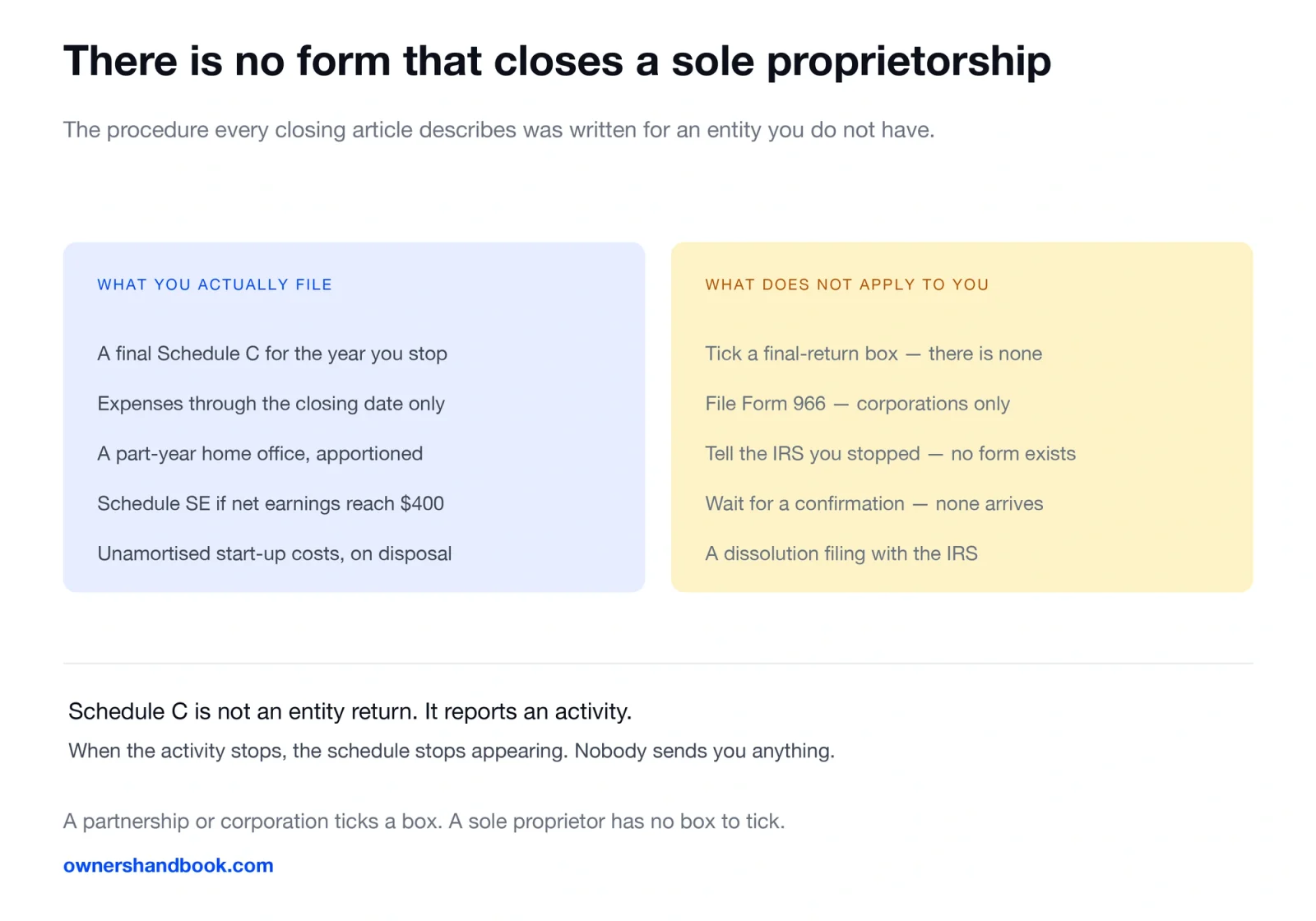
There is no form that closes a sole proprietorship. You take the job, you stop invoicing, and the only visible trace is a Schedule C that does not appear the following April. Nobody sends you anything.
Which is unsettling, because every article on closing a business describes a procedure — final returns, dissolution filings, asset sales — written for a company with inventory, employees and partners. Almost none applies to a freelancer. Here is what does.
Partnerships and corporations tick a box. You do not
This distinction causes most of the confusion. For a partnership, the IRS instruction is specific:
Check the “final return” box (it’s near the top of the front page of the return, below the name and address).
Corporations get the same instruction, plus Form 966. Those entities exist separately from you and carry an open filing obligation; the box is how it is switched off.
Schedule C has no such box. It is not an entity return but a schedule attached to your 1040, reporting an activity — when the activity stops, the schedule stops. So the honest answer to “how do I report that I closed” is that for most freelancers you do not.
The final Schedule C, and what changes on it
You still file one for the year you stop — the IRS instruction for sole proprietors is to file Schedule C “with your individual tax return for the year you close your business.”
The form does not change: same lines, same categories, same Schedule C walkthrough as every other year. What changes is what feeds it.
Expenses through the closing date only. Once you are no longer carrying on the business, later costs are not business expenses.
A part-year home office. It applies for the months you used the space for business, not the full year. Our home office deduction post covers the apportionment.
Schedule SE if net earnings reach the threshold. File it “if you have net earnings of $400 or more from your business.” A part year does not exempt you, and self-employment tax works the same way on a stub year.
Unamortised start-up costs. If you elected to amortise start-up costs over 180 months and closed before they ran out, section 195 provides that on a complete disposition of the business the deferred expenses not yet deducted “may be deducted to the extent allowable under section 165.” Most people who stop after two or three years have a balance there and never claim it.
The equipment you keep
You have a laptop, a camera, a desk, and you are not selling them. In tax terms you are retiring that property from service by converting it to personal use:
You stop depreciating property when you retire it from service, even if you have not fully recovered its cost or other basis.
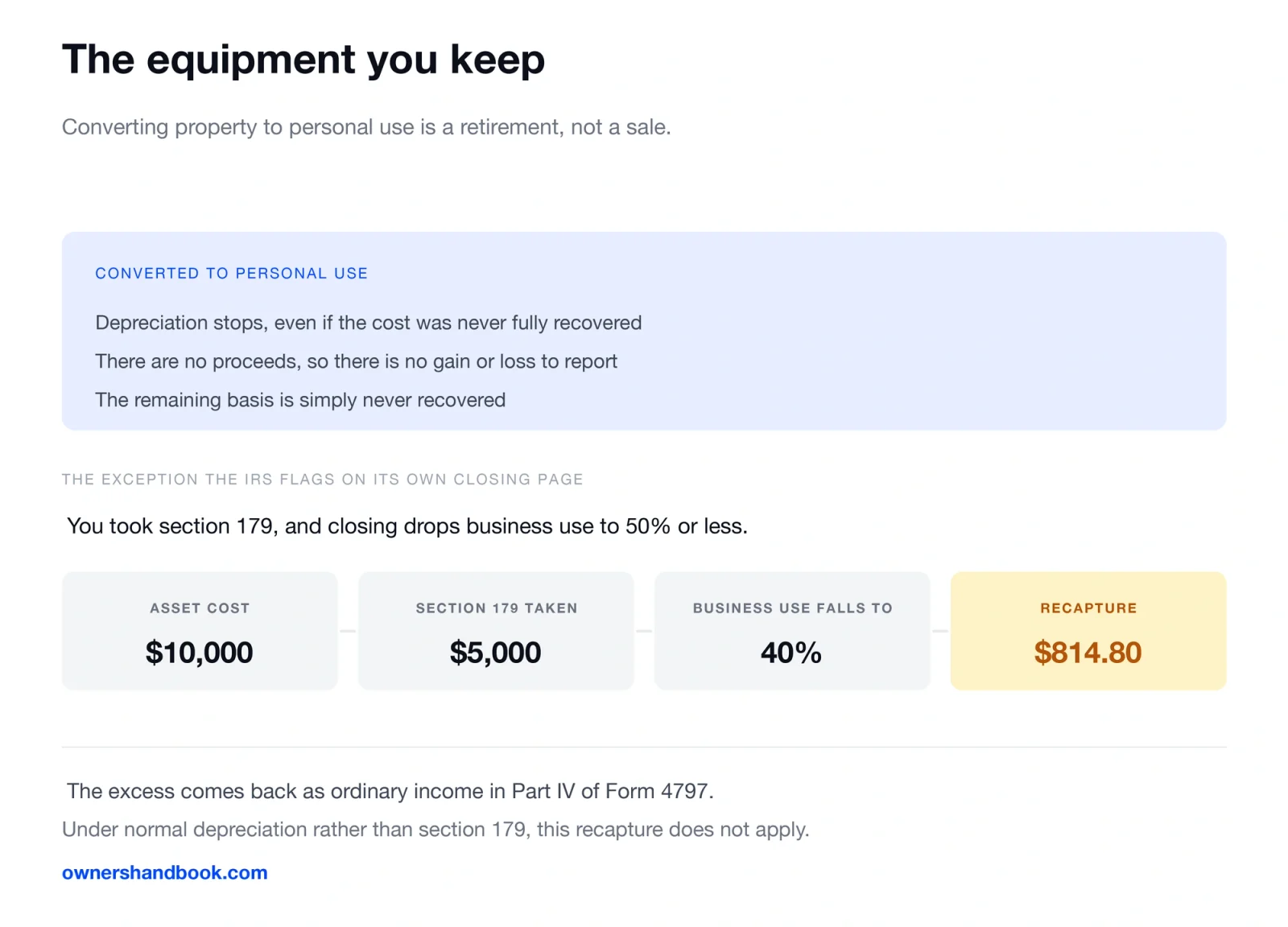
Conversion to personal use is one of the retirement events. Depreciation stops, remaining basis is never recovered, and because there is no sale there are no proceeds and no gain or loss to report.
Now the exception, which the IRS flags on its own closing page. If you took a section 179 deduction and closing drops that property’s business use to 50% or less, you owe recapture — file Form 4797 “if closing your business causes the business use of an eligible property under Section 179 to drop to 50% or less.”
You recompute what ordinary depreciation would have been allowed instead of the section 179 write-off, and the excess comes back as ordinary income in Part IV of Form 4797, with basis increased by the same amount. The IRS’s example runs a $10,000 asset with a $5,000 section 179 deduction; when business use falls to 40% in the third year the recapture is $814.80.
So keeping the gear is not free if you expensed it aggressively. Under normal depreciation rather than section 179, this recapture does not apply.
The equipment you sell
Different rule, and harsher than people expect.
If you dispose of depreciable or amortizable property at a gain, you may have to treat all or part of the gain (even if otherwise nontaxable) as ordinary income.
Your basis has been reduced by every year of depreciation you claimed. Sell a camera for $1,400 when its adjusted basis is $300 and the portion of the $1,100 gain attributable to depreciation is ordinary income, not capital gain. This is section 1245 property, and it covers essentially everything a freelancer owns.
The 1099s you may still have to issue
If you paid subcontractors in your final year, closing does not release you — the obligation attaches to the payments, and those already happened.
The threshold changed, and it is the number most pages still have wrong. For tax years beginning after 2025 it rose to $2,000, adjustable for inflation from 2027. It was $600 before.
| Payments made in | Report on 1099-NEC if you paid one payee at least |
|---|---|
| A tax year beginning in 2025 or earlier | $600 |
| A tax year beginning after 2025 | $2,000 |
Paper copies go in with Form 1096, and our guide to issuing a 1099-NEC covers the deadlines and the W-9 you should already hold. If you had employees there is a longer sequence on top: a final Form 941 or 944 with the closure box ticked, a final Form 940 with box “d” checked, and W-2s by the due date of that final return.
Your EIN cannot be closed. It can be deactivated
The item people get wrong most often:
If you no longer need your employer identification number (EIN), we can’t cancel it, but we can deactivate it. Once we assign an EIN to a business entity, it becomes that entity’s permanent federal taxpayer ID number.
The number is yours forever. Deactivation closes the IRS business account attached to it, which is not the same thing.
Send a letter with the entity’s EIN, legal name and address, the assignment notice if you kept it, and your reason. The EIN page directs it to Kansas City, MO 64108 (MS 6055) or Ogden, UT 84201 (MS 6273); the older closing-a-business page still shows Cincinnati, so check before posting. One condition applies:
We cannot close your business account until you have filed all necessary returns and paid all taxes owed.
You may not need to do any of this. An EIN obtained purely to open a business bank account can be left dormant.
If there is an LLC, the state filing is the part that matters
Federally, a single-member LLC is usually a disregarded entity — it files nothing of its own, and its income has been on your Schedule C all along. There is nothing to dissolve.
The state is where the entity lives. Until you file articles of dissolution or the equivalent it continues to exist, which generally means continuing annual reports and continuing franchise or registration fees. People who stop freelancing and forget this find out two years later, as accumulated penalties on an entity that earned nothing. The office that handled your LLC formation handles the ending — do it before the next annual report falls due.
Keeping records, and for how long
The periods run from the return, not the business.
| Records | Keep for |
|---|---|
| General return records | 3 years from filing, or 2 years from paying the tax, whichever is later |
| If you omitted more than 25% of gross income | 6 years |
| If you filed no return, or a fraudulent one | Indefinitely |
| Employment tax records | At least 4 years after the tax became due or was paid, whichever is later |
| Property records | Until the period of limitations expires for the year you dispose of the property |
Notice that last row if you kept the equipment — you have not disposed of it, so its records keep running. See tax record keeping.
Money that arrives after you closed
A client pays in February for work you did in October. The business is closed. Where does that go?
On a Schedule C, for the year you received it. Under the cash method you report income “actually or constructively received during the year,” and receiving it after you stopped working changes nothing. File one showing the receipt, any related expense, and Schedule SE if net earnings reach $400.
It feels absurd to file a schedule for a business that no longer exists. It is still the right answer — the alternative is income reported to the IRS but missing from your return.
Should you keep filing a Schedule C with zeros
No. A Schedule C for a business you are not carrying on is a return position, not a neutral placeholder — and in loss years, a position about deductions.
The question underneath is about attention: does a Schedule C simply disappearing look like something. Nobody can tell you that, and anyone who quantifies it is inventing a number. What is knowable is the mechanics — a 1099-NEC arriving for a final payment against a return with no Schedule C is a mismatch with a cause, answered by the invoice and the bank record.
Frequently asked questions
Do I have to tell the IRS I stopped freelancing?
No. There is no notification and no form for a sole proprietorship. If you have an EIN you can ask for the business account to be deactivated, but that is separate and optional.
Do I owe tax on equipment I keep?
Generally no. Converting property to personal use stops depreciation without triggering a sale. The exception is section 179 recapture when business use drops to 50% or less.
Do I still have to pay estimated tax?
Only on income you still expect. Once you are on a salary with withholding, the basis for the payments goes with it. Cancel the recurring software subscriptions the same week too — not a tax matter, but the most common avoidable cost of stopping.
Sources
IRS, Closing a business
https://www.irs.gov/businesses/small-businesses-self-employed/closing-a-business
IRS, If you no longer need your EIN
https://www.irs.gov/businesses/small-businesses-self-employed/if-you-no-longer-need-your-ein
IRS, How long should I keep records?
https://www.irs.gov/businesses/small-businesses-self-employed/how-long-should-i-keep-records
IRS, Publication 946, How To Depreciate Property
https://www.irs.gov/publications/p946
IRS, Publication 544, Sales and Other Dispositions of Assets
https://www.irs.gov/publications/p544
IRS, Instructions for Forms 1099-MISC and 1099-NEC
https://www.irs.gov/instructions/i1099mec
IRS, Instructions for Schedule C (Form 1040)
https://www.irs.gov/instructions/i1040sc
26 U.S. Code § 195, Start-up expenditures