You Haven’t Done the Books Since January. A Catch-Up Plan.
Our pages on record keeping and receipt rules describe how to keep records correctly as the year goes by. This page assumes you did not, because catching up is a different job with a different goal: not a clean ledger, but a defensible one.
The shape of the work is lopsided. Most of it is mechanical sorting that goes faster than you expect. Then there is one genuinely hard question — what to do about expenses with nothing behind them — and the regulations answer it more narrowly than most people assume. For your car and your travel they answer it with a flat no.
What follows is the order to do it in. Out of order is what turns a weekend into three.
Step 1 — Fix the container before you sort anything
Open a dedicated business checking account today if you do not have one, and run everything through it from here. Publication 583 puts this first for a reason: you should keep your business account separate from your personal checking account, and use the business account for business purposes only.
Do not try to retroactively reorganise this year. You cannot, and attempting it is the most common way a catch-up stalls.
The account you open now does nothing for 2026. It stops you having to do this again for 2027, which is most of its value.
Step 2 — Pull everything, as data, in one sitting
Download twelve months of statements from every account money moved through. Business checking, personal checking, every credit card, PayPal, Stripe, Wise, every platform that paid you.
Pull CSV, not PDF. Every bank offers it and it is usually buried one click deeper. A PDF is a document you read; a CSV is a document you sort, and you are about to sort four thousand rows.
Put them in one folder, named by account and month, before you open any of them. Exports are records in their own right — the IRS has accepted electronically stored records since Revenue Procedure 97-22, provided the system produces a complete, legible, retrievable copy.
If a statement is missing, request it now. Banks take days, and this is the only step with an external dependency.
Step 3 — Reconstruct income first, and over-count it
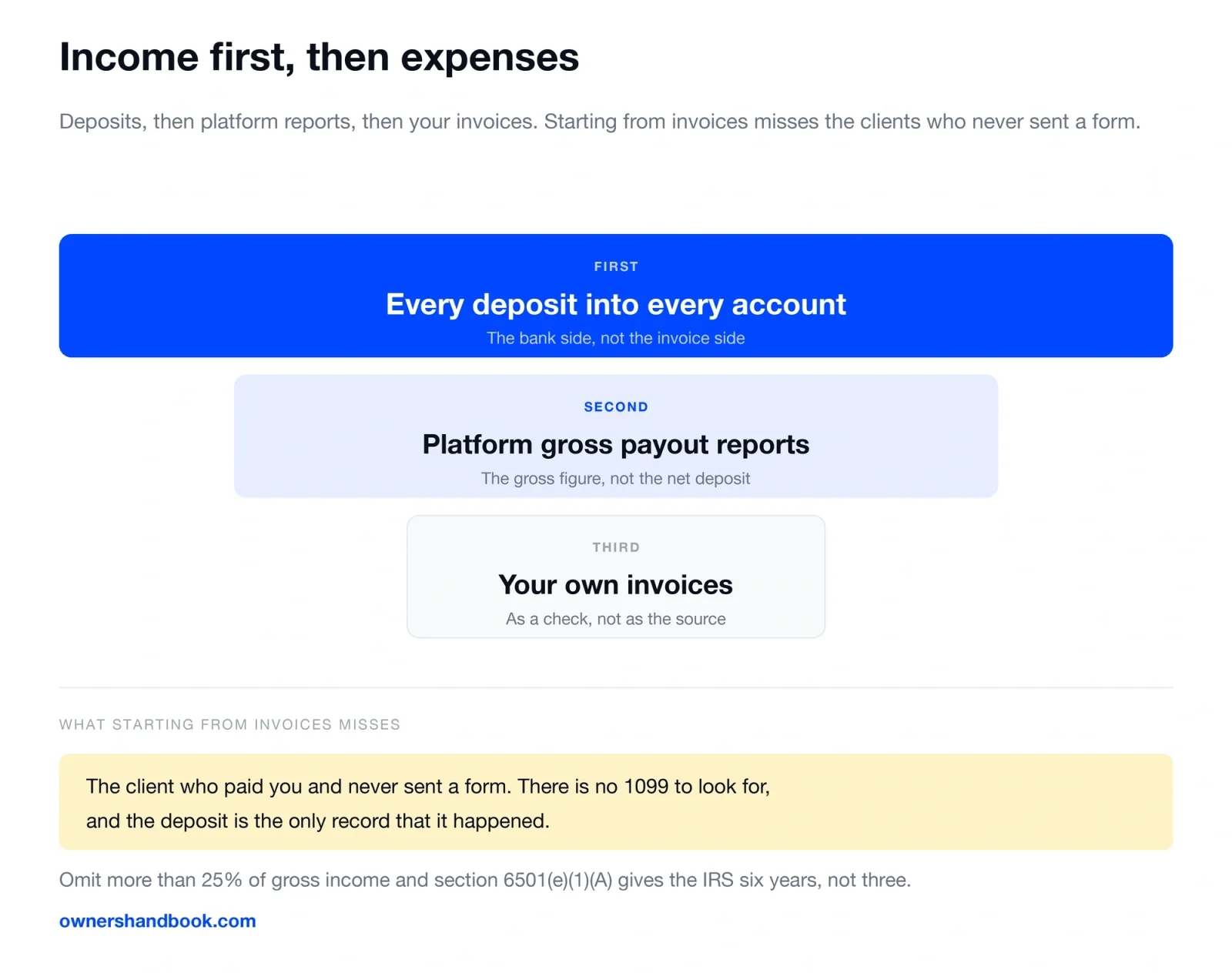
Income before expenses, always. An understated deduction costs you money. Understated income is what extends how long the year stays open — omit an amount in excess of 25% of the gross income stated on the return and the IRS has six years to assess instead of three, under section 6501(e)(1)(A).
Three sources, in this order.
Every deposit into every account. Start from the bank side rather than the invoice side, because deposits include the clients who never sent you anything.
Platform payout reports. Download the annual summary, not the transaction list, and note the gross figure separately from the net — you report gross receipts and deduct the platform’s fee, not the net deposit.
Your own invoices, used last, as a check on the other two rather than as the source.
A note on the transcript everyone recommends. The IRS Wage and Income Transcript shows the information returns it has received — Forms W-2, 1098, 1099, 5498 — for the current and nine prior years, free, from your IRS online account. It is useful and it will not help you in December: current-year data is typically not available until the first week of February, and it is capped at roughly 85 income documents.
So the transcript is a February cross-check, not a December source. Pull it before you file and reconcile it against what you built here.
Step 4 — Bulk-categorise using Schedule C’s own labels
Do not invent a chart of accounts. Use the expense lines already printed on Schedule C, because that is the form the numbers have to land on, and sorting twice is the thing to avoid.
Advertising. Car and truck. Commissions and fees. Contract labor. Insurance. Interest. Legal and professional. Office expense. Rent. Repairs. Supplies. Taxes and licenses. Travel. Meals. Utilities. Other.
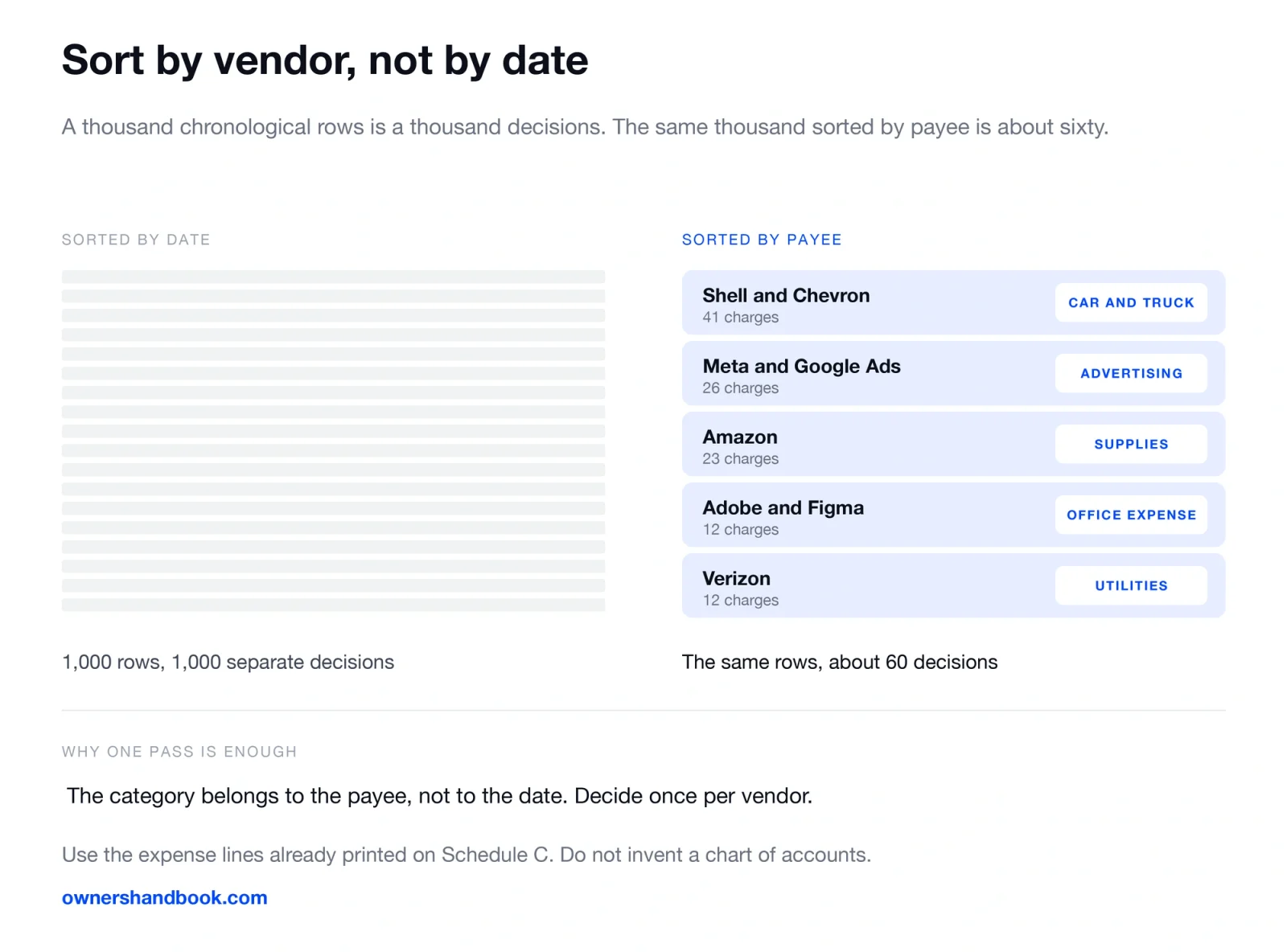
Then sort by payee instead of by date. One pass down a column sorted by vendor turns a thousand rows into about sixty decisions, because the same twelve vendors account for most of them. Our Schedule C walkthrough covers what belongs on which line.
Software can do this pass, and it is the one step where it earns its price in a single evening. Rule-based auto-categorisation from a bank feed is the core feature of every product in the category — accounting software for freelancers covers what each one charges, and replacing QuickBooks Self-Employed covers the migration if you were on it. If you would rather not pay, the spreadsheet approach in free tools does the same work slower.
Whatever you use, check that it imports a full year of history before you subscribe. Some plans limit how far back a bank feed reaches.
Step 5 — Pull the personal spending out, honestly
If business and personal ran through one account, this step decides whether the rest of the work holds up.
Go line by line on anything ambiguous and make a call you would be willing to repeat out loud. Mixed-use items get a percentage, and the percentage needs a basis you can state in one sentence.
A phone bill is business to the extent of business use, and “all of it” is almost never right for a single-line account. A laptop used for work and for everything else is a percentage. Software you use for both is a percentage.
Transfers between your own accounts are not income and not expenses. Neither is money you took out for yourself — a draw is not a deduction, and tagging draws as an expense is the most common error in a self-built ledger.
Write the percentage and its basis into the ledger as you go. The number invented in April is the one that falls apart.
Step 6 — Reconstruct what has no receipt, within the actual rules
For ordinary expenses — supplies, software, professional fees, office costs — the governing rule is section 6001 and the regulation under it: keep records sufficient to establish the amounts shown on your return. No dollar threshold appears there. A bank or card statement plus a written note of what was bought and why it was business is a real record, and it is what most of this will be built from.
It is weaker than a receipt. The IRS lists card statements among acceptable supporting documents and asks for a description of the item purchased alongside them. So add the description, one line per row, written now.
The Cohan rule is what people reach for next, and it needs stating accurately. Cohan v. Commissioner, 39 F.2d 540 (2d Cir. 1930) is a real decision in which a court approximated a deduction it was satisfied had been incurred but could not be proved to the dollar. It is a court’s power to estimate, not your entitlement to — it requires convincing someone the expense happened at all, and the burden of proving what is on your return sits with you.
It also has an explicit limit. The substantiation regulation under section 274(d) says in one line that it supersedes the doctrine found in Cohan v. Commissioner.
Which produces the rule to plan around.
| What you are missing | Can reconstruction help | Why |
|---|---|---|
| Supplies, software, fees, office | Yes, partly | Section 6001, no stated threshold, statement plus written purpose |
| Meals in your own city | Partly | Write down who was there and what it was about |
| Travel away from home | No | Section 274(d) strict substantiation |
| Business gifts | No | Section 274(d) |
| Your car, every mile | No | Listed property, section 274(d) |
For travel, gifts, and your vehicle, approximation is not available. No record means no deduction, and that is written into the regulation rather than inferred from it.
There is one carve-out and it does not cover you. Where records were lost through circumstances beyond your control — the regulation names fire, flood, earthquake, or other casualty — you have a right to substantiate by reasonable reconstruction. Not having kept them is not a casualty.
The fallback that remains is your own statement plus corroborating evidence, and the corroboration is tiered. For amount, time and place it has to be direct or documentary. For business purpose, and for your relationship to whoever got the benefit, circumstantial evidence can carry it.
So a calendar entry, an email thread, a signed contract — those corroborate purpose. None of them establishes an amount.
Step 7 — Close the categories you cannot defend
The last step is subtraction, and it is what makes the file hold.
If your mileage has no contemporaneous log, you do not have a mileage deduction. Reconstructing one from a calendar produces a document whose own dating says it was written in December, and Publication 463 is direct about what that is worth: a timely kept record has more value than a statement prepared later, when there is generally a lack of accurate recall.
That is a real loss, and better taken now than in an examination. A return with one weak category is a different problem from a return built on one.
Where a receipt is genuinely gone on a cash payment, Publication 583 gives the procedure: make an adequate explanation in your records at the time of payment. Written late is weaker, and written at all beats nothing.
What draws the look in the first place is in common audit triggers, and the file you hand over is the subject of what to give your CPA.
Step 8 — Two things December buys that April does not
Most of this work is equally doable in April. Two pieces are not.
If the catch-up surfaces contractors you paid, you have a January filing obligation. For 2026, payments of $2,000 or more for services trigger a Form 1099-NEC — the threshold rose from $600 for tax years beginning after 2025 and may be inflation-adjusted beginning in 2027. Section 6071(c) requires the form by January 31, and chasing a W-9 is easier while an invoice is still unpaid. Our guide to issuing a 1099-NEC has the mechanics.
Knowing your actual profit before December 31 is also what lets you use the year-end levers at all, several of which close on that date — see what expires on December 31.
That is the argument for doing this in December rather than April. Not the bookkeeping. The two decisions the bookkeeping unlocks.
Frequently asked questions
Is it too late to deduct something I paid for in February?
No. The deduction turns on whether the expense was ordinary and necessary for your business and whether you can establish the amount, not on when you recorded it.
Can I just hand a shoebox and twelve statements to a preparer?
You can, and you will pay for the sorting at their hourly rate rather than yours. The categorising pass is the cheapest part to do yourself and the most expensive to outsource, because it is volume work rather than judgement work.
I have no receipts at all for the whole year. Where does that leave me?
With a real return, built on statements plus written purpose for ordinary expenses — and with no deduction for travel, gifts, or vehicle mileage, where section 274(d) blocks approximation outright.
Does a photo of a receipt count, or do I need the paper?
The photo counts. Revenue Procedure 97-22 has permitted imaged records since 1997, provided the system reproduces complete, legible copies you can retrieve. A folder of named files meets that. An unsorted camera roll technically does and practically does not.
Should I pay for a catch-up bookkeeping service?
It depends which half of the job you are stuck on. The mechanical half — pulling statements, categorising by vendor — is what a service charges most for and what you can do. The judgement half, on commingled accounts or a year with inventory or payroll, is where paying is reasonable.
Does the IRS know what I made even if I never recorded it?
It knows what was reported about you. The Wage and Income Transcript shows the information returns the IRS actually received, which is not the same as everything you were paid — clients under the reporting threshold, and clients who simply did not file, leave no trace there. Your deposits are the complete record; the transcript is the cross-check.
Sources
Legal Information Institute, 26 CFR 1.274-5T, Substantiation requirements (temporary)
https://www.law.cornell.edu/cfr/text/26/1.274-5T
Legal Information Institute, 26 CFR 1.6001-1, Records
https://www.law.cornell.edu/cfr/text/26/1.6001-1
IRS, Burden of proof
https://www.irs.gov/businesses/small-businesses-self-employed/burden-of-proof
IRS, What kind of records should I keep
https://www.irs.gov/businesses/small-businesses-self-employed/what-kind-of-records-should-i-keep
Legal Information Institute, 26 U.S.C. 6501, Limitations on assessment and collection
https://www.law.cornell.edu/uscode/text/26/6501
IRS, Publication 583, Starting a Business and Keeping Records
https://www.irs.gov/pub/irs-pdf/p583.pdf
IRS, Publication 463, Travel, Gift, and Car Expenses
https://www.irs.gov/pub/irs-pdf/p463.pdf
IRS, Transcript types and ways to order them
https://www.irs.gov/individuals/transcript-types-and-ways-to-order-them
IRS, Revenue Procedure 97-22, electronic storage of books and records
https://www.irs.gov/pub/irs-tege/rp-97-22.pdf
IRS, Instructions for Forms 1099-MISC and 1099-NEC