LLC or Sole Proprietor: What Actually Changes
Forming an LLC does not lower your federal taxes. Not by a dollar. The IRS treats a one-owner LLC as a disregarded entity, which means it looks straight through the company to you — same Schedule C, same 15.3% self-employment tax, same profit. What an LLC actually buys is a legal wall between the business and your house, and that is worth something entirely different.
What an LLC does not change
Disregarded entity is the IRS’s own phrase. The company exists under your state’s law. For federal income tax, it is ignored.
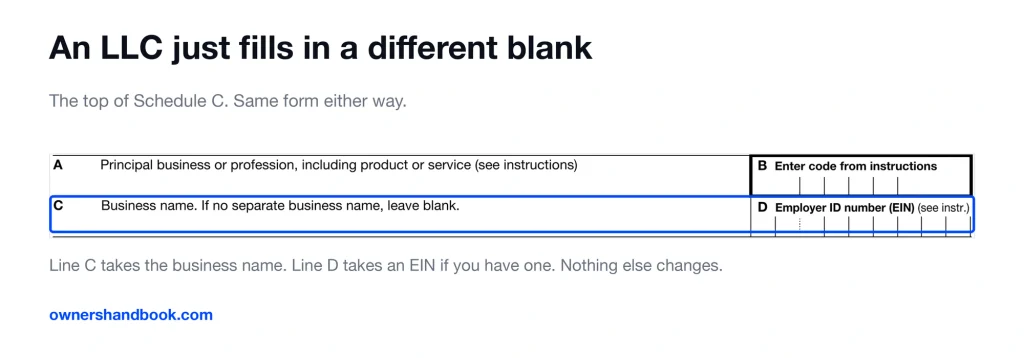
So the LLC’s activity gets reported on your personal return. Schedule C, exactly as before, with the same line 31 at the bottom.
Self-employment tax follows. The IRS says an individual owner of a single-member LLC that operates a trade or business is subject to it in the same manner as a sole proprietorship.
Same $80,000 of profit, same $11,304 of self-employment tax, same four quarterly payments.
No deduction opens up either. Nothing becomes writeable that was not writeable the day before you filed with the state. Your laptop was already deductible.
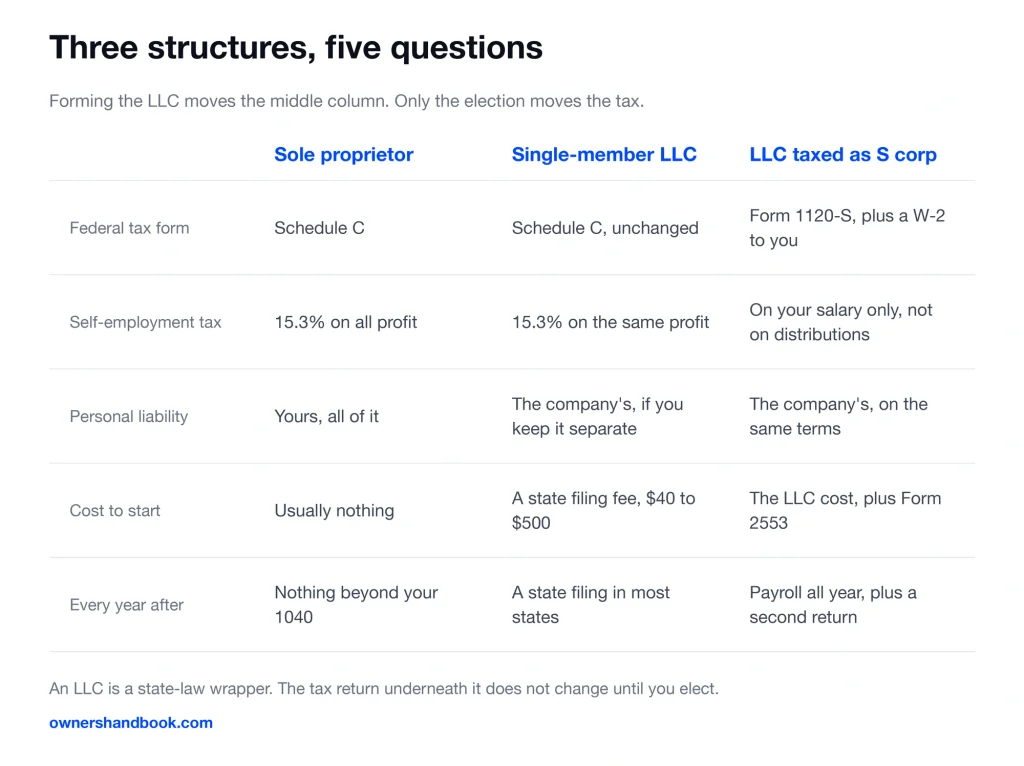
| What changes | Sole proprietor | Single-member LLC |
|---|---|---|
| Federal tax form | Schedule C | Schedule C, unchanged |
| Self-employment tax | 15.3% on 92.35% of profit | 15.3% on the same profit |
| Quarterly estimated payments | Yours to make | Still yours to make |
| Deductions available | Ordinary and necessary | The identical list |
| Who owes the business debts | You do | The company, if you keep it separate |
| Cost to start | Usually nothing | A state filing fee |
| Yearly upkeep | None | A state filing in most states |
What an LLC actually buys
Read what the SBA says about a sole proprietorship, slowly. Your business assets and liabilities are not separate from your personal assets and liabilities, and you can be held personally liable for the debts and obligations of the business.
There is no gap in that sentence. A creditor suing the business is suing you.
An LLC inserts the gap. The SBA puts it this way: LLCs protect you from personal liability in most instances, so your vehicle, house, and savings are not at risk if the LLC faces bankruptcy or lawsuits.
Hold on to the words in most instances. The rest of this article is that hedge.
The wall covers obligations of the company. A contract it signed, a debt it took on, an unpaid vendor, a claim against the business itself.
It does not cover what you personally did. If you were the one who was negligent, you are still the person who was negligent, and the LLC does not stand between you and that.
That distinction matters more for freelancers than for most businesses. When you are the only one doing the work, most claims point at your own hands.
What breaks the protection
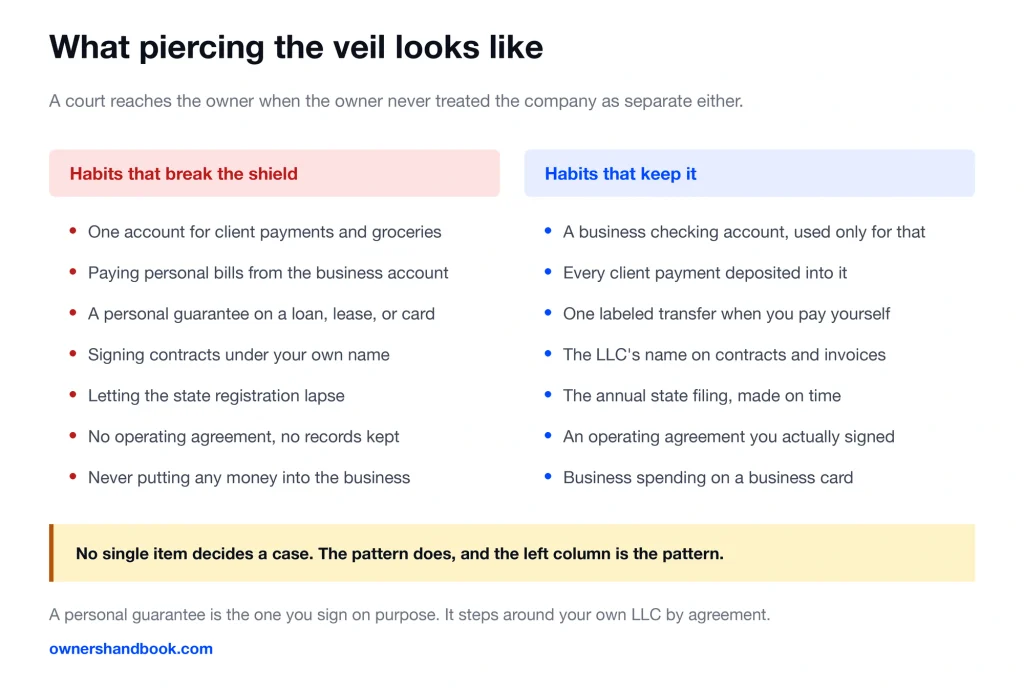
A court can decide to ignore the company and reach the owner anyway. Lawyers call it piercing the veil, and it usually starts with the owner having ignored the company first.
Commingling is the classic one. Commingling means running business and personal money through the same account.
Do it and the separation exists on a certificate and nowhere else. There is no company to point at, only your checking account with some invoices in it.
IRS Publication 583 gives the habit in four short instructions. Open a business checking account. Keep it separate from your personal account. Deposit all business receipts into it. Use it for business purposes only.
Pay yourself with one labeled transfer out of that account. Not by tapping the business card at the grocery store and sorting it out in April.
Personal guarantees are the second one, and they are voluntary. Signing a guarantee means you agreed to step around your own LLC for that specific debt.
This is not rare. SBA loan rules require an unlimited personal guaranty from anyone owning 20% or more of the business. Most commercial leases and many business credit cards want one too.
A guarantee is enforceable against you directly. The lender does not have to chase the company first and fail.
Third is signing your own name where the company’s name belongs. Contracts, invoices, proposals, and your email signature should all say the LLC.
Then the quiet ones. Letting the state registration lapse. Never funding the business at all. Having no operating agreement to point to.
None of these lose a case by themselves. They pile up into a pattern, and the pattern is the argument against you.
What it costs depends entirely on your state
This is where an LLC becomes a real decision, and the answer changes at the state line.
| State | To form | Every year after |
|---|---|---|
| Kentucky | $40, Articles of Organization | $15 annual report |
| California | $70, Articles of Organization | $800 minimum annual tax, plus $20 every two years |
| Massachusetts | $500, Certificate of Organization | $500 annual report |
Same company, same clients, same federal tax return. Massachusetts costs $1,000 in the first year and $500 every year after. Kentucky costs $40 and then $15.
Delaware is its own case. Every LLC formed there owes a $400 annual tax by June 1, whether or not the business made anything.
Budget for the extras too. A registered agent if you do not want your home address on a public record, any local business license, and in some states a separate state return for the LLC.
Look up your own state before you decide. The federal side of this is identical everywhere; the bill is not.
The EIN, and when you actually need one
An EIN is an Employer Identification Number, the business version of a Social Security number. It is free from the IRS and issued online in minutes.
The IRS is specific about the requirement. A single-member LLC that is a disregarded entity, has no employees, and has no excise tax liability does not need one.
You do need one once you hire anyone, or if you have to file excise tax returns. Banks also generally want one to open an account in the LLC’s name.
There is a good reason to get one anyway. An EIN goes on your W-9s instead of your Social Security number, which keeps your SSN off twenty clients’ files.
Never pay for one. The IRS warns plainly that you never have to pay a fee for an EIN.
The election that does change your taxes
When people say an LLC saves taxes, this is the thing they are half-remembering. It is a separate choice, made after the LLC exists.
An LLC can elect to be taxed as an S corporation. That election does change federal tax, because it changes what your profit is called.
You file Form 2553. An eligible entity can file it alone, without filing Form 8832 first, and it is treated as a corporation as of the election’s effective date.
Timing is tight. The election must be filed no more than 2 months and 15 days after the start of the tax year it takes effect, or during the year before.
What changes is that you become an employee of your own company. You take a reasonable W-2 salary, and distributions above that salary are not hit with self-employment tax.
What it costs is payroll, a separate corporate return, and a reasonable compensation standard the IRS enforces. Set the salary too low and it gets recharacterized as wages.
Around $50,000 of profit it becomes worth pricing out. Below that, payroll and filing fees usually swallow the savings.
One structural note. A sole proprietorship cannot make this election, because there is no entity to elect anything. Forming the LLC is the step that makes the option available later.
If you and your spouse run it together
A business owned jointly by a married couple is, by default, a partnership for federal tax purposes. That means Form 1065, a partnership return, and a K-1 for each of you — a filing obligation most couples running a small operation never intended to take on.
There is an election out of it. The IRS calls it a qualified joint venture, and it has three conditions: the only members are a married couple filing jointly, both spouses materially participate in the business, and both elect not to be treated as a partnership.
Make the election and you each file your own Schedule C reporting your share of the income and expenses. No partnership return.
The reason to bother is not the paperwork. It is Social Security. The IRS puts it plainly: couples who failed to file properly as a partnership “may have been reporting on a Schedule C in the name of one spouse, so that only one spouse received credit for Social Security and Medicare coverage purposes.” Under the election, “both spouses will receive credit.”
That is a retirement consequence, not an April one, and it compounds quietly for years before anyone notices.
Two limits. Both spouses have to genuinely work in the business — a spouse whose name is on the paperwork but who does not participate does not qualify. And in most states an LLC owned by two people cannot use this election, because the LLC is itself the entity; the rules differ in community property states.
Insurance covers the risk an LLC does not
The SBA says it in two sentences. LLC or corporation status can protect your personal property from lawsuits. However, that protection has limits.
Professional liability insurance, also sold as errors and omissions coverage, protects against financial loss from malpractice, errors, and negligence. That is your work being wrong.
Which is the claim a freelancer actually faces. A missed launch date, a file that was not backed up, advice that cost the client money.
An LLC does not pay that claim. It only argues about whose assets are exposed after somebody has already won.
They are complements, not substitutes. Plenty of client contracts require the insurance regardless of how you are organized.
Frequently asked questions
Does forming an LLC lower my taxes?
No. A single-member LLC is a disregarded entity, so you file the same Schedule C and owe self-employment tax on the same profit. Only an S corporation or C corporation election changes federal tax.
Do I need a new EIN if I form an LLC?
Not necessarily. A single-member LLC with no employees and no excise tax liability can use the owner’s Social Security number, though most banks want an EIN to open an account in the company’s name.
Can a client still reach my personal savings if I have an LLC?
Yes, in three situations: the claim is about work you personally did, you commingled business and personal money, or you signed a personal guarantee. The shield covers company obligations, not your own conduct.
Do I file a separate tax return for my LLC?
Not federally, by default. The LLC’s income and expenses go on your Schedule C. Some states require a separate LLC filing or fee even though the IRS does not.
Is an LLC worth it if I only make $30,000?
That depends far more on your state than your income. $55 a year in Kentucky is easy to justify; $800 a year in California is a real decision at that income.
Can I switch from sole proprietor to LLC in the middle of the year?
Yes. You file with the state whenever you like, and your federal reporting does not change — one Schedule C still covers the whole year.
None of this is legal advice. Formation rules, fees, and annual filings are set by each state and change, and whether an LLC is the right wrapper for your situation depends on facts this page does not know. Check your own state’s Secretary of State page, and talk to someone licensed before you file.
Sources
IRS, Single Member Limited Liability Companies
IRS, Limited Liability Company (LLC)
https://www.irs.gov/businesses/small-businesses-self-employed/limited-liability-company-llc
IRS, S Corporations
https://www.irs.gov/businesses/small-businesses-self-employed/s-corporations
IRS, Instructions for Form 2553
https://www.irs.gov/instructions/i2553
IRS, Get an Employer Identification Number
https://www.irs.gov/businesses/small-businesses-self-employed/get-an-employer-identification-number
IRS, Publication 583, Starting a Business and Keeping Records
https://www.irs.gov/publications/p583
IRS, Self-Employment Tax (Social Security and Medicare Taxes)
SBA, Choose a Business Structure
https://www.sba.gov/business-guide/launch-your-business/choose-business-structure
SBA, Get Business Insurance
https://www.sba.gov/business-guide/launch-your-business/get-business-insurance
SBA, Form 148, Unconditional Guarantee
https://www.sba.gov/document/sba-form-148-unconditional-guarantee
California Secretary of State, Business Entities Fee Schedule
https://bpd.cdn.sos.ca.gov/pdf/be-fee-schedule-062018.pdf
California Franchise Tax Board, Limited Liability Company
https://www.ftb.ca.gov/file/business/types/limited-liability-company/index.html
Delaware Division of Corporations, Annual Tax Instructions
Massachusetts Secretary of the Commonwealth, Limited Liability Company Information
Kentucky Secretary of State, Business Filing Fees