Tax Software or a CPA? A Threshold, Not a Preference
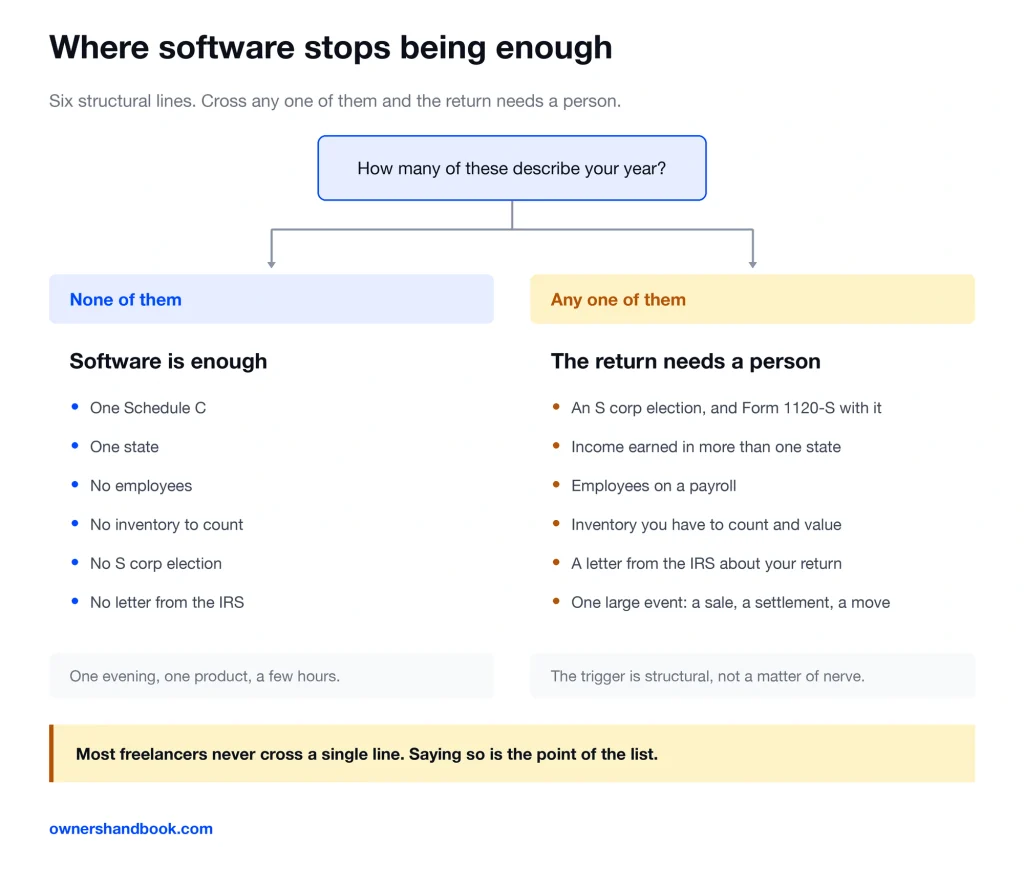
One Schedule C, one state, no employees, no inventory, no S corp election. That is a software return, and paying a person several hundred dollars to type it in buys you nothing you did not already have. Six specific things move you across the line. Until one of them happens to you, the answer is no.
Most freelance returns are one form and one schedule
A freelancer with clients and no staff files a Form 1040, a Schedule C for the business, and a Schedule SE for self-employment tax.
Consumer tax software is built around exactly that shape. The interview asks for your income, walks you through the expense categories, and fills the two schedules.
What makes a return hard is not the amount of money. It is the number of moving parts.
$140,000 of profit from six clients in one state is a simpler return than $30,000 split across three states with one part-time employee.
So the question is not whether you feel ready. It is whether your year contains a part the software was not built for.
The six things that end it
Any one of these, on its own, is enough. They do not accumulate. One is the whole trigger.
| What happened | What it adds to your filing | The form or the deadline |
|---|---|---|
| An S corp election | A second, separate return for the business, plus payroll | Form 1120-S, due the 15th day of the 3rd month |
| Income in more than one state | A return in each state, plus a credit to stop the same money being taxed twice | Varies by state |
| Employees | Deposits on a schedule and quarterly employment returns | Forms 941 and 940, plus W-2s |
| Inventory | Cost of goods sold, counted and valued at both ends of the year | Schedule C, Part III |
| A letter from the IRS | Someone who can speak to the IRS on your behalf | Form 2848 |
| One large one-off event | Basis, timing, and character questions with no default answer | Depends on the event |
Take the S corp election first, because it is the cleanest of the six.
Electing S corporation taxation means the business files its own return. Form 1120-S is generally due the 15th day of the 3rd month after year end, so March 15 for a calendar year.
Your personal return is due April 15. The business return lands a month before it, on a date you did not have last year.
Miss it and the penalty is $255 for each month or part of a month, up to 12 months, multiplied by the number of shareholders.
More than one state is the trigger people underestimate. Where you performed the work often decides which state may tax it, and every state writes that rule differently.
Employees turn a yearly task into a running schedule. Deposits, Form 941 every quarter, Form 940 once a year, W-2s in January.
Inventory means Schedule C Part III and a real count at both ends of the year. There are simplifications for small businesses, but the counting itself does not go away.
An IRS letter is unlike the other five. It is not a filing problem. It is a representation problem, which has its own rules and its own section below.
The one-off event is the loosest of the six. Selling the business, a legal settlement, a move between states halfway through the year.
CPA, enrolled agent, unenrolled preparer
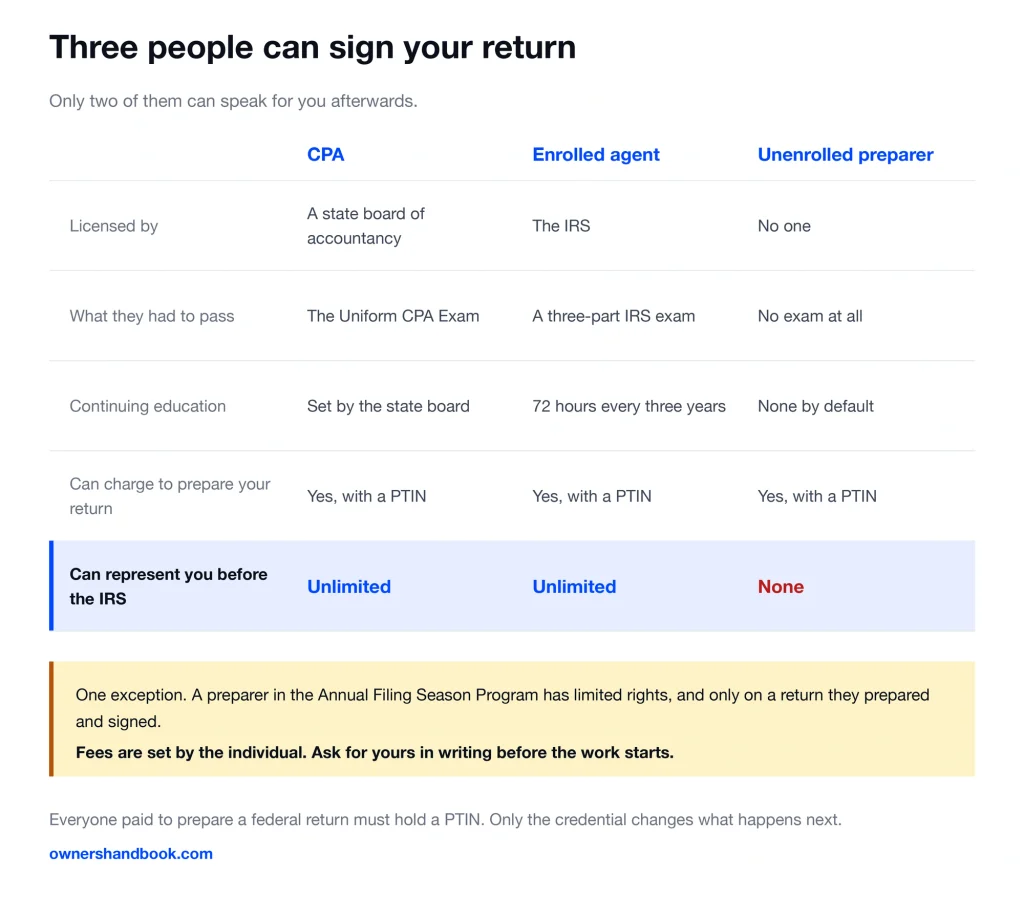
Most people know two options: software, or a CPA. There are three kinds of person, and the middle one is the one hardly anybody has heard of.
A CPA is licensed by a state board of accountancy and has passed the Uniform CPA Exam. The licence covers audit and financial reporting as well as tax.
An enrolled agent is licensed by the IRS itself, through a three-part exam on individual and business returns or through prior IRS employment. The IRS calls it the highest credential the agency awards.
Enrolled agents do tax and nothing else, and they must complete 72 hours of continuing education every three years. For a Schedule C with one complication, that is often the closer match.
An unenrolled preparer is anyone else who takes money to prepare returns. No exam, no licence, and no continuing education required.
| What you are choosing | Software alone | Unenrolled preparer | Enrolled agent or CPA |
|---|---|---|---|
| Who checks the work | You | The preparer | The preparer |
| Needs a PTIN to charge you | Not applicable | Yes | Yes |
| Can represent you before the IRS | No | No | Yes, unlimited |
| Listed in the IRS preparer directory | Not applicable | Only through the Annual Filing Season Program | Yes |
Fees here are not standardized, and we could not verify a current national survey of preparer rates, so treat any single figure you read as one person’s price. Ask for yours in writing before the work starts.
The software side is easier to pin down. TurboTax lists its self-employed tier, Premium, at $139 for a federal return, with state filing charged separately.
FreeTaxUSA prices the same work at $0 for the federal return, self-employment forms included, and $15.99 for a state.
There is a third option at $0 for both, and it needs explaining, because the name tells you nothing useful about it. Cash App Taxes was Credit Karma Tax until 2021. When Intuit — the company that owns TurboTax — agreed to buy Credit Karma for $7.1 billion, the Justice Department sued to block the deal and settled on a condition: Credit Karma had to sell its tax business to someone else. The buyer was Square, now called Block, which also runs Cash App.
The reason the government insisted matters here. Its filing described Credit Karma Tax as the fifth-largest do-it-yourself tax product in the country, and the whole point of forcing the sale was to keep a free competitor alive against TurboTax. So the product is not a payments app that started doing taxes on the side. It is an established tax filer that changed owners by court order, and its independence from Intuit is a matter of public record rather than a marketing claim.
Block is a public company. It also owns Square, the white card reader on café counters, and Cash App itself, one of the larger peer-to-peer payment apps in the country. Cash App Taxes is the tax product inside that group — a real named service, not a generic term.
What it handles: its help centre lists Schedule C, Schedule SE for self-employment tax, Form 4562 for depreciation, Form 8829 for the home office, and Form 8995 for the qualified business income deduction. That is the whole freelance core. Audit defense is included at no cost through a third-party firm. Its own page states it is an Authorized IRS e-file provider, which is the designation any service needs before it can transmit returns electronically.
Two things it is not. It is not an IRS Free File partner — Free File is a separate program with its own list, and people confuse the two constantly. And we could not independently confirm the e-file authorization, because the IRS publishes no checkable public list of consumer tax software; its provider locator covers professionals who opted in, and the IRS says inclusion there “does not constitute any endorsement.”
The question worth asking of anything free is what it does with your data. The law does most of the work here, and it binds every preparer equally: Internal Revenue Code section 7216 makes it a misdemeanour for a tax return preparer to use your return information for any purpose other than preparing the return, and the Treasury regulations setting out the consent requirements have been in force since December 2012.
Its own privacy notice says Block does “not sell your personal information” and does not share it for unaffiliated direct marketing, and limits affiliate sharing to running the service. It is worth knowing what the notice does not do: it never mentions section 7216 and never draws a line between your tax return information and ordinary account data. The criminal statute is the real protection, not the notice.
Block does not say how the product is funded. The one mechanism it advertises openly is the refund: deposit it into Cash App and you get it up to five days early. Read that as customer acquisition rather than charity.
Then the limits, and they are real.
You must install the Cash App mobile app and make an account to log in, though the filing itself then runs in a normal browser. It will not file more than one state, a part-year state return, or a non-resident state return — so if you moved this year, or you owe a return somewhere you do not live, it is not available to you at any price. It also does not support Form 2210, the underpayment of estimated tax form, which is exactly what a freelancer who missed a quarterly payment needs. That one is survivable: the IRS will compute the penalty and bill you instead.
The guarantees are thinner than they sound. The accuracy guarantee reimburses “up to a maximum of $1,000 in the form of gift card(s),” and only where a tax authority actually charged you penalties or interest because of their calculation error. The maximum refund guarantee pays “up to $100 (minimum $25) in the form of a gift card,” federal returns only — state claims are automatically denied. Gift cards, not money, in both cases.
Those form lists were last updated in January 2025 and written for tax year 2024, so re-check them against the season you are actually filing.
All three file an identical Schedule C. What separates them is the interview and the hand-holding, not the form that reaches the IRS.
Representation is the thing you are actually buying
This is what the credential argument is really about, and it has nothing to do with who types faster.
CPAs, enrolled agents, and attorneys hold unlimited representation rights. They may represent any taxpayer on any tax matter before any IRS office, whether or not they prepared the return.
A preparer in the Annual Filing Season Program has limited rights. Only a return they prepared and signed, and only before revenue agents and customer service representatives.
Everyone else has none. Since January 1, 2016, a PTIN holder with no credential cannot represent you at all.
You authorize representation on Form 2848, and the person you name has to be eligible to practice before the IRS.
None of this matters in a quiet year. It matters completely in the year a letter arrives, and that is the year you can no longer go back and choose differently.
Below a line, you should not be paying anyone
Before hiring a person, check whether you should be paying for software either.
IRS Free File offers guided tax software at no cost if your adjusted gross income is $89,000 or less. Adjusted gross income is your total income after a short list of deductions, near the bottom of page one of the 1040.
Free File Fillable Forms is open at any income level. It is the paper forms on a screen, with limited calculations and no state return.
VITA prepares returns free for people earning $69,000 or less, people with disabilities, and limited English speakers. What each site can handle depends on which volunteers are certified there, so call ahead.
Having a Schedule C does not disqualify you from any of these on its own.
What to hand a preparer
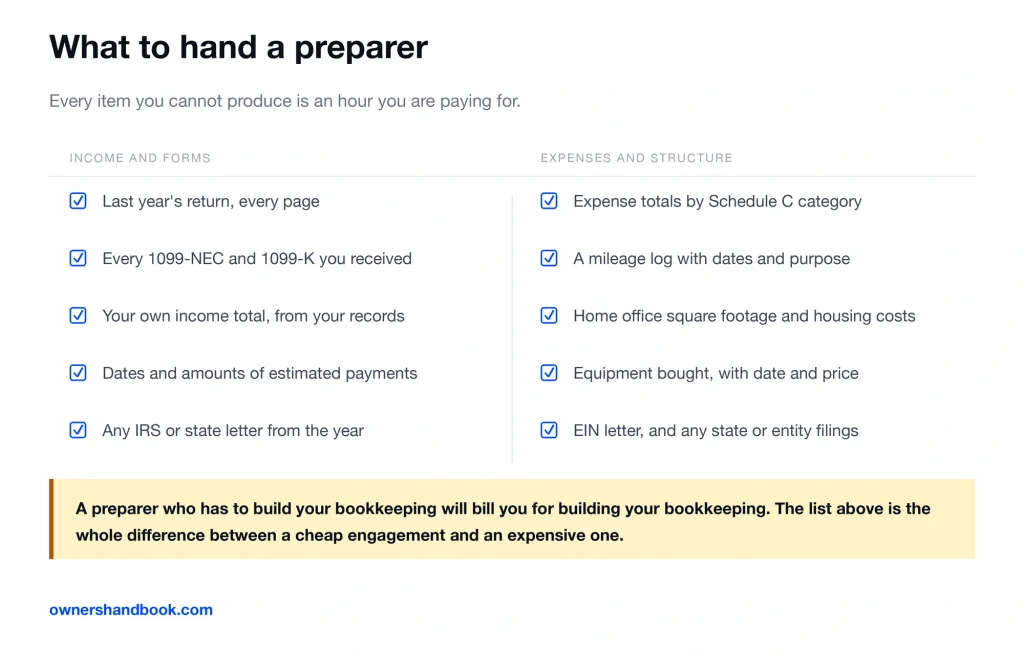
If you do hire someone, the size of the bill is largely yours to control. The expensive part is rarely the return. It is the hours spent assembling what should already exist.
Bring your own income total, computed from your records rather than from the 1099s you received. The forms are the cross-check, not the source.
Bring expenses already totalled by Schedule C category. A bank export is raw material. A categorised total is finished work.
Bring last year’s return in full, every page, including the schedules you think are irrelevant.
And bring the mileage log, the square footage, the estimated payment dates. Every gap is a question, and every question is billed.
Check the person is real before you pay them
Anyone paid to prepare a federal return must hold a valid PTIN, a preparer tax identification number issued by the IRS. It is not a credential. It is the permission to charge.
The IRS publishes a Directory of Federal Tax Return Preparers with Credentials and Select Qualifications. Search it by ZIP code before you hand over a single document.
The directory covers attorneys, CPAs, enrolled agents, and Annual Filing Season Program participants. An unenrolled preparer with no credential does not appear in it at all.
Then watch the signature. The IRS warns about ghost preparers, who prepare a return for a fee and then refuse to sign it.
A preparer who will not put their own PTIN on your return is telling you what they think of the work.
Two more habits, both cheap. Never sign a blank or incomplete return, and never let a refund be deposited into an account that is not yours.
Frequently asked questions
Do I need a CPA to file a Schedule C?
No. A Schedule C with one state, no employees, and no inventory is an ordinary consumer software return. The question only starts when one of the six structural triggers appears.
Is an enrolled agent as good as a CPA for taxes?
For representation before the IRS they hold identical unlimited rights. An enrolled agent is a tax specialist by definition, while a CPA licence covers a much broader field than your return.
Can any preparer represent me if the IRS writes to me?
No. Only attorneys, CPAs, and enrolled agents have unlimited rights. Annual Filing Season Program participants are limited to returns they prepared and signed, and everyone else has none.
What changes if I made an S corp election?
The business files Form 1120-S in addition to your personal return, generally by the 15th day of the 3rd month after year end. Late filing runs $255 per month, per shareholder, for up to 12 months.
How do I check a preparer is legitimate?
Search the IRS Directory of Federal Tax Return Preparers, confirm they hold a PTIN, and confirm they will sign the return. Refusing to sign is the pattern the IRS calls a ghost preparer.
Can I file for free with self-employment income?
Often, yes. IRS Free File guided software runs to $89,000 of adjusted gross income, Free File Fillable Forms has no income limit, and VITA serves people at $69,000 or less.
The software prices here were read off the vendors’ own pages in September 2026, and filing season pricing changes every year. The IRS thresholds are for the 2026 filing season. Check both before you rely on them.
Once you have decided
If the answer was software, the order you enter things in matters more than which product you picked, and there are four places it asks a question badly. There is a step-by-step walkthrough of filing it yourself.
If the answer was a person, what you hand them decides what you pay, because a preparer sorting a shoebox bills the same rate as a preparer giving advice. There is a list of what to send them.
And if you are still deciding, the priced comparison of both routes, with real figures from the vendors and the IRS, is in the full cost comparison.
Sources
IRS, Understanding Tax Return Preparer Credentials and Qualifications
IRS, Choosing a Tax Professional
https://www.irs.gov/tax-professionals/choosing-a-tax-professional
IRS, Directory of Federal Tax Return Preparers with Credentials and Select Qualifications
https://irs.treasury.gov/rpo/rpo.jsf
IRS, Enrolled Agent Information
https://www.irs.gov/tax-professionals/enrolled-agents/enrolled-agent-information
IRS, PTIN Requirements for Tax Return Preparers
https://www.irs.gov/tax-professionals/ptin-requirements-for-tax-return-preparers
IRS, About Form 2848, Power of Attorney and Declaration of Representative
https://www.irs.gov/forms-pubs/about-form-2848
IRS, Instructions for Form 1120-S
https://www.irs.gov/instructions/i1120s
IRS, About Form 1120-S, U.S. Income Tax Return for an S Corporation
https://www.irs.gov/forms-pubs/about-form-1120-s
IRS, Instructions for Schedule C
https://www.irs.gov/instructions/i1040sc
IRS, Employment Taxes
https://www.irs.gov/businesses/small-businesses-self-employed/employment-taxes
IRS, When to File
https://www.irs.gov/filing/individuals/when-to-file
IRS, Free File: Do Your Taxes for Free
https://www.irs.gov/filing/irs-free-file-do-your-taxes-for-free
IRS, Free Tax Return Preparation for Qualifying Taxpayers
https://www.irs.gov/individuals/free-tax-return-preparation-for-qualifying-taxpayers
TurboTax, Premium online pricing
https://turbotax.intuit.com/personal-taxes/online/premium
FreeTaxUSA, Pricing