Notary Taxes: Part of Your Fee Skips Self-Employment Tax
Part of what you earn as a notary is exempt from self-employment tax. Not exempt from income tax — exempt from the 15.3% on top of it. The IRS says so in the Schedule SE instructions, and it has said so for decades.
The catch is that if you work as a loan signing agent, only a fraction of what the signing service pays you qualifies. The rest is ordinary self-employment income, and the two arrive together in one payment, on one form, with no breakdown.
Here is the rule, and here is how to split the payment.
What the Schedule SE instructions actually say
The exclusion is not a deduction you claim. It is income that never enters the self-employment tax calculation at all. The instructions list it among the items excluded from net earnings:
Fees received for services performed as a notary public. If you had no other income subject to SE tax, check box number 3 and enter “Exempt—Notary” on Schedule 2 (Form 1040), line 4.
That is the simple case — a notary who does nothing else self-employed. Most loan signing agents are not that person, and the instructions handle them separately:
However, if you had other earnings of $400 or more subject to SE tax, enter “Exempt—Notary” and the amount of your net profit as a notary public from Schedule C on the dotted line to the left of Schedule SE, line 3. Subtract that amount from the total of lines 1a, 1b, and 2, and enter the result on line 3.
Read that closely. You still file Schedule C reporting everything you earned. You still file Schedule SE. What you do is write a specific phrase and a specific number on a dotted line, and subtract.
| Your situation | What you do |
|---|---|
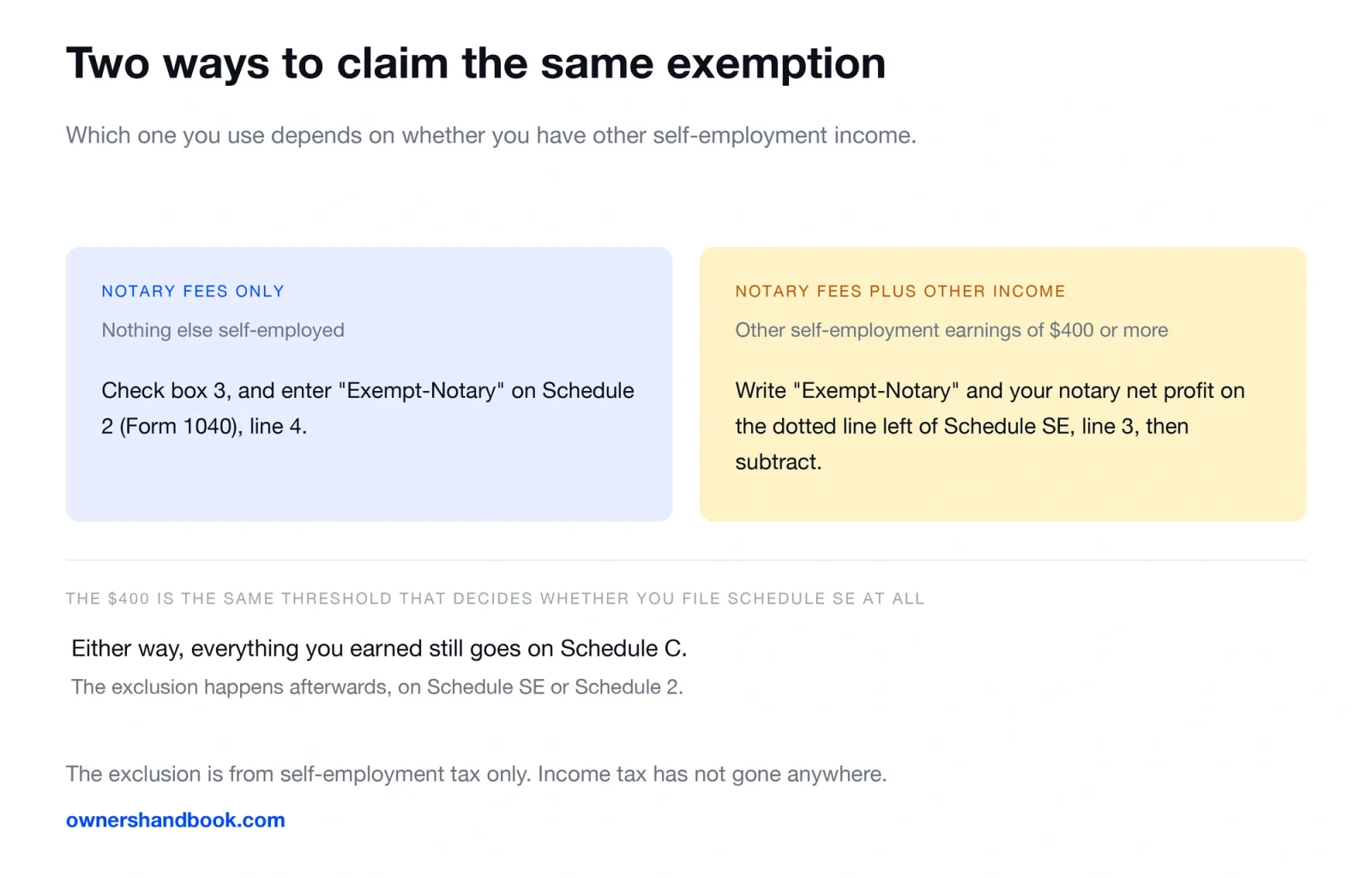
| Notary fees only, nothing else self-employed | Check box 3, write “Exempt—Notary” on Schedule 2, line 4 |
| Notary fees plus other self-employment income of $400 or more | Write “Exempt—Notary” and the notary net profit on the dotted line left of Schedule SE, line 3, then subtract |
The $400 figure is the same threshold that decides whether you file Schedule SE at all. The instructions require it when the amount on line 4c is $400 or more.
The exemption is from one tax, not from tax
This is the most common misreading, and it costs people money in April.
Notarial fees are excluded from net earnings from self-employment. Net earnings from self-employment is the base for self-employment tax — Social Security and Medicare. It is not the base for income tax.
Your notary income is still income. It still goes on Schedule C. It is still taxed at your ordinary rate. What it escapes is the 15.3% layer that sits on top of everything else you earn as a sole proprietor.
So the saving is real but bounded. On $8,000 of genuine notarial fees the exclusion is worth roughly $1,130 in self-employment tax, and nothing at all in income tax. Plan your quarterly estimated payments around the income tax, which has not gone anywhere.
Your signing fee is mixed, and only one part is exempt
A loan signing appointment is not one service. It is a bundle, and the IRS exclusion reaches exactly one item in it.
When you notarise a signature you are performing a notarial act, and the fee for that act is excluded. When you drive to the borrower’s kitchen table, print a 150-page loan package, shepherd the signer through documents that need no notarisation, scan the executed set back, and drop it at FedEx, you are performing ordinary services for a company. Those are not notarial acts. They are self-employment income like any other.
| What you did | Exempt from SE tax |
|---|---|
| Taking the acknowledgment or administering the oath | Yes |
| Printing and returning the document package | No |
| Driving to the signing | No |
| Walking the borrower through non-notarised pages | No |
| Scanning, shipping, courier work | No |
| The signing service’s coordination fee paid to you | No |
The signing service does not care about this distinction. It pays you one lump sum — commonly $75 to $175 for a refinance package — and reports the year’s total on a single 1099-NEC with no itemisation. The split is yours to make and yours to defend.
Your state’s fee schedule caps the exempt portion
Here is the part that keeps the exemption honest.
You cannot decide that $90 of a $125 signing fee was notarial. The exempt amount is limited to what you were actually entitled to charge for the notarial acts you performed — and every state sets a statutory maximum per act, usually per signature or per seal.
Those maximums vary enormously, they change, and some states regulate travel fees separately. Look up your own state’s current schedule on your Secretary of State’s website before you compute anything. Any figure you find in a blog post, including this one, is the wrong figure for you.
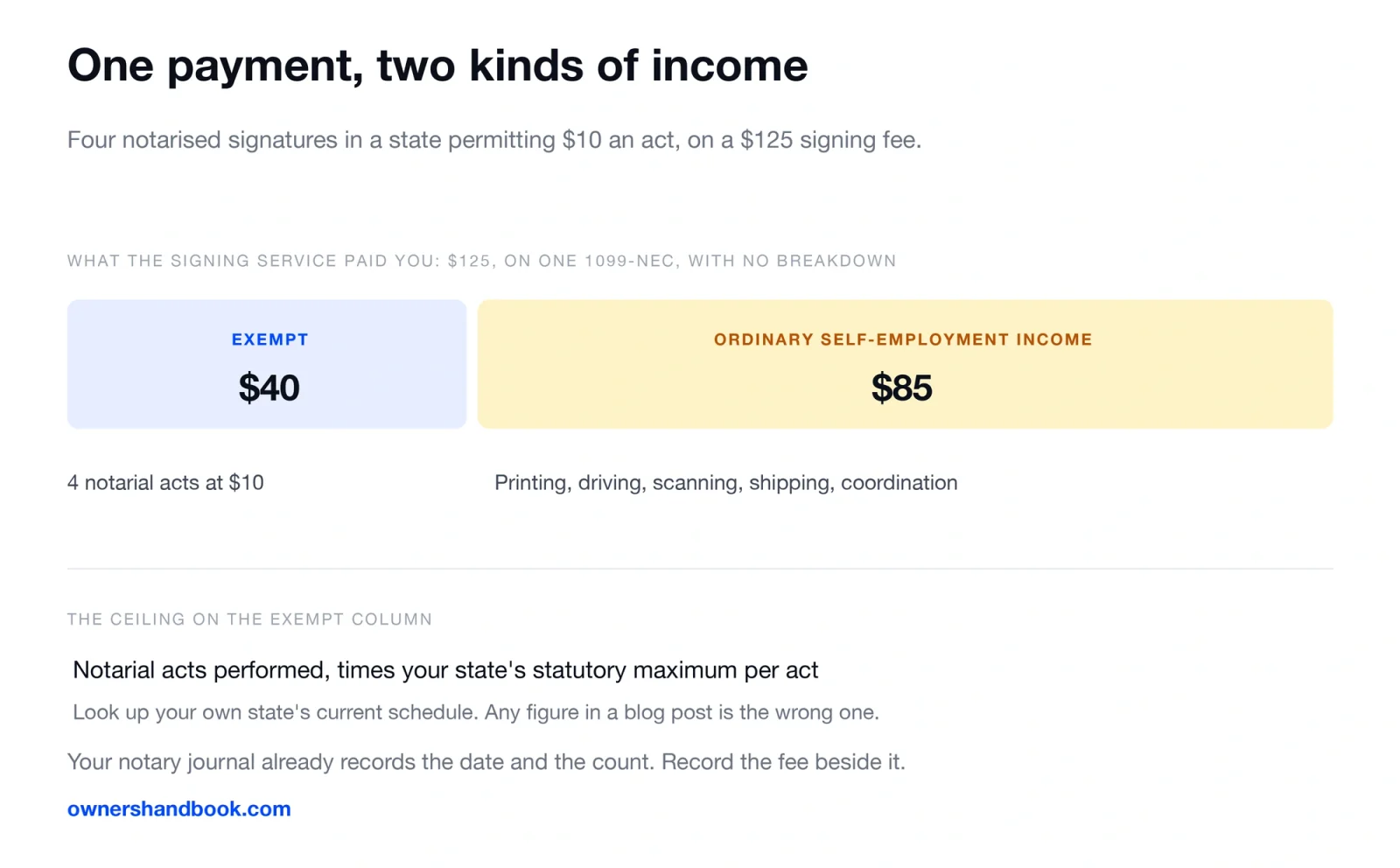
The arithmetic then runs: number of notarial acts performed × your state’s maximum fee per act = the exempt portion. Everything else in the payment is ordinary income.
A signing with four notarised signatures in a state permitting $10 per act yields $40 exempt. If the signing service paid $125, the remaining $85 is ordinary self-employment income. That ratio — a minority of the fee — is typical, and it is why “I am a notary, so I owe no self-employment tax” is a costly belief.
Your notary journal is the substantiating record
Most states already require you to keep a journal of notarial acts. That journal is the single most useful tax document you own, because it is a contemporaneous log of exactly the thing you need to prove.
For each signing, your journal establishes the date, the number of notarial acts, and the signer. Match that against the payment you received and you have a defensible split rather than an estimate.
Build the habit of recording, alongside the journal entry, the fee the signing service paid for that appointment. Then the year-end calculation is mechanical: total notarial acts at the statutory rate is the exempt column, the remainder is the taxable column, and the two together reconcile to the 1099-NEC.
Without that, you are reconstructing a split from memory against a single annual figure, which is exactly the position our guide to record keeping is written to keep you out of.
Mileage is probably your largest deduction
Loan signing is a driving business. Most agents underestimate this deduction badly because they think of it as commuting, and it is not — travel from your home office to a signing appointment is business travel.
The standard mileage rate for 2026 changed mid-year. It is $0.725 per mile for January through June and $0.76 per mile for July through December, so you need your mileage split by half of the year rather than as one annual total.
At 9,000 business miles a year, evenly split, that is roughly $6,660 of deduction. Run your own figures through the mileage calculator, and see the 2026 rate post for what the mid-year change means for your log.
The other costs worth claiming
| Expense | Notes |
|---|---|
| E&O insurance | Deductible business insurance. Signing services commonly require $25,000 of cover or more |
| Surety bond premium | Deductible. The premium is the expense, not the bond’s face amount |
| Commission and renewal fees | Deductible |
| NSA certification and background screening | Deductible when maintaining an existing business |
| Printer, toner, paper | A high-volume laser printer is the classic signing-agent purchase |
| Journal, seal, stamp | Deductible supplies |
Printing is a genuine cost here in a way it is not for most freelancers. Dual-tray laser printers, toner at volume, and legal-size paper add up, and they belong in your deduction list alongside the equipment rules in writing off equipment.
About that 1099-NEC
Two things changed, and both affect what lands in your mailbox in January.
The reporting threshold rose to $2,000 for tax years beginning after 2025, up from $600. A signing service that paid you $1,600 across the year now sends nothing at all. Your obligation to report that $1,600 is unchanged — the threshold governs their paperwork, not your income.
And if the service pays you through a payment app or card processor rather than directly, the reporting shifts to a 1099-K from the processor. Our comparison of 1099-NEC and 1099-K covers which is which and why you may receive both, neither, or one of each.
Frequently asked questions
Does the exemption apply to my whole signing fee?
No. It applies only to the fee for the notarial acts themselves, limited to your state’s statutory maximum per act. Printing, travel, scanning and coordination are ordinary self-employment income.
Do I still file Schedule C?
Yes. Everything you earned goes on Schedule C, including the notarial fees. The exclusion happens later, on Schedule SE or Schedule 2.
Do I still pay income tax on notary fees?
Yes. The exclusion is from self-employment tax only. Notary income is ordinary income for income tax purposes.
What if notarising is all I do, no signings?
Then you are in the simple case. Check box 3 and enter “Exempt—Notary” on Schedule 2, line 4, provided you have no other self-employment income subject to SE tax.
Does excluding the income reduce my Social Security credits?
Yes, and this is worth weighing. Earnings excluded from net earnings from self-employment do not count toward Social Security. The exclusion is not optional, but its long-run effect on your benefit record is real.
What if I have been paying SE tax on all of it for years?
Amended returns are the route, subject to the normal limits on how far back a refund claim can reach. Work out what the correct split would have been first, using whatever journal records you have.
Sources
IRS, Instructions for Schedule SE (Form 1040), Self-Employment Tax
https://www.irs.gov/instructions/i1040sse
IRS, Standard mileage rates
https://www.irs.gov/tax-professionals/standard-mileage-rates
IRS, Instructions for Forms 1099-MISC and 1099-NEC
https://www.irs.gov/instructions/i1099mec
IRS, About Schedule C (Form 1040), Profit or Loss From Business