Owner-Operator Truck Driver Taxes: Meals Are 80%, Not 50%
Every guide to deducting business meals tells you the limit is 50%. For you it is 80%, and the difference is written into the statute specifically for people working under the Department of Transportation’s hours-of-service rules. If you have been halving your per diem, you have handed back a quarter of that deduction in every year you did it.
That is not the only thing general freelance tax advice gets wrong about your year. You also file a federal excise return in order to keep your plates, and you cannot use the mileage rate that almost every driver guide is built around.
First, you are not a gig driver
Our guide to driving for Uber, Lyft and DoorDash is written for a different taxpayer. A gig driver uses a passenger car, takes the standard mileage rate, and gets a 1099-NEC or a 1099-K from a platform at the end of January.
You run a tractor, deduct actual operating costs, and are paid by brokers and shippers against settlement statements. Even the activity code differs — 485300 is taxi, limousine and ridesharing, 484120 is long-distance general freight trucking. Our guide to choosing a Schedule C business code covers why that line matters more than it looks.
Read anything written for the first reader with that in mind. Most of it does not transfer.
Your meals are 80% deductible, not 50%
The general rule is in section 274(n)(1) of the code:
The amount allowable as a deduction under this chapter for any expense for food or beverages shall not exceed 50 percent of the amount of such expense which would (but for this paragraph) be allowable as a deduction under this chapter.
Then paragraph (3) of the same subsection carves you out of it:
In the case of any expenses for food or beverages consumed while away from home (within the meaning of section 162(a)(2)) by an individual during, or incident to, the period of duty subject to the hours of service limitations of the Department of Transportation, paragraph (1) shall be applied by substituting “80 percent” for “50 percent”.
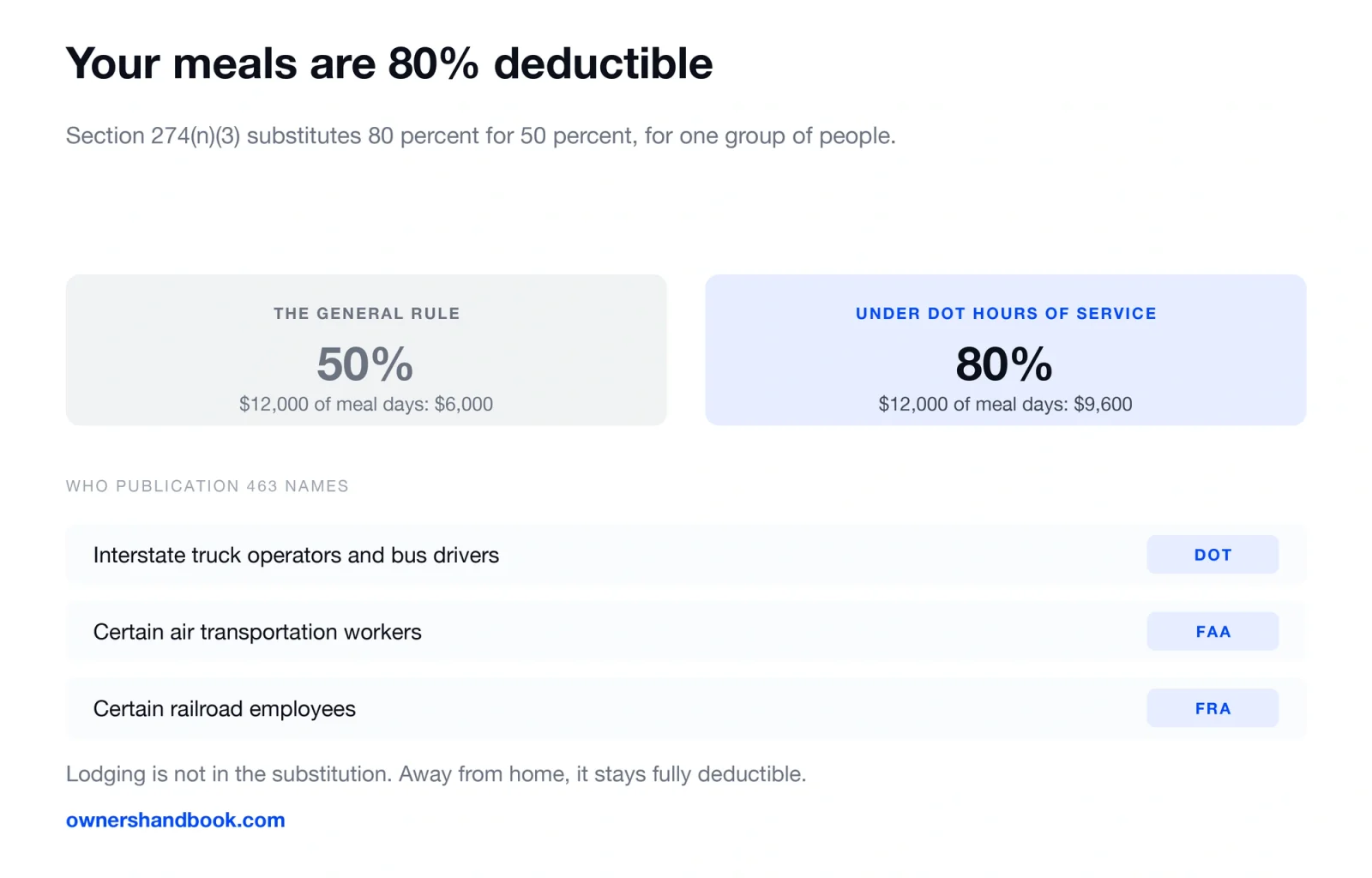
Publication 463 says the same thing in plainer words — *”The percentage is 80%”* — and names who is covered. Interstate truck operators and bus drivers under DOT regulations. Certain air transportation workers under FAA regulations. Certain railroad employees under FRA regulations.
| Who you are | Limit on deductible meals |
|---|---|
| A freelancer taking a client to lunch | 50% |
| A consultant on an overnight trip | 50% |
| An interstate truck operator under DOT hours-of-service rules | 80% |
On $12,000 of meal days, that is $9,600 deductible instead of $6,000. Our general post on meals and travel states the 50% rule because it is written for the general case. This is the exception to it.
The standard meal allowance, and the record it still needs
You do not have to keep a receipt for every meal. You can claim a flat daily allowance instead, and because you work in the transportation industry you use a single national figure rather than looking up each city.
Publication 463 defines the industry test. Your work must directly involve moving people or goods by airplane, barge, bus, ship, train or truck, and must regularly require travel away from home to areas with different allowance rates.
The rate itself is set by an annual IRS notice, not by the publication. Notice 2026-60 sets it at $80 per day within the continental United States and $86 outside it, effective for meals paid or incurred on or after 1 October 2026. Both figures are unchanged from the previous notice, which is worth knowing because the rate has held while the standard lodging allowance moved. The notice runs on the federal fiscal year, so a successor notice sets the figure from 1 October 2027 — check that notice rather than assuming the number holds.
Partial days are counted at three quarters of the daily rate for the day you leave and the day you return.
The allowance replaces receipts for the cost of the meals. It does not replace the record of the trip. Publication 463 is explicit:
If you use the standard meal allowance, you must still keep records to prove the time, place, and business purpose of your travel.
Your logs already do most of this. Keep them with the tax file rather than only in the ELD, and keep settlement statements alongside them. Our guide to keeping records that survive a question covers how long to hold what.
One condition trips people who run short regional lanes. The meal must be incurred while away from home in the tax sense, which requires that your duties keep you away substantially longer than an ordinary day’s work and that you need sleep or rest. Publication 463 adds that the rest requirement *”isn’t satisfied by merely napping in your car.”* A day out and back is not a per diem day.
Form 2290, the return that keeps your plates
No other self-employed trade files a federal excise return to stay registered. You do.
The instructions for Form 2290 set the threshold and the period:
You must file Form 2290 and Schedule 1 for the tax period beginning on July 1, 2026, and ending on June 30, 2027, if a taxable highway motor vehicle … is registered, or required to be registered, in your name under state, District of Columbia, Canadian, or Mexican law at the time of its first use during the tax period and the vehicle has a taxable gross weight of 55,000 pounds or more.
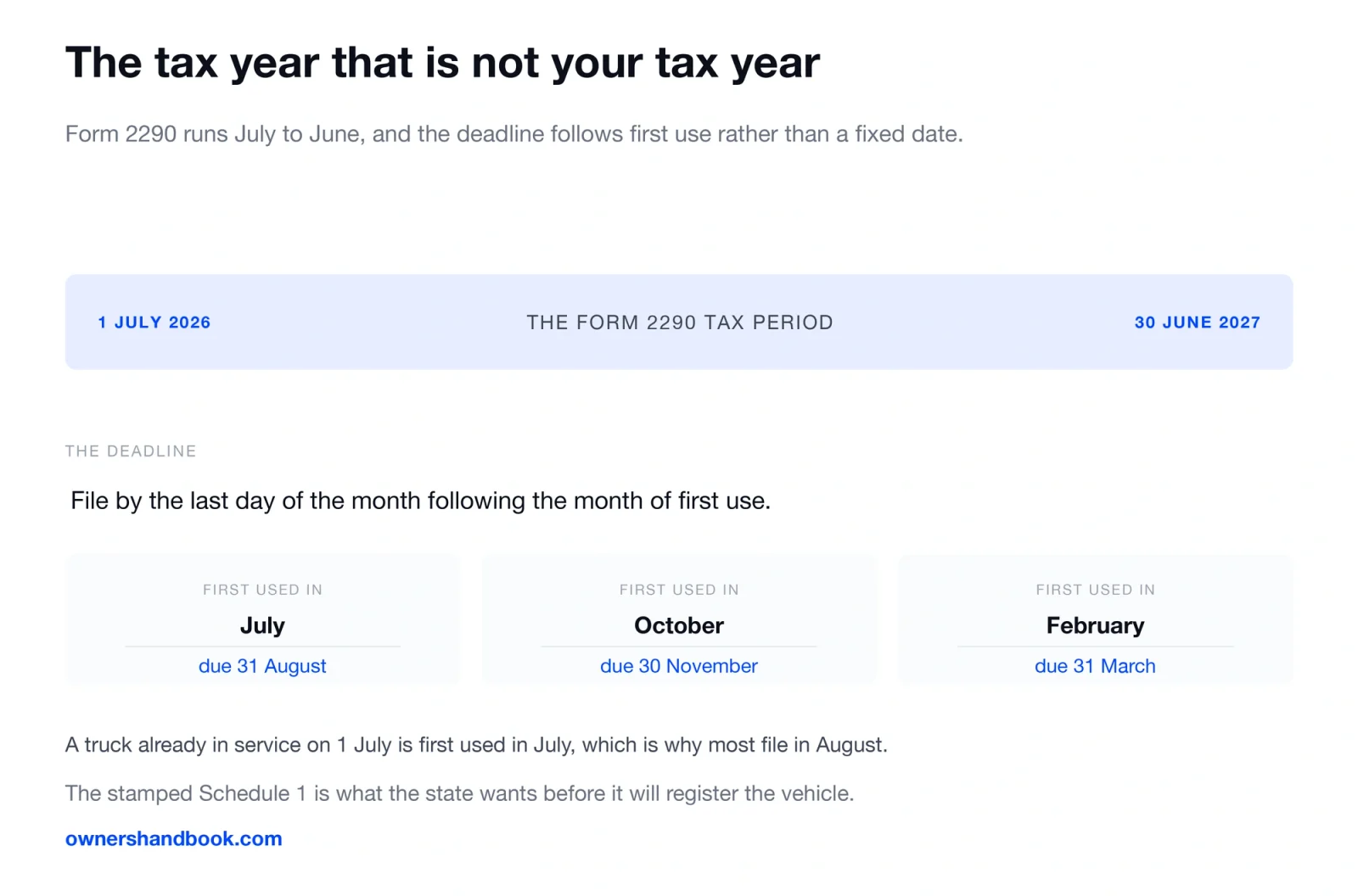
The tax year is not the calendar year and not your Schedule C year. It runs 1 July to 30 June. And the deadline is not a fixed annual date — it follows first use:
Form 2290 must be filed for the month the taxable vehicle is first used on public highways during the current period. The current period begins July 1, 2026, and ends June 30, 2027. Form 2290 must be filed by the last day of the month following the month of first use.
| Month of first use | Form 2290 due |
|---|---|
| July | 31 August |
| October | 30 November |
| February | 31 March |
A truck already in service on 1 July is first used in July, which is why most owner-operators file in August. Buy a truck in October and your first return is due at the end of November, for a short period rather than a full year.
The reason it matters beyond the tax is the receipt. The instructions state that *”states will require verification of payment of the tax for any taxable vehicle before they will register the vehicle”*, and that the stamped Schedule 1 is the proof. Miss the filing and the registration problem arrives before any IRS letter does.
The mileage rate does not apply to your truck
The 2026 standard mileage rate is 72.5 cents a mile for January to June and 76 cents for July to December. None of it is available to you.
Publication 463 defines the vehicle the rate covers in one sentence: *”In this publication, ‘car’ includes a van, pickup, or panel truck.”* A tractor is none of those. The publication even notes that you may elect the rate for a car used for hire, such as a taxi — which is exactly how a rideshare driver qualifies and exactly why you do not.
So you deduct actual costs, which for most owner-operators is the larger number anyway: fuel, tyres, repairs, insurance, permits, tolls, scales, parking, washing, and the depreciation below.
Depreciating the tractor
Two points that surprise people who have only read general equipment advice.
First, a tractor unit for over-the-road use is 3-year property under MACRS. Publication 946 lists it first among the 3-year class. Trailers and trailer-mounted containers sit at 5 years. Most business equipment is 5 or 7, so your cost recovery is faster than the generic guidance assumes.
Second, the 100% first-year write-off is back and it is permanent. Publication 463 summarises the change:
a permanent 100% additional first-year depreciation deduction for qualified property acquired and placed in service … after January 19, 2025
Section 179 is the other route, with a 2026 limit of $2,560,000, reduced once property placed in service in the year exceeds $4,090,000. Neither ceiling will bind on one truck. Our post on writing off equipment covers why taking the whole deduction in year one is not always right — a large deduction in a low-revenue year is worth less than the same deduction spread across profitable ones.
What this adds up to
Your net profit after all of the above carries self-employment tax at 15.3%, and nobody withholds it for you. Settlements arrive net of the broker’s deductions, not net of tax. Our guide to quarterly estimated payments covers the dates and the safe-harbour rule that stops the penalty even in a year you cannot forecast.
Frequently asked questions
Do I need receipts if I use the standard meal allowance?
Not for the meals themselves. You still need records showing the time, place and business purpose of the travel, which your logs and settlements cover.
Does the 80% figure apply to lodging as well?
No. The 80% substitution in section 274(n)(3) applies to food and beverages. Lodging on a business trip away from home is deductible in full, subject to the usual substantiation.
Can I claim per diem for a day I got home?
Only if the trip required sleep or rest away from your tax home. The day you return is claimed at three quarters of the daily rate under the standard method.
I lease my truck to a carrier. Am I still self-employed?
That depends on the agreement and how you are paid, not on the word used in it. If you receive settlements rather than a W-2 and bear the operating costs, you are filing a Schedule C.
Do I file Form 2290 if I bought the truck in March?
Yes, for the period from first use through 30 June, due by the last day of April. The next return then follows the normal July cycle.
Is the heavy vehicle use tax deductible?
It is an ordinary and necessary cost of operating the vehicle in your business, deductible on Schedule C like your permits and registration fees.
Sources
Cornell Law School, 26 U.S. Code § 274
https://www.law.cornell.edu/uscode/text/26/274
IRS, Publication 463, Travel, Gift, and Car Expenses
https://www.irs.gov/publications/p463
IRS, Notice 2026-60, 2026-2027 Special Per Diem Rates
https://www.irs.gov/pub/irs-drop/n-26-60.pdf
IRS, Instructions for Form 2290
https://www.irs.gov/instructions/i2290
IRS, Publication 946, How To Depreciate Property
https://www.irs.gov/publications/p946
IRS, Instructions for Schedule C (Form 1040)
https://www.irs.gov/instructions/i1040sc
IRS, Self-employment tax (Social Security and Medicare taxes)