Freelance Developer Taxes: Section 174A Changed Your Costs
If you freelanced as a developer and also built something of your own — a side product, a SaaS, an internal tool you later sold — then for tax years 2022 through 2024 the law said you could not deduct what it cost you in the year you spent it. You had to spread it over five years. Almost no solo developer knew, and almost no solo developer did it.
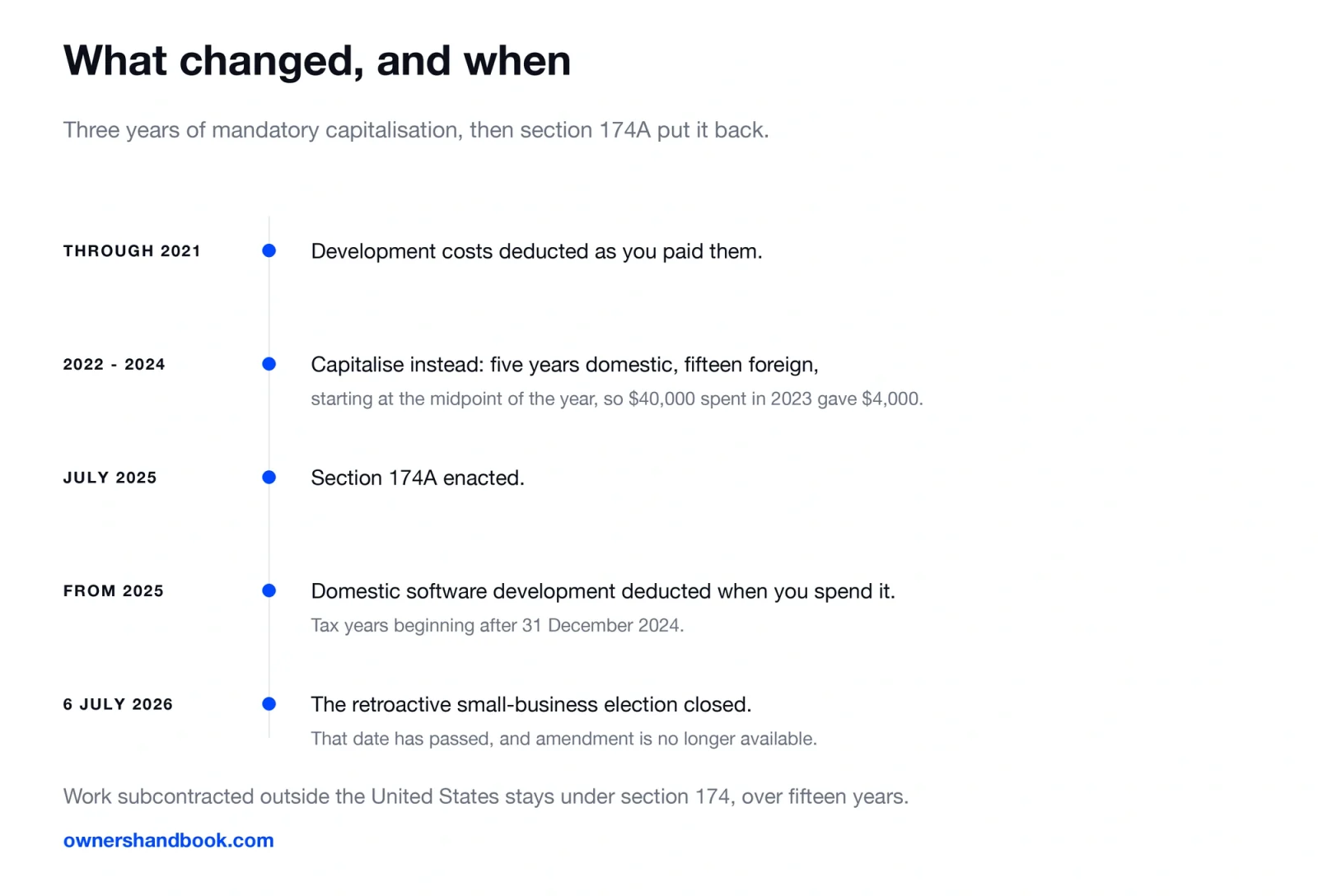
That rule is gone. Section 174A, enacted in July 2025, restores an immediate deduction for domestic software development from tax years beginning after 31 December 2024. What follows is what the section actually says, the line it forces you to draw between client work and your own development, and what is still open for the years you got wrong.
What section 174A says
Three sentences matter. The first is the deduction itself:
Notwithstanding section 263, there shall be allowed as a deduction any domestic research or experimental expenditures which are paid or incurred by the taxpayer during the taxable year.
The second pulls software in by name:
Software development. For purposes of this section, any amount paid or incurred in connection with the development of any software shall be treated as a research or experimental expenditure.
The third is the effective date, in the enacting act:
Except as otherwise provided in this subsection or subsection (f)(1), the amendments made by this section shall apply to amounts paid or incurred in taxable years beginning after December 31, 2024.
So from your 2025 return onward, money you spend developing software in the United States is deductible when you spend it. You may elect instead to capitalise and amortise it over a period of not less than 60 months, which a few people with loss years will want, but the default is immediate.
Domestic is doing real work in that sentence. Section 174A(b) defines domestic expenditures as those which are not attributable to foreign research, and foreign research means “any research conducted outside the United States, the Commonwealth of Puerto Rico, or any possession of the United States”. If you subcontract development to someone abroad, that portion stays under section 174 and is amortised over fifteen years. For a freelancer who hires offshore help, this is the single most expensive detail in the whole area.
What happened for 2022 through 2024
Under the former section 174 you deducted research costs as you paid them. For tax years beginning after 2021, the 2017 tax act required capitalisation instead: five years for domestic expenditures, fifteen for foreign, with amortisation beginning at the midpoint of the year rather than at the start.
The midpoint convention is what makes the arithmetic so unpleasant. Half a year of amortisation in year one means you recovered a tenth of the cost, not a fifth.
Take a developer who spent $40,000 in 2023 on contractors, design and infrastructure building a product of their own:
| Year | Amortisation allowed |
|---|---|
| 2023 | $4,000 |
| 2024 | $8,000 |
| 2025 | $8,000 |
| 2026 | $8,000 |
| 2027 | $8,000 |
| 2028 | $4,000 |
A $40,000 outlay produced a $4,000 deduction. If you deducted the whole $40,000 that year, as most people did, your 2023 return overstated the deduction by $36,000 — and the offsetting understatements sit in the four years that follow.
The line nobody draws: client work versus development
Here is the distinction that decides whether any of this touches you, and it is not the one people assume.
“I wrote software” is not the test. “I developed software as a research or experimental expenditure of mine” is. The IRS set out how to think about it in Notice 2023-63, which was written as interim guidance under the old section 174 but frames the same question section 174A now asks. Two concepts carry the weight.
The notice calls the contractor the “research provider” and the paying client the “research recipient”, and it calls the thing being built an “SRE product” — broadly, software or similar property that is protectable under law.
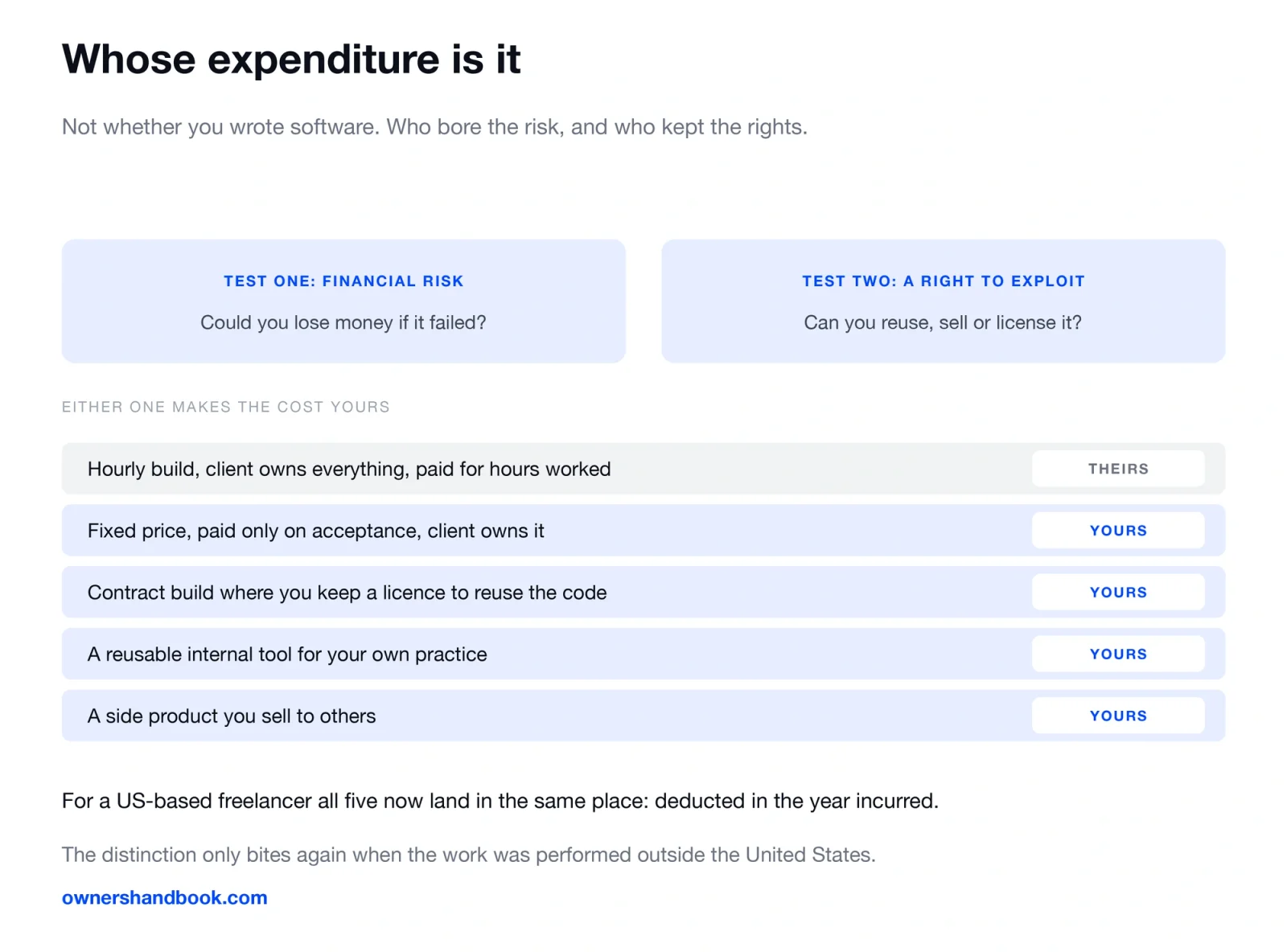
Financial risk, defined in the notice as “the risk that the research provider may suffer a financial loss related to the failure of the research to produce the desired SRE product.”
And a right to exploit the result. Even where you bear no financial risk, if you as the contractor have “a right to use any resulting SRE product in the trade or business of the research provider or otherwise exploit any resulting SRE product through sale, lease, or license”, your costs are research expenditures.
Put concretely:
| What you did | Whose expenditure | Why |
|---|---|---|
| Hourly build for a client, they own everything, you get paid for hours worked | Theirs, not yours | No financial risk on you, no rights retained |
| Fixed-price build where you are paid only on acceptance, client owns everything | Arguably yours | You bear the risk of failure |
| Contract build where you keep a licence to reuse the code | Yours | You retain a right to exploit |
| Reusable internal tool you built for your own practice | Yours | Your own development, for your own trade or business |
| Side product you sell to others | Yours | Unambiguously your own development |
For a US-based freelancer, all five rows now land in the same place: deducted in the year incurred, either as an ordinary business expense under section 162 or as a domestic research expenditure under section 174A. That is why this was a serious problem for 2022 through 2024 and is a bookkeeping question from 2025 onward. The distinction only bites again if the work is foreign.
A caveat worth stating plainly: Notice 2023-63 was issued under the former section 174, and Treasury has not yet published regulations applying these concepts to section 174A. The notice is the best available statement of the framework, not a rule written for the current section.
What you can still do about 2022 through 2024
The enacting act gave small businesses a route to go back and fix it, and that route has closed.
Eligible small taxpayers could elect to apply section 174A retroactively to tax years beginning after 31 December 2021, by filing amended returns. The election had to be made within one year of enactment. Revenue Procedure 2025-28 fixed the date precisely:
Because July 4, 2026, is a Saturday, the election under OBBBA § 70302(f)(1)(A) must be made by Monday, July 6, 2026.
That date has passed. If you did not make the election, retroactive amendment is no longer available to you.
What remains is the second route, and it is still live. If you actually capitalised research costs for 2022 through 2024, you may elect to recover the remaining unamortised amount either in full in your first tax year beginning after 31 December 2024, or rateably across that year and the next. It is treated as an automatic change in method of accounting made with the Secretary’s consent, applied on a cut-off basis with no section 481(a) adjustment.
The honest problem is that most solo developers never capitalised anything, so there is no unamortised balance to recover — they simply deducted everything and moved on. Whether that leaves an exposure worth raising with a preparer depends on the amounts and on whether the years are still open. That is a conversation to have with someone looking at your actual returns, not a thing to decide from an article.
What a developer deducts without any of this
The routine costs are unaffected by section 174A and are ordinary business expenses.
| Cost | Where to look |
|---|---|
| Laptops, monitors, keyboards, test devices | Writing off equipment |
| Cloud, hosting, domains, CI minutes | Schedule C, ordinary expense |
| IDEs, APIs, design tools, AI subscriptions | Schedule C, ordinary expense |
| A room used regularly and exclusively for work | Home office deduction |
| Contractors, designers, fractional help | Freelance tax deductions |
The business code for the return is 541510, Computer systems design and related services — see Schedule C business codes. Keep invoices split by where work was performed; our note on record keeping covers what to retain and for how long. Because nothing is withheld from what clients pay you, see quarterly estimated taxes and the self-employment tax guide.
This post is about how development costs are treated. The money coming the other way — subscription revenue, app store payouts, platform reporting — is covered in app and SaaS revenue taxes.
Frequently asked questions
Does section 174A apply if I only build for clients and never for myself?
Usually not in any way you would notice. If you are paid for hours worked, bear no risk of failure and keep no rights in the result, your costs are ordinary business expenses under section 162 and always were.
I spent nothing but my own time. Is there anything to capitalise?
Your own unpaid time is not an expenditure. You cannot deduct the value of your labour, so there is nothing to spread. This matters most for people who paid contractors, bought infrastructure, or hired designers.
What if my contractor is in another country?
Then that portion is foreign research and stays under section 174 with a fifteen-year amortisation period. Split the invoices by where the work was performed and keep the evidence.
Is an R&D credit involved?
Section 41 is a separate credit with its own qualification rules and its own paperwork, and claiming it interacts with what you deduct under section 174A. It is worth asking about if your development spend is substantial.
I deducted everything for 2023 and never capitalised. What now?
Take it to a preparer with the returns in front of them. The retroactive small-business election closed on 6 July 2026, and what is left depends on the amounts and which years remain open.
Does electing the 60-month amortisation ever make sense?
Occasionally — if you are in a loss year and the deduction would be wasted, spreading it forward can be worth more than taking it now. It is an election you must make by the return’s due date including extensions, and it binds you for later years.
Sources
26 U.S. Code § 174A, Domestic research or experimental expenditures
https://www.law.cornell.edu/uscode/text/26/174A
26 U.S. Code § 174, Amortization of research and experimental expenditures
https://www.law.cornell.edu/uscode/text/26/174
26 U.S. Code § 41, Credit for increasing research activities
https://www.law.cornell.edu/uscode/text/26/41
IRS, Notice 2023-63, Guidance on amortization of specified research or experimental expenditures
https://www.irs.gov/pub/irs-drop/n-23-63.pdf
IRS, Revenue Procedure 2025-28
https://www.irs.gov/pub/irs-drop/rp-25-28.pdf
IRS, Instructions for Schedule C (Form 1040)
https://www.irs.gov/pub/irs-pdf/i1040sc.pdf
IRS, Instructions for Forms 1099-MISC and 1099-NEC