Cost of Goods Sold on Schedule C
Part III of Schedule C is ten lines on the back of the page, and for most people reading this they all stay blank. So does line 4 on the front. That is the correct answer, not a shortcut, and the IRS says so in Publication 334: “You don’t have to figure the cost of goods sold if the sale of merchandise is not an income-producing factor for your business.”
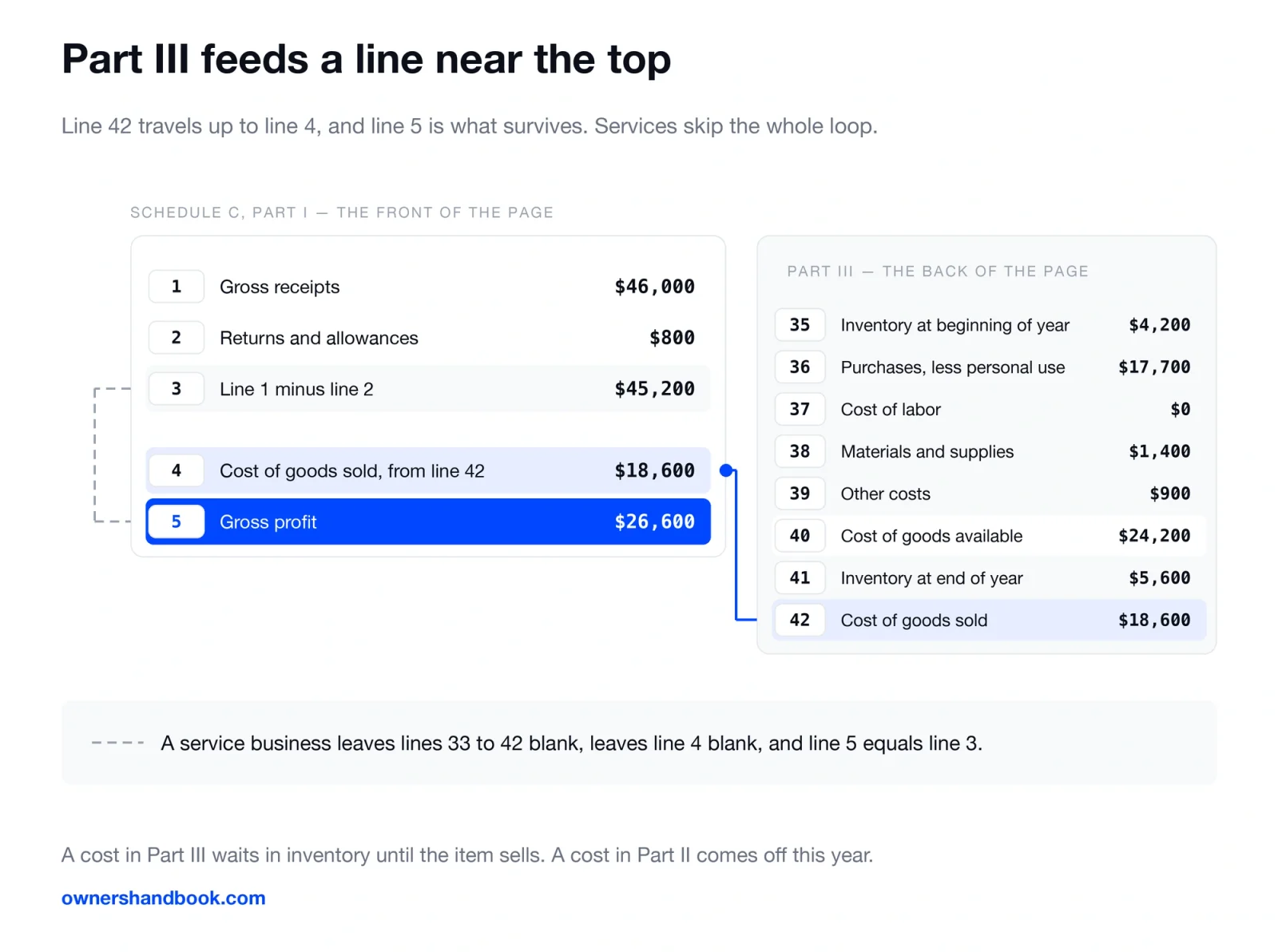
If you do sell goods, Part III is where what those goods cost you comes out of what you were paid for them. It is also the only part of Schedule C whose answer travels *upward* — line 42 feeds line 4 near the top of the form, which is why people filling the page in order hit line 4 before they have any way to answer it.
This walks the 2025 Schedule C. The line numbers in Part III are unchanged on the 2026 draft form. Where every other line on the page goes is covered in the full walkthrough of Schedule C; this is only Part III and the one line it feeds.
Why blank is the right answer for most of this site’s readers
Publication 334 draws the boundary by trade, not by revenue:
This chapter applies to you if you are a manufacturer, wholesaler, or retailer or if you are engaged in any business that makes, buys, or sells goods to produce income. This chapter does not apply to a personal service business, such as the business of a doctor, lawyer, carpenter, or painter.
A designer, a writer, a developer, a consultant, a photographer selling shoots rather than prints — all personal service businesses. Part III is not yours. Your line 3 and your line 5 are the same number, because nothing comes out in between.
There is one condition attached, and it catches a few people: “However, if you work in a personal service business and also sell or charge for the materials and supplies normally used in your business, this chapter applies to you.” A photographer who sells framed prints has merchandise. A photographer who bills a day rate does not.
The test the Schedule C instructions use is one clause, and it is the whole question: “if you engaged in a trade or business in which the production, purchase, or sale of merchandise was an income-producing factor, you must take inventories into account at the beginning and end of your tax year.” Merchandise, and an income-producing factor — not “I bought some things for work.”
Part III, lines 33 through 42
| Line | What the form says | What to enter |
|---|---|---|
| 33 | Method(s) used to value closing inventory: Cost / Lower of cost or market / Other | Check Cost unless you have a reason not to |
| 34 | Was there any change in determining quantities, costs, or valuations between opening and closing inventory? | No, in a normal year. “Yes” needs an attached explanation |
| 35 | Inventory at beginning of year | Last year’s closing inventory. A difference needs an explanation |
| 36 | Purchases less cost of items withdrawn for personal use | What you bought to sell, minus what you kept |
| 37 | Cost of labor. Do not include any amounts paid to yourself | Usually $0. See below |
| 38 | Materials and supplies | Used in making the goods |
| 39 | Other costs | Freight-in, containers, production overhead |
| 40 | Add lines 35 through 39 | Cost of goods available for sale |
| 41 | Inventory at end of year | What is still on the shelf on December 31 |
| 42 | Cost of goods sold. Subtract line 41 from line 40 | Goes to line 4 |
Lines 36 through 39 are where the judgment lives
Line 36 has two reductions built in. Trade discounts come off, because “you must use the prices you pay (not the stated prices) in figuring your cost of purchases.” And merchandise you took for yourself comes off: “If you withdraw merchandise for your personal or family use, you must exclude this cost from the total amount of merchandise you bought for sale.”
Line 37 carries a prohibition printed on the form: “Do not include any amounts paid to yourself.” A sole proprietor cannot charge their own labor to cost of goods sold, any more than they can pay themselves a salary and deduct it. Publication 334 narrows it further: “Labor costs are usually an element of cost of goods sold only in a manufacturing or mining business. Small merchandisers (wholesalers, retailers, etc.) usually do not have labor costs that can properly be charged to cost of goods sold.”
Line 38’s qualifier decides everything: “Materials and supplies, such as hardware and chemicals, used in manufacturing goods are charged to cost of goods sold. Those that are not used in the manufacturing process are treated as deferred charges. You deduct them as a business expense when you use them.” The same box of supplies lands in Part III or Part II depending on whether it goes into the product.
Line 39 holds the costs people forget. Publication 334 names them: freight-in, express-in and cartage-in on raw materials and merchandise bought for sale; containers and packages “that are an integral part of the product manufactured”; and manufacturing overhead — “rent, heat, light, power, insurance, depreciation, taxes, maintenance, labor, and supervision” — where those are direct and necessary expenses of the manufacturing operation.
Packaging has a seam in it. A box that is part of the product is line 39. A shipping mailer is not: “If they are not an integral part of the manufactured product, their costs are shipping or selling expenses.”
What belongs in Part III, and what belongs in Part II
| What you paid for | Where it goes | Why |
|---|---|---|
| Inventory you bought to resell | 36 | Merchandise |
| Raw materials that become the product | 38 | Used in making the goods |
| Freight to get materials to you | 39 | Freight-in |
| Printed boxes the product ships inside as part of itself | 39 | Integral to the product |
| Plain shipping mailers and postage | Part II, 18 office expense | Selling expense, not product cost |
| Etsy or Shopify fees | Part V, then 27b | Platform fee, not product cost |
| Your own time making the product | Nowhere | Line 37 forbids it |
| A $900 camera you use to shoot the products | Part II, 13 or 22 | Equipment, not inventory |
| Studio rent | Part II, 20b | Not a manufacturing operation |
The distinction that actually matters is timing, not category. A cost in Part III sits in inventory until the item sells. A cost in Part II comes off this year. That is the entire difference, and it is why the IRS cares which side things land on.
A worked example, start to finish
A seller with $46,000 of receipts, $800 of refunds for damaged items, $4,200 of inventory on hand January 1, $18,000 of purchases for resale, $300 of that taken for personal use, $1,400 of materials that go into the products, $900 of freight-in and integral packaging, and $5,600 of inventory left on December 31.
| Line | Figure |
|---|---|
| 33. Method used to value closing inventory | Cost |
| 34. Change in method | No |
| 35. Inventory at beginning of year | $4,200 |
| 36. Purchases less personal withdrawals | $17,700 |
| 37. Cost of labor | $0 |
| 38. Materials and supplies | $1,400 |
| 39. Other costs | $900 |
| 40. Add lines 35 through 39 | $24,200 |
| 41. Inventory at end of year | $5,600 |
| 42. Cost of goods sold | $18,600 |
Now the front of the form, where that number lands.
| Line | Figure |
|---|---|
| 1. Gross receipts | $46,000 |
| 2. Returns and allowances | $800 |
| 3. Subtract line 2 from line 1 | $45,200 |
| 4. Cost of goods sold, from line 42 | $18,600 |
| 5. Gross profit | $26,600 |
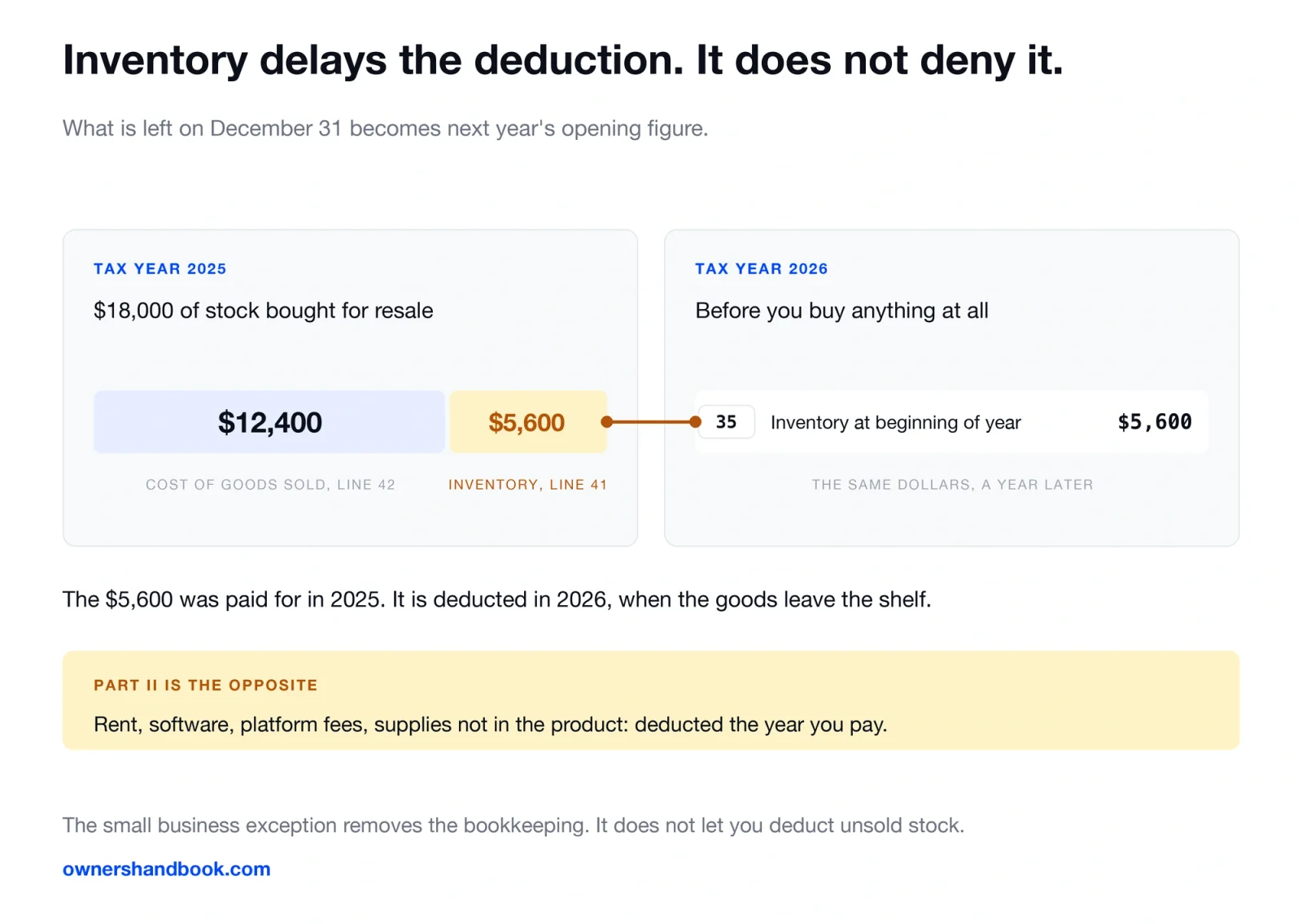
Note what line 41 did. The $5,600 still on the shelf never became an expense this year, even though you paid for it this year. It becomes line 35 next January. That is the only mechanism on this page, and it is why a big year of buying stock does not produce a deduction until the stock sells.
Now run it again as a service freelancer — same $46,000 of receipts, no merchandise. Lines 33 through 42 are blank, line 4 is blank, and line 5 equals line 3 at $45,200. The expenses that would have sat in inventory are ordinary Part II deductions, taken the year you pay them.
The small-business exception, and what it actually changes
There is a statutory escape from inventory accounting, and every reader of this site is inside it. Section 471(c):
In the case of any taxpayer (other than a tax shelter…) which meets the gross receipts test of section 448(c) for any taxable year — (A) subsection (a) shall not apply with respect to such taxpayer for such taxable year, and (B) the taxpayer’s method of accounting for inventory for such taxable year shall not be treated as failing to clearly reflect income if such method either — (i) treats inventory as non-incidental materials and supplies, or (ii) conforms to such taxpayer’s method of accounting reflected in an applicable financial statement.
The Schedule C instructions give the threshold: “You qualify as a small business taxpayer if you (a) have average annual gross receipts of $31 million or less for the 3 prior tax years (indexed for inflation), and (b) are not a tax shelter (as defined in section 448(d)(3)).”
The exception buys less than it sounds like. The instructions: “If you are a small business taxpayer, you can choose not to keep an inventory, but you must still use a method of accounting for inventory that clearly reflects income.” And the non-incidental materials and supplies treatment still waits for the goods to move: “you deduct the amounts paid to acquire or produce the inventoriable items (treated as materials and supplies) in the year in which they are first used or consumed in your operations.”
First used or consumed. Not when you paid. The exception removes the bookkeeping of valuing inventory; it does not let you deduct unsold stock.
Two related exceptions sit nearby. A small business taxpayer “is not required to capitalize certain expenses to inventory or other property” under the uniform capitalization rules. And one is written for this audience specifically: “If you are a freelance artist, author, or photographer, you may be exempt from the capitalization rules. However, your personal efforts must have created (or reasonably be expected to create) the property.” That exemption stops at “any expense related to printing, photographic plates, motion picture films, videotapes, or similar items.”
Switching how you account for inventory is a change in accounting method, not a different answer on a line. The instructions point at Form 3115 and a section 481(a) adjustment, with a net positive adjustment “generally taken into account over a period of 4 years.”
What trips people up
Putting platform fees in Part III. Etsy’s cut, Shopify’s subscription and payment processing are not product costs. They go in Part V and total up to line 27b, and that is also where most sellers leave money behind.
Deducting everything you bought. Line 41 exists to stop that. Stock you still hold on December 31 is not an expense yet.
Charging your own labor to line 37, or filling the page in order. The form prints the first prohibition on the line itself, and line 4 cannot be answered until line 42 exists. Do Part III first.
Confusing line 2 with line 41. Returns and allowances are refunds you gave on sales. Closing inventory is goods you still own. Unrelated numbers that both reduce the result.
Treating digital goods as inventory. A file you sell a thousand copies of has no closing inventory to value. Creator income and app or SaaS revenue are receipts with ordinary expenses against them, not merchandise.
Leaving box B blank because Part III is blank. They are unrelated. Box B still needs the right six-digit code, and a service business has one.
Frequently asked questions
Where exactly does cost of goods sold go on Schedule C?
Two places, in this order. You figure it in Part III on page 2, lines 35 through 42. Then you copy line 42 to line 4 on page 1, where it is subtracted from line 3 to give gross profit on line 5.
I sell services only. Do I leave Part III blank or enter zero?
Blank. Publication 334 is explicit that you do not have to figure cost of goods sold when merchandise is not an income-producing factor, and line 5 then simply equals line 3.
I buy supplies but do not resell anything. Is that inventory?
No. Supplies you consume doing the work are ordinary business deductions in Part II — line 22 for supplies, line 18 for office expense. Inventory means goods held for sale.
Does the small-business exception let me deduct unsold stock?
No. It lets you skip valuing inventory, then deducts the cost “in the year in which they are first used or consumed.” Unsold stock is neither.
What if I sell on a platform that also handles fulfillment?
The goods are still yours until they sell, so Part III still applies, and the platform’s fees are a Part V expense. Platform-by-platform reporting is a separate question from how the goods are costed.
How much proof do I need for the inventory figures?
Enough to reproduce line 35 and line 41 from your own records — a count on December 31 with the cost next to each item. That is the kind of thing that matters most if the return is ever questioned: see record keeping and what actually draws attention.
Sources
IRS, Schedule C (Form 1040), Profit or Loss From Business, 2025
https://www.irs.gov/pub/irs-pdf/f1040sc.pdf
IRS, Instructions for Schedule C (Form 1040), 2025
https://www.irs.gov/pub/irs-pdf/i1040sc.pdf
IRS, Publication 334, Tax Guide for Small Business, 2025
https://www.irs.gov/pub/irs-pdf/p334.pdf
26 U.S.C. § 471(c), Exemption for certain small businesses
https://www.law.cornell.edu/uscode/text/26/471
26 U.S.C. § 448(c), Gross receipts test
https://www.law.cornell.edu/uscode/text/26/448
IRS, Instructions for Schedule C (HTML edition)