Raise Your W-4 Instead of Paying Quarterly Taxes
If you have a job alongside your freelance work, you can cover the tax on the freelance income by raising the withholding on the job instead of sending quarterly payments. That much is widely known. What is not widely known is that the two methods are not treated the same way in time — and the difference runs in your favour.
Withholding is credited as though it were spread evenly across the whole year, no matter which month it actually came out of your pay. An estimated payment is credited when you send it. So extra withholding taken in December can repair a shortfall from April. A cheque posted in December cannot.
The rule, in the form’s own words
This is not folklore. It is printed in the instructions to the form that calculates the underpayment penalty:
For withheld federal income tax and excess social security or tier 1 RRTA, you are considered to have paid one-fourth of these amounts on each payment due date unless you can show otherwise.
One-fourth on each due date. If you withhold an extra $4,000 entirely in the last two months of the year, the penalty calculation treats $1,000 of it as having arrived in April, $1,000 in June, $1,000 in September and $1,000 in January.
Estimated payments get no such treatment. The same instructions say so directly:
The penalty is figured separately for each installment due date. Therefore, you may owe the penalty for an earlier due date even if you paid enough tax later to make up the underpayment.
That is the whole contrast in two sentences. Four separate periods — for 2026 they close on 15 April, 15 June, 15 September and 15 January 2027 — and paying double in September does not unmake a missed April. Withholding is the one payment method the calculation treats as having arrived on time.
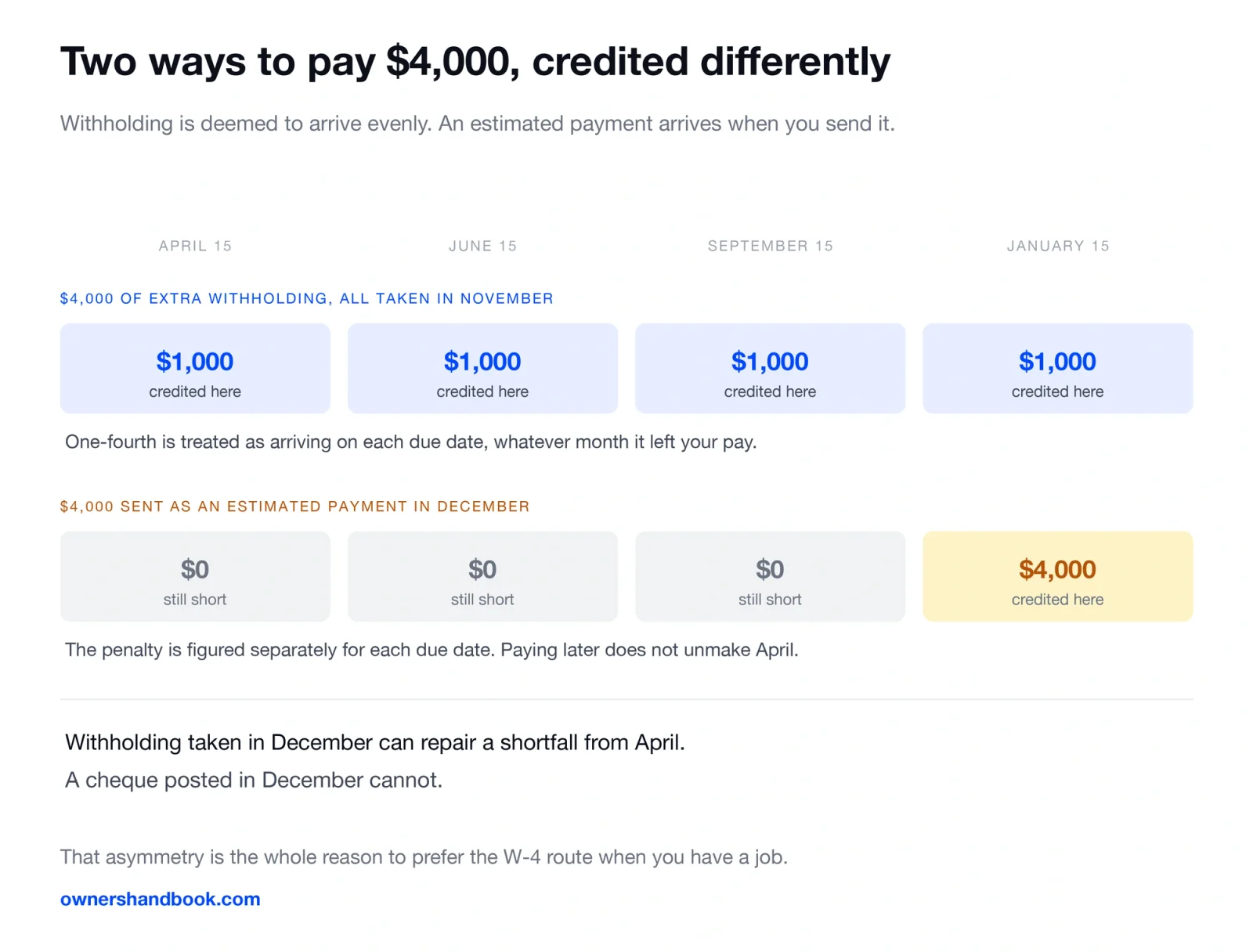
That asymmetry is the whole reason to prefer the W-4 route. Our guide to missed estimated payments covers the repair from the other direction.
The line on the form
On the 2026 Form W-4 it is Step 4(c), and its printed label is exactly this:
Extra withholding. Enter any additional tax you want withheld each pay period
Per pay period. Not per year. This is the single most common mistake — entering the annual figure and having ten times that withheld.
There are two other lines in Step 4 and they do different jobs:
| Line | What it does | Use it when |
|---|---|---|
| Step 4(a) | Other income (not from jobs) | You want the employer to gross up withholding for freelance profit automatically |
| Step 4(b) | Deductions | You expect deductions beyond the standard deduction |
| Step 4(c) | Extra withholding each pay period | You have worked out a dollar figure yourself |
Step 4(a) is the gentler option: you enter your expected freelance profit and the employer’s tables handle the rest. It has one blind spot — it accounts for income tax, not self-employment tax. The form itself points people with self-employment income to the IRS Tax Withholding Estimator for precisely that reason.
Step 4(c) is the one to use when you have done the arithmetic. Which is worth doing.
Working backwards to the number
Take a single filer with a $70,000 salary and $30,000 of freelance profit.
Self-employment tax comes first. Schedule SE multiplies net profit by 92.35%, then applies 12.4% for Social Security and 2.9% for Medicare — 15.3% combined.
| Step | Figure |
|---|---|
| $30,000 × 92.35% | $27,705 |
| × 15.3% | $4,239 |
| Deduction for one-half of that tax | $2,119 |
| Freelance profit added to taxable income | $27,881 |
| Income tax at a 22% marginal rate | $6,134 |
| Total to cover | $10,373 |
The 22% is not a guess. With a $16,100 standard deduction, a $70,000 salary lands taxable income in the band running from $50,400 to $105,700 for 2026, and $27,881 of extra profit does not leave it.
This example ignores the qualified business income deduction, which would reduce the income tax portion. Treat $10,373 as a ceiling, not a target.
Now divide by pay periods. Paid twice a month, from a standing start in January, that is $10,373 ÷ 24 = $432 on Step 4(c).
Starting in September with eight pay periods left, it is $10,373 ÷ 8 = $1,297 per period — and the even-spreading rule means those eight late payments are still credited as four timely quarters.
If you would rather check the figure a second way, the quarterly tax calculator works out the same number.
How much is enough
You do not have to cover the tax exactly. You have to clear one of three bars, and the lowest one wins.
| Bar | What it requires |
|---|---|
| The de minimis one | You owe less than $1,000 after withholding and refundable credits |
| Current year | Withholding and estimated tax of at least 90% of this year’s tax |
| Prior year | 100% of the tax shown on last year’s return |
There is a fourth line to know: if your adjusted gross income for the prior year was more than $150,000 — $75,000 if you file married filing separately — the prior-year bar rises to 110%.
The prior-year bar is usually the cheapest and always the most certain, because the number is already printed on a return you have. Set Step 4(c) to hit that, and the penalty becomes arithmetically impossible whatever this year turns into. The full mechanics are in quarterly estimated taxes, and first-year quarterly taxes covers why a first year can be a special case.
Where this fails
The method has one hard limit, and it is a plumbing limit rather than a tax one.
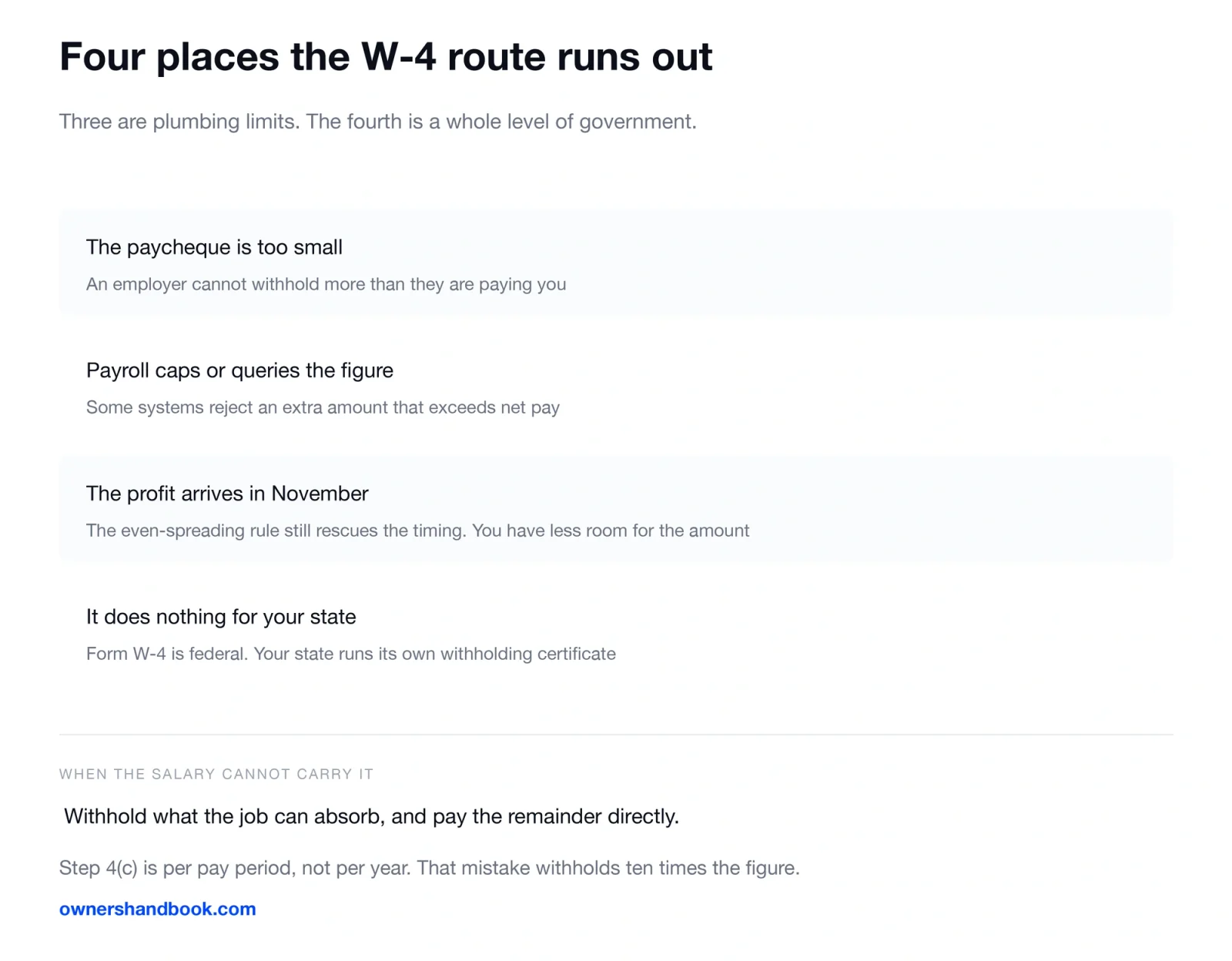
Your paycheque has to be big enough. An employer cannot withhold more than they are paying you. Salary $30,000, freelance profit $60,000, and the tax on the freelance side exceeds what the job nets out across the whole year. There is nothing to take it from.
The failure is sharper late in the year, because the annual figure is being squeezed into fewer periods. A number that works comfortably over 24 pay periods can be larger than a single cheque over four.
Payroll may cap or query it. Some systems reject an extra-withholding figure that exceeds net pay, and some payroll teams ask questions before processing an unusual one. Submit the new W-4 with enough time to find out.
Irregular income breaks the planning, not the rule. If your freelance profit arrives in one lump in November, you may not know the number until most pay periods are gone. The even-spreading rule still rescues the timing — you just have less room to fit the amount.
When the salary cannot carry it, the answer is a split: withhold what the job can absorb and pay the remainder directly. How to pay estimated taxes covers the mechanics of the direct payment.
The married version, which is simpler than people expect
On a joint return there is one tax, one total of payments, and no attribution of either to a particular spouse. Withholding from either salary counts toward the couple’s liability. It does not matter whose freelance income created the obligation.
So if one spouse freelances and the other has the larger salary, put the extra withholding on the larger salary. It has the capacity, and the credit lands in the same place.
Do check Step 2 on the W-4 while you are in there. Two-earner couples are systematically under-withheld by default, because each employer’s tables assume theirs is the only income. That gap is separate from the freelance gap, and it stacks with it.
It does nothing for your state
This is the part that gets skipped, and it produces a clean federal result alongside a state bill.
Form W-4 is a federal form. It directs federal income tax withholding and nothing else. Your state’s withholding runs on its own certificate — a separate form, filed separately with the same employer.
Most states with an income tax have their own estimated payment schedule and their own underpayment penalty. Raising Step 4(c) to cover a $30,000 profit federally leaves the state tax on that same $30,000 entirely unpaid.
Find your state’s withholding certificate, file it alongside the W-4, and raise both.
One nuance worth knowing about the even-spreading rule
The one-fourth treatment is a default, not a cage. If you front-loaded your withholding early in the year — a large bonus in February, say — the even-spreading assumption can work against you by pretending some of it arrived later than it did.
You can elect out. The instructions to Form 2210 provide for it:
If you treat withholding as paid on the dates it was actually withheld for estimated tax purposes, you must check box D in Part II and complete and attach Form 2210 to your return.
For almost everyone using the strategy in this post, the default is the better deal and you should leave it alone. Know the election exists for the year when it is not.
Frequently asked questions
Do I enter the annual amount on Step 4(c)?
No. It is per pay period. Divide your target by the number of pay periods remaining in the year.
Is this genuinely better than paying quarterly?
For most people with a steady job, yes. It is harder to forget, it needs no diary entry, and it carries the timing advantage described above. Quarterly payments are better when your salary is too small to carry the tax, or when you want to keep the two streams visibly separate.
Can I fix a missed April payment by raising withholding now?
That is precisely what the one-fourth rule allows. Withholding in the remaining pay periods is credited across all four due dates, including ones that have passed.
Does the extra withholding cover self-employment tax?
Yes. Withholding is credited against your total tax liability on Form 1040, and self-employment tax is part of that total. The label on the withholding does not restrict what it pays.
How often can I change my W-4?
As often as you like. Employers must put a new one into effect within a set period, so submit it with time to spare if the year is nearly over.
What if I over-withhold?
You get it back as a refund. There is no penalty for withholding too much — only the cost of having lent the money interest-free.
Do I still file Schedule C and Schedule SE?
Yes. Withholding changes how the tax gets paid, not what gets reported. The freelance income still goes through Schedule C and Schedule SE.
Sources
IRS, 2026 Form W-4, Employee’s Withholding Certificate
https://www.irs.gov/pub/irs-pdf/fw4.pdf
IRS, Instructions for Form 2210, Underpayment of Estimated Tax by Individuals
https://www.irs.gov/instructions/i2210
IRS, Topic no. 306, Penalty for underpayment of estimated tax
https://www.irs.gov/taxtopics/tc306
IRS, Form 1040-ES, Estimated Tax for Individuals (2026)
https://www.irs.gov/pub/irs-pdf/f1040es.pdf
IRS, Schedule SE (Form 1040), Self-Employment Tax
https://www.irs.gov/pub/irs-pdf/f1040sse.pdf
IRS, Self-employment tax (Social Security and Medicare taxes)
IRS, Revenue Procedure 2025-32 (inflation adjustments for tax year 2026)
https://www.irs.gov/pub/irs-drop/rp-25-32.pdf
IRS, Tax Withholding Estimator