No Tax on Tips, If You’re Self-Employed
The tips deduction reaches the self-employed. That part of the general coverage is right. What almost none of it says is where the deduction lands on your return, and the location is the whole story: it comes off after your adjusted gross income is already settled, so it cannot touch the 15.3% you pay in self-employment tax. A barber tipped $9,000 pays the same self-employment tax with the deduction as without it.
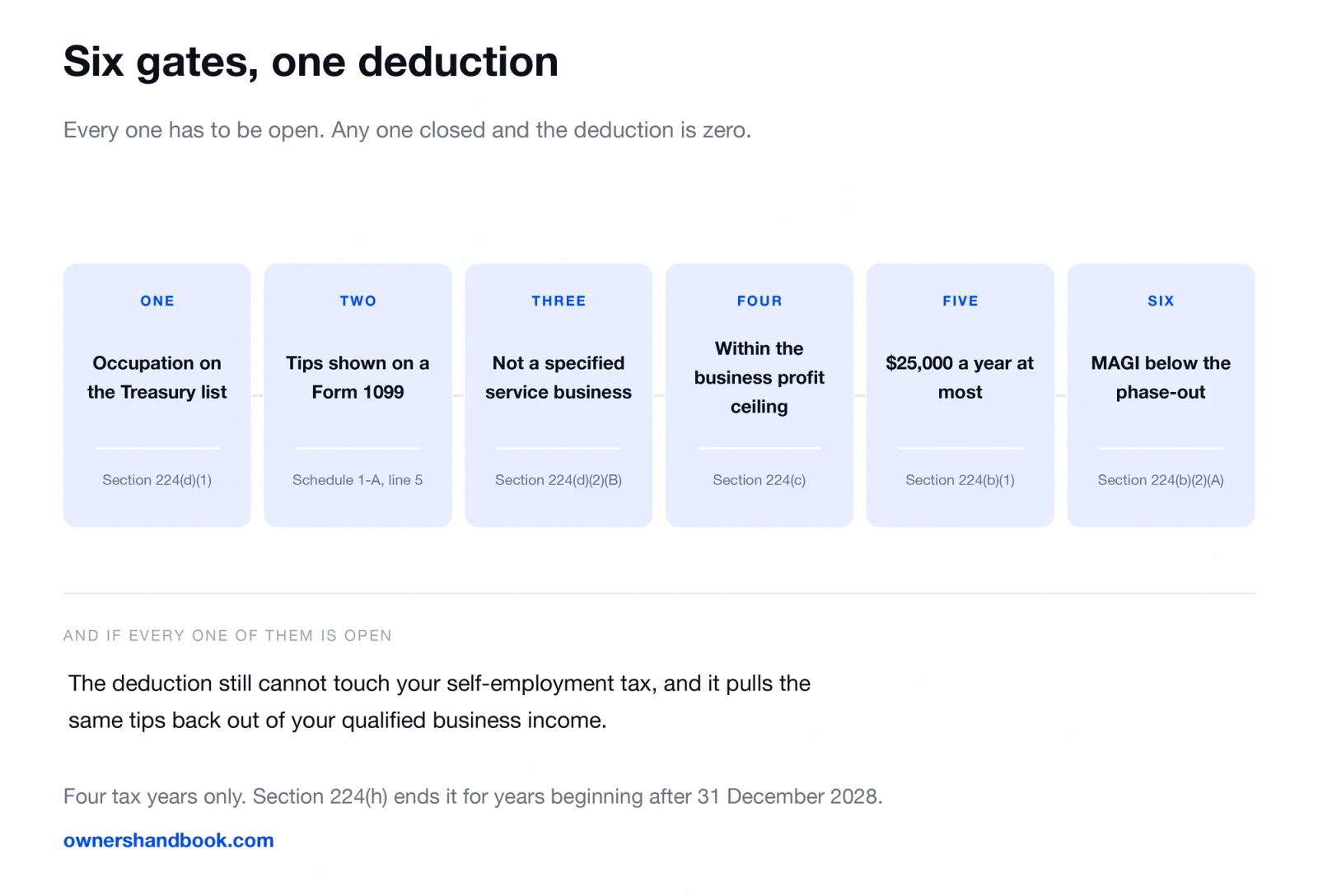
The income tax saving is real but smaller than $9,000, because a second rule pulls deducted tips out of your qualified business income. And three gates decide whether you get anything: your occupation has to be on a Treasury list, the tips have to appear on a Form 1099, and the deduction cannot exceed what the tipped business actually earned. Here is each, from the statute and the form.
Where the deduction sits on the return
Section 70201 of Public Law 119-21 created a new section 224 of the tax code. Its first sentence sets up everything that follows:
There shall be allowed as a deduction an amount equal to the qualified tips received during the taxable year that are included on statements furnished to the individual pursuant to section 6041(d)(3), 6041A(e)(3), 6050W(f)(2), or 6051(a)(18), or reported by the taxpayer on Form 4137 (or successor).
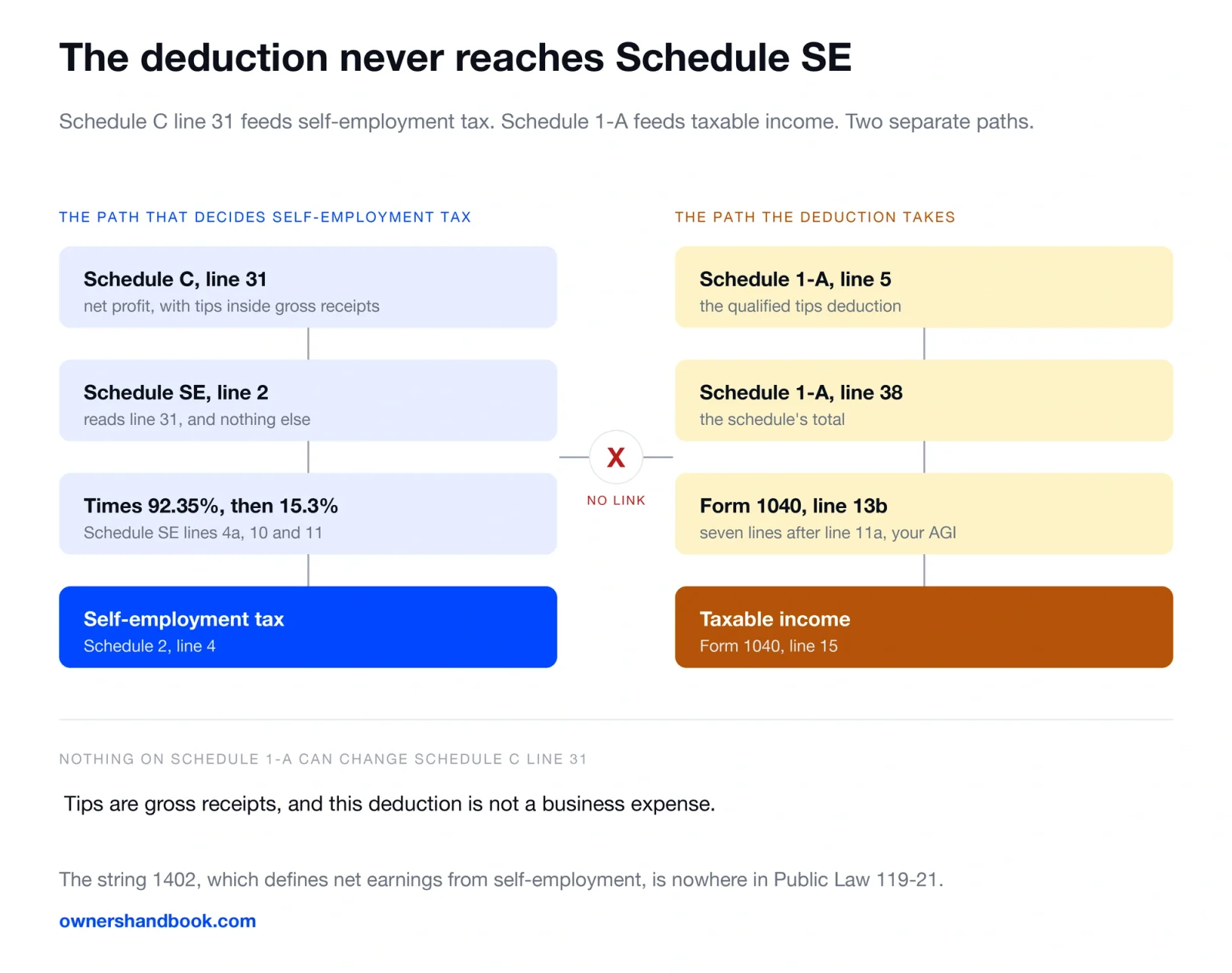
You claim it on Schedule 1-A, a new schedule. Part II is the tips part, and line 5 is the line for the self-employed. Schedule 1-A line 38 carries to Form 1040 line 13b. Your adjusted gross income is line 11a, seven lines earlier.
That placement matters twice. It is why the deduction does not reduce AGI, so it cannot help you clear anything keyed to AGI. And it is why self-employment tax is untouched.
It is available whether or not you itemize. Section 70201(b) added section 224 to the list in section 63(b), so it sits alongside the standard deduction the way the qualified business income deduction does.
Why your self-employment tax does not move
Follow the forms rather than the argument.
| Step | Form and line | What enters |
|---|---|---|
| Net profit | Schedule C, line 31 | Gross receipts, including tips, minus business expenses |
| Self-employment tax base | Schedule SE, line 2 | Net profit or (loss) from Schedule C, line 31 |
| Multiply by 92.35% | Schedule SE, line 4a | — |
| Multiply by 15.3% | Schedule SE, lines 10 and 11 | — |
| Qualified tips deduction | Schedule 1-A, line 5 → Form 1040, line 13b | Never reaches Schedule SE |
Schedule SE line 2 reads your Schedule C profit. Nothing on Schedule 1-A can change Schedule C line 31, because tips are gross receipts and this deduction is not a business expense.
There is a cleaner confirmation. The string “1402” — the code section defining net earnings from self-employment — appears nowhere in the 331 pages of Public Law 119-21. The Act never amended the self-employment tax base.
The IRS page on the deduction does not mention self-employment tax at all. That silence is not permission. A business expense cuts both taxes; this one cuts a single tax, for the same structural reason set out in business expenses are not itemized deductions.
Your occupation has to be on Treasury’s list
Section 224(d)(1) defines qualified tips as cash tips received “in an occupation which customarily and regularly received tips on or before December 31, 2024, as provided by the Secretary.” Section 70201(h) gave Treasury 90 days to publish that list, and it exists: the IRS publishes it as the Treasury Tipped Occupation Codes, on a page dated 28 June 2026, with a three-digit code per occupation. These are the entries that matter here.
| Code | Occupation |
|---|---|
| 209 | Digital content creators |
| 503 | Private event and portrait photographers |
| 504 | Private event videographers |
| 507 | Tutors |
| 601 | Skincare specialists |
| 602 | Massage therapists |
| 603 | Barbers, hairdressers, hairstylists, and cosmetologists |
| 605 | Manicurists and pedicurists |
| 606 | Eyebrow and eyelash technicians |
| 607 | Makeup artists |
| 608 | Exercise trainers and group fitness instructors |
| 609 | Tattoo artists and piercers |
| 802 | Taxi and rideshare drivers and chauffeurs |
| 804 | Goods delivery people |
Code 209 deserves a second look. Digital content creators are on the list, which puts tips, donations and live-stream gratuities inside section 224 for anyone filing creator income taxes. Codes 802 and 804 cover the platform drivers, and the Form 1040 instructions use a rideshare driver as one of their own worked examples. The personal appearance codes, with the booth-rent arrangement that usually comes with them, are covered in hairstylist and booth renter taxes.
What is absent is equally informative. There is no code for writing, design, development, bookkeeping, consulting or marketing. If your work is billed on an invoice rather than a tip line, this deduction is not for you.
Only tips that appear on a 1099 count
This rule will disqualify more self-employed people than any other, and it is almost never mentioned.
Schedule 1-A line 5 states what belongs on it: “Qualified tip amount included in Form 1099-NEC, box 1; Form 1099-MISC, box 3; or Form 1099-K, box 1a.” The worksheet behind it has columns for 1099s and nothing else. The Form 1040 instructions say it outright, in a tip box beside a self-employed tour guide example:
Only amounts that appear in the aggregate on Forms 1099 can be considered qualified tips. Any “cash tips” received by the tour guide in actual cash that don’t appear on Form 1099-K cannot be included in the deduction.
Read that against how tipping actually works. A client who hands you a $20 bill has generated no information return. That tip is taxable income and it is not deductible under section 224. The same $20 added to a card payment is deductible, because the processor’s Form 1099-K picks it up in box 1a. Same money, different outcome, decided by how the customer paid.
For 2025 there is transition relief, because the 1099 forms had no separate tip box yet: the requirement is treated as satisfied if the tips are inside the total reported on one of those forms, and you substantiate the tip portion yourself. The 2026 forms are being updated to break cash tips out. Either way the record is yours — the instructions name “receipts, point-of-sale system reports, daily tip logs, third party settlement organization records.” See record keeping for how long to hold them.
The ceiling is below your net profit
Section 224(c) is the provision written for the self-employed:
In the case of qualified tips received by an individual during any taxable year in the course of a trade or business (other than the trade or business of performing services as an employee) of such individual, such qualified tips shall be taken into account under subsection (a) only to the extent that the gross income for the taxpayer from such trade or business for such taxable year (including such qualified tips) exceeds the sum of the deductions (other than the deduction allowed under this section) allocable to the trade or business in which such qualified tips are received.
General coverage renders that as “limited to your net income.” The instructions are more specific, and the specifics cost money:
Qualified tips from a trade or business can’t be more than the gross income from the trade or business in which the qualified tips were received minus the total of all deductions allocable to that trade or business, including the deductible part of self-employment tax; the deduction for contributions to self-employed SEP, SIMPLE, and qualified plans; and the self-employed health insurance deduction, but not including the deduction for qualified tips.
The ceiling is not Schedule C line 31. It is line 31 less the deductible half of your self-employment tax, less your retirement plan contributions, less your health insurance deduction. Funding a SEP IRA lowers the ceiling on your tips deduction.
It applies business by business. The instructions’ rideshare example: $1,800 of qualified tips, $15,000 gross, $14,000 of expenses, a $1,000 ceiling, $800 of tips lost. A loss year produces no deduction at all.
The cap, the phase-out, and four other conditions
Section 224(b)(1) sets the maximum at $25,000. Section 224(b)(2)(A) phases it down “by $100 for each $1,000 by which the taxpayer’s modified adjusted gross income exceeds $150,000 ($300,000 in the case of a joint return).”
That is $100 per $1,000, not a percentage. Divide $25,000 by $100 and you get 250 steps of $1,000, so a full deduction reaches zero at $400,000 of MAGI, or $550,000 joint. Those two are the statutory arithmetic, not IRS-published figures.
| Condition | Authority |
|---|---|
| Maximum $25,000 | §224(b)(1) |
| Phases down $100 per $1,000 above $150,000 / $300,000 | §224(b)(2)(A) |
| Valid Social Security number on the return | §224(e) |
| Married filers must file jointly | §224(f) |
| Not a specified service trade or business | §224(d)(2)(B) |
| No deduction for tax years beginning after 31 December 2028 | §224(h) |
Section 70201(j) applies the provision to taxable years beginning after 31 December 2024; section 224(h) ends it for years beginning after 31 December 2028. Four tax years: 2025 through 2028.
The $25,000 is not indexed. Section 224 runs from subsection (a) to (h) and none of them is an inflation adjustment — which stands out, because Congress wrote an explicit annual escalator into section 164(b)(7) in the same Act. A fixed $25,000 shrinks in real terms every year it survives.
The SSTB exclusion, and who it catches
Section 224(d)(2)(B) excludes any amount unless the trade or business in which it was received “is not a specified service trade or business (as defined in section 199A(d)(2)).” It is written as an exclusion from the definition, so the tips are simply not qualified tips.
Specified service trades or businesses are the category that limits the QBI deduction at higher incomes — health, law, accounting, performing arts, consulting, athletics, financial services, brokerage. Barbering and hairdressing are not on that list. Health services are. So a massage therapist on code 602 has a question to settle that a hairstylist on code 603 does not, and so, depending on characterisation, does a trainer on code 608.
One difference in scope matters. The SSTB limitation on the QBI deduction itself only engages above $201,750 of taxable income for a 2026 single filer. The section 224 exclusion has no income threshold at all. The occupation list and the SSTB test are separate gates, and clearing the first does not open the second.
What the deduction costs you in QBI
Section 70201(d) added a new subparagraph (D) to section 199A(c)(4). Qualified business income does not include “any amount with respect to which a deduction is allowable to the taxpayer under section 224(a).”
Deduct your tips here and they leave your QBI. Here is what that is worth, on a sole proprietor barber, single, 2026, with $48,000 of profit of which $9,000 is tips in box 1a of a Form 1099-K.
| Step | Without §224 | With §224 |
|---|---|---|
| Schedule C net profit | $48,000 | $48,000 |
| Self-employment tax | $6,782 | $6,782 |
| Deductible half | −$3,391 | −$3,391 |
| Adjusted gross income | $44,609 | $44,609 |
| 2026 standard deduction, single | −$16,100 | −$16,100 |
| Qualified tips deduction | $0 | −$9,000 |
| Qualified business income | $44,609 | $35,609 |
| QBI deduction | −$5,702 | −$3,902 |
| Taxable income | $22,807 | $15,607 |
Self-employment tax is $6,782 in both columns. So is AGI. Only taxable income moves, and it moves by $7,200 rather than $9,000, because the QBI deduction fell by $1,800.
That ratio generalises for anyone taking a clean 20%. Both limbs of the QBI calculation — 20% of qualified business income, and 20% of taxable income — fall by the deducted tips, so whichever limb binds, the QBI deduction drops by 20% of the tips. A dollar of tips deduction is worth 80 cents of taxable income reduction.
At a 12% marginal rate, $9,000 of tips saves roughly $864 rather than the $1,080 the headline implies. Real money. Not what “no tax on tips” sounds like.
What it does not do
It does not make tips untaxable. Tips stay in gross receipts on Schedule C, stay in the base for self-employment tax, and stay in your quarterly estimated payments. The deduction arrives after both have been figured. It does not cover a service charge either — a mandatory 18% added to a party of six is not a tip, because the customer did not determine the amount.
If the aim is to pay less rather than to claim one named deduction, the ordinary levers are stronger, because they cut both taxes: the list in freelance tax deductions and the moves in lowering your freelance tax legally.
Frequently asked questions
Does the tips deduction reduce my self-employment tax?
No. Self-employment tax is computed on Schedule SE from Schedule C line 31. The deduction sits on Form 1040 line 13b, after adjusted gross income. Public Law 119-21 never amended section 1402.
I drive for a delivery app. Are my tips qualified?
Your occupation is — code 804 for goods delivery, code 802 for rideshare and taxi. Whether a given tip qualifies then turns on it appearing on the Form 1099-NEC or 1099-K the platform sends, and on your net income from the driving business being at least that large. Platform reporting differs by app; see taxes by platform.
My clients tip me in cash. Can I deduct that?
For a self-employed person, the Form 1040 instructions say only amounts appearing on Forms 1099 can be qualified tips, and cash appearing on no 1099 cannot be included. The cash is still taxable income.
Is the $25,000 per person or per return?
Section 224(b)(1) caps the deduction at $25,000 for the taxable year, and Schedule 1-A applies that single cap to the combined tips of both spouses. Only the phase-out threshold doubles on a joint return.
Do I have to itemize to claim it?
No. Section 70201(b) put section 224 on the section 63(b) list, so it is available alongside the standard deduction.
How long does this last?
Four tax years. Section 224(h) allows no deduction for any taxable year beginning after 31 December 2028, and the $25,000 is not indexed in between.
Sources
U.S. Government Publishing Office, Public Law 119-21, section 70201
https://www.govinfo.gov/content/pkg/PLAW-119publ21/pdf/PLAW-119publ21.pdf
IRS, What the No Tax on Tips deduction means for you
https://www.irs.gov/newsroom/what-the-no-tax-on-tips-deduction-means-for-you
IRS, Occupations that customarily and regularly received tips on or before Dec. 31, 2024
IRS, Schedule 1-A (Form 1040), Additional Deductions
https://www.irs.gov/pub/irs-pdf/f1040s1a.pdf
IRS, Instructions for Form 1040, Instructions for Schedule 1-A
https://www.irs.gov/pub/irs-pdf/i1040gi.pdf
IRS, Schedule SE (Form 1040), Self-Employment Tax
https://www.irs.gov/pub/irs-pdf/f1040sse.pdf
Legal Information Institute, 26 U.S. Code § 224
https://www.law.cornell.edu/uscode/text/26/224
Federal Register, Occupations That Customarily and Regularly Received Tips; Definition of Qualified Tips