Years Behind on Filing, and the Order to Fix It
The clock you are probably hoping will run out has not started. Section 6501 gives the IRS three years to assess tax after a return is filed — but section 6501(c)(3) says that in the case of failure to file a return, the tax may be assessed at any time. No return, no clock. A year you never filed stays open indefinitely, and filing it is what starts the three years running.
That is the central mechanic, and almost everything else follows from it. Filing an old return is not an admission. It is how a year closes.

What the statutes actually say
Four provisions cover almost every question people have about old returns. They are short, and they do different jobs.
| Provision | What it does | Period |
|---|---|---|
| § 6501(a) | Time to assess tax after a return is filed | 3 years from filing |
| § 6501(c)(3) | Time to assess when no return was filed | No limit |
| § 6502(a) | Time to collect after an assessment is made | 10 years from assessment |
| § 6511(a) | Time to claim a refund | 3 years from filing or 2 years from payment, whichever is later |
Section 6501(a) runs from filing, not from the due date. Section 6501(b)(1) treats an early return as filed on the due date, so an on-time return starts the clock in April. A return filed five years late starts it the day it arrives.
Section 6502(a) is the collection side: the tax may be collected by levy or by a proceeding in court, but only if the levy is made or the proceeding begun within 10 years after the assessment. Collection has a deadline. Assessment, for an unfiled year, does not.
One more provision surprises people. Section 6501(e)(1) gives the IRS six years instead of three if you omit more than 25% of gross income from a return you did file. That is a separate rule, and it is the one that catches an understated Schedule C.
Statute and practice are not the same thing
You will read in a lot of places that the IRS requires six years of back returns. The number is real. Its source is not a statute.
It is Policy Statement 5-133, in the Internal Revenue Manual, and the sentence is: normally, application of the above criteria will result in enforcement of delinquency procedures for not more than six (6) years. Going further back requires prior managerial approval, and so does stopping short of six.
The same statement says two other things worth having in front of you. Taxpayers failing to file will be requested to prepare and file all such returns, except where there is an indication that the failure was willful or there is any other indication of fraud. And: all delinquent returns submitted by a taxpayer, whether upon his or her own initiative or at the request of a Service representative, will be accepted.
So six years is administrative practice and can move. The three-year assessment period and the ten-year collection period are statutes and cannot. Any article presenting all three as the same kind of rule is blurring something important.
Which year first, and why
The order is not arbitrary, because only one of these deadlines is actually running against you.
First, the years where a refund is still live. Section 6511 is the only hard deadline here, and it closes on its own schedule whether or not anyone contacts you.
Second, any year the IRS has already assessed. A notice showing a balance for a year you never filed means the IRS built that number itself. Filing the real return replaces it.
Third, the rest, oldest to newest. These have no deadline. Filing them starts the assessment clock and makes you current, which is the precondition for everything else.
That last phrase is not a slogan: a payment plan request will not be considered unless you are current on all filing and payment requirements. One unfiled year blocks the arrangement for the year you did file. If the balance is the real problem, the payment plan options and what each costs is the companion to this page — returns first, plan second.
The refunds that are already gone
This is the part that costs money and gets the least attention.
Section 6511(a) lets you claim a refund within three years from the time the return was filed. File a 2021 return today and you are, technically, inside that window — you just filed it.
Then section 6511(b)(2)(A) limits the amount: the refund shall not exceed the portion of the tax paid within the period, immediately preceding the filing of the claim, equal to three years plus the period of any extension of time for filing.
And section 6513(b) decides when your money counts as paid. Withholding is deemed paid on the 15th day of the fourth month after the close of your taxable year, and any amount paid as estimated income tax is deemed paid on the last day prescribed for filing the return.
Put those three together and the arithmetic closes the door.
| Tax year | Payments deemed made | Three-year lookback from today reaches | Refund? |
|---|---|---|---|
| 2023 | April 2024 | October 2023 | Yes |
| 2022 | April 2023 | October 2023 | No |
| 2021 | April 2022 | October 2023 | No |
Your 2022 withholding and estimated payments are treated as made in April 2023. That is more than three years before today, so even a correctly filed 2022 return showing an overpayment produces nothing. The money is not held somewhere. It is gone.
One exception worth checking before you conclude that: section 6511(b)(2)(A) adds the period of any extension of time for filing. If you filed a Form 4868 for that year, the lookback stretches by six months, which can pull an April payment back inside the window. Our piece on what an extension moves covers which deadlines it touches.
File the year anyway. A year with no refund still needs filing — for the Social Security reason below, and because filing is what closes it.
When the IRS files for you
Section 6020(b) authorises it: if any person fails to make any return required at the time prescribed, the Secretary shall make such return from his own knowledge and from such information as he can obtain through testimony or otherwise. A return so made and subscribed by the Secretary is prima facie good and sufficient for all legal purposes.
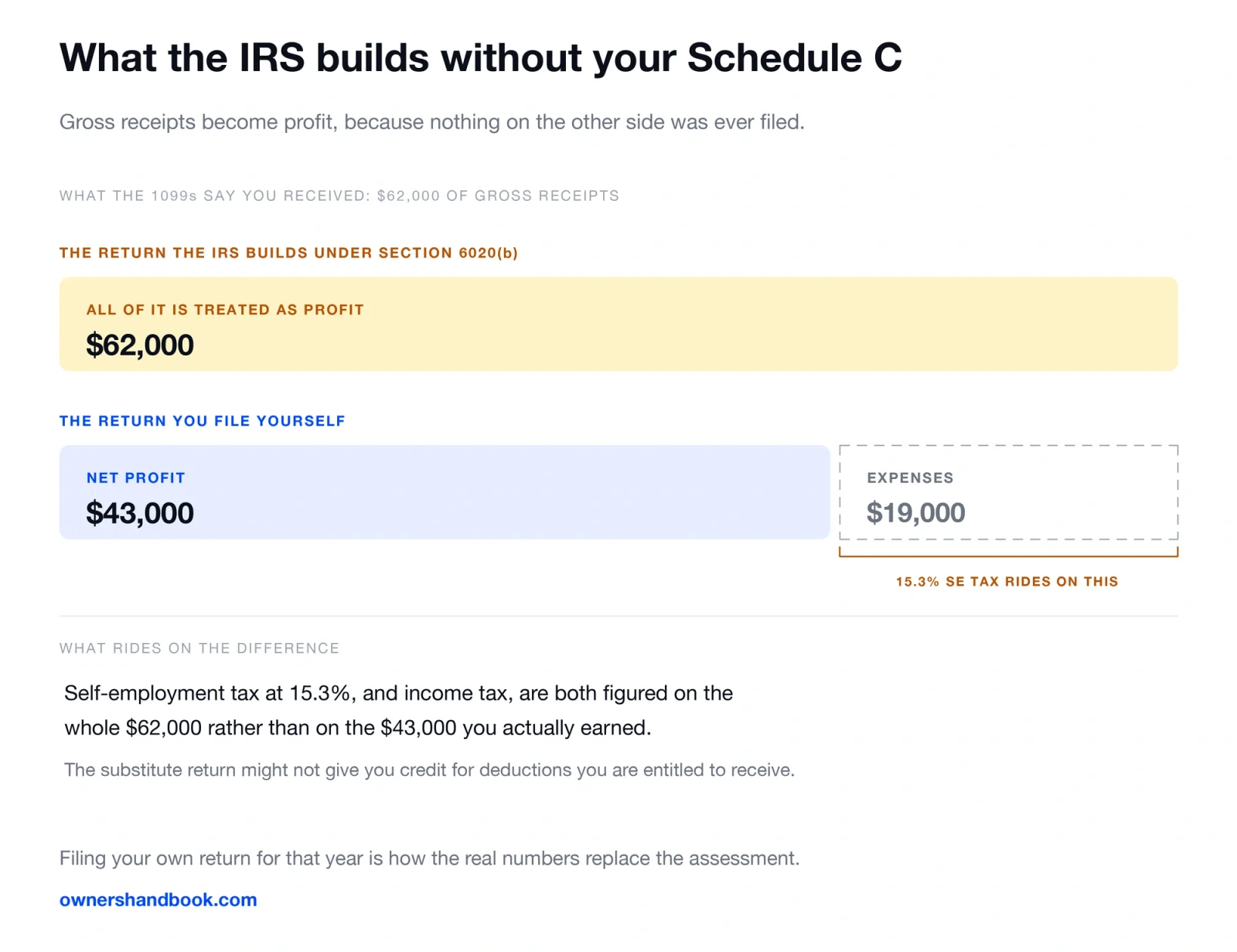
In practice it is built from the information returns in your file — the 1099s and W-2s your clients and platforms sent in. The IRS is blunt about what is missing: the substitute return might not give you credit for deductions and exemptions you may be entitled to receive.
For a self-employed person that is severe in a specific way. The 1099s report gross receipts. No Schedule C is attached, so there are no expenses, which means gross receipts become profit and self-employment tax is figured on a number that was never your income. A courier with $62,000 of 1099s and $19,000 of mileage and phone is assessed as though the $19,000 did not exist.
Then section 6501(b)(3) adds the asymmetry. Notwithstanding section 6020(b)(2), the execution of a return by the Secretary does not start the running of the period of limitations on assessment and collection. An IRS-prepared return does not close the year for you — but the assessment coming out of it does start the ten-year collection period under section 6502. A balance can be in active collection on a year that is, for assessment purposes, still wide open.
Filing your own return for that year is how you replace the assessment with a real one.
The Social Security year you cannot get back
General articles about back taxes miss this entirely, and for a self-employed person it is the one consequence that does not reverse.
Your Schedule SE is how self-employment earnings reach your Social Security record. The IRS puts it plainly: for an unfiled year, the self-employment income you earned will not be reported to the Social Security Administration and you will not receive credits toward Social Security retirement or disability benefits.
That is fixable by filing — up to a point, and the point is statutory. Section 405(c)(1)(B) of the Social Security Act defines a time limitation as a period of three years, three months, and fifteen days. Section 405(c)(4)(C) then says the absence of an entry in the Commissioner’s records as to self-employment income alleged to have been derived in a year shall be conclusive that none was derived, unless it is shown that he filed a tax return of his self-employment income for such year before the expiration of the time limitation following such year.
Three years, three months and fifteen days after the end of a calendar year lands on April 15 four years later. For 2023 that is April 15, 2027. For 2022 it has already passed.
So a Schedule SE filed inside that window gets credited. One filed after it generally does not, and the record is treated as conclusive. There are narrow exceptions in section 405(c)(5), but they are exceptions, not the rule.
The tax on those earnings is still owed. The credit toward your benefit is what expires.

| What filing late still does | What it cannot do |
|---|---|
| Closes the assessment period for that year | Recover a refund outside the § 6511 lookback |
| Replaces an IRS-prepared assessment with your real numbers | Restore Social Security credits past the § 405(c) time limitation |
| Makes you eligible for a payment plan | Remove interest already accrued |
| Produces a return you can show a lender | Reset the § 6502 ten-year clock on an existing assessment |
Reconstructing a year whose records are gone
You do not need shoeboxes. Most of what the IRS knows about your income is retrievable from the IRS.
The wage and income transcript shows data from information returns received — Forms W-2, 1098, 1099 and 5498 — and it is available for the current and nine prior tax years. That covers the whole six-year window and more. Order it through your IRS online account, or on Form 4506-T for older years.
Two limits before you rely on it. It only displays information return documents that have been filed with the IRS, which may not reflect everything issued to you. And it is capped at roughly 85 income documents, after which the online request will not generate and you need the 4506-T.
The first limit is the important one. A client who paid you $8,000 and never filed a 1099 will not appear on the transcript, and that income is still reportable. The transcript is a floor, not the answer.
For expenses, the order that works is bank and card statements for the year, then the recurring items you can prove existed — phone, software subscriptions, insurance — then mileage from whatever contemporaneous trace survives. Our guide to what records actually need keeping tells you which categories are worth digging for, and the receipt rules tell you where an estimate will and will not hold.
Report each year on the forms that applied to that year, with that year’s rates and thresholds rather than this year’s. If you also had a W-2 job in any of them, the mixed-year arithmetic changes how much self-employment tax is actually due.
What this is not
Two things, stated plainly, because most of what is written about this topic is advertising.
Willful failure to file is a crime under section 7203 — a misdemeanor, fined not more than $25,000 or imprisoned not more than one year, or both. The word doing the work is *willful*. Policy Statement 5-133 directs that delinquent returns be requested and accepted except where there is an indication of willfulness or fraud. Filing voluntarily is the behaviour the policy is built around.
And nothing here needs buying. The transcripts are free, the forms are free, and the payment plans are applied for directly through the IRS website. If you want help with the returns themselves, that is a question about doing them yourself versus not, and the answer does not depend on how far behind you are.
Frequently asked questions
How many years do I actually have to file?
Policy Statement 5-133 says delinquency enforcement will normally not reach back more than six years, and going further requires managerial approval. That is IRS practice, not law. The statute puts no limit on an unfiled year.
Will filing six years at once trigger an audit?
The IRS does not publish selection criteria tied to late filing. What it does publish is that all delinquent returns submitted will be accepted. The things that do correlate with examination are about a return’s contents, not its timing.
Can I file them all at the same time?
Yes, each year on that year’s forms, in separate submissions. Old years generally cannot be e-filed, so most of this is paper.
I never got a 1099 for some of that work. Do I report it?
Yes. The reporting threshold governs the payer’s obligation to send a form, not your obligation to report income. The filing threshold for self-employment runs on your net earnings, and it is far lower than most people assume.
What if the IRS already assessed me for a year I never filed?
File the real return for that year. Section 6020(b) lets the IRS build one from information returns, and the IRS says that version may not give you credit for deductions you are entitled to — which for a Schedule C filer usually means no expenses at all.
Do I owe estimated taxes while I am catching up?
The current year runs independently. If you missed this year’s installments too, the charge is interest rather than a fine, and the missed-payment arithmetic is smaller than people expect. Going forward, the four dates are what stop this recurring.
I need income documentation for a loan. Does filing late help?
A filed return is the document lenders ask for, and the IRS lists delayed loan approval as a consequence of not filing. Our piece on proving freelance income covers what else gets accepted.
Sources
26 U.S.C. § 6501, Limitations on assessment and collection
https://www.law.cornell.edu/uscode/text/26/6501
26 U.S.C. § 6502, Collection after assessment
https://www.law.cornell.edu/uscode/text/26/6502
26 U.S.C. § 6511, Limitations on credit or refund
https://www.law.cornell.edu/uscode/text/26/6511
26 U.S.C. § 6513, Time return deemed filed and tax considered paid
https://www.law.cornell.edu/uscode/text/26/6513
26 U.S.C. § 6020, Returns prepared for or executed by Secretary
https://www.law.cornell.edu/uscode/text/26/6020
26 U.S.C. § 7203, Willful failure to file return, supply information, or pay tax
https://www.law.cornell.edu/uscode/text/26/7203
42 U.S.C. § 405, Evidence, procedure, and certification for payments
https://www.law.cornell.edu/uscode/text/42/405
IRS, Internal Revenue Manual 1.2.1.6.18, Policy Statement 5-133, Delinquent Returns
https://www.irs.gov/irm/part1/irm_01-002-001
IRS, Filing Past Due Tax Returns
https://www.irs.gov/businesses/small-businesses-self-employed/filing-past-due-tax-returns
IRS, Transcript Types for Individuals and Ways to Order Them
https://www.irs.gov/individuals/transcript-types-for-individuals-and-ways-to-order-them