How Much to Set Aside for 1099 Taxes (Not 30%)
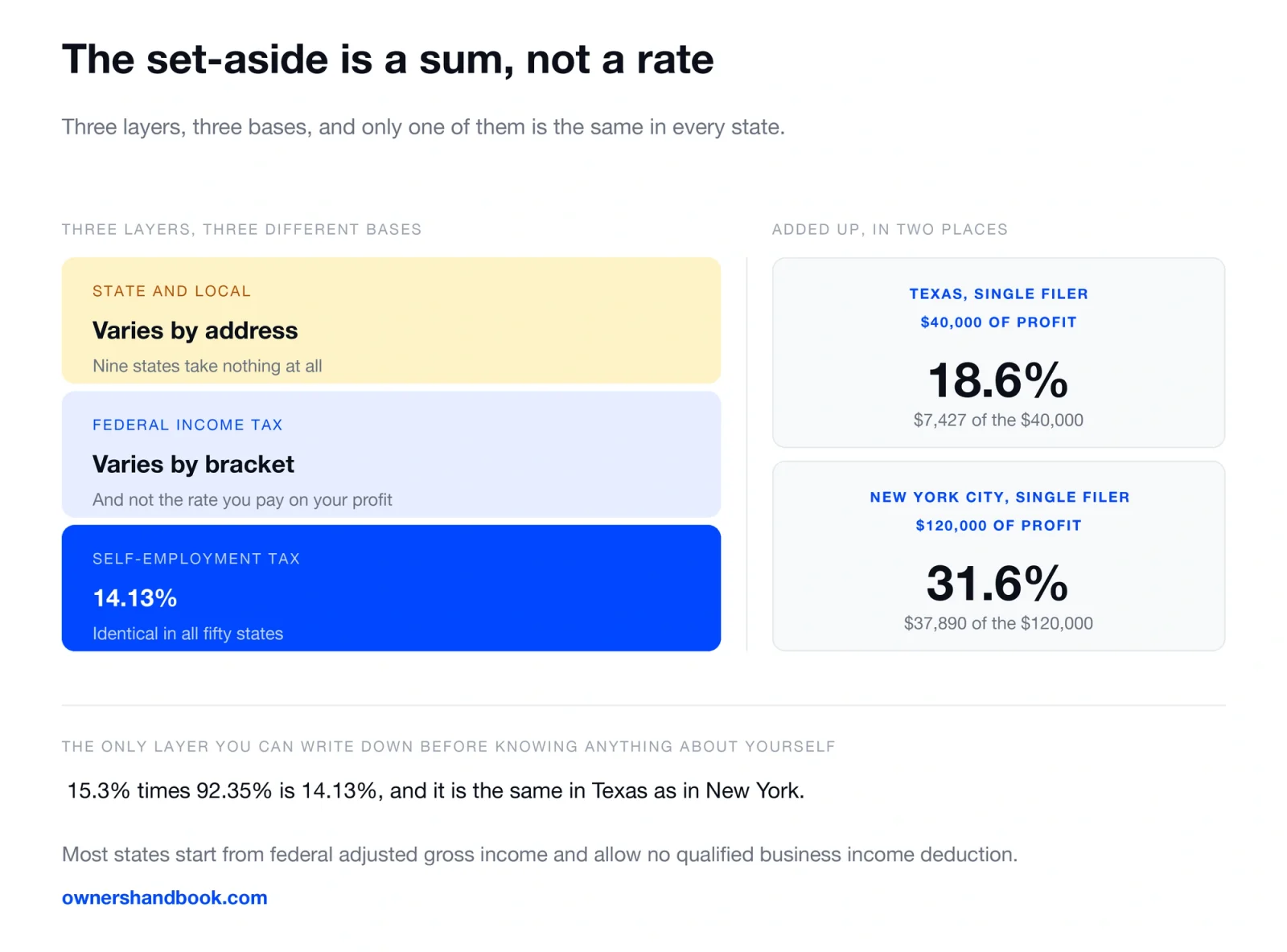
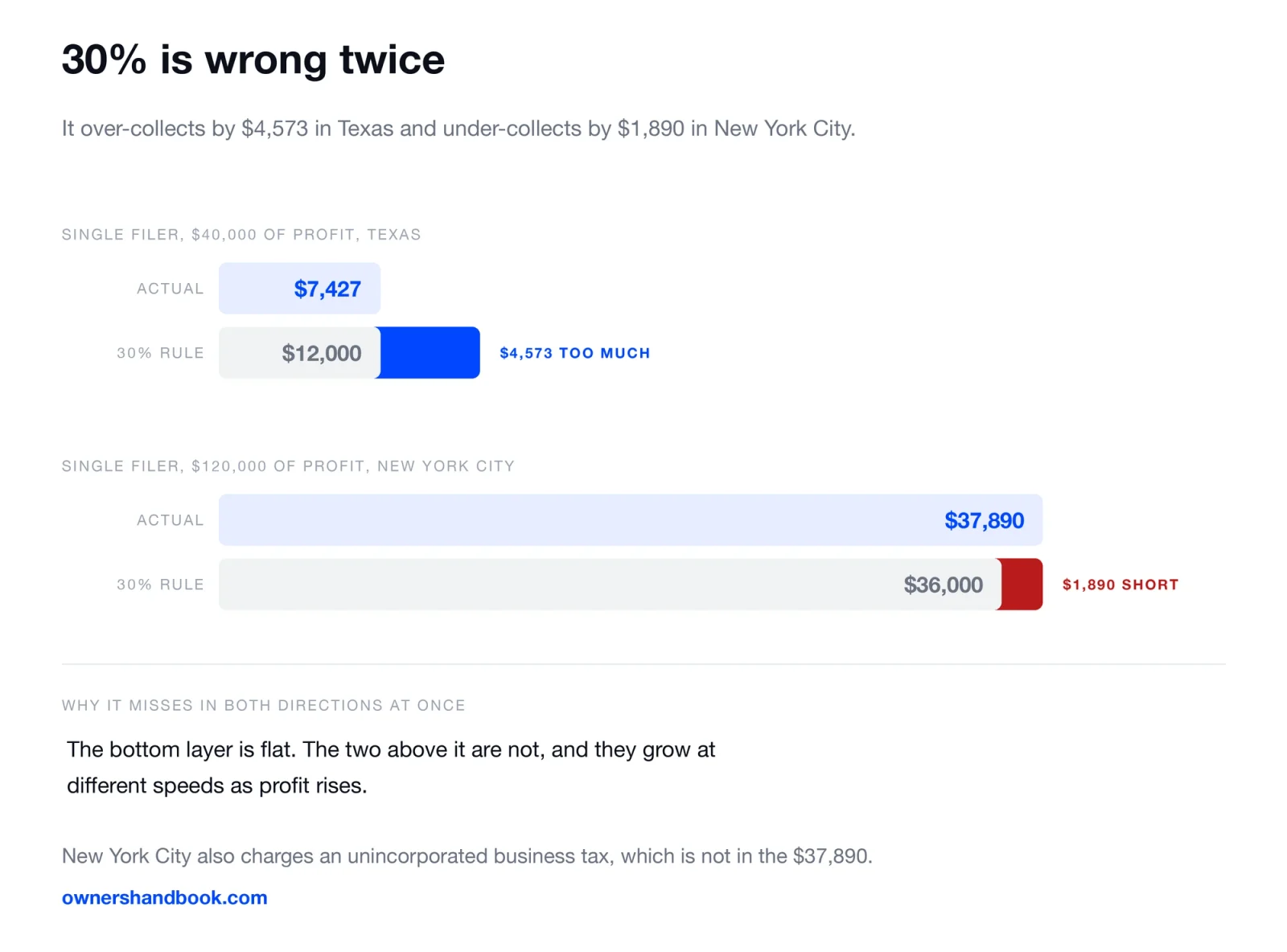
Thirty percent is the number everybody repeats, and it is wrong in both directions. A single freelancer clearing $40,000 in Texas needs to hold back 18.6%. A single freelancer clearing $120,000 in New York City needs 31.6%, and that is before the city’s separate business tax.
The reason the advice fails is that the set-aside is not a rate. It is a sum of three different taxes with three different bases, and only one of the three is the same everywhere in the country.
This page builds the number from its parts so you can work out your own. It does not ask you to trust a percentage.
The three parts, and why only one is fixed
Self-employment tax is federal, flat, and identical in all fifty states. It is the only part of the answer you can write down before knowing anything about you.
Federal income tax sits on top of it, at whatever bracket your taxable income reaches. That bracket is not the rate you pay on your profit, for reasons set out below.
State and local tax is the third layer, and it ranges from nothing to four separate taxes depending on where you sleep and work. Nine states do not tax individual income at all, which our guide to state tax for the self-employed covers in full.
Add the three. That is your set-aside. Nothing about the arithmetic is difficult; the difficulty is that every guide stops after the first layer and rounds up.
Part one is 14.13%, not 15.3%
The self-employment tax rate is 15.3% — 12.4% for Social Security and 2.9% for Medicare. But it is not charged on your profit.
Form 1040-ES is explicit about the step people skip: when estimating net earnings from self-employment, use only 92.35% of your total net profit.
So the rate against your profit is 15.3% × 92.35%, which is 14.13%. On $40,000 of profit that is $5,652, not $6,120.
The Social Security half stops. For 2026 the Form 1040-ES worksheet puts the social security tax maximum income at $184,500. Above that, only the 2.9% Medicare part continues, so the marginal cost of the layer drops to about 2.68% of profit.
Below $400 of net earnings for the year the layer does not exist at all. That threshold, and the separate one for filing a return, are in our guide to the self-employment filing threshold.
This is the one piece of the answer that is genuinely national. Our self-employment tax calculator handles the case that breaks it — a W-2 job filling the Social Security ceiling first.
Part two is your bracket, times about three-quarters
Here is where the flat-percentage guides go wrong by the largest margin.
Three deductions stand between your profit and your taxable income, and all three are already in the law before you do anything clever.
Half your self-employment tax comes off as an adjustment. The standard deduction comes off — $16,100 single, $32,200 married filing jointly for 2026. And roughly 20% of your business profit comes off through the qualified business income deduction, which our 20% deduction guide works through.
The combined effect is arithmetic you can state exactly. Each extra dollar of profit adds about 93 cents to adjusted gross income, because about 7 cents leaves as the self-employment tax adjustment. The qualified business income deduction then takes a fifth of that 93 cents.
| Each extra $1.00 of profit | Effect |
|---|---|
| Adds to adjusted gross income | $0.9293 |
| Less qualified business income deduction | −$0.1859 |
| Adds to taxable income | $0.7434 |
So a freelancer sitting in the 22% federal bracket pays 22% on about 74 cents of each new dollar of profit. The cost against profit is 16.35%, not 22%.
In the 12% bracket it is 8.92%. That single correction is most of the gap between 30% and the real answer.
Part three is where the answer stops being national
The third layer is the one the generic advice cannot supply, because it is not one number.
| State | What it taxes | Rate at $120,000 of profit |
|---|---|---|
| Texas, Florida | Nothing. No individual income tax | 0% |
| California | Taxable income, after a $5,706 standard deduction | 9.30% marginal |
| New York State | Taxable income, after an $8,000 standard deduction | 5.90% marginal |
| New York City, on top of the state | Taxable income, residents only | 3.876% marginal |
| Washington | Gross receipts, not profit, through the B&O tax | 1.5% of receipts |
Read the Washington row twice. The business and occupation tax is charged on what came in, with no deduction for what it cost to earn, which means it does not behave like a percentage of profit at all. Our Washington guide works that one separately.
Two things carry across most income-tax states. They start from your federal adjusted gross income, so the self-employment tax adjustment carries through. And almost none of them allow the qualified business income deduction, so the state layer bites a wider base than the federal one.
A $40,000 freelancer in Texas: 18.6%
Single, no other income, no employees, 2026.
| Step | Amount |
|---|---|
| Net profit | $40,000 |
| Self-employment tax, 14.13% of profit | $5,652 |
| Adjusted gross income, after half of that | $37,174 |
| Less standard deduction | −$16,100 |
| Less qualified business income deduction | −$4,215 |
| Taxable income | $16,859 |
| Federal income tax | $1,775 |
| Texas income tax | $0 |
| Total to set aside | $7,427, or 18.6% |
Setting aside 30% would have parked $12,000 against a $7,427 bill. That is $4,573 of your own money held hostage for a year, and for a freelancer at $40,000 it is not a rounding error.
Texas takes nothing on the profit. What it does want is a filing, which the Texas guide covers, and Florida runs the same way with a different deadline.
The marginal rate here is 23%: 14.13% of self-employment tax plus 12% of 74 cents. So the next dollar costs more than the average, which is normal and is why a single percentage misleads in both directions at once.
A $120,000 freelancer in New York City: 31.6%
Same person, same filing status, three times the profit and a different address.
| Step | Amount |
|---|---|
| Net profit | $120,000 |
| Self-employment tax, 14.13% of profit | $16,955 |
| Adjusted gross income | $111,522 |
| Taxable income after both federal deductions | $76,338 |
| Federal income tax | $11,506 |
| New York State tax, on $103,522 of state taxable income | $5,540 |
| New York City resident tax | $3,888 |
| Total to set aside | $37,890, or 31.6% |
Thirty percent leaves this freelancer $1,890 short, and the shortfall is worse than it looks, because New York City also charges an unincorporated business tax on the business itself. It phases in between about $90,000 and $140,000 of profit and the New York guide works out what it adds.
Two notes on the state figure. New York applies a tax computation worksheet above $107,650 of state adjusted gross income that recaptures some of the lower brackets, so the $5,540 from the rate schedule is a floor rather than a final number. And the marginal rate on this freelancer’s next dollar is about 39.6% once all four layers are counted.
The same $120,000, four more places
Only the third layer moves.
| Where you live | Federal | State and local | Total | Set-aside |
|---|---|---|---|---|
| Texas or Florida | $28,462 | $0 | $28,462 | 23.7% |
| California | $28,462 | $6,280 | $34,742 | 29.0% |
| New York City | $28,462 | $9,428 | $37,890 | 31.6% |
| Washington | $28,462 | B&O on receipts, not profit | — | see below |
California’s figure uses the 2025 rate schedule, which is what Form 540-ES itself directs you to use for 2026 estimates, and it is before the personal exemption credit. California also runs its installments at 30%, 40%, 0% and 30% rather than in quarters, which the California guide covers and which no federal calculator knows about.
The spread between the lowest and highest row is 7.9 percentage points of profit — about $9,400 a year on the same work at the same price. If you moved during the year, moving states mid-year handles the apportionment.
What to do with the number once you have it
Put the percentage on every payment as it arrives, into a separate account, on the day it lands. Not monthly, and not at quarter end.
Then use the number twice a year rather than four times. Our quarterly tax calculator turns last year’s return into this year’s four payments and is the better tool once you have a filed return to work from. The three-layer build-up above is the tool for your first year, when no prior return exists.
Two things the set-aside percentage is not.
It is not your quarterly payment. The four payments are set by the safe harbor rules, not by your running total, and our guide to quarterly estimated taxes sets out how those are chosen.
And it is not your rate. A set-aside is a cash reserve. The actual bill is settled on the return, and anything left over comes back.
When the build-up is the wrong tool
Three cases where you should stop and use something else.
You also have a W-2 job. Your wages fill the Social Security ceiling first, so a flat 14.13% on freelance profit overstates the first layer, sometimes badly. Read W-2 and 1099 in the same year, and consider covering the whole thing through W-4 withholding instead of quarterlies — withholding is treated as paid evenly across the year in a way estimated payments are not.
You are married. The bill is computed on one joint return and your spouse’s withholding counts toward the same target. Married filing jointly estimated taxes covers it.
Your profit is a guess. Revenue minus the expenses you will actually claim is the arithmetic Schedule C does, and running it once in June with rough numbers beats setting aside a percentage of deposits. If you are pricing work rather than paying tax on it, the set-aside belongs inside your hourly rate instead.
Frequently asked questions
Is 30% ever the right number?
For a single freelancer somewhere around $100,000 of profit in a middling income-tax state, it lands close. Below $60,000 it over-collects almost everywhere, and in New York City or California at six figures it under-collects.
Should I set aside a percentage of revenue or of profit?
Of profit, which means after the expenses you will actually claim. Setting aside a percentage of every deposit is simpler and always too much, which is fine as a cash habit and misleading as a tax estimate.
Does forming an LLC change the percentage?
No. A single-member LLC is taxed exactly as a sole proprietorship, so all three layers come out identically. The state filing fees change; the tax does not.
My state has no income tax. Is my set-aside just the federal part?
In Texas and Florida, yes. In Washington, no — the B&O tax is charged on gross receipts rather than profit, so it is a separate line that does not scale with the percentage.
What about 2027? Should I use next year’s numbers?
They do not exist yet. The 2027 inflation adjustments have not been published, so the brackets, standard deduction and Social Security limit above are 2026 figures. The 2027 payment dates can be worked out, and are April 15, June 15 and September 15 of 2027, then January 18, 2028.
I set aside too little. What happens?
You owe the tax in April plus interest on whatever each quarterly payment was short. Our guide to missed estimated taxes has the arithmetic and the repair.
Sources
IRS, Form 1040-ES, Estimated Tax for Individuals (2026)
https://www.irs.gov/pub/irs-pdf/f1040es.pdf
IRS, Publication 505, Tax Withholding and Estimated Tax (2026)
https://www.irs.gov/pub/irs-pdf/p505.pdf
IRS, Self-Employment Tax (Social Security and Medicare Taxes)
California Franchise Tax Board, 2026 Instructions for Form 540-ES
https://www.ftb.ca.gov/forms/2026/2026-540-es-instructions.html
California Franchise Tax Board, 2025 California Tax Rate Schedules
https://www.ftb.ca.gov/forms/2025/2025-540-tax-rate-schedules.pdf
New York State Department of Taxation and Finance, Instructions for Form IT-2105 (2026)
https://www.tax.ny.gov/pdf/current_forms/it/it2105i.pdf
Texas Comptroller, Taxes of Texas: A Field Guide
https://comptroller.texas.gov/transparency/revenue/docs/96-1774.pdf
Washington Department of Revenue, Business & Occupation Tax