You Owe State Tax Too. Here Is How Much.
Nine US states do not tax individual income at all. Everywhere else, add roughly 3% to 6% on top of what you already set aside for the IRS, and expect a second set of quarterly payments on a schedule your state picks for itself. There is no state version of self-employment tax, so this second layer is income tax only.
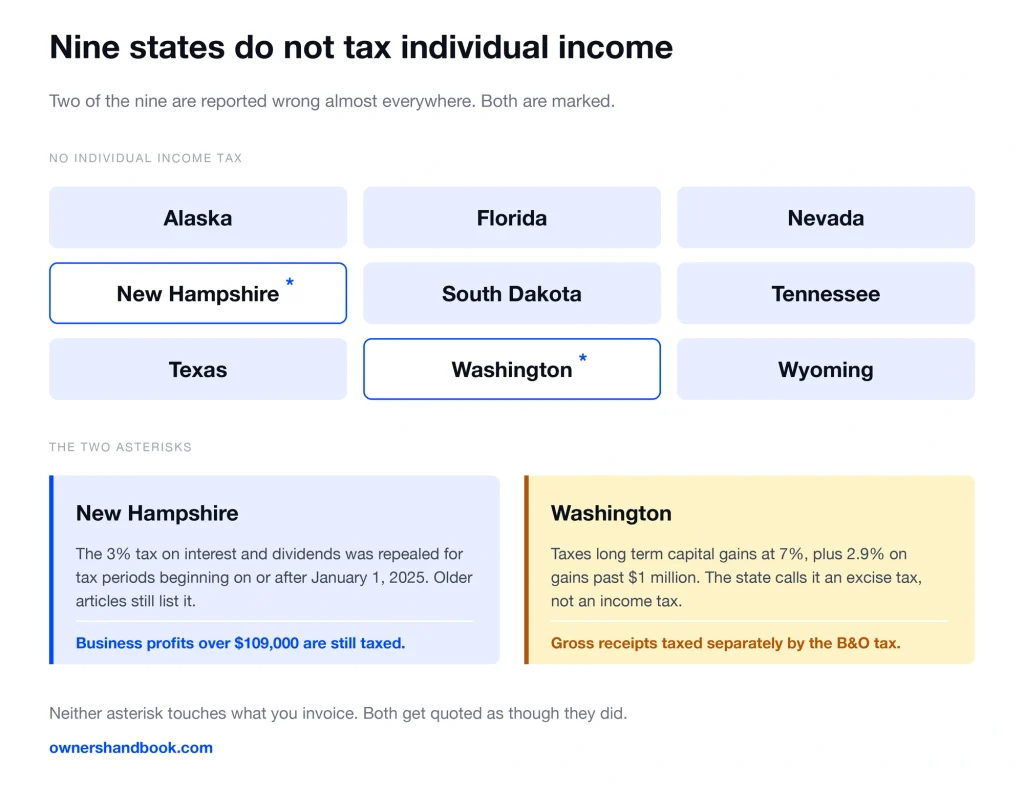
The nine states, and the two that get misreported
Alaska, Florida, Nevada, New Hampshire, South Dakota, Tennessee, Texas, Washington, Wyoming.
If you live in one of those, this page is short for you. You still owe federal tax. You owe nothing to a state income tax department, because there is no individual income tax to administer.
Two of the nine carry asterisks, and both get reported wrong constantly.
New Hampshire used to tax interest and dividends at 3%. That tax was repealed for tax periods beginning on or after January 1, 2025. Anything written before then still lists New Hampshire as a partial-tax state. It is not one now.
Washington taxes long term capital gains at 7% above an inflation adjusted deduction, with an extra 2.9% on gains past $1 million. Washington calls it an excise tax on the act of selling, not an income tax.
Neither one touches what you invoice.
| State | What it leaves alone | The asterisk |
|---|---|---|
| New Hampshire | Wages, freelance profit, interest, dividends | The interest and dividends tax ended January 1, 2025. Business profits are still taxed. |
| Washington | Wages, freelance profit | 7% on large long term capital gains. Gross receipts are taxed separately. |
| Alaska, Florida, Nevada, South Dakota, Tennessee, Texas, Wyoming | All individual income | None |
Where three to six percent comes from
The self-employment tax guide told you to add 3% to 6% for state. Here is the arithmetic behind that range.
Flat rate states give the cleanest picture. Pennsylvania charges 3.07%. Illinois charges 4.95%. Those are the actual numbers, applied to your income with no bracket math involved.
On $60,000 of profit that is about $1,840 in Pennsylvania and about $2,970 in Illinois, before any state level deductions or credits.
Graduated states land in a similar band at freelance sized income. A few have top brackets in the double digits.
But a top bracket applies to the last slice of a very large income. It does not apply to the whole of a $60,000 Schedule C.
So 3% to 6% is a planning number, not a promise. It gets you close enough to open a savings account and start moving money into it.
No state charges self-employment tax
Social Security and Medicare are federal programs. Schedule SE goes to the IRS and nowhere else. That 15.3% does not repeat at the state level.
This is why the state layer costs less than people brace for. On the federal side one dollar of profit gets taxed twice, by two different systems. On the state side it gets taxed once.
Most states also start their calculation from a figure that came off your federal return, so a deduction you already took usually carries through. Which figure, and which deductions survive, is state specific.
Your state wants its own quarterly payments
The federal quarterly guide covers four dates and one payment portal. A state that taxes income generally runs its own version of all of it: its own form, its own website, its own threshold for who has to pay.
Paying the IRS does not pay your state. Nothing gets forwarded between them.
Most states copy the federal dates. Some do not, and the ones that do not are worth knowing about.
| State | Its own schedule | How it differs from federal |
|---|---|---|
| Iowa | April 30, June 30, September 30, January 31 | Every installment lands two weeks to a month later |
| Hawaii | April 20, June 20, September 20, January 20 | The 20th, not the 15th |
| California | April 15, June 15, September 15, January 15 | Same dates. But the split is 30%, 40%, 0%, 30% — nothing is due in September |
| Most other states | April 15, June 15, September 15, January 15 | It matches |
California is the one that catches people. Seventy percent of the year’s state tax is due before July, and then a quarter goes by with no payment at all.
Which state gets it when you live in one place and work in another
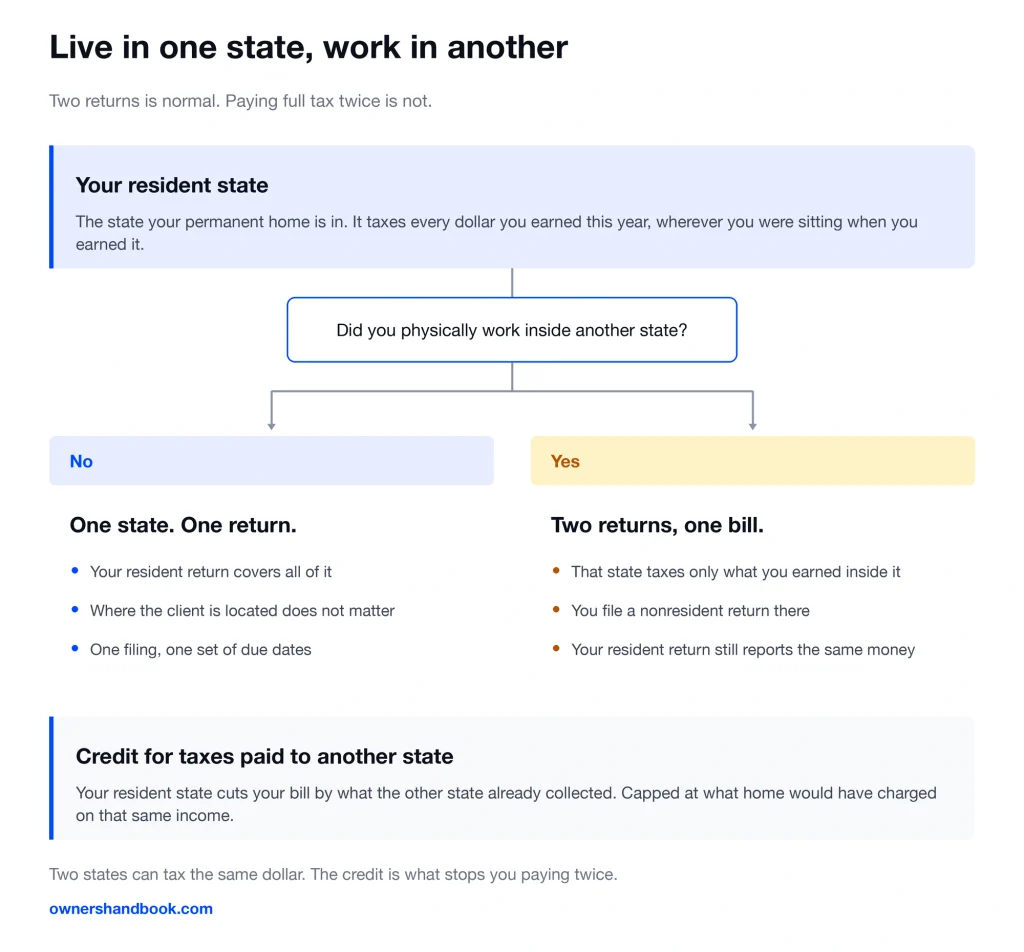
Two words carry this whole question.
Resident means the state you are domiciled in, which is the place that counts as your permanent home. Your resident state taxes all of your income, no matter where you earned it.
Nonresident means a state you earned money in without living there. It taxes only the income sourced to it, which for service work generally means what you earned while physically working inside its borders.
Having a client in another state is not, by itself, income sourced to that state. What usually matters is where you were sitting, not where the client’s office is.
A few states apply their own twist to that rule. New York is the one that comes up most.
There is a second way to become a resident without meaning to.
Many states, New York among them, treat you as a statutory resident if you keep a permanent home there and spend more than 183 days in the state. That holds even when you are domiciled somewhere else.
When two states do both tax the same dollar, the fix is a credit for taxes paid to another state. That is a reduction in your home state bill for what the other state already collected.
Virginia calls its version Schedule OSC. Most states have an equivalent.
The credit is capped at what your home state would have charged on that income. If the state you worked in charges more, the difference stays gone.
That cap is the reason a week of work in a high tax state can cost you a little extra, and the reason true double taxation is rare.
Some places tax the business, not the income
A state with no income tax can still send you a bill.
Washington charges a business and occupation tax on gross receipts. That means the full amount clients paid you, with no deduction for what it cost to earn it.
Freelance services fall under the service and other activities classification. Rates and small business credits have changed recently, so read the current page at dor.wa.gov.
New Hampshire taxes business profits. A sole proprietor whose gross business income from everywhere exceeds $109,000 files Form NH-1040 for tax periods beginning on or after January 1, 2025.
Cities do this too. Philadelphia charges freelancers a Business Income and Receipts Tax and a Net Profits Tax, and as of tax year 2025 the old $100,000 exemption is gone. A single 1099 from a Philadelphia client can create a filing obligation.
San Francisco requires a Business Registration Certificate from anyone doing business in the city, consultants working from a spare bedroom included.
None of these are income taxes. None of them show up on your state return. They are separate registrations with separate deadlines, and they are the ones freelancers miss.
How to find your own state’s answer
No single page can cover fifty states honestly, and any page that claims to is out of date somewhere.
Search for your state department of revenue estimated tax. Open the result ending in .gov, not the calculator site sitting above it.
Write down three things. The four due dates. The dollar threshold that makes payments mandatory, which varies by state. The form number and the page where you actually pay.
If you worked in more than one state this year, run a second search for each: that state, nonresident, income tax filing requirement. Every state sets its own floor, and some of those floors are low.
Do this once, in January, and put the dates in the same calendar as the federal ones.
Frequently asked questions
Do I have to pay state estimated taxes if I already paid the IRS?
Yes, if your state taxes income. The two systems are separate, use separate forms, and neither one knows what you sent the other.
My client is in another state. Do I owe tax there?
Generally no, if you never physically worked there. Service income is usually sourced to where the work was performed, not to where the client sits.
What if I moved states partway through the year?
You will likely file a part year resident return in both states, each covering the months you lived there. Check the rules for both, since the two definitions rarely line up perfectly.
Can I deduct state income tax on Schedule C?
No. State income tax is personal, and it comes off only if you itemize on Schedule A. Business licenses and gross receipts taxes are different and do belong on Schedule C.
Do states charge underpayment penalties like the IRS does?
Most do, each with its own rate, its own form, and sometimes its own safe harbor, meaning the amount you can pay to be protected from a penalty no matter what you end up owing. Do not assume the federal safe harbor protects you at the state level.
I worked in three states this year. Do I file three returns?
Possibly four, counting your resident return. Each nonresident state has its own filing threshold, and the credit for taxes paid to another state gets claimed on the resident one.
State by state
Twelve states now have their own page here, written because each one does something a rate table cannot show you.
California splits the year 30/40/0/30 and takes nothing in September. New York stacks the MCTMT and, in the five boroughs, an unincorporated business tax. Texas has no income tax but your LLC still files by May 15. Washington taxes gross receipts instead of profit. Pennsylvania hides a second tax at the township level.
Ohio can tax you three times over, though its business income deduction means most freelancers owe the state nothing. Michigan is flat until you work in one of two dozen cities that add their own. Maryland gives every county a rate and none of them is zero. Indiana does the same across all 92 counties, fixed by where you lived on January 1.
Illinois is simple until a second member joins your LLC. Georgia and North Carolina both cut their rate on a schedule, so an old article is wrong by a quarter point. New Jersey will not let a business loss offset your other income.
Oregon has no sales tax and a high income tax instead, and Portland adds three more. Colorado starts from your federal number and Denver charges a few dollars a month for the privilege of working there. Florida charges nothing on profit and still has a May 1 deadline.
Whichever one you land in, the federal side does not change, and the choice of where to form an LLC is separate from where you are taxed.
Sources
New Hampshire Department of Revenue Administration, Repeal of NH Interest and Dividends Tax Now in Effect
https://www.revenue.nh.gov/news-and-media/repeal-nh-interest-and-dividends-tax-now-effect
New Hampshire Department of Revenue Administration, Business Profits Tax
https://www.revenue.nh.gov/resource-center/frequently-asked-questions/business-profits-tax
Washington Department of Revenue, Capital Gains Tax
https://dor.wa.gov/taxes-rates/other-taxes/capital-gains-tax
Washington Department of Revenue, Business and Occupation Tax
Iowa Department of Revenue, Estimated Income Tax Payments
https://revenue.iowa.gov/taxes/tax-guidance/individual-income-tax/estimated-income-tax-payments
California Franchise Tax Board, Estimated Tax Payments
https://www.ftb.ca.gov/pay/estimated-tax-payments.html
Hawaii Department of Taxation, Tax Facts 2019-3, Estimated Income Tax for Individuals
https://files.hawaii.gov/tax/legal/taxfacts/tf2019-3.pdf
Virginia Tax, Credit for Taxes Paid to Another State
https://www.tax.virginia.gov/credit-for-taxes-paid-to-another-state
City of Philadelphia, Five Things to Know as an Independent Contractor Working in Philadelphia
City of Philadelphia, Net Profits Tax
San Francisco Treasurer and Tax Collector, Register a Business
https://sftreasurer.org/business/register-business
IRS, Estimated Taxes
https://www.irs.gov/businesses/small-businesses-self-employed/estimated-taxes