What to Send Your CPA at Tax Time
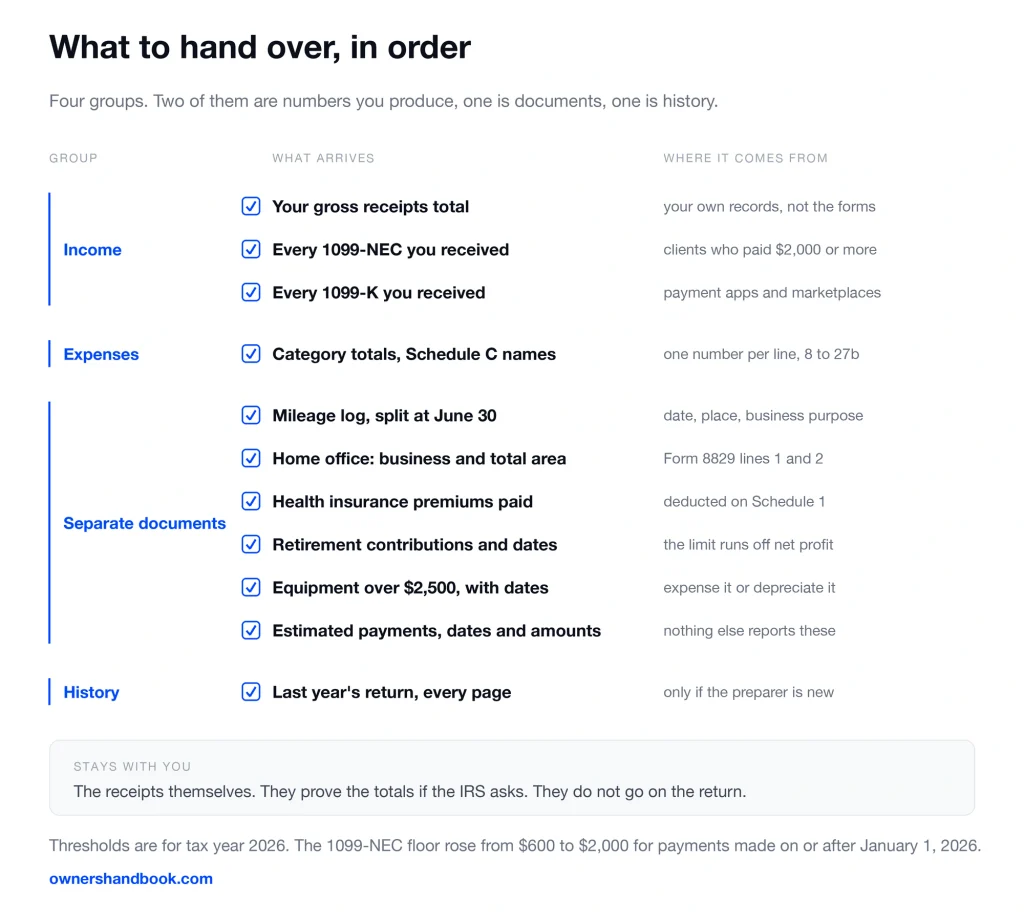
Four things: your own gross receipts total, your expenses already totalled by Schedule C category, every 1099 you received, and last year’s return if the preparer is new. Everything else stays in your filing cabinet.
Hand over those four and you are paying for advice. Hand over a folder of receipts and you pay the same hourly rate for typing.
Your own income total comes first, not the 1099s
Start with what your records say clients paid you during the year. Gross receipts, meaning every dollar that came in before platform fees or refunds came out.
That number is the real one. The 1099s are a partial copy of it, and they are incomplete by design.
A client who paid you $1,800 in 2026 issues nothing at all. The 1099-NEC floor for payments made on or after January 1, 2026 is $2,000, raised from the $600 that stood for decades.
Payment platforms run on a separate floor. A payment app or marketplace files a 1099-K once your payments pass $20,000 across more than 200 transactions.
The IRS is blunt about what that means for you. “Whether or not you receive a Form 1099-K, you must still report any income on your tax return.”
So bring both. Your total, and every form that arrived, because the preparer’s first real task is reconciling the two.
The gap between them is where notices come from. The IRS holds a copy of every 1099 filed under your name and matches the set against the top line of your Schedule C.
Two kinds of gap show up. Forms that add to more than your books, usually because one payment got reported twice by a client and a platform both.
And forms that add to less than your books, which is normal and expected, because everyone who paid you under the threshold sent nothing.
A preparer who finds either in February resolves it in a sentence. The IRS finding it eighteen months later costs you a letter and a reply.
Expenses, already totalled by Schedule C category
A preparer does not want your bank export. They want a list shaped like the form they are about to fill in.
Schedule C Part II has twenty-two numbered expense lines. Use their names as your category names and the transfer takes minutes.
| Line | Category | What a freelancer puts there |
|---|---|---|
| 8 | Advertising | Ads you ran, your site, business cards |
| 9 | Car and truck expenses | Mileage or actual costs, never both |
| 10 | Commissions and fees | Referral fees, agency splits |
| 11 | Contract labor | Other freelancers you paid |
| 12 | Depletion | Rarely used outside natural resources |
| 13 | Depreciation and section 179 | Equipment written off now or over years |
| 14 | Employee benefit programs | Only if you have employees |
| 15 | Insurance (other than health) | Liability, errors and omissions |
| 16a, 16b | Interest | Mortgage, and other business interest |
| 17 | Legal and professional services | This preparer’s own fee |
| 18 | Office expense | Software, postage, small recurring items |
| 19 | Pension and profit-sharing plans | Employee plans, not your own |
| 20a, 20b | Rent or lease | Studio, coworking, rented gear |
| 21 | Repairs and maintenance | Fixing what you already own |
| 22 | Supplies | Things consumed doing the work |
| 23 | Taxes and licenses | Business licenses and state fees |
| 24a | Travel | Airfare, lodging, getting there |
| 24b | Meals | Usually deductible at half |
| 25 | Utilities | For a separate business space |
| 26 | Wages | Payroll, if you run one |
| 27a | Energy efficient commercial buildings | Almost never a freelancer |
| 27b | Other expenses | Written out in Part V |
Most freelancers use eight of these. Blank lines are normal and no preparer is surprised by them.
Two categories are traps. Your own health insurance does not belong in Part II, and money you moved to your personal account is not an expense at all.
Six things that need their own document
Everything else is a total. These six are not, because each one needs a fact the total does not carry.
| Item | What the preparer needs | Why a total is not enough |
|---|---|---|
| Mileage | The log itself, and the split at June 30 | The mileage rate changed mid-2026 |
| Home office | Business square feet and total home square feet | Form 8829 lines 1 and 2 are both areas |
| Health insurance | Premiums paid, and whether a spouse had coverage available | It is deducted on Schedule 1, not Schedule C |
| Retirement | Plan type, amount, and date contributed | The limit is computed from your net profit |
| Equipment | Item, cost, and date placed in service | Anything over $2,500 has a treatment choice |
| Estimated payments | Every date and amount, with confirmation numbers | Nothing reports these to your preparer |
Take the mileage log first. Publication 463 asks you to prove the time, the place, and the business purpose of the trip, so a single annual figure answers none of that.
The home office needs two numbers, not one. Form 8829 line 1 is the area used for business and line 2 is the total area of the home, and the ratio between them drives the deduction.
Equipment is where the $2,500 matters. The de minimis safe harbor lets you deduct items up to $2,500 per invoice or item outright, and above that the preparer has to choose between expensing and depreciating.
Estimated tax payments are the item people forget most often. Nobody files a form telling your preparer you paid $4,000 in June, and a payment nobody knows about simply does not get claimed.
Last year’s return, if the preparer is new
Bring the whole thing. Every page, every schedule, including the ones you are certain do not matter.
Three things live in there that this year’s return needs. Depreciation already taken on equipment you still own, any losses or credits carried forward, and last year’s total tax.
That last figure sets your safe harbor for this year’s quarterly estimated taxes, 110% of it if your prior-year adjusted gross income was over $150,000, and it is not recoverable from memory.
What they do not need is your receipts
This is the distinction that decides your bill. Substantiation is your job. Preparation is theirs.
Substantiation means being able to prove a number if the IRS asks. Publication 583 is explicit that proof of payment alone does not establish a deduction — you also need to show what the money bought.
So you keep the receipts, generally for three years after filing, and you produce them only if a question arrives. That is a separate discipline from filing, with its own rules about what to save and how long.
Preparation means putting correct numbers on the right lines. For that a preparer needs totals, not paper.
One honest exception. The IRS notes that reputable preparers do ask to see records and will ask detailed questions about income and deductions, so expect to be asked about anything unusual.
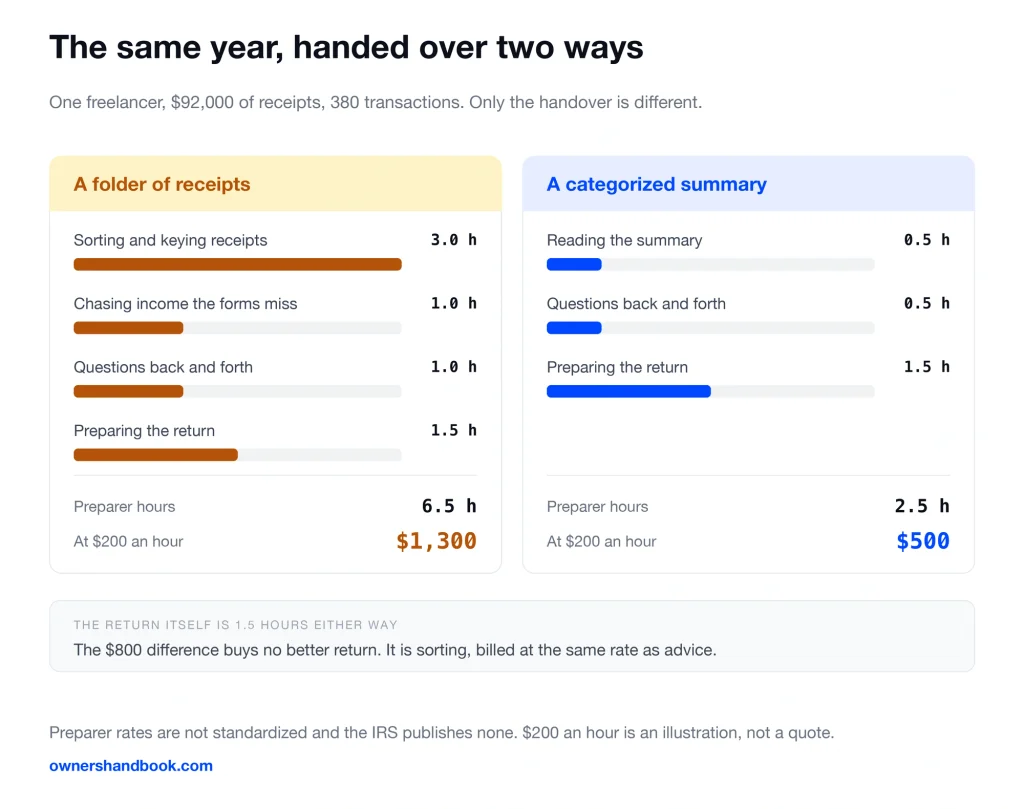
Put an hourly rate on that gap. At $200 an hour, the four extra hours a folder of receipts costs comes to $800, and none of it changed a single number on the return.
Preparer rates are not standardized and the IRS publishes none, so ask for yours in writing. The arithmetic holds at any rate, because sorting bills at the same figure as advice.
How to actually produce the summary
A spreadsheet is enough. One row per transaction, five columns: date, who you paid, amount, category, and a short note on what it was for.
The category column is the whole point. If it says “software” instead of “Office expense,” somebody has to translate it, and that somebody bills you.
Then one pivot table, or one sort and subtotal, gives you a category total list. That list is the deliverable.
Accounting software produces the same thing as a profit-and-loss report, which is simply income and expenses grouped by category for a period. Set your chart of accounts to Schedule C names once and the export is already correct.
Disclosure: I run this site and I also run Mozey, at mozey.co, which exports a Schedule C-categorized expense summary and a profit-and-loss report built for this handover, described in what Mozey does.
Whatever produces it, the test is the same. Could a stranger copy your list onto Schedule C without asking you a single question?
What to ask before you hire
Ask five questions, all of them before any documents change hands.
Do you have a PTIN and will you sign my return? Anyone paid to prepare a federal return must hold a preparer tax identification number, and the IRS tells you to confirm the preparer enters it and signs.
What is your credential? Only attorneys, CPAs, and enrolled agents can represent you before the IRS on any matter, which stops mattering entirely until the year it matters completely.
What is the fee, and what makes it go up? Get a written quote, and ask specifically what an uncategorized bank export would add to it.
The IRS names one fee structure to walk away from: a preparer who charges a percentage of your refund, or who offers to route your refund through their own account.
Who actually does the work, and will you be reachable in July? A question about your return rarely arrives in season.
Whether you need a person at all is a separate question, and for a single-state Schedule C with no employees the answer is often no.
April is triage, not optimization
A preparer who receives your documents on April 5 is producing a correct return. That is not the same as producing the best available one.
The difference is that every choice worth making needs your profit number to already exist. Mileage against actual costs, expensing against depreciating, how much to put into a retirement plan.
One lever genuinely survives until the deadline. A SEP can be set up as late as the due date of your return including extensions, so a late filer can still fund one.
But you cannot size that contribution without knowing net profit, and net profit is exactly what nobody has computed yet on April 5.
Filing an extension buys six months to file. It does not buy time to pay, and the balance is still due in April.
Send your summary in February. The preparer has hours to think in February, and in April they have a queue.
Frequently asked questions
My 1099s add up to less than my income total. Is that a problem?
No, that is the normal case. Clients paying under $2,000 issue nothing, so the forms almost always total less than your books. Report your own figure.
Do I have to give my preparer every receipt?
No. They need category totals. You keep the receipts to substantiate those totals if the IRS ever asks, which is a different job with a different timeline.
What if I never tracked a category during the year?
Rebuild it from bank and card statements before you hand anything over. Doing it yourself in a spreadsheet costs you an evening. Having someone else do it is sold as its own product: Bookkeeper360 lists prior bookkeeping at “starting at $1,000 per project” and Bench charges a $1,200 onboarding fee on top of $55 an hour.
Does the preparer need my bank login?
No. A categorized summary and the supporting exports are enough. Read-only access to accounting software is a reasonable alternative if they ask.
Is a profit-and-loss report the same as a categorized summary?
Effectively yes, if the categories match Schedule C line names. If your software uses its own category names, rename them before exporting.
How much should a Schedule C return cost?
There is no standard rate, and any single figure you read online is one firm’s price. Ask for a written quote, and ask what the number would be with and without a categorized summary.
Sources
IRS, Instructions for Schedule C (Form 1040)
https://www.irs.gov/instructions/i1040sc
IRS, About Schedule C (Form 1040)
https://www.irs.gov/forms-pubs/about-schedule-c-form-1040
IRS, Instructions for Forms 1099-MISC and 1099-NEC
https://www.irs.gov/instructions/i1099mec
IRS, Understanding Your Form 1099-K
https://www.irs.gov/businesses/understanding-your-form-1099-k
IRS, Publication 583, Starting a Business and Keeping Records
https://www.irs.gov/publications/p583
IRS, Publication 463, Travel, Gift, and Car Expenses
https://www.irs.gov/publications/p463
IRS, Instructions for Form 8829
https://www.irs.gov/instructions/i8829
IRS, Tangible Property Final Regulations
https://www.irs.gov/businesses/small-businesses-self-employed/tangible-property-final-regulations
IRS, Tax Topic 254, How to Choose a Tax Return Preparer
https://www.irs.gov/taxtopics/tc254
IRS, PTIN Requirements for Tax Return Preparers
https://www.irs.gov/tax-professionals/ptin-requirements-for-tax-return-preparers
IRS, Choosing a Tax Professional
https://www.irs.gov/tax-professionals/choosing-a-tax-professional
IRS, Retirement Plans for Self-Employed People
https://www.irs.gov/retirement-plans/retirement-plans-for-self-employed-people
IRS, About Form 4868