Your First Year Freelancing: The Tax Checklist
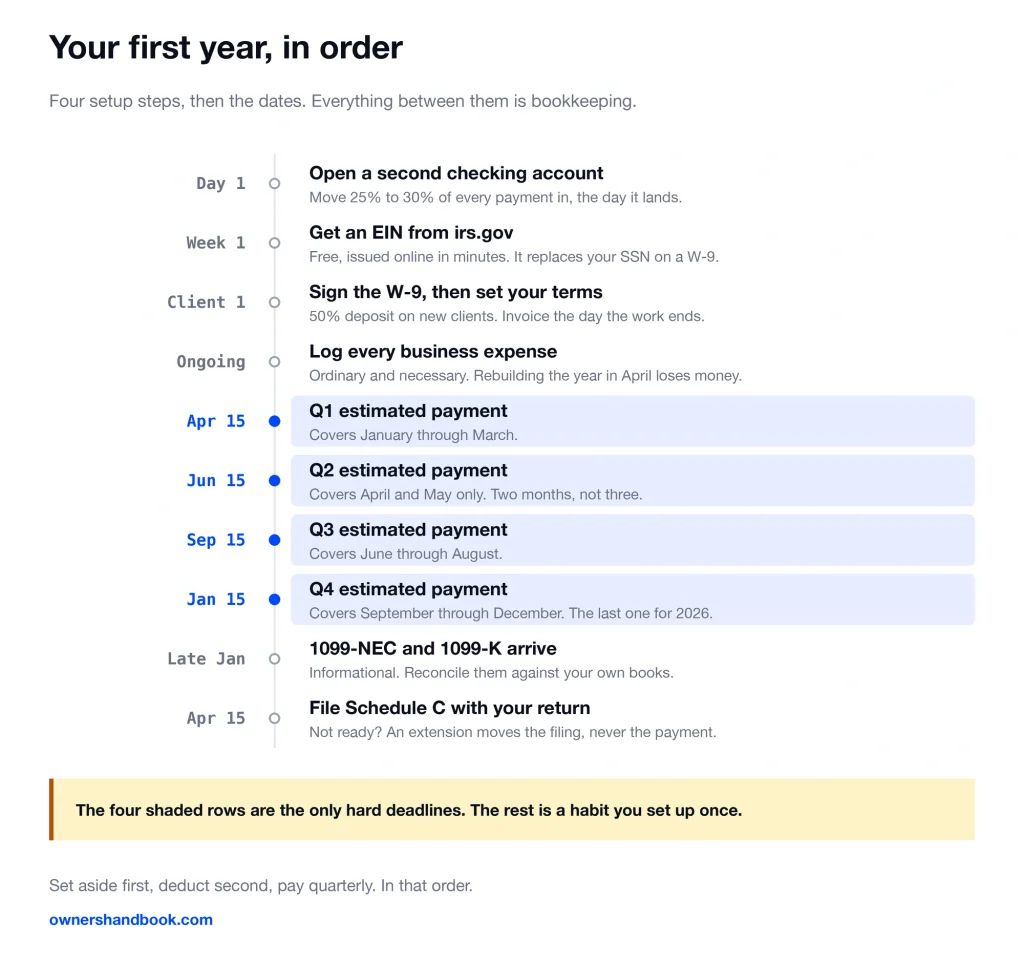
Five things decide your first year, and the rest is detail. Open a second bank account and move 25% to 30% of every payment into it the day the money lands. Get an EIN from irs.gov, free, in about ten minutes. Record every business expense from your first dollar. Pay the IRS four times a year instead of once. Keep the paperwork that backs all of it. Do those five and April becomes an afternoon of filing rather than a crisis.
Week one: an account and a number
Open a second checking account. Any bank, no fee, nothing clever about it.
It exists so that tax money stops looking like your money. That is the entire function.
Move 25% to 30% of every payment into it the day the payment arrives. That covers self-employment tax at 15.3% plus federal income tax. Add 3% to 6% more if you live in a state with an income tax.
Money you move back out to live on is an owner’s draw. It is not a business expense and it does not lower your tax by a dollar.
Then get an EIN, the nine-digit number the IRS uses to identify a business. It is free, it is issued online in minutes, and the IRS says outright that you never have to pay a fee for one.
An EIN keeps your Social Security number off every form you sign for a client. Getting an EIN and a business bank account in the same week is the whole setup.
You do not need a company to do any of this. Whether to form an LLC or stay a sole proprietor changes your liability, not your taxes, and an S corp election is a question for a year when profit is large.
Before you quote anyone: set the rate
Most first-year underpricing comes from one mistake. You quote a number that would have been a fine salary.
It is not a fine salary now. You pay both halves of Social Security and Medicare, you buy your own coverage, and roughly half your working hours are unbillable.
The freelance hourly rate formula that accounts for taxes starts from what you want to keep and works backward, using the same 25% to 30% you are already setting aside.
The next call is flat fee vs hourly. Clear scope, flat fee. Vague scope, hourly, because you are the one absorbing the vagueness.
Decide how you will handle raising your rate before you need to. The conversation is much easier in January than in the middle of a project.
The first client: a W-9, then your terms
Almost every new client opens with a W-9. One page, three real boxes: your name, your business type, your taxpayer number.
Five minutes. Put the EIN in the number box instead of your SSN.
The W-9 is how a client knows where to send a 1099 next January. Signing one costs you nothing and triggers nothing.
Then set your own terms. Net 30 is a corporate default, not a law, and invoice payment terms are negotiable. The date you send the invoice matters more than the number of days on it.
Ask new clients for a 50% deposit. A deposit works where reminders do not, because it turns a client into someone with money already in the project.
And when a client has not paid, escalate on a schedule rather than on feeling. A note on day 22 reads as helpful. The same note on day 40 reads as an accusation.
From the first dollar: what counts as an expense
The standard is two words: ordinary and necessary. Ordinary means common in your line of work. Necessary means helpful to it.
That is the whole test for what you can deduct. There is no secret list.
A deduction comes off your self-employment tax and your income tax both, so a real business dollar is worth more to you than your tax bracket alone suggests.
Four categories cover most freelance spending.
The home office deduction, which has a simplified method and an actual-expense method. Mileage, where the 2026 mileage rate changed in the middle of the year.
Equipment, where Section 179 and the $2,500 rule decide whether a laptop is written off at once. And business meals and travel, the most closely examined of the four.
Record it as you go. A mileage log written up in April is not a record, and a year rebuilt from memory loses real money.
Then keep what backs the return. Three years after you file is the general rule, and unusual years run longer than that.
You do not need to buy anything yet. The free tools that get you through year one are genuinely enough, and accounting software starts earning its price when volume arrives.
April, June, September, January
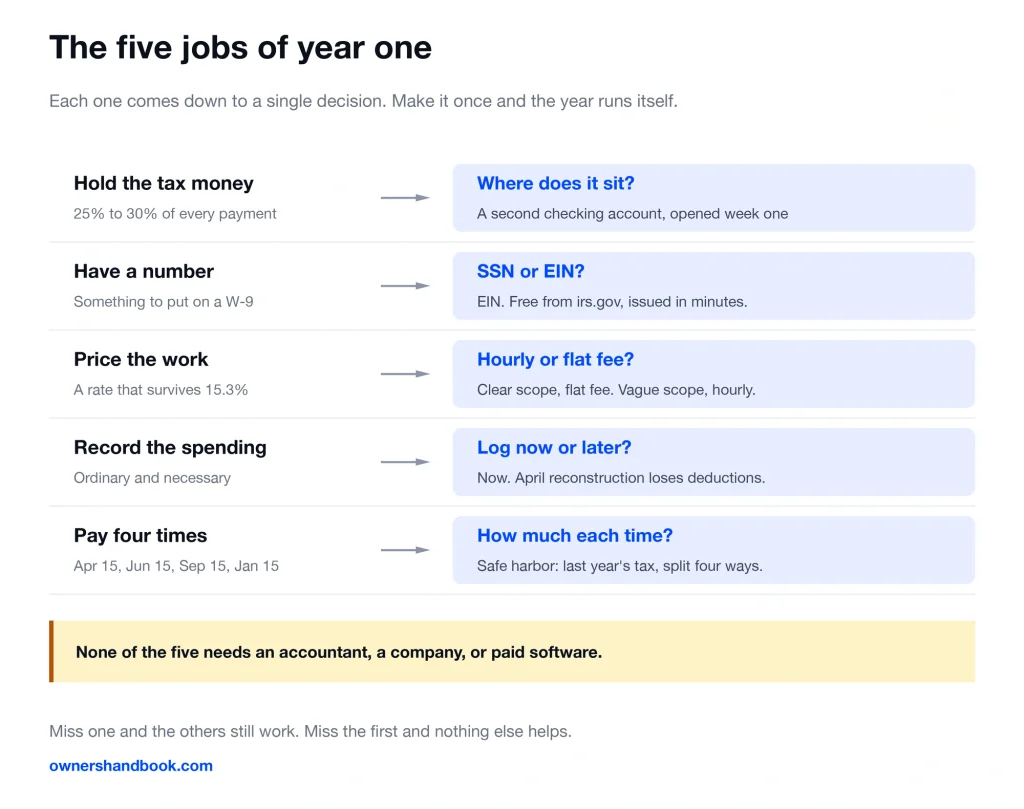
The IRS does not want one payment in April. It wants the money roughly as you earn it.
If you expect to owe $1,000 or more when you file, you owe quarterly estimated taxes.
There is one exception, and in a genuine first year it catches a lot of people. If you owed no tax at all for the previous full twelve-month year, and you were a US citizen or resident for that whole year, you are not required to make estimated payments this year no matter what you earn. A student who graduated, someone returning from unpaid time off, anyone whose prior-year return showed zero total tax — that is the situation this covers.
It is worth saying what the exception does and does not do. It removes the penalty for not paying quarterly. It does not remove the tax. The whole bill arrives in April instead, and it will be the largest single payment most people have made. If you use the exception, set the money aside anyway.
Also worth knowing: the exception turns off after one year. In your second year you have a prior-year figure to safe-harbor against, and the ordinary rules apply.
| Due date | Covers income earned | Length |
|---|---|---|
| April 15, 2026 | January 1 to March 31 | 3 months |
| June 15, 2026 | April 1 to May 31 | 2 months |
| September 15, 2026 | June 1 to August 31 | 3 months |
| January 15, 2027 | September 1 to December 31 | 4 months |
The periods are not equal. Q2 covers two months, which is exactly why June is the payment people pay late without understanding why.
How much to send is the easier half. Use the safe harbor — the rule that says a certain payment level cannot be penalized no matter how the year turns out.
Pay 100% of last year’s total tax, divided by four. That becomes 110% if your prior-year adjusted gross income was over $150,000.
In a true first year there is no prior year of self-employment to copy. Estimate from what is sitting in the tax account and correct in September.
Your state usually wants its own quarterly payments on its own calendar. State taxes for the self-employed are a separate filing, not a line on the federal one.
And if you reach autumn having paid nothing, missed payments are recoverable. The charge is interest on the shortfall, so a late payment always beats no payment.
Mid-year: the questions that arrive with the work
Under $400 in net self-employment earnings for the whole year, self-employment tax does not apply at all. Income tax still might.
If the work is small and irregular, the hobby vs business test decides whether you are allowed to deduct a loss against your other income.
If the money comes through Uber, DoorDash, Etsy, or Upwork, gig work follows the same structure. You report the gross, then deduct the platform’s cut as an expense.
If you hire help, you are the issuer now. You owe a 1099-NEC to anyone you paid $2,000 or more during 2026, and it is due by January 31.
Two more once profit is real. Self-employed health insurance comes off your income further down the return, not on your Schedule C. And Solo 401(k) vs SEP IRA decides how much you can shelter from tax entirely.
January: the forms show up
In late January, forms start arriving. They are informational, and the IRS already holds copies of all of them.
| What arrives | Who sends it | Threshold for 2026 | If it never comes |
|---|---|---|---|
| 1099-NEC | A client you did work for | $2,000 or more paid during the year | You report the income anyway |
| 1099-K | A payment platform | Over $20,000 and more than 200 transactions | You report the income anyway |
| Nothing at all | No one | Under both floors | You report the income anyway |
That last row is the one that catches people. A form is a client’s obligation, not the definition of your income.
Knowing 1099-NEC vs 1099-K matters because both can report the same $5,000. Add them together and you have doubled your income on paper.
One number moved this year. The 1099-NEC floor rose from $600 to $2,000 for payments made on or after January 1, 2026, under the One Big Beautiful Bill. Most articles online still print $600.
Report from your own books, then reconcile against the forms you received.
April: the return itself
Your whole business fits on one page. Schedule C puts income at the top and expenses below it, and the bottom line is net profit.
That profit then feeds two separate calculations. Self-employment tax takes 15.3% of 92.35% of it. Income tax takes its share of the same number, stacked on any other income you had.
Two things hand money back. The QBI deduction removes up to 20% of your business profit from taxable income. And business expenses vs the standard deduction is not a choice at all — you take both.
Filing it yourself is reasonable for one Schedule C in one state. Whether to hire a CPA turns on how complicated your year was, not on how much you made.
If April arrives and you are not ready, filing an extension moves the paperwork to October 15. It does not move the payment. Send what you owe by April 15 regardless.
Frequently asked questions
I only made $3,000 freelancing. Do I still have to report it?
Yes. Net self-employment earnings of $400 or more mean you file Schedule SE and owe self-employment tax. Income tax has its own separate thresholds.
Do I need an LLC before I start?
No. You are a sole proprietor from your first paid job, with no filing required. An LLC changes your liability exposure, not what you owe.
Do I have to pay quarterly in my very first year?
Usually yes, if you expect to owe $1,000 or more. But not if you owed zero tax for the previous full twelve-month year and were a citizen or resident throughout it — that exception removes the requirement entirely for one year. Either way, there is no prior-year figure to safe-harbor against, so estimate from your set-aside account and adjust each quarter.
What if a client never sends me a 1099?
You report the income regardless. The form is the payer’s obligation and the thresholds are theirs, not a line below which income stops counting.
It is already September and I have set nothing aside. What now?
Pay what you can now through IRS Direct Pay. Interest runs on the shortfall from each original due date, so shrinking the gap today reduces what accrues.
Is 25% to 30% an IRS rule?
No, it is a working estimate that covers 15.3% self-employment tax plus a typical federal rate. The IRS number that actually matters is the $1,000 that triggers quarterly payments.
Sources
IRS, Self-Employment Tax
IRS, Estimated Taxes
https://www.irs.gov/businesses/small-businesses-self-employed/estimated-taxes
IRS, Estimated Taxes Frequently Asked Questions
https://www.irs.gov/faqs/estimated-tax
IRS, Schedule SE (Form 1040)
https://www.irs.gov/forms-pubs/about-schedule-se-form-1040
IRS, About Schedule C (Form 1040)
https://www.irs.gov/forms-pubs/about-schedule-c-form-1040
IRS, Get an Employer Identification Number
https://www.irs.gov/businesses/small-businesses-self-employed/get-an-employer-identification-number
IRS, Instructions for Forms 1099-MISC and 1099-NEC
https://www.irs.gov/instructions/i1099mec
IRS, Understanding Your Form 1099-K
https://www.irs.gov/businesses/understanding-your-form-1099-k
IRS, How Long Should I Keep Records
https://www.irs.gov/businesses/small-businesses-self-employed/how-long-should-i-keep-records
IRS, Get an Extension to File Your Tax Return
https://www.irs.gov/filing/get-an-extension-to-file-your-tax-return