You Moved States Mid-Year. Now You File Two State Returns.
You do not file one state return for the year. You file two — one for each state, each covering the part of the year you lived there. Most people discover this in April, after they have already sent a year of estimated payments to the wrong place.
Here is how the split actually works for someone self-employed, and the three things that go wrong.
Two returns, not one
The category you fall into is part-year resident, and both states you touched will want a return from you.
Virginia states the test plainly:
An individual who establishes or abandons Virginia as his or her state of legal residence during the taxable year is a part-year resident.
Every state with an income tax has an equivalent. The forms differ — Virginia uses Form 760PY, New York folds part-year filers into Form IT-203 — but the structure is the same everywhere: you report the whole year, then subtract what belongs to the other state.
| What you file | Covers | Taxes |
|---|---|---|
| Old state, part-year return | January 1 to the day you left | Everything you earned while living there |
| New state, part-year return | The day you arrived to December 31 | Everything you earned after |
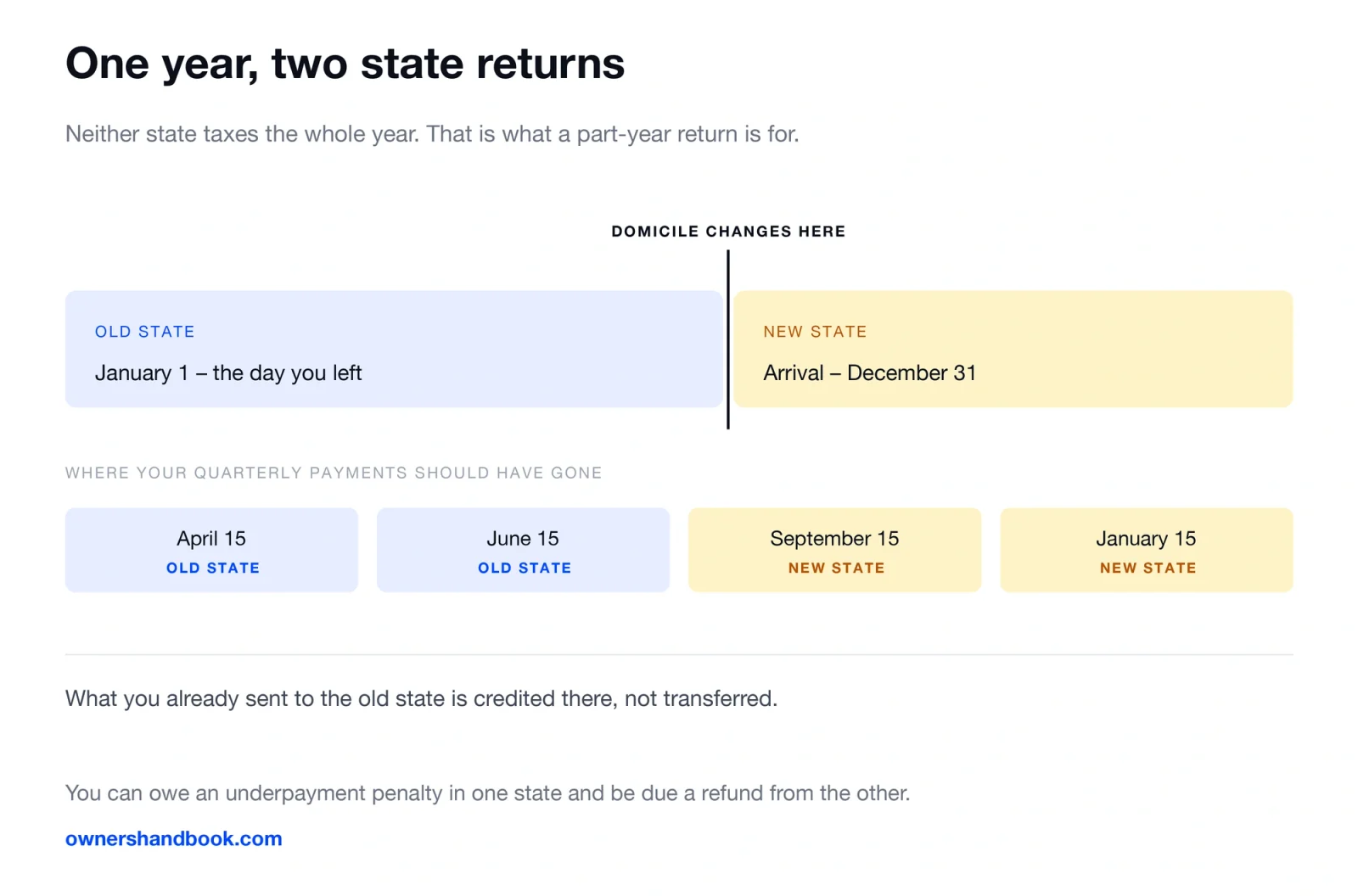
Neither state taxes the whole year. That is the point of the part-year return, and it is why filing one return and hoping is not an option.
If only one of the two states has an income tax, you file one return — but you still have to work out which months belong to it. Our guide to state taxes for the self-employed lists which states charge nothing.
What actually decides the date
Not your lease. Not your driver’s licence. **Domicile.**
New York defines it the way most states do:
In general, your domicile is your permanent and primary residence that you intend to return to or remain in after being away.
Domicile changes when you abandon the old one and establish a new one — and that requires both intent and action. Moving your body is not enough on its own, and neither is renting somewhere.
This matters more for freelancers than for employees, because a freelancer often has no employer address, no new payroll state, and no obvious paper trail. Nothing automatically records that you left.
| Evidence that you moved | Evidence that you did not |
|---|---|
| Driver’s licence and voter registration in the new state | Keeping the old home available to you |
| Vehicle registration | Family still in the old state |
| Bank and professional accounts moved | Returning there most weekends |
| Where you actually spend your days | Old state listed on your business filings |
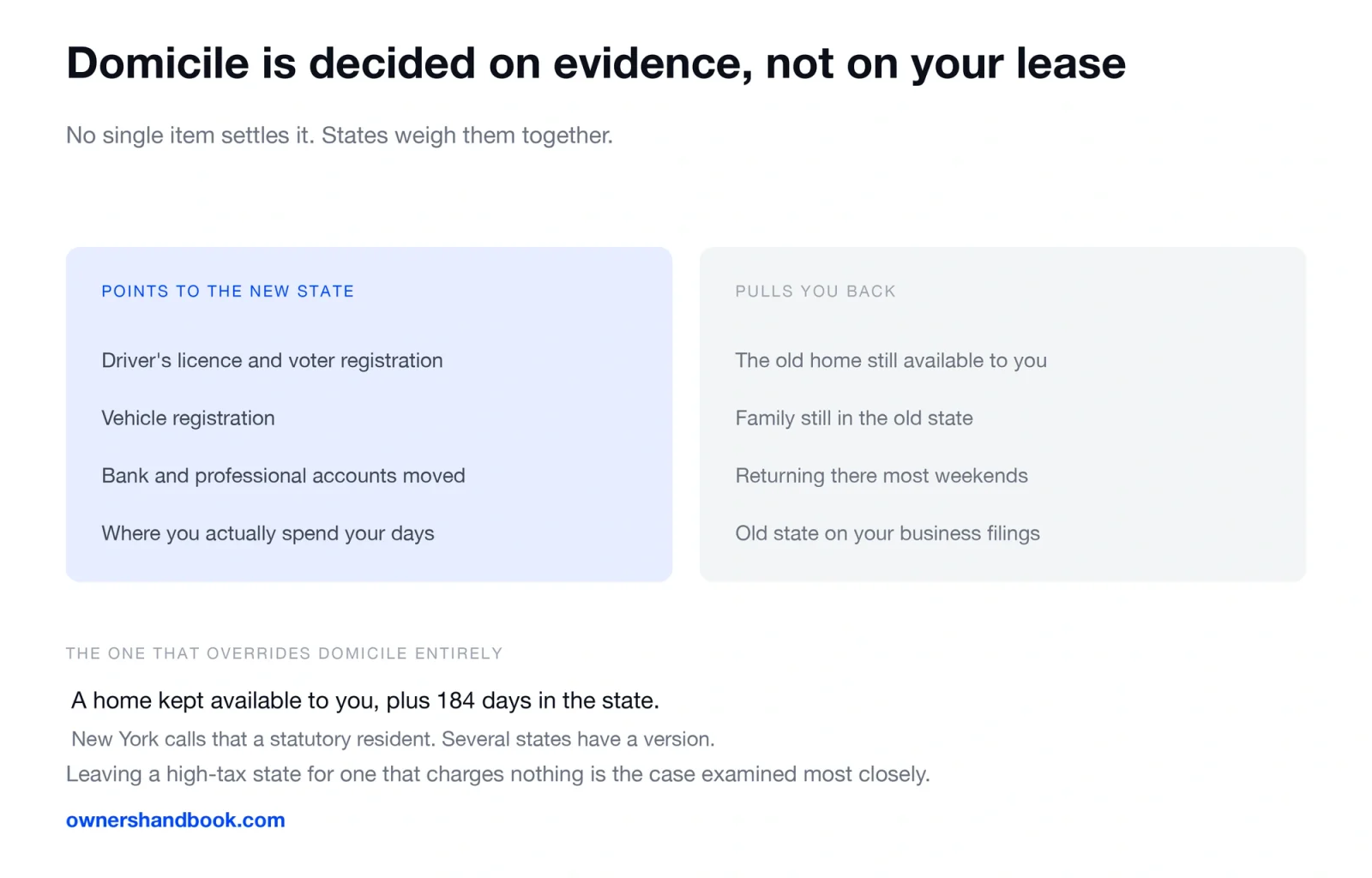
No single item decides it. States weigh them together, and a state losing revenue will look hard if you moved somewhere cheaper.
The trap for people who keep a place behind
Leaving does not always end the old state’s claim.
New York treats you as a resident, regardless of domicile, if:
you maintain a permanent place of abode in New York State for substantially all of the taxable year; and you spend 184 days or more in New York State during the taxable year.
Keep the apartment as a pied-à-terre, come back often, and you can end up a resident of two states for the same year. A number of states have a version of this rule with a similar day count.
The fix when two states both tax the same dollar is the credit for taxes paid to another state — covered in our state tax guide. It prevents true double taxation, but it is capped at what your home state would have charged, so the difference is not always recovered.
The part nobody writes: your estimated payments
This is where the money actually goes wrong, and it is specific to being self-employed.
You have been sending quarterly payments all year. If you moved in July, some of those went to a state that is no longer going to tax that income.
| Quarter | You were living in | Who should have it |
|---|---|---|
| April 15 | Old state | Old state |
| June 15 | Old state | Old state |
| September 15 | New state | New state |
| January 15 | New state | New state |
The payments you already sent to the old state are not lost — they go on that state’s part-year return and are credited there. But if the old state’s share of your income is small, you may have overpaid it and underpaid the new one.
Two consequences:
You may owe an underpayment penalty in the new state even though you paid plenty overall, because the new state looks only at what it received.
You may be due a refund from the old state at the same time. Those do not offset each other. They are separate returns.
The practical move is to switch your estimated payments to the new state the quarter you arrive, and to check the new state’s schedule rather than assuming it matches the federal one. Some states differ — Virginia’s first instalment is May 1, not April 15.
Our quarterly tax calculator handles the federal side, which does not change at all when you move. Only the state part does.
Where freelance income is actually sourced
For service work the general rule is where you were sitting when you did the work, not where the client is.
That is the same rule that applies when you live in one state and work in another, and it means a move splits your income by date of performance rather than date of payment.
Two things follow.
A December invoice paid in January belongs to the year you received it if you are on the cash method — but the work itself was performed in December, which is what the state allocation looks at. If those fall on opposite sides of a move, the two states will not agree without an explanation.
Having clients in the old state does not keep you taxable there. A client’s office address is not what sources the income. What matters is where you performed the work.
A few states apply their own twist to this, and New York is the one that comes up most often.
Moving to or from a no-tax state
The two directions are not symmetrical.
| Direction | What to expect |
|---|---|
| To a no-tax state mid-year | The old state taxes everything up to your departure. Expect scrutiny of the date |
| From a no-tax state mid-year | The new state taxes only what came after you arrived — but wants proof of when |
Leaving a high-tax state for one that charges nothing is the case states examine most closely, because the incentive to backdate is obvious. Keep something contemporaneous that fixes the date: a lease, a utility connection, a licence issued that week.
If you were moving for business reasons rather than personal ones, our guide to choosing a state to register a business covers why the answer is usually where you actually live.
Look up both states
The rules above are the framework. The amount depends on the two states involved, and they vary more than people expect — flat rates, bracket systems, county add-ons, city taxes, and entity-level charges that a sole proprietor escapes but an LLC does not.
| State | What makes it unusual |
|---|---|
| California | Its own estimated schedule, front-loaded to April and June |
| New York | Statutory residency, and the abode-plus-days rule above |
| Washington | No income tax, but a B&O tax on gross receipts |
| Texas | No income tax, but an LLC still has a franchise deadline |
| Pennsylvania | A flat 3.07% that is not the whole bill |
| Ohio | Taxed at three levels |
| Michigan | Flat state rate plus two dozen city taxes |
| Maryland | A county tax on every dollar |
| Indiana | Low flat rate, every county adds its own |
| Oregon | No sales tax, and Portland pays for it elsewhere |
| Colorado | Starts from your federal number, then sends some back |
| Illinois | Flat 4.95%, plus 1.5% if your LLC has a second member |
Also: Florida, Georgia, North Carolina, New Jersey, and Massachusetts.
Read the one you left and the one you arrived in. The differences between them are usually where the surprise is.
What to do, in order
Fix the date. Decide when your domicile changed and collect the two or three documents that support it. Do this now, while you remember.
Split your records. Tag income and expenses by the date the work was performed, not the date you were paid. You will need both halves separately.
Redirect your estimated payments to the new state starting with the first due date after you arrive, and look up that state’s schedule rather than assuming April/June/September/January.
File both returns together in the spring so the two allocations agree. Filing one now and the other later is how the numbers end up inconsistent.
Check whether the old state still has a claim — the abode-plus-days rule above, or a business registration you never closed.
Frequently asked questions
Do I really have to file in both states?
If both have an income tax, yes. Each taxes the part of the year you lived there. Skipping the smaller one is the most common mistake, and it is the one that generates a notice, because the other state’s return shows the income existed.
Which state do I send my quarterly payments to after moving?
The one you are living in when the payment is due. Payments already sent to the old state are credited on that state’s part-year return, not transferred.
My client is in the old state. Does that keep me taxable there?
Generally no. For service work what matters is where you were physically working, not where the client’s office is. A handful of states take a different view in specific situations, so check the one you left.
What if I moved twice in the same year?
Then you may have three part-year returns. The framework does not change — each state taxes the stretch you were domiciled there.
What if I move states but keep the old apartment?
That is the situation the statutory-residency rules are written for. Keeping a home available to you plus enough days in the state can make you a resident there even though you are domiciled elsewhere.
Does any of this change my federal return?
No. Federal tax does not care which state you live in. Your Schedule C, your self-employment tax and your federal estimated payments are unaffected by the move.
Sources
Virginia Department of Taxation, Residency Status
https://www.tax.virginia.gov/residency-status
Virginia Department of Taxation, Individual Estimated Tax Payments
https://www.tax.virginia.gov/individual-estimated-tax-payments
New York State Department of Taxation and Finance, Nonresident and part-year resident FAQs
https://www.tax.ny.gov/pit/file/nonresident-faqs.htm
New York State Department of Taxation and Finance, Income tax definitions
https://www.tax.ny.gov/pit/file/pit_definitions.htm
IRS, Form 1040-ES, Estimated Tax for Individuals (2026)