Can You Charge Clients the Credit Card Fee?
Sometimes, and three separate rule sets all have to permit it. Most freelancers only ever hear about one of them. Before state law becomes relevant at all, the contract you accepted when you opened the account may already have decided it — PayPal’s User Agreement says, in a section headed “No surcharges”, that you will not impose a surcharge for accepting PayPal as a payment method.
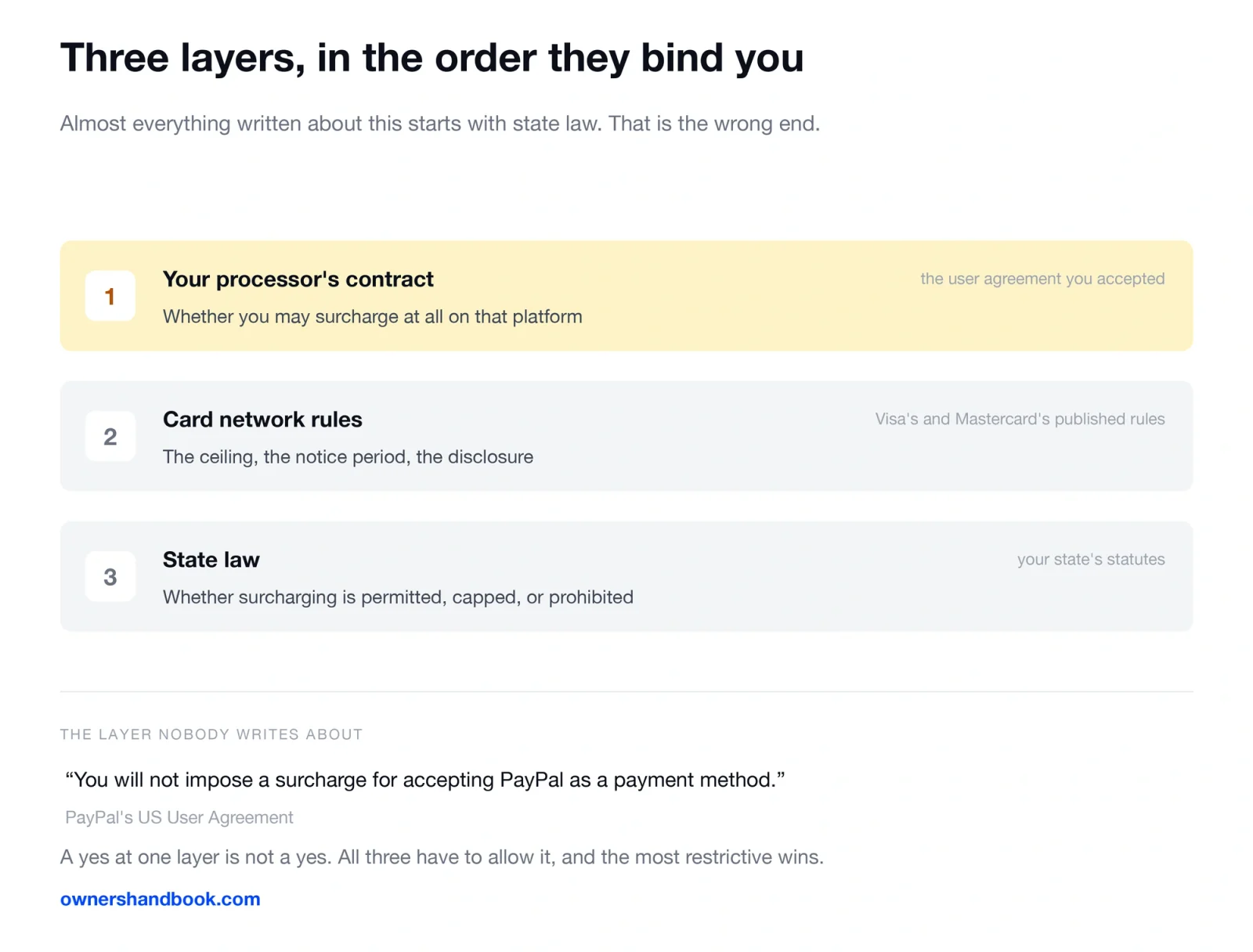
Here is how the three layers stack, in the order they reach you.
The three layers, in the order they bind you
Almost everything written about this starts with state law. That is the wrong end, because the first two layers apply whatever your state says.
| Layer | What it controls | Where it is written |
|---|---|---|
| Your processor’s contract | Whether you may surcharge at all on that platform | The user agreement you accepted |
| Card network rules | The ceiling, the notice period, the disclosure | Visa’s and Mastercard’s published merchant rules |
| State law | Whether surcharging is permitted, capped, or prohibited | Your state’s statutes |
A yes at one layer is not a yes. All three have to allow it, and the most restrictive wins.
What your processor already agreed on your behalf
This is the layer nobody writes about, and for a freelancer invoicing through a consumer-facing platform it usually ends the conversation.
PayPal’s US User Agreement is explicit:
You agree that you will not impose a surcharge or any other fee for accepting PayPal as a payment method.
It leaves one narrow door open, and the wording of it matters:
You may charge a handling fee in connection with the sale of goods or services as long as the handling fee does not operate as a surcharge and is not higher than the handling fee you charge for non-PayPal transactions.
Read that carefully. A fee applied only when the client pays by PayPal is a surcharge whatever you call it on the invoice. A handling fee that appears identically on every invoice regardless of payment method is not.
Read your own processor’s agreement before you read anything else. Different platforms take different positions, and the terms you accepted bind you independently of what your state permits.
The ceiling the card networks set
If your processor permits it, the networks impose the next set of conditions. Both publish them, and they do not agree with each other.
| Rule | Visa | Mastercard |
|---|---|---|
| Cap on the surcharge | The lower of your merchant discount rate or 3% | 4%, capped against your cost of acceptance |
| Advance notice | At least 30 days to your acquirer | No less than 30 days, to Mastercard and your acquirer |
| Disclosure | At point of entry, point of sale, and on every receipt | At the point of interaction, with the dollar amount on the receipt |
| Cards you may surcharge | Credit only — debit and prepaid cannot be surcharged | Credit products, at brand or product level |
Visa’s merchant surcharging guidance tells merchants to:
Limit surcharging to credit cards only (debit cards and prepaid cards cannot be surcharged)
Mastercard’s published rule sets the notice period:
advance notice to both Mastercard and the merchant’s acquirer of the merchant’s intention to impose a surcharge no less than thirty days before the merchant implements a surcharge
Both networks distinguish a brand-level surcharge — the same percentage on every credit card of that brand — from a product-level one applied to particular card products. Visa’s guidance is that a US merchant may do one or the other, not both.
Two things follow for a freelancer. The notice requirement assumes an acquirer relationship a solo operator on a payment platform does not have. And the disclosure requirement is not met by a line item discovered at the bottom of an invoice.
Then your state gets a say
Some states prohibit surcharging outright. Some permit it with conditions of their own on top of the network rules. Below are three states whose statutes we read while writing this — examples of the range, not a national survey.
Connecticut prohibits it:
No person, firm, partnership, association or corporation shall impose a surcharge on a holder of a credit card or debit card on account of the use of the credit card or debit card in a transaction.
Maine defines the surcharge broadly, which is the part that catches people:
any means of increasing the regular price to a cardholder that is not imposed on a customer paying by cash, check or similar means
New York permits a surcharge but regulates how the price is displayed. Under General Business Law section 518 a seller must:
clearly and conspicuously post the total price for using a credit card in such transaction, inclusive of surcharge
and the statute caps it:
any such surcharge may not exceed the amount of the surcharge charged to the business by the credit card company for such credit card use
New York’s requirement is really about the posted number. The final price including the surcharge cannot exceed the price you posted, so the credit card price has to be the one on display — or you show two prices side by side.
| State | How the statute is written |
|---|---|
| Connecticut | Surcharges prohibited outright, on credit and debit |
| Maine | Prohibited, with a broad definition of what counts as a surcharge |
| New York | Permitted, but the total card price must be posted and the surcharge capped at your cost |
Three states, three different answers. That is why no article can tell you what applies to you.
Look up your own state
The surcharge question is one of many things that turn on where you are. Our state guides cover self-employment and state income tax rather than surcharge statutes — for the surcharge rule itself, go to your state legislature’s statute pages or your attorney general.
| Region | State guides |
|---|---|
| West | California, Washington, Oregon, Colorado |
| Northeast | New York, New Jersey, Pennsylvania, Massachusetts, Maryland |
| Midwest | Illinois, Ohio, Michigan, Indiana |
| South | Texas, Florida, Georgia, North Carolina |
The distinction doing most of the work
A surcharge and a discount can leave the client paying the identical amount and still be treated completely differently.
Maine’s statute draws the line in one sentence:
A discount or reduction from the regular price is not a surcharge.
Connecticut, having banned surcharges, then says:
Nothing in this section shall prohibit a person, firm, partnership, association or corporation from offering a discount for the purpose of encouraging the use of a method of payment other than a credit card or debit card.
The structure, not the label, decides which one you have built. A price you post and then add to when the client picks a card is a surcharge. A price you post and then reduce when the client pays by bank transfer is a discount. Renaming it a “convenience fee” on the invoice changes nothing.
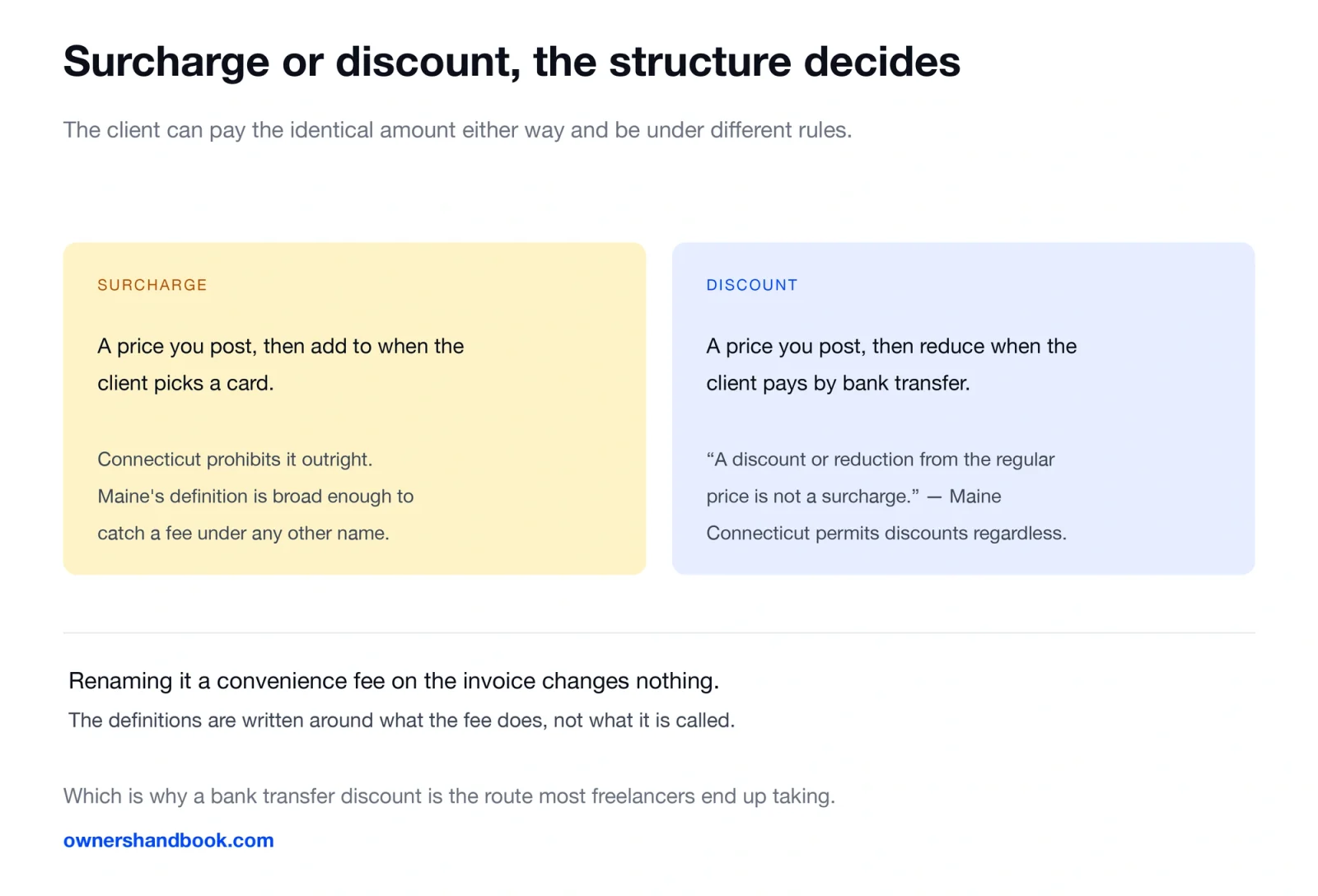
This is why a bank transfer discount is the route most freelancers take. It sidesteps the network notification rules, sits outside the surcharge statutes in states that permit discounts, and — because ACH is genuinely far cheaper than card — funds itself out of the fee you save.
If this is really about the 3 percent
It usually is. Three moves do not require you to read a statute.
Price it in. A rate set to absorb card processing is a rate, not a surcharge, and nothing restricts what you charge for your work. Our guide to freelance payment terms covers where to state it.
Offer a bank transfer option with a discount attached. On a four-figure invoice the gap is typically over a hundred dollars.
Take a deposit, and charge for lateness. A deposit up front cuts your exposure and the transaction count; late payment fees are a separate mechanism with separate rules, and the late fee calculator works out the figure.
Put whichever you choose in writing before the work starts. Our guide to what belongs in a freelance contract covers the payment clause, and the freelance invoice template shows where it appears.
The tax consequence nobody mentions
If you do collect a surcharge, it is your revenue, and it lands in your gross receipts.
It therefore increases the gross figure on any 1099-K you receive, because the platform reports what it settled, not what you kept. The processing fee you paid is separately deductible on Schedule C, covered in our list of freelance tax deductions.
Netting the two against each other is the common error. It produces a figure that does not match the form, plus a deduction you never claimed.
Frequently asked questions
Can I legally charge my client the credit card fee?
That depends on your processor’s terms, the card network rules, and your state — all three, and the most restrictive governs. Check the user agreement first; it is the fastest one to rule you out. This describes how the rules are written, not what applies to your situation.
Is a bank transfer discount treated the same as a surcharge?
Statutes generally distinguish them. Maine’s says directly that a discount from the regular price is not a surcharge, and Connecticut permits discounts despite banning surcharges. The structure decides it, not the word on the invoice.
What is the maximum surcharge?
Visa’s guidance caps it at the lower of your merchant discount rate or 3%. Mastercard publishes a 4% cap tied to your cost of acceptance. Your state may set a lower one — New York’s statute limits it to what the card company actually charged you.
Do I have to tell anyone before I start?
The networks say yes. Visa’s guidance is at least 30 days’ notice to your acquirer; Mastercard’s rule is no less than thirty days to both Mastercard and your acquirer.
Does calling it a convenience fee get around this?
No. The definitions are written around what the fee does, not its name. Maine’s covers “any means of increasing the regular price to a cardholder” that is not applied to customers paying another way.
My client is overseas and the fees are worse. Does that change anything?
Not the rules, but the arithmetic. Cross-border rates and currency conversion stack on top of the base rate — our guide to international client payments covers what actually gets deducted.
Sources
PayPal, User Agreement for PayPal Services
https://www.paypal.com/us/legalhub/useragreement-full
Visa, Merchant Surcharging Questions and Answers
Visa, Visa Rules
https://www.visa.com/en-us/support/visa-rules
Mastercard, US Merchant Surcharge Rules
https://www.mastercard.us/en-us/business/overview/support/merchant-surcharge-rules.html
Connecticut General Assembly, General Statutes Sec. 42-133ff
https://www.cga.ct.gov/current/pub/chap_739.htm
Maine Legislature, 9-A M.R.S. Sec. 8-509
https://www.mainelegislature.org/legis/statutes/9-A/title9-Asec8-509.html
New York State Senate, General Business Law Sec. 518